

Bonding solutions for low surface energy substrates
Last update on Mar 27, 2026
This article was earlier published in 2017 and revised in 2026.
Some polymer materials such as polyolefins, fluoropolymers, and silicone rubber, are hard to bond. This creates challenges for both formulators and end users. The main issue is their low surface energy. This makes them very different from metals, ceramics, and most other polymers.
Because of the low surface energy, standard adhesives cannot make close contact with the surface. As a result, the bond is weak.
To improve bonding, you need to focus on the joint interface. Choosing the right surface treatment and adhesive for each material is essential. These methods are based on well-known theories of adhesion.
In this guide, let’s look at the key factors to consider when bonding low surface energy materials.
Adhesion theory for different substrates
Surface energy of substrate
The adsorption theory of adhesion says that bonding happens when two materials make close molecular contact. This contact creates surface forces that hold them together.
The process of forming this close contact between an adhesive and a surface is called wetting. Once the adhesive fully wets the surface, it hardens. This gives it the strength needed to form a strong bond.
Good and poor wetting
- Good wetting occurs if the adhesive spreads out over the substrate in a uniform film. For example, epoxy adhesive on metal substrate).
- Poor wetting occurs when the adhesive forms droplets on the surface. For example, epoxy adhesive on fluoroethylene propylene substrate).
Figure 1 below illustrates good and poor wetting of a liquid adhesive spreading over a surface:

Ideally for an adhesive to fully wet a surface, the adhesive should have a lower surface tension (γ) than the substrate's surface energy or critical surface tension (γc). Thus, one of the rules relevant to bonding low energy substrates is that:

Some important implications develop out of this concept about epoxy and similar adhesives that they would:
- Bond very well to metal, glasses, and other high-energy surfaces
- Bond poorly to polyethylene, fluorocarbon, and low energy surfaces
Shown below is the table listing surface tensions of common adherends and adhesive liquids:
| Solid Materials | Critical Surface Tension (dynes / cm) |
| Acetal | 47 |
| ABS | 35 |
| Cellulose | 45 |
| Epoxy | 47 |
| Fluoroethylene propylene | 16 |
| Polyamide | 46 |
| Polycarbonate | 46 |
| Polyethylene terephthalate | 43 |
| Polyethylene | 31 |
| Polymethylmethacrylate | 39 |
| Polystyrene | 33 |
| Polytetrafluoroethylene | 18 |
| Polyvinyl chloride | 39 |
| Silicone | 24 |
| Aluminum | ~500 |
| Copper | ~1000 |
| Liquid Materials | Critical Surface Tension (dynes / cm) |
| Epoxy resin | 47 |
| Fluorinated epoxy resin | 33 |
| Glycerol | 63 |
| Petroleum lubricating oil | 29 |
| Silicone oils | 21 |
| Water | 73 |
Based on these values, you might expect polyethylene and fluorocarbon polymers to work well as adhesives. In theory, they should bond strongly to many surfaces, including low surface energy polymers and metals.
In practice, they do show good adhesion. Commercial polyethylene often contains low molecular weight components. These form a weak boundary layer that reduces bond strength. Fluorocarbons have a different problem. They are hard to melt or dissolve, which makes them difficult to use as adhesives.
Because of this, fluorocarbons are hard to bring into a fluid state. This makes it difficult for them to wet a surface and then solidify without creating internal stress.
Polyethylene, however, can work well as a hot melt adhesive. This is true once the weak, low molecular weight components are removed. Researchers are also developing epoxy resins with fluorinated chains that can wet a wide range of surfaces more easily.
It is useful to keep a few key points in mind:
- Silicone and fluorocarbon coatings make good mold release surfaces because most resins do not wet them easily.
- Oils such as mineral oil or oils from handling create weak boundary layers. They spread easily due to their low surface tension, and adhesives do not bond well to contaminated surfaces.
- Lowering the surface tension of a coating or adhesive can improve wetting. However, it may also make it harder for future coatings or adhesives to bond after curing. Graffiti-resistant paints work in this way.
Adhesive/substrate miscibility
Another useful idea is the diffusion theory of adhesion. This theory helps when choosing adhesives for low surface energy polymers. The concept is simple. Adhesion arises through the inter-diffusion of molecules from one material to another across the interface.
Wetting is followed by inter-diffusion of chain segments across the interface. This establishes an entangled network of molecules around the joint interface as shown in the figure below. For this to occur, the adhesive and the adherend must be chemically compatible in terms of diffusion and miscibility.
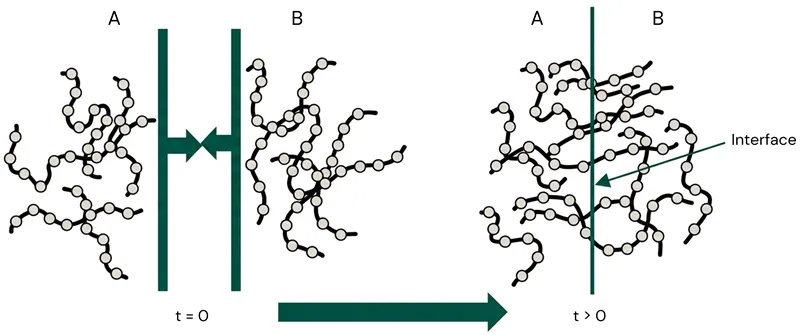
The diffusion theory also explains why some monomers and solvents improve bonding. These are often used in adhesives and primers for materials like polypropylene. The small molecules can move into the surface and create strong molecular interlocking. Because of this, these products can achieve strong bonds on low surface energy materials, even without extra surface treatment.
Surface treatment processes to optimize interface
For low surface energy materials and adhesives with high surface tension, surface roughening does not always improve bond strength. In fact, it often makes it worse. This is because roughening does not increase surface energy. Instead, it creates grooves and valleys on the surface. Due to poor wetting, the adhesive cannot fully fill these gaps before it cures. As a result, air becomes trapped between the adhesive and the surface.
This reduces the effective bond area and creates stress points at the interface. The best way to treat low surface energy (LSE) materials is to increase their surface energy. This can be done using chemical or physical pretreatment methods. Passive methods, such as abrasion, may actually reduce bond strength in these materials. Solvent cleaning can remove surface contaminants. However, it does not increase surface energy.
There are several surface treatments that can be used to raise the surface energy of thermoplastics. The specific process will depend on:
- The plastic involved
- The way it was processed, and
- The degree of adhesion required for the end-use application
Active methods used to improve the bonding characteristics of these polymeric surfaces include:
- Oxidation via chemical or flame treatment
- Electrical (corona) discharge to leave a more reactive surface
- Ionized inert gas treatment which strengthens the surface by a chemical change. For example, crosslinking or physical change and leaves it more reactive
- Metal-ion treatment that removes fluorine from the surfaces of fluorocarbons
- Application of primers, adhesion promoters, and other wettable chemical species
These processes are developed over time and used in many production applications. The most common processes for specific thermoplastic substrates are explained in Table 3.
| Treatment | Polymer | Result |
| Flame |
|
|
| Corona or electrical discharge |
|
|
| Plasma discharge |
|
|
| UV radiation |
|
|
| Laser treatment |
|
|
| Oxidizing acids |
|
|
| Sodium naphthalene etch |
|
|
| 'Cyclizing' concentrated sulfuric acid |
|
|
New surface preparation methods are being developed to support the use of engineering plastics and composites. These materials are widely used in lightweight, energy-efficient vehicles in the automotive and aerospace industries.
There are many sources of information on plastic surface treatment. The most important sources are the suppliers of the adhesive and the material itself. Several textbooks2,3,4 also provide detailed reviews of surface treatments for different types of substrates.
ASTM D2093 provides recommended surface preparation methods for many plastic materials. Other joining methods, such as solvent welding and heat welding, do not use conventional adhesives. Because of this, they do not require chemical changes to the surface. However, cleaning or degreasing is still important before bonding. Weak boundary layers can still form and reduce bond strength.
Considerations when selecting adhesives for LSE plastics
Despite the challenges of low surface energy, adhesive bonding can be a simple and reliable way to join plastics. It can be used to bond one plastic to itself, to another plastic, or to a non-plastic material. Pocius, et. al., provides a detailed overview of how adhesives are used to join plastics.5 There are also many articles on plastic joining methods. These cover adhesive bonding, as well as thermal welding, solvent welding, and mechanical fastening.6
The physical and chemical properties of both the cured adhesive and the plastic substrate affect the strength of the bond. In addition to surface energy, several key properties of the substrate must be considered:
- Thermal expansion coefficient
- Modulus, and
- Glass transition temperature
Table 4 highlights the most important factors to consider when selecting an adhesive for low surface energy plastics.
Characteristic | Function |
Low surface energy |
|
| |
Compatibility with substrate during application and service |
|
Glass transition temperature |
|
Reducing stress at the interface
Large differences in thermal expansion between the adhesive and the substrate can create high stress at the interface. This often happens when bonding plastics to metals, as their expansion rates can differ by about 10 times. These stresses can increase during thermal cycling or at low temperatures. To reduce this effect, you can use a flexible adhesive or adjust its thermal expansion with fillers or additives.
Bonded plastic parts are often exposed to peel stress. This is because they are usually thin and have a low modulus. For this reason, tough adhesives with high cleavage and peel strength are recommended for bonding plastics.
Structural adhesives for LSE substrates
Structural adhesives are usually one- or two-component thermosetting systems. In contrast, non-structural adhesives are typically hot melt or pressure-sensitive types. Flexible epoxy and polyurethane adhesives are often used for structural bonding of plastics. However, they are not the best choice for low surface energy plastics.
Adhesives designed for these harder-to-bond materials include:
- Thermosetting acrylic
- Cyanoacrylate, and
- Light curing acrylic and cyanoacrylate structural adhesives
Structural adhesives should have Tg higher than operating temperature, ideally higher than the parts being bonded. This prevents weak bonds and creep problems at high temperatures. Some engineering plastics have very high glass transition temperatures. These plastics include polyimide or polyphenylene sulfide.
Table 5 lists structural adhesives commonly used for bonding plastics:
Structural Adhesives | Non-Structural Adhesives |
|
|
Thermosetting acrylic adhesives
Thermosetting acrylic adhesives can bond directly to many low surface energy plastics without special surface preparation. These include:
- Polypropylene
- Polyethylene
- Other polyolefins
This ability comes from the diffusion of acrylic monomers into the substrate before curing. On low-density polyethylene, the bond can be so strong that the substrate itself may fail before the adhesive does.
These adhesives are usually rubber-toughened, two-component systems that cure quickly at room temperature. This creates a crosslinked, structural adhesive suitable for bonding metals, engineering plastics, and many other materials.
In this way, thermosetting acrylics compete with two-part, room-temperature curing epoxy and polyurethane adhesives. Table 6 shows the shear strengths of a commercial thermosetting acrylic adhesive on various substrates:
Substrate Type | Specific Joint Materials | Lap Shear Strength (psi) |
Polyolefins | High density polyethylene | 1658 |
Low density polyethylene | 632 | |
Polypropylene | 239 | |
| Metals | Steel-to-high density polyethylene | 657 |
Aluminum | 423 | |
Plastics | Epoxy | 1045 |
Polycarbonate | 726 | |
Polyvinyl chloride | 1237 |
Cyanoacrylate adhesives
Cyanoacrylate adhesives are generally methyl or ethyl cyanoacrylate-base, single component liquids. When bonding metals and other rigid surfaces, methyl cyanoacrylate bonds are stronger and more impact resistant than ethyl cyanoacrylate bonds. However, on rubber or plastic surfaces, ethyl cyanoacrylate is preferred.
Cyanoacrylate adhesives generally do not wet or adhere well to polyolefins. The surface tension of the adhesive is much higher than that of the substrate. However, polyolefins can be primed for adhesion with cyanoacrylates by certain chemical compounds normally considered to be activators for cyanoacrylate polymerization.
These primers are simply sprayed or brushed onto the substrate. After drying of the primer, the cyanoacrylate adhesive is conventionally applied and bonds extremely well to the substrate.
Table 7 shows the significant strength improvements that can be realized with cyanoacrylates on primed low energy plastic substrates:
Substrate | Block Shear Strength (psi) | |||
Ethyl Cyanoacrylate | Ethyl Cyanoacrylate with Primer | Rubber Toughened Ethyl Cyanoacrylate | ||
Fluorocarbon | ETFE | 100 | >1650 | 50 |
FEP | <50 | <50 | 50 | |
PTFE | 300 | 1050 | 250 | |
Polyolefin | HDPE | <50 | 2000 | 50 |
LDPE | 150 | 500 | <50 | |
PP | 50 | >1950 | 50 | |
Light curing acrylic and cyanoacrylate adhesives
Typically acrylic monomers and oligomers have been formulated for use with UV light sources. New formulations are now available that will also cure on exposure to visible light sources. These acrylic formulations cure to form thermoset resins. They offer better thermal and chemical resistance than uncrosslinked adhesives such as conventionally cured cyanoacrylates.
Depending on the formulation and curing conditions, light curing acrylic formulations can be varied to provide adhesives ranging from hard, high modulus to slightly flexible, moderate elongation materials. Formulations can come in a range of viscosities from thin water-like liquids to thixotropic gels.
Table 8 shows typical bond strengths on hard-to-bond substrates using a standard UV or visible light curing acrylic adhesive:
Substrate | Block Shear Strength (psi), per ASTM 4501 |
Acetal | 250 |
Fluoropolymer | 150 |
Polyethylene | 350 |
Polypropylene | 100 |
Thermoplastic vulcanizate | 120 |
Recently, light-curing cyanoacrylate adhesives have been developed that offer the rapid light-cure properties of a thermosetting acrylic adhesive coupled with the ease and speed of a secondary cyanoacrylate cure. Light-curing cyanoacrylates are ethyl-based products that have photoinitiators added to the formulation. These allow them to set rapidly on exposure to low intensity light, and to cure in shadowed areas.
A major benefit that light-curing cyanoacrylate adhesives offer is that the liquid adhesive can be cured to attack free surface in less than 3 seconds through exposure to a low intensity light.
Light curing cyanoacrylate adhesives provide many of the same benefits to the manufacturer as do light curing acrylic adhesives such as rapid cure and high bond strength. However, light curing cyanoacrylate adhesives differ from light curing acrylics, in that they bond well to polyolefins and fluorocarbons. They do this by making use of the specialty primers that have been previously developed for standard cyanoacrylates.
Light curing cyanoacrylates also offer excellent bond strengths to unprimed higher energy plastics and elastomers as do conventional cyanoacrylate adhesives. This is shown in Table 9:
Substrate | Block Shear Strength (psi), per ASTM 4501 | |
Low Viscosity | High Viscosity | |
ABS | 4750 | 4895 |
Acrylic | 1410 | 1550 |
Aluminum (etched) | 3390 | 3360 |
Neoprene | 110 | 115 |
Phenolic | 1880 | 1670 |
Polycarbonate | 1870 | 1660 |
PVC | 660 | 830 |
Steel (grit blasted) | 2310 | 2490 |
Primers and adhesion promoters
There are several instances where primers have provided excellent adhesion without having to go through the process of surface preparation. This is a distinct advantage because surface treatment methods may be:
- Hazardous
- Inconvenient
- Time consuming, and
- Often expensive
The use of a surface primer, although an extra step in the bonding process, is a more desirable alternative for use on the production line. It appears that one of the main reasons for improved adhesion by primers is that the solvents in the primer system wet-out and swell the low surface energy plastic. This then facilitates interpenetration of the low viscosity adhesive.
Solvent-based chlorinated polyolefins: These are often used for priming low energy surfaces such as polyolefin plastics. Based on either chlorinated polyethylene or polypropylene. Usually used as a solvent based solution.
They are generally used to improve the adhesion of paint to polyolefin substrates, but they can also be utilized for adhesive bonding. A primer based on a solution of chlorinated polypropylene has been used to adhere paint to polypropylene automobile bumpers with some interdiffusion of primer into the part.- Solvent free, water borne chlorinated polyolefin: Such primers based on emulsions and dispersions of chlorinated polyolefin have also been developed. They provide an increase in bond strength and water resistance for polypropylene and other thermoplastic polyolefin joints.
- Primers for cyanoacrylate adhesion to polyolefin substrate: Cyanoacrylate requires a primer for optimal adhesion to polyolefin substrates as discussed above. Polyolefins can be primed for adhesion to cyanoacrylates by certain chemical compounds normally considered to be activators for cyanoacrylate polymerization.
Materials such as long chain amines, quaternary ammonium salts, and phosphine can be applied in either pure form or in solution to the surface of the polyolefin. These primers are simply sprayed or brushed onto the substrate. After drying of the primer, the cyanoacrylate adhesive is conventionally applied and bonds extremely well to the substrate.
- Triphenylphosphine or cobalt acetylacetonate primers: These used with cyanoacrylate adhesives produce adhesive bonds with polypropylene and low-density polyethylene that are sufficiently strong to exceed the bulk shear strength of the substrate. They are also sufficiently durable as to withstand immersion in boiling water for long periods of time.
- Fourche. (1995). An Overview of the Basic Aspects of Polymer Adhesion: Part I: Fundamentals. Polymer Engineering and Science.
- Petrie. (2007). Handbook of Adhesives and Sealants 2nd Edition. McGraw-Hill.
- Rotheiser. (1999). Joining of Plastics. Hanser Publishers.
- Wegman. (1989). Surface Preparation Techniques for Adhesive Bonding. Noyes Publications.
- Pocius. (1991). The Use of Adhesives in the Joining of Plastics. Treatise on Adhesion and Adhesives.
- Rotheiser. (1997). Handbook of Plastics Joining: A Practical Guide. Plastics Design Library.
- Sprovieri. (2012). Bonding Breakthrough for Polyolefins. Assembly.
- Salerni. (n.d.). Adhesive Bonding Technology for the Assembly of Hard-to-Bond Plastics. Loctite Technical Brief, Issue No. 4.
- Courtney. (2001). Light Curing Cyanoacrylates. Adhesives Age.