
The Importance of Glass Transition Temperature in formulating adhesives and sealants
Last update on May 28, 2003
Edward M. Petrie, Member of SpecialChem Technical Expert Team
Polymeric materials have several fundamental physical properties that are important in adhesion. These properties are controlled by the chemical structure of the base polymer from which the adhesive or sealant is made and from the various formulating agents used to modify the base polymer. This article will review one of the more important properties, the glass transition temperature, Tg, which is actually a composite of several physical attributes. We will examine the relationship that Tg has on cohesive strength, pressure sensitive adhesion, and certain application properties.
Structure - Property Relationship
The structural characteristics of polymeric molecules that have been identified as affecting the physical properties of adhesives and sealants include molecular weight, composition of the polymer chain, functionality, polarity, chain structure, crystallinity, and crosslinking. These determine the physical properties of the adhesive or formulation including glass transition temperature, melting or softening point, surface energy, bulk and rheological properties, and stability.
Glass transition temperature, Tg, is a very useful physical property measurement that reflects the behavior of polymers in both adhesive and sealant systems. The Tg is a useful concept because it is a way of understanding the molecular motion that occurs in a polymeric system. The degree of molecular motion is of fundamental concern when considering adhesion, cohesion, and other properties of polymers.
Molecular freedom influences the behavior of all polymers. At low temperatures the polymers exist as solids in which the molecular segments vibrate rather gently and independently. As the temperature of a polymer is increased, a point is reached at which the molecule suddenly becomes more flexible and mobile. This increased flexibility occurs when the molecular vibrations become strong enough to shake the adjacent chain segments apart and allow molecules the freedom to slip by one another. The temperature required to cause this increase in molecular freedom is known as the glass transition temperature, Tg.
The Tg signifies a transition of the polymer from a glassy to a rubbery state. As the temperature of a polymer is raised further and further above its Tg, the effective distance between molecular segments is increased. This is evident by an increase in the slope of the polymer's specific volume as a function of temperature (See Figure 1).
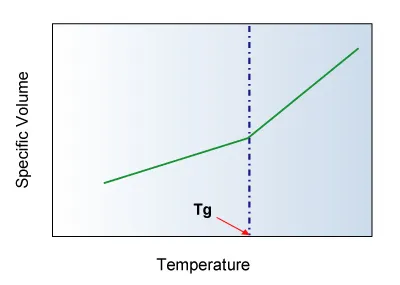
Figure 1: The effect of temperature on the total volume of a polymer.
Flexibility, toughness, and solvent penetration also increase at temperatures above the Tg, while tensile strength and elastic modulus decrease. Figure 2 illustrates general trends of some adhesive properties related to temperature or molecular mobility.
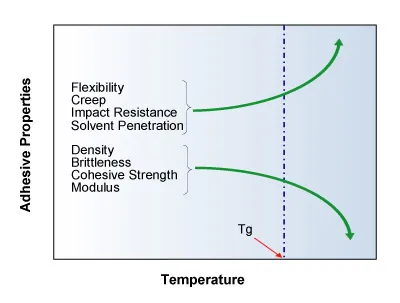
Figure 2: General trends of some adhesive properties related to temperature or molecular mobility.
It must be noted, however, that Tg can occur at very low temperatures as well as at high temperatures. Polymeric materials have Tg both above and below room temperature. For example, the Tg of natural rubber is -73°C; whereas, the Tg of many epoxy systems is greater than +100°C. (See Table 1.) Many adhesive and sealant formulations are optimized for performance over a specific temperature range (i.e., service temperature). Therefore, the relationship between the Tg and the service temperature is a critical consideration in predicting the performance requirements of all polymer materials.
Adhesive Type | Approximate Glass Transition Temperature, °C |
Silicone | -90 |
NaturalRubber | -73 |
Polyamide | +60 |
Epoxy | +100 |
Polyvinyl Acetate | +29 |
SBR Latex | -17 to -46 |
Poly SIS | -28 |
Polybutadiene | -85 |
Polybutylacrylate | -21 |
Polyethylhexylacrylate | -70 |
Polychloroprene | -48 |
Table 1: Glass Transition Temperature of Common Polymers
The Glass Transition Temperature, Tg
The glass transition is the reversible change in polymers between a glassy state and a rubbery viscous state. Figure 3 shows the effect of these various rheological states on adhesive joint strength. Transition from a glassy to a rubber state typically occurs with a sufficient increase in temperature, or upon introduction into the polymer of such penetrants as plasticizers, which increase the free volume content.
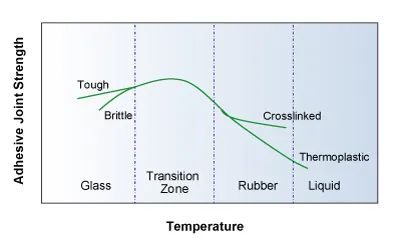
Figure 3: Schematic of the effect of the rheological state on adhesive lap shear joint.
The glass transition undergone by a polymer on heating or cooling does not take place at a single, unique temperature, but typically over a temperature range. It is the temperature at the approximate mid-point of that range that is conventionally called the "Tg". The actual value of this temperature for a given polymer is not a constant. It is influenced by such factors as:
- Molecular weight of the polymer
- Degree of crosslinking within the polymer
- The polymer's chain structure (e.g., amorphous, crystalline, branched)
- The material property being monitored for Tg determination (e.g., dielectric constant, thermal expansion, modulus)
- Nature and type of test used to determine Tg, and
- Rate of temperature increase or decrease during testing.
Thus, it should be noted that the Tg is not a singular, fundamental property of a polymer, but a complex property that depends on several basic characteristics of the polymer structure and the conditions by which it is measured. Nevertheless, it becomes an extremely important consideration in formulating adhesives and sealants.
Glass transition temperature is generally measured by observing the variation of some thermodynamic property (e.g., measurement of specific volume by dilatometry) as a function of temperature. Note in Figure 1 that the slope of the volume versus temperature plot increases above the glass transition temperature.
Apart from dilatometry, the methods commonly used to determine the Tg of polymers and the properties that are measured in each test are shown in Table 2. In these test methods the change in property or its rate of change with temperature signifies a glass transition. Test methods involving slow rates of testing will give lower Tg value than other, faster rate methods. This effect is due to the thermal conductivity of the material under test as well as the test method itself.
Test Method | Property Measured |
Dilatometry | Specific Volume |
Differential Thermal Analysis | Thermal Expansion Coefficient |
Differential Scanning Calorimetry | Heat Flow |
Dynamic Mechanical Analysis | Storage Modulus |
| Dielectric Analysis | Dissipation Factor (Loss Factor) |
Table 2: Common Methods Used to Determine Tg and the Property Measured
Tg and Cohesive Properties
The strength of a crosslinked adhesive at elevated temperatures is very much indicated by its Tg. The Tg should be above the upper use temperature of the adhesive or sealant for good bond strength and creep resistance. However, the peel strength is low when Tg is appreciably above the upper use temperature. The low temperature performance properties of a relatively high Tg material are limited because of the materials relatively brittle properties.
Using a resin with lower Tg increases the molecular flexibility of the polymer, other things being equal such as crosslink density, fillers, etc. With lower Tg polymers, the molecules are more flexible and impact resistant at a given temperature than with a higher Tg polymer. Also, low Tg resins retain their flexibility at low temperatures simply because the resin remains in its rubber state at lower service temperatures. Silicone adhesives and sealants, which have good low temperature impact properties, illustrate this point. These materials, however, will become brittle once the service temperature finally falls below the Tg.
The structural relationship between Tg and the cohesive strength of thermoplastics is very similar to thermosets. However, with non-crosslinked thermoplastics, a sharper decrease of tensile strength and creep resistance is generally evident as the service temperature exceeds the Tg.
Figure 4 presents the tensile strength of carboxylic acid containing acrylic terpolymer as a function of temperature. The glass transition temperature of this terpolymer is 36°C. The joint strength characteristic is typical of non-crystalline thermoplastic adhesive systems. In the rubbery range (above Tg), the joint strength is low because the polymer itself is cohesively weak. At temperatures, approaching Tg, the adhesive's joint strength increases and is maximized near the Tg. In the glassy region, it has been found that the joint strength depends on how brittle the adhesive material is. If the adhesive is brittle in the glassy state, the adhesive joint strength will decrease more rapidly with dropping temperature. With tougher plastics or resins there is little or no drop in joint strength immediately below Tg. Usually a broad maximum joint strength plateau is observed as with the crosslinked adhesives.
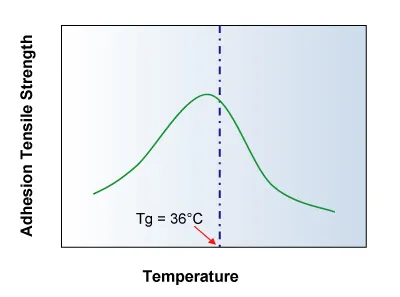
Figure 4: Adhesive joint strength of a carboxylic acid containing acrylic terpolymer to aluminum as a function of temperature[1].
Tg and Pressure Sensitive Adhesive Properties
One of the requirements of a pressure sensitive adhesive is that it must undergo plastic flow on contact. (The other requirement is that it must wet the substrate surface.) A polymeric material can only be pressure sensitive (flowable under slight pressure) above its glass transition temperature. As a result, most materials considered pressure sensitive have Tg below room temperatures. Although this provides the desired pressure sensitive characteristic, pressure sensitive adhesives do not achieve high cohesive strengths because they are used above their Tg. In this rubbery state, their molecules are mobile enough to flow under load until the bond fails. Therefore, the formulator must seek an optimum Tg in order to provide a balance between polymer mobility and cohesive properties.
To meet these requirements, pressure sensitive adhesives should have a Tg of about -15 to -5°C or less. As shown in Table 1, the Tg of some pressure sensitive adhesive base polymers are, in fact, much lower. A typical pressure sensitive acrylic adhesive possesses a Tg range of -40° to -60°C, and some styrene butadiene rubber latex used for pressure sensitive adhesives have a Tg of -35 to -60°C[2].
The Tg of the final pressure sensitive adhesive formulation is generally the result of a low Tg base elastomer (-20°C in the case of natural rubber) and high Tg additives (+10°C in the case of certain tackifier resins).
The ability to adjust Tg gives the formulator an opportunity to optimize the adhesive for a specific end-use. Generally, low Tg values ensure very high tack; whereas, medium Tg polymers give an optimum peel combined with an acceptable cohesive strength. The effect of the Tg on peel adhesion at constant molecular weight and tackifier level has been studied. The peel adhesion increases with increasing Tg and passes through a maximum. The Tg is not an absolute measure of an adhesive's suitability for use, but it is a good predictor.
Tg and Application Properties
Reactive polymers, such as epoxies, polyurethanes, cyanoacrylates, and silicones, are generally applied to a substrate in the liquid state and then reacted once in place. Thus, Tg does not come into play until once the adhesive is cured.
The other method of application is to join the substrates with a fully polymerized adhesive in a molten (e.g., hot melt adhesive) or rubbery state (e.g., pressure sensitive adhesive). This requires the polymer to be applied to the joint area while it is in a fluid, molecularly mobile state. Wetting is then possible because the molecular motion will permit the adhesive to compete with contaminants for attachment to surface sites. Hot melts and water or solvent-based pressure sensitive adhesives exemplify this process.
Hot melt adhesive are applied above their melting temperatures, Tm, which is generally significantly higher than their Tg. Bond strengths of hot melt adhesives develop as the adhesive solidifies. At this point, the relationship of Tg to performance properties of the hot melt adhesive is much like that discussed above with regard to cohesive properties. Since the performance of a hot melt adhesive is generally maximized at or near room temperature, the Tg of a hot melt adhesive should be at least 20°C below room temperature. Unfortunately, there are relatively few thermoplastic base polymers that meet this criterion.
Film formation of water based adhesives, such as acrylic dispersions, depend strongly on the Tg of the polymer as well as other additives in the system. The dispersed adhesive coating will form a continuous film after drying, if its particles are soft enough to be deformed and exhibit coalescence. Coalescence is only possible at temperatures above the Tg. Water based pressure sensitive adhesives and laminating coatings, therefore, are formulated from very low Tg polymers. Coalescence can be achieved at all application temperatures above the Tg.
Options for Adjusting Tg
The formulator has several options in adjusting the Tg of the polymeric system used in adhesives or sealants. These options are primarily through:
- Polymer selection or synthesis and
- Formulating with additives, such as tackifiers or plasticizers, that change the "packing density" of the molecules.
The Tg of the base polymer varies considerably depending on the type of polymer molecule and its structure. Table 1 defines Tg of several common base polymers used in adhesives and sealants.
Polar groups in polymers increase intermolecular forces and, thus, reduce free volume and increase Tg. This is illustrated by the effect of replacing the C-CH3 bonds in natural rubber with C-Cl bonds, as in polychloroprene. This increases the Tg by 25°C. In contrast, non-polar side groups tend to hold chains apart and lower the Tg.
The copolymerization of various monomers can provide different chain flexibility and intermolecular forces, especially in low Tg pressure sensitive adhesives. Copolymerization of polymers may give the formulator opportunities to produce products having differing Tg and differing rheological properties. The Tg of mutually soluble copolymers can be roughly estimated by a linear interpolation between the Tg values for homopolymers derived from each of the component comonomers. The copolymerization of vinyl acetate with ethylene provides the opportunity for a Tg ranging from +29 to -30°C.
In the case where the components are not mutually soluble, blended polymers will generally exhibit a dual Tg, one for each of the component parts. This is a technique that is sometimes used to provide toughness and good performance properties over a broad temperature range.
Plasticizers and flexibilizers exert lower Tg in polymer systems by inserting a cohesively weak region of material between the base polymer molecules. Liquids have a relatively high free volume, so the effect of mixing a liquid with a polymer is to lower Tg. The plasticization of PVC with phthalate diesters is a well-known example of this. Adhesives and sealants can also have their Tg reduced during service by absorbed water penetrating into the polymer network.
Since plasticizers change the degree of order of the molecules, using high amounts of plasticizer can drastically reduce the Tg. Low stiffness and poor cutting properties (important with slit tape, labels, etc.) are the drawbacks associated with low Tg. However, the decrease of the Tg by a plasticizer yields increased plasticity and, thus, better tack of the adhesive. In this way, plasticizers act like tackifiers.
Certain tackifier resins, depending on their chemistry, can result in a higher Tg. In these cases the better flow properties and improvements in the tack are due to the decrease in the modulus.
Tackifying resins have been considered to improve tack by a two-step process:
- Reducing the modulus and viscosity of the adhesive to give faster, more complete wetting of the substrate and
- Raising the Tg of the adhesive. Plasticizers and solvents accomplish the first objective but not the second. Reducing modulus and viscosity make bond formation easier while increased Tg makes bond failure more difficult.
- Lewis, A.F., and Saxon, R., "Epoxy Resin Adhesives", Chapter 6 in Epoxy Resin Chemistry and Technology, C.A. May and Y. Tanaka, eds., Marcel Dekker, New York, 1973.
- Benedek, I. and Heymans, L.J., "Physical Basis for the Viscoelastic Behavior of Pressure Sensitive Adhesives", Chapter 3 in Pressure Sensitive Adhesives Technology, Marcel Dekker, New York, 1997.