

Decoding 10 Myths Related to Adhesion
Last update on Jul 18, 2025
Get clarity on some of the most common myths to utilize your precious time and resources focusing on ideas that will really help you deliver improved adhesion.
Myth #1: Surface Energy & Adhesion
The first, and biggest myth is that surface energy is important for adhesion. Many companies spend time trying to get an extra 1 dyne/cm of surface energy in the hope of getting extra adhesion. This extra dyne is a complete waste of time, as we can easily show.
Adhesion can be measured in terms of:
- Work of Adhesion - It is the work/energy needed to separate 1 m² of an adhesive interface. Work of adhesion is measured in J/m².
- Peel - It is the force required to pull off a strip 1 m wide. Peel is measured in N/m.
These two measures are identical. This means 1 J/m² equals 1 N/m.
Go to www.stevenabbott.co.uk/practical-adhesion/basics.php for more details.
Work of adhesion: Order of magnitude
To give us some idea of what these units mean, and using round numbers:
- A typical PostIt-style note will have a peel of 4 N/m.
- A strong tape will have a peel of 400 N/m.
- The typical surface energy of a polymer is 40 dyne/cm is 40 mN/m.

This immediately tells us that surface energy is irrelevant. A Postit-style note is 100x stronger than surface energy. It has 10000x stronger adhesion. This makes the hunt for that extra 1 dyne/cm look foolish.
One area where this hunt is most common is the corona or plasma treatment of films such as:
- Polyethylene (PE)
- Polypropylene (PP) or
- Polyester (PET)
The faulty logic goes like this: 'We get no adhesion onto PE, PP or PET without corona treatment. When treated, the dynes level goes up and we can get good adhesion. Therefore, the increase of adhesion is due to the dynes.' This is the old trap of saying that correlation equals causation.
So what is really going on? Here's a clue: the surface energy of amorphous PET is the same as that of PET film. Yet it is very easy to stick to amorphous PET without corona treatment.
The real effect of corona treatment
To understand what corona is doing, you need to look at a fundamental bit of adhesion science. The word "corona" here is used as a short-hand to include the most common plasma and flame treatments. Assume that there is no surface energy adhesion between surfaces. But it leads to an understanding of how to get significant adhesion.
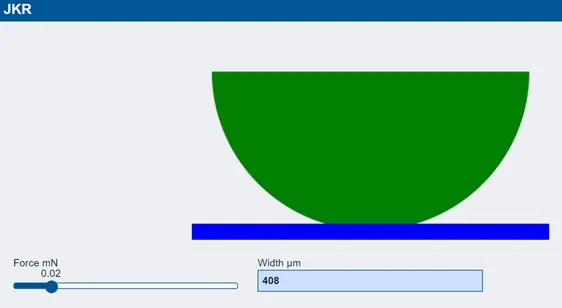
Let us take a sphere of some material of interest with radius "R" and modulus "E*" (so-called reduced modulus). Push it with a force "F" against a flat surface. If there is no attraction between the 2 surfaces, then you can consider the Hertzian formula. This gives half contact width "a" via the below equation:
The results of this equation can be seen in the first app. All the apps are free, there are no marketing hooks or registration. These apps run on everything from phones to laptops and on all operating systems.

The image shows that at zero force there is zero contact width.
But let's do it in the real world where there is always attraction between surfaces. You can use the JKR (Johnson, Kendall, Roberts) formula and include the surface energy "γ".

Now you can see why apps are a good idea. You don't have time to work out what that equation means, but you would like to see what it's like in practice. In the above equation, if γ=0, it becomes the Hertz formula. Find out more in this app.

- If polymer chains cross an interface and, at first, they intermingle and then entangle. You get strong adhesion.
- For crystalline surfaces, polymer chains cannot move via modest heat or suitable solvent. Then you have just surface energy adhesion which is useless.
The true effect of corona treatment: Proofs
- In classic heat sealing, the polymers are taken above their melting point. No one disputes that the effect is due to entanglement. But if you press together corona-treated PE and warm to 50°C, then you get good heat sealing, 70°C below the melting point.
- In the 1980s, 3M, Hoechst, and others found PET-treated surfaces exhibiting high adhesion. The surface was treated with an excimer laser or xenon flash. This was done via solvent coatings or (as with the corona PE) heat sealing at modest temperatures. Experiments showed that there was no degradation or functionalization of the surface. All that had happened was a sudden heating above the melting point. This was followed by a rapid cooling to give an amorphous surface which is easy to adhere to.
Myth #2: Substrate Wetting
There is another popular argument for wanting a high surface energy via corona. This states that you cannot coat an adhesive unless it wets the surface. This is only a half truth, which gives us a chance to introduce another app:
The app explores the idea that if you have a coating of:
- A thickness of h,
- A defect of size d, and
- A contact angle of θ
Then a hole will open to give you a visible pinhole and bad adhesion if h/d < 2(1-Cosθ).

In the example shown, a contact angle of 30° for a 30 µm adhesive coating with a defect of 100µm will not show a pinhole. But (explore this yourself) if the thickness goes down to 25 µm then you have a visible pinhole.
So, you don't just care about the dynes level of your corona treatment. You should care about the contact angle, the likely size of any defects (e.g. from dust) and reduced wet thickness.
Is there any use for measuring dyne levels or contact angles? Yes! If the surface tension of a successful product was 40 dyne/cm last year and today it is 38. This tells you that something is wrong.
Am I admitting that a low dyne level is bad? No! This is because it is equally the case that if today it is 42 dyne/cm you should be equally worried. 'Higher' doesn't mean 'better' – it means that something has changed. This means that your process has changed, which generally means there is some problem.
Now let's discuss other adhesion myths and address the argument about surface functionalization via corona. Here, again, some half-myths have to be corrected.
Myth #3: Surface Roughness Increases Adhesion
It is often said that a rougher surface increases adhesion. An image from a surface profile meter which might look like the following. This image is taken from my Surface Profile app.

If you imagine an ant walking across the smooth surface (the dashed line at 2.5 µm). Now imagine the same ant walking up and down all those mountains and valleys. It seems obvious that it would have to walk much further. All that extra surface must surely increase adhesion.

Yet if you look at all the readouts that the app provides you see that the LR value (Length Ratio) is 1.00. This says that to 2 decimal places, the ant walks the same distance up and down the 'mountains'. There is no significant extra surface area to help adhesion!
This makes sense if you click the Scale option in the app. You get the same data plotted to scale which is 12.5 mm in the X direction and 12500 µm in the Y direction:

Now the flatness of the surface is obvious. In other words, the adhesion community has deceived itself for years. They were looking at surface roughness profiles without considering the scale.
The effect on adhesion of roughening most surfaces is very small – which is no surprise. The main exception is the 'roughening' of surfaces (with sandpaper) to remove contaminants. For example, metal surfaces often have layers such as oxides on the surface. They can fail mechanically if adhesive is applied to them. Removing those oxides is what increases adhesion, not the extra (minimal) surface area.
There is an extreme case of roughening aluminum surfaces electrochemically. It gives extreme roughness with 1 µm pillars that are 100 nm wide. These give an increase of adhesion – but only by a factor of 2-3, not a big deal.
Myth #4: The Mechanical Interlocking
Professor Kevin Kendall is known for the K in JKR theory of surface energy and adhesion. In his book "Molecular Adhesion and Its Applications: The Sticky Universe," he makes a bold statement. He says the idea of mechanical interlocking is not just wrong - it's impossible.
Scientists often show diagrams from corona/plasma treatments or AFM plots of treated surfaces. These diagrams show "rough" surfaces. Many claim these rough surfaces help with "mechanical interlocking." However, there's no real science backing these claims.
The problem gets worse because many don't understand how tiny these surface changes really are. The extra "roughness" created by these treatments is extremely small. When you look at the actual scale, the mechanical interlocking theory makes even less sense.
There is an exception. Adhesion to paper, board, or non-wovens often relies on adhesive wrapping around fibers. This provides true mechanical interlocking which is very effective. But on 'normal' surfaces, the idea is without merit. There was a Russian trend to believe that electrostatics at the interface could provide strength. But again this has proven to be wrong.
Myth #5: Chemical Bonds
The final half-myth is that chemical bonds provide strong adhesion. It will, therefore, come as a surprise that if you calculate how much adhesion you get from a surface made up entirely of chemical bonds it is less than 1 J/m2. The app does the calculation for you:

As you can see, if you have 5 bonds every 10 nm² (and that's a lot of bonds!) and if the bond strength is a typical C-C or C-O bond ~350 kJ/mole you only get 0.3 J/m². If you don't believe me, here is a quote from the famous book by Gordon, Structures: or why things don't fall down:
Why are chemical bonds, on their own, so useless? Note the phrase 'on their own'. The answer is that Gordon's 1 J/m² comes from glass. If you put a crack into glass, the strong silica bonds across the interface are easy to break.
To take another quote from Gordon: 'The worst sin in an engineering material is not lack of strength or lack of stiffness, desirable as these properties are, but lack of toughness, that is to say, lack of resistance to the propagation of cracks'.
In the context of adhesion, it means that we often have to focus more on toughness than on raw strength. All those chemical bonds are strong, but they certainly aren't tough!
Using chemical bonds for strong adhesion
So how do we use chemical bonds intelligently to get strong adhesion? A good example, which returns to the myths surrounding corona, is the use of PEI as a primer to PE. Polyethylene imine is a truly poor polymer in terms of mechanical properties. It is lightly pre-crosslinked for these primer applications.
A typical corona treatment might result in 5% of the surface being functionalized with a mix of:
- OH
- C=O
- CO2H groups
The -OH groups are unable to bond with the PEI. And yet for decades products have relied on the PEI reacting with the PE surface. Epoxies, urethanes or acrylates react on the other surface to provide strong adhesion.
Note that the ideal thickness of the weak PEI layer is <50 nm. Thicker coatings are at risk of cohesive failure within the PEI.
So how does this combination of low levels of functionalization and a weak polymer give strong adhesion? The answer is 'entanglement' where polymer chains can cross an interface and become entangled as discussed above. Here is the simple definition of entanglement:

If the polymer chain crosses the interface marked with * twice then if you pull on that polymer chain, it can slide out. But if it crosses 3 times then attempts to pull it out will be stopped by another chain where it will form a tangle. Whether a polymer chain is stopped by a physical encounter with another polymer chain or a crosslink to that chain makes no difference. So chemical crosslinking gives exactly the same entanglement. Both forms absorb the crack energy along the interface by:
- spreading it across the polymer network,
- dissipating the energy, and
- stopping the crack from propagating
Why adhesion decreases with high crosslink density?
And now a point that is often overlooked. In adhesion, too much of a good thing is a bad thing. It has often been noticed that adhesion increases when you start to increase crosslink density. But at a certain point, adhesion decreases with a further increase in crosslinks. This is when you go from a dissipative system to a rigid system which fails, like glass, with 1 J/m². That is why the low functionalization level of PE and the rather weak PEI are such a great combination. They don't try too hard!
Another classic example is APTES (3-aminopropyltriethoxysilane). It is a wonderful adhesion promoter between aluminum and epoxies or urethanes. This happens at relatively low levels. Increase APTES further and adhesion strength falls off rapidly. Learn how to select the right adhesion promoter for adhesives here.
We can summarize what we've learned about the myths and point to a more positive view. Let's compare the 'classic' list of adhesion mechanisms to the correct list:
| The Classic List | The True List |
|
|
Going forward, we will build on the theme that dissipation is important for adhesion. Let's see that when it comes to dissipation, time is equivalent to temperature!
No one is going to tell their customer that they have provided a weak adhesive. So, they tend to use a different language such as 'hot melt' or 'laminating adhesive'. In the next section, I will refer to them all as Pressure Sensitive Adhesives (PSA). The one fact we can all agree upon is that PSA has no significant dependence on pressure!
We will discuss primarily the generic PSA system such as tapes with which we are all familiar. Later we will brief you more about hot melts or laminating adhesives.
There are many hot melt adhesives which deliver a polymer which is strong in itself. They get entangled with the adherends. Some laminating adhesives have special chemical functionalities. They provide the necessary entanglement via crosslinks. Strong adhesives don't break down under their normal intended use. They use the dissipative mechanism that is at the heart of all PSA.
Myth #6: Weak Adhesives Cannot Give Great Strength
A typical strong polymer has a modulus of 4 GPa. A typical PSA tape must have a modulus <0.3 MPa, so it is at least 1000x weaker than a standard polymer. The need for this low modulus was first mentioned by Dahlquist from 3M. It is called the Dahlquist criterion. It’s easy to see the reason for the Dahlquist criterion with an app.

We want to stick our adhesive onto a normal surface. This surface has a roughness of height "h" and a radius "R". Most rough surfaces can be approximated with just these two numbers!
- If the modulus of the PSA is too high, then even with applied pressure you can't push the adhesive all the way into the rough structure.
- If the modulus is less than a critical value (Gc), then the adhesive will spontaneously flow into good contact and give good adhesion. Gc also depends on the surface energy W.

In this example the modulus has to be less than 0.2 MPa.
How does a weak polymer give great strength?
A strong PSA can easily have a peel of 500 N/m. Yet the only thing that has brought the PSA into contact with the surface is surface energy. This energy is 10000x too weak and the answer is dissipation.
To understand this, we need to look at another app which describes the 'simple' 90° peel test. The theory was developed by the brilliant theoretician and experimentalist, Kaelble. This theory has been implemented in the app:
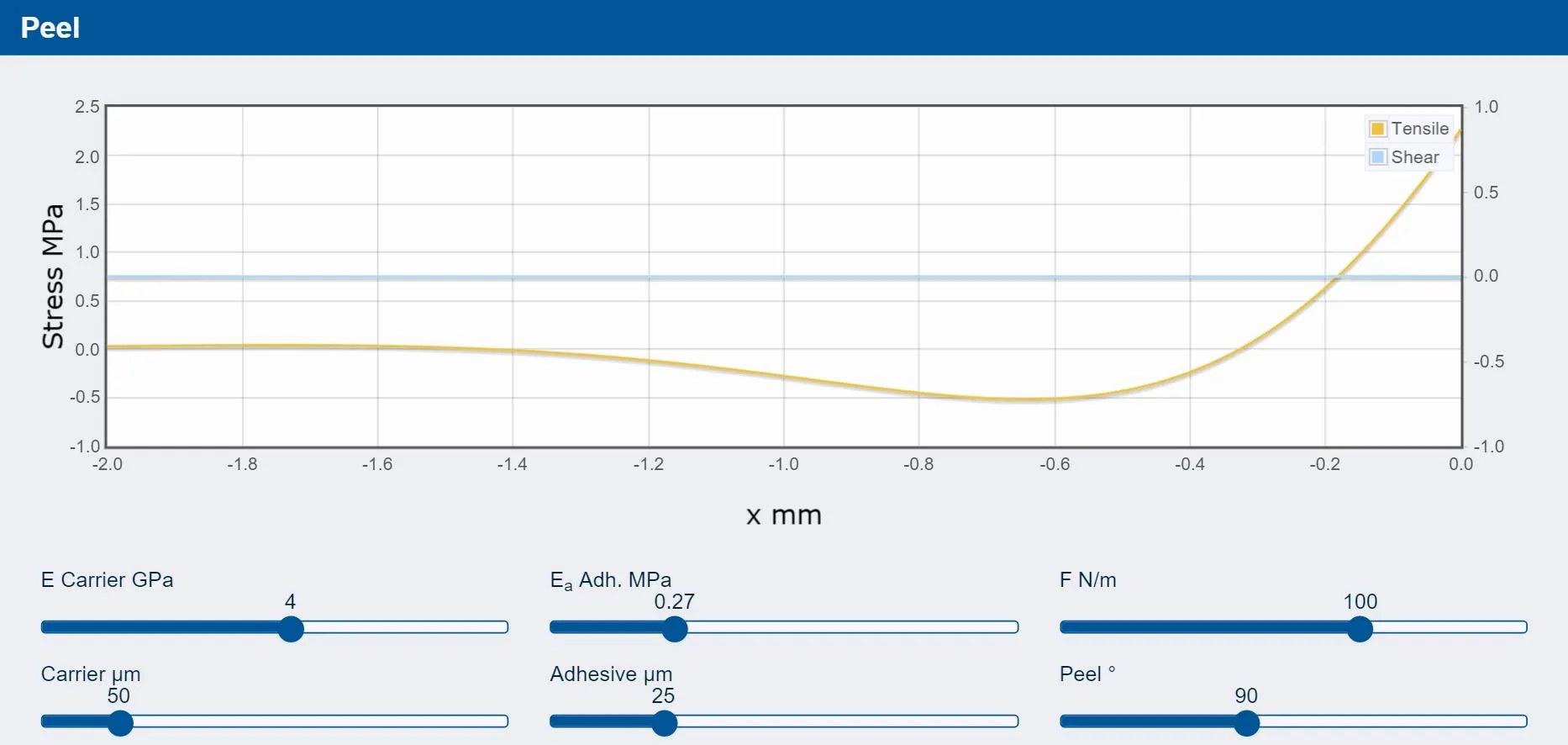
The PSA is being pulled at 90° at the right-hand end of the graph, and that's where the maximum tensile stress is ~2.2 MPa. If the peel force was fully focused on a weak surface energy interface, it would fall apart instantly. But look what is happening. The tensile stress extends to 0.3mm ahead of the peel. Then it amazingly, goes negative – yes, it compresses the PSA. The effects extend out to 1.4 mm.
So, part of the answer to how PSA works is that the stresses are spread out. diluting the force on any part of the interface. If you increase the modulus of the adhesive to 2.7 MPa, the forces are concentrated over 0.8 mm. So the harder you try, the worse it can get. You can try adjusting the modulus using the app.
A closer look at the PSA compression zone
There is more to it than that. It is well-known that you can get good PSA release from some silicone surfaces. People lazily say, 'that's because the surface energy is low'. But this is clearly wrong.
You can have some silicone and fluoro surfaces with the same low surface energy and still get strong PSA adhesion. It turns out that the compression zone ahead of the peel is critical to success.
- On a proper silicone release surface, the whole thickness of the adhesive slides forward and backwards. There is no dissipation in this zone. This can be seen with fluorescent beads.
- But on any other surface, the adhesive in contact with the surface remains fixed. The material above it moves – i.e., there is viscous dissipation. This is the case with fluoropolymers.
This is heavy science! But so much of PSA work has been based on intuitions that happen to be wrong. We need to understand what is really going on. I've used the great science that is out there (and largely ignored). He provides apps and explanations, so we don't have to formulate in ignorance.
Role of peel rate
There is a big problem with what I've just said about a PSA having a maximum peel of, say, 500 N/m. We can guarantee that the same PSA can easily be measured to have a peel of 40 mN/m (i.e. just surface energy).
Anyone who has had a plaster removed by a nurse knows this. When the plaster is pulled carefully by yourself, the adhesion is painful. But when the plaster is pulled quickly by the nurse, then there is no pain. It's not that the pain is over before it starts, the adhesion is genuinely lower.
Similarly, if you take most PSA tapes down to liquid nitrogen temperatures then they peel off easily from the backing tape. This is a handy, little-known trick if you want to examine the pure PSA without its backing sheet.
One of the profound laws of physics is that temperature is equivalent to time. So the nurse's fast peel is identical to a slow peel done at a lower temperature. In polymer science, the Time Temperature Equivalence/Superposition (TTE/TTS) principle is described by the WTF equation. Here, W stands for Williams, L stands for Landell, and F stands for Ferry.
The equation (not shown here) is a little obscure, but that's why we have apps. Here you will find this example, taken from a famous paper on rubber adhesion (so not directly related to PSA). The data on the left are peel versus peel rate at a range of temperatures. Not surprisingly, they look like unrelated curves. But if you apply a WLF transformation on the right then you see they all follow a single curve.

Why should you care? Because your customers often do strange things to your product. You may have tested it over a 'reasonable' temperature range. But if your customer also does a high-speed process, the adhesion might be the equivalent of that at very low temperatures, i.e. very little. These high-speed processes include slitting or sheeting.
Here's the real magic: WLF factors for your PSA
If you do a temperature/time sweep on your rheometer to measure the G', G'' and tanδ, then the rheometer's software will give you a WLF to the data. I'm sure you all have great rheometers because formulation without one is very difficult.
If you measure peel at different speeds and temperatures, you find that peel can be fitted to WLF with exactly the same parameters. However, this is very difficult to do in practice. So, a rather straightforward experiment on a modern rheometer (or DMA) can tell you what will happen to your peel at whatever temperature/speed your customer chooses to use.

Which gives us an excuse for the final app, on the same WLF page. Suppose you have created a batch of PSA in your excellent QC lab at 25°C. You have determined the peel at a certain speed. Now, your customer complains that their peel is too low. You can ask them at what temperatures are they using it. For example, they say 29°C.
With the help of WLF factors, you simply tell them to measure the peel at a speed 2.2x faster. Now, they will find the same value as yours. I would suggest you spend a little money on a good rheometer. This will help you save a lot of money on customer complaints later.
What about hot melts and laminating adhesives? They follow the same rules. But without the need for the 0.3 MPa Dahlquist criterion at 25°C, they need to be 0.3 MPa at their laminating temperature. You can use a higher modulus polymer. f done carefully, can give you better properties such as reduced creep under shear.
And what about entanglement? The weak polymer must show some resistance when it is stretched. A light level of entanglement provides exactly that need. Too much entanglement and you have a 'strong' polymer that simply cracks along the interface. Too little entanglement and your PSA is too weak.
How do you formulate for the right level? The starting point, of course, is a rheometer and, if you are very keen, the Luth-Burgers Ideal PSA you can find here.
Finally, I am not saying that you can formulate a great PSA with just a rheometer. But I can say that without a rheometer your chances of formulating a great PSA in an acceptable timescale are very small.
Now to help you get rid of the seventh myth, let's help you understand why testing gives us the information we really want about our adhesive system. You don't have to keep looking for a test better than the 'industry standards' they are required to use.
Myth #7: You can Measure "True" Adhesion at Interface
People fondly imagine that they can measure the 'true' adhesion at an interface, but this is a delusion. The reason is that Adhesion is a Property of the System. A phrase that should stand above every formulator's bench and manager's desk. An app allows us to see this fact very clearly in a case where we happen to know exactly what the 'true' adhesion is, 40 mN/m, pure surface energy.
Battle for objective measure of adhesion system
At one time I was brought into a battle between two brilliant formulators – a physicist and a chemist. They needed an 'objective' measure of their novel adhesion system. But the chemist just wanted to use the crude cross-hatch tape test. The physicist objected (rightly!) that this was a barbaric test with little direct relevance to 'real' adhesion. He had access to a fancy nanoindenter and wanted to use that for a more objective test.
Two arguments defeated the physicist.
The first is that the nanoindenter imposes a very complex set of forces onto a system. These forces include:
- flow,
- hoop stresses,
- compression,
- adhesion failure
Except in special cases, it is impossible to extract anything that resembles adhesion:

- The second argument was that 100% of the customers only used the tape test. This is because they knew that anything which passed a test done under reasonable conditions would never fail their customer.
Various industries have created 'standard' tape tests that show all the obvious shortcomings. The test is a robust way of showing, at the very least, if there is a problem with a batch or a formulation.
Now that you have identified the problem, it's time to look at some tests!
Peel test
Take 2 pieces of rubber, held together by surface energy, and test them in a peel tester, a lap shear joint and a 'butt' joint:
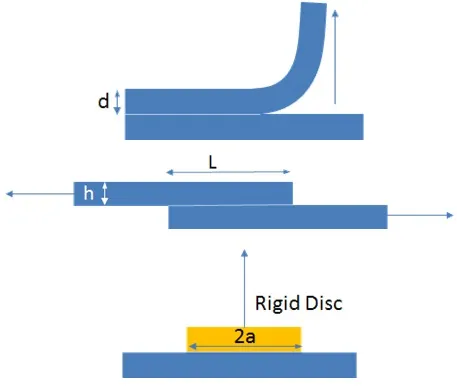
This app allows you to explore what happens. In each case, the amount of rubber in contact is similar but look at the scientifically correct results. because they were worked out by (and tested by) Prof Kevin Kendall:

It takes a force of 0.01 N to peel them apart, 2.24 N to pull the lap joint apart and 50 N to pull the butt joint apart. Which is the 'true' force? They all are. Adhesion is a Property of the System (equations are shown in the app). The modulus of the rubber plays a large part in the lap and butt joints. It gives an instant magnification through purely mechanical means.
Who cares about rubber sticking together with surface energy? Let's stick a wing onto an aircraft. For this we use a lap shear joint, this time with some adhesive in between the adherends:

It is obvious that the force to failure will depend linearly on the overlap length L. The joint will fail in pure shear – that's why it's called the lap shear joint. Both 'facts' are wrong. It needs a very complex model to show what is going on, but fortunately modern apps are very powerful. The Goland-Reisner model is a good approximation to the truth:

Points of interest
- All the forces in the middle are 0 – i.e. all that adhesive in the overlap is doing no good at all!
- There are strong shear forces – not a surprise – but there are even stronger peel forces. In fact, most lap 'shear' joints fail via peel rather than shear.
In early modern aviation days, engineers conducted a test about adhesive joints. They tested aluminum (Al) parts that were glued together (lap joints) with a lap shear test. Any lap joint that failed a test with a force greater than a given amount was not going to fall out of the sky from adhesive failure.
The engineers knew that the test was bogus. It was testing peel whereas the relevant failure mode in the sky was shear. But the test is easy to do and if no planes fall out of the sky, that's good enough.
Soon the composite aircraft arrived. Give them the same 'industry standard' test and they fail catastrophically. However, we know they are actually stronger than aluminum ones in shear. As it happens, composites are very weak in peel, which is why they fail in this 'shear' test. The industry had to change to the double-lap shear joint. This is much more inconvenient but a better approximation to pure shear.
Note that all the inputs to the Goland-Reisner model are mechanical and geometrical. There is nothing about 'adhesion'. The model assumes that there is good basic interfacial adhesion. It also assumes that failure has much more to do with stresses concentrated at the end of the joint. Adhesion is a Property of the System.
Challenges with peel test
The peel test is full of problems. If, for example, the backing tape is rather too weak then a lot of the 'peel' is just stretching of the backing. As discussed previously, many things are going on at the same time, especially if you do a 180° peel which involves lots of shear forces. Look up the Kaelble app if you missed it.
PSA scientists tend to love the 'probe tack test' as it has lots of inputs and outputs to study.

The image gives you some idea of the complexity of what happens when you pull the probe away from the sample. The trouble is that this is a 'butt' test and as we saw, but tests have no relation to other tests. The failure is 'all at once' whereas a typical PSA fails along a peel line.
It turns out that the PSA lab needs the following testing equipments.
- Rheology,
- Peel,
- Probe tack,and
- Tensile testing
These are probably to be able to understand why a formulation is bad or good, and how to make it better.
Knowledge is power! If you can characterize your PSA via a broad set of scientific measures, you will have the power to develop superior formulations.
Finally, if we look at the thin film industry, there are all sorts of fancy tests that claim to measure 'adhesion'. A good example is the 4-point bend test, of which there are at least two versions, explained in the app:

The problem is that to calculate the fracture energy, G, you need a horrible formula:
Here, I in the formula is given by I=Σ[(Δ-1/η)2-(Δ-1/η)+1/3]+Δ/η(Δ-1/η)+1/3η3
It doesn't matter what all this means (it's explained in the app). The important thing is that an 'objective' measure of adhesion requires a complex set of numbers. This makes it not at all obvious what is going on.
Rolling ball test
One area that is desperate for an objective measure of adhesion is Pressure Sensitive Adhesives, PSA. But, a PSA is a hugely complex system so there is no single test which shows that it is fit for purpose. Rheology provides a basic grounding – if it is not in the right part of rheology space it will not work. But some formulators try to formulate with little more than a rolling ball test:

It is important to note that this test has no scientific basis. This is because the ball is moving along the tape at highly variable speeds, so the temperature/time issues are totally mixed up. It is a great QC test to say that this batch is the same as the last one. But if the distance changes there is no way to know which aspect of the formulation has gone wrong.
Similarly, the loop tack test is so complex that there is little scientific merit in using it for formulation, though it is a handy QC test.
Sorry to depress you with the negatives associated with these tests. Once you grasp that 'Adhesion is a Property of the System' and that no single test is ever good enough, the result is quite liberating. You use whatever test gives you the most formulation insight (and industry-accepted data) for the least effort. Always keep in mind that properties such as modulus might be much more important than 'adhesion'. Good luck with your testing!
My mission here is to use some of the previous themes to explore how we can ensure low adhesion (abhesion) for the times that we require it. At the same time, I will help you find ways to identify why unwanted adhesion failure occurred.
Because we know that surface energy is of no importance to real adhesion. Its modest role in ensuring a good coating of a liquid adhesive.
Instead for those who want abhesion, here is a set of proven methods, taken from my webpage:
- Provide a 'sharp' interface
It is relatively easy to have a "sharp" interface in 2 ways:
- Either having crystalline materials (un-corona-treated PE)
- Or by ensuring no intermingling or entanglement via incompatibility. For polymers use Hansen Solubility Parameters to maximize the "Distance" between them. Make sure there's insufficient temperature/time for intermingling to take place.
With a sharp interface, all the energy of a crack is focused on a sub-nm scale and failure is guaranteed.
- Provide no chemical entanglements
- This is similar to the previous one - just have too few chemical bonds and/or make sure that they are not coupled into some sort of entangled network.
- Provide too much chemical entanglement
- Conversely, make sure there is so much cross-linking that the system is brittle. This ensures little dissipation and therefore "only" chemical bonds which are in the range of 1 J/m2.
- Prepare the surface badly
- Surface junk through under-cleaning or from over-zealous corona/plasma will give poor adhesion. Roughening is nearly always useless at best (the extra surface area provides negligible extra adhesion). It can often be positively harmful if the adhesive cannot flow into the structure.
- Arrange the mechanics badly
- If you are involved in structural adhesion, then focusing all the forces onto the weakest spot will ensure bad adhesion.
- Use the wrong temperature/time
- An adhesive which is perfect at 40° or tested at 1Hz might be perfectly useless at 0° or 100Hz. Time Temperature Superposition/William-Landell-Ferry should help you get the correct (bad!) combination of factors for abhesion.
That little list is also helpful when failure is not an option. The most important lesson to draw from it is 'Don't try too hard'. Let me give three areas of adhesion where trying too hard made matters worse. You can readily apply the lessons to your own area.
Myth #8: More UV Curing Means Stronger Adhesion
I then suggested reducing the UV power. This was heresy – more UV means more cure means stronger adhesion. In the end, they had nothing to lose and reduced the power. This solved their problem.
On careful analysis, the tough coating was converted to a strong but brittle coating. This was because of excess UV and that's what was causing the failure.
Myth #9: Too much Chemical Primer is Good for Adhesion System
There are plenty of academic papers showing this is true. Also, there are all too many industrial users (including myself!) who have found out the hard way. It is the same story – trying too hard makes the system brittle.
Myth #10: Stronger Epoxies Work Better
The world of structural adhesives really needs high-modulus adhesives. Early epoxies were of modest modulus. But ingenious formulators gradually made them stronger, to great effect. But they hit a limit.
Even stronger epoxies made matters worse – the joints became susceptible to brittle failure. The solution was to add some rubber spheres (with a hard shell) to the epoxies. These somewhat reduced the overall modulus yet acted as shock absorbers for cracks.
Problems with adhesion
- Our biggest problem with adhesion is predicting the effects of time and temperature. To a modest extent, these are predictable and can be used to our advantage.
- If an adhesive system is subjected to a high-speed process that can't be simulated in lab, we conduct a standard test at low temperatures. This is done using Time Temperature Superposition to tell us what temperature will mimic the customer's conditions.
Similarly, if the customer is concerned about long-term shear issues we can (with due recognition that a lot of 'shear' is actually 'peel') use a higher temperature to simulate the long timescale.
In both cases, the effects are likely to be 'WLF' rather than 'Arrhenius'. WLF and its app have been discussed earlier. Arrhenius is the old thumb rule that increasing temperature by 10°C doubles the rate at which things happen. A 50°C increase in temperature will cause a 32x increase in rate via Arrhenius. But for WLF, depending on where you are in the curve, it could be a factor of 1000 or a factor of 2!
- The problem we all face is not so much that of temperature but that of humidity. Water is a small, reactive molecule that can readily diffuse to the interface. It can destroy a key primer bond ('interfacial failure') or simply swell the whole system. This is done through cycles of stresses induced by swelling, which damage the joint mechanically. Because water effects (unlike thermal effects) are so specific, there is no convenient app to unleash.
However, when I teach adhesion science courses a lot of interest is always aroused when I mention a technique ASAP. Accelerated Stability Assessment Program was originally developed by Dr Kenneth Waterman and colleagues at Pfizer for modelling ageing characteristics of pharmaceuticals. Yes, the pharma industry has as difficult a time as we do in predicting the long-term effects of temperature and humidity.
I have no personal examples of using ASAP in the world of adhesion. But Dr Waterman, now at his own company, provides many free on-line explanations of the technique. These seem amazingly powerful, though still targeted largely at the pharma world.
The key is that it generates meaningful long-term failure data in (ideally) less than 14 days. This bypasses those 60-day 'accelerated ageing' tests that yield so little information for so much time spent. It can be implemented at no cost via:
- A simple Excel sheet (contact me if you would like an example that I created for my adhesion courses)
- Sophisticated statistical techniques to extract the most predictive data for the least experimental effort
Lessons to remember
Adhesion is a property of the system
The next lesson is to remember that 'Adhesion is a Property of the System' so think of the whole system, not just your adhesive layer. A key example is the lap shear joint where a systems analysis shows that failure is via peel. An adhesive which is perfect for one temperature/speed combination will shift to a totally unsatisfactory adhesive at a different combination.
Failure comes in many modes
At the same time, broaden your mind from the old 'failure is adhesive or cohesive' binary system. Failure comes in many modes. It is very hard to distinguish between adhesive failure and interfacial failure, but it is important to do so.
- Interfacial failure (often through humidity) is a bond of a primer molecule to a rigid surface such as glass or metal.
- Substrate failure is relatively rare and is a strange outcome of the laws of fracture mechanics.
I was shocked when I first saw it in a coating of PET film! Near interface failure is when the adhesive and adherend are influencing each other in an undesirable way. And, of course, dissipative failure is often a good thing as it provides the strength of PSA and a lack of it provokes brittle failure.
Finally, I want to summarize some key themes:
- There are a lot of unnecessary myths in adhesion science that should be unlearned as soon as possible.
- Adhesion is a Property of the System, so think of the system not just the adhesive.
- Time and temperature are equivalent, so be alert to that duality.
- Dissipation is often more important than mere strength.
- Too much of a good thing is a bad thing.
- Tests of 'adhesion' are often not measuring what you think they measure.
- And, most importantly, with a large set of free, powerful apps to help you master the science, you can develop better formulations faster.
Learn more by visiting Prof Abbott's 'Practical Science' series here or from his book, Adhesion Science: Principles and Practice, DesTech 2015.
