

Hot Melt Adhesives for Low Surface Energy Substrates
Last update on Mar 8, 2021
This article was first published in 2018 and is revised in 2021.
Low energy polymeric surfaces, such as polyolefins, fluorocarbons, acetals, and polystyrene, are notoriously difficult to bond with adhesives. Wetting becomes a challenge when using conventional adhesives to bond these low surface energy (LSE) substrates.
Traditionally, LSE plastics have been primed or pretreated with flame, corona, or plasma to raise the surface energy so that they can be bonded with conventional adhesives. While finding solutions for better bonding in these substrates, the joint interface becomes the overriding concern.
Thus, in order to find bonding solutions for LSE substrates; first ensure that you have a clear understanding of LSE, difficulties associated with them and hence their respective adhesive bonding requirements.
To ease your problems! We have come up with a solution – Hot melt adhesives for bonding LSE substrates. Certain hot melt adhesives are capable of offering moderate bond strengths to these substrates without expensive and time consuming substrate pre-treatment. For this reason, they are primarily used in:
- Packaging
- Automotive
- Component assembly
- Medical and electronic assembly, and
- Textiles
Check out the strengths and weaknesses of using hot melt adhesives for bonding LSE substrates from the table below:
| Advantages | Disadvantages |
|
|
Explore some interesting tips on requirements for formulating optimal hot melt adhesive for your specific application.
Hot Melt Base Polymers for Formulating Adhesives for LSE Substrates
The base polymer provides the main framework for the hot melt adhesive's overall physical properties.
The table below summarizes the types of hot melt adhesive polymers that have generally been used in the manufacture of plastic products.
| Hot Melt Base Polymer | Formulation Characteristics | Variations |
| Ethylene vinyl acetate (EVA) |
| Various melt indices and vinyl acetate concentrations |
| Styrene block copolymer (SBC) |
| Styrene-butadiene-styrene, styrene-isoprene-styrene, styrene-ethylene-butylene-styrene, blends of these, and blends with other polymers |
| Polyolefin (PO) |
| Polyethylene and polypropylene with various molecular weights and branching, blends with other polymers |
| Amorphous polyolefin (APAO) |
| Amorphous / crystalline concentration, blends with other polymers |
| Metallocene polyolefin (MPO) |
| Metallocene catalyzed polyethylene and metallocene catalyzed polypropylene |
| Moisture cured silicone (Si) |
| Melt indices and modulus |
| Polyurethane (PU) |
| Polyol and isocyanate type Moisture reactive variation are possible |
| Butyl |
| Melt indices and molecular weight |
(Continue reading or click on to go on specific polymer technology details)
Ethylene Vinyl Acetate
The first copolymer to be used as a base for hot melt adhesives was ethylene vinyl acetate (EVA).
- EVA resins are highly flexible products, compatible with many other polymers and additives, and easy to process.
- They have high cohesive strength and excellent adhesion to a wide range of substrates.
- EVA copolymers can be used in soft, permanently tacky pressure sensitive adhesives or in tough, rigid hot melt compositions used for semi-structural applications.
The table below identifies the major advantages and limitations associated with EVA based hot melt adhesives.
| Advantages | Disadvantages |
|
|
EVA Resins in Hot Melt Adhesive Formulations
Generally, for hot melt adhesives EVA resins with vinyl acetate concentration of 18-40% are utilized. The vinyl acetate content can be a significant parameter in varying the properties of the adhesive.
vinyl, aluminum, and steel, while the lower vinyl acetate copolymers are often used for bonding low energy surfaces
The materials with high vinyl acetate concentration exhibit reduced crystallinity and increased polarity. At about 50% vinyl acetate content, all crystallinity is lost. Recrystallization rate or setting speed is greatly influenced by the choice of specific EVA resin.
Melt index (MI) or melt viscosity is another important criterion in choosing the correct EVA resins for adhesive formulations.
- Low melt index EVA grades provide high viscosity, strength, and hot tack.
- In contrast, high MI grades enable higher polymer content and low application viscosities. Mid-range MI grades provide formulation flexibility.
Review the table given below for understanding: a starting formulation for a general purpose, EVA hot melt adhesive formulation for bonding difficult substrates (e.g., polyethylene and polypropylene).
| Components | Parts by Weight |
| Ethylene vinyl acetate copolymer resin (28% vinyl acetate, melt index of 25) | 50 |
| Microcrystalline wax (190°F to 195°F melting point) | 30 |
| Tackifier (Zonarez B-125, Talas) | 20 |
| Properties | Value |
Brookfield viscosity, cps
|
|
| Sealing temperature, °F | 177 |
Adhesion, oz/inch:
|
|
The adhesive is stable at high temperatures. It will adhere to most packaging foils and films, including polypropylene. It has increased tackiness and heat sealable properties.
EVA Copolymer Resins for Packaging Applications
Packaging applications are a primary market for hot-melt adhesives that are based predominantly on EVA copolymer resins. A tackified EVA is necessary for bonding plastic substrates that have a relatively low surface energy.
A starting formulation for a low cost, general purpose EVA hot melt formulation for bonding plastic substrates is given in the table below, have a look!
| Components | Parts by Weight |
| EVA polymer (ELVAX® 250, Dow) | 35.0 |
| EVA polymer (Elvax® 260, Dow) | 10.0 |
| Tackifier – Polyterpene resin, 115°C m.p. | 30.0 |
| Filler – Calcium carbonate (15 μm) | 24.8 |
| Antioxidant - Butylhydroxytoluene | 0.2 |
| Properties | Value |
| Viscosity at 149°C, cps | ~1500 - 2500 |
| Melting temperature by DSC, °C | ~150 |
Adhesive application temperature is critically important in bonding LSE substrates. This is because it directly affects how long the hot melt remains 'open' during the manufacturing process. If the hot melt pot is not hot enough, open time will be too short, and the substrates will fail to adhere properly. If it's too hot the adhesive may have a detrimental effect on temperature sensitive substrates, and the adhesive's viscosity will be too thin creating excessive seepage.
Styrene Butadiene Copolymers
Adhesives that are based on styrene butadiene block copolymers (SBCs) are both useful and unusual. These polymers consist of a polystyrene end-block with mid-blocks consisting primarily of isoprene and butadiene. The mid-blocks are non-polar and result in relatively low surface energies for good bond strength to LSE substrates.
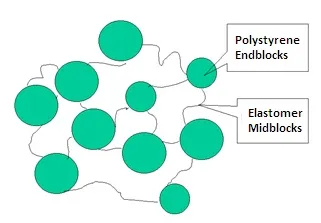
Representation of an SBC Structure in Bulk
The SBC polymers have the solubility and thermoplastic nature of polystyrene;but while at ambient temperature, they possess the toughness and resilience of a low surface energy elastomer.This characteristic provides SBC adhesives with versatile properties in both pressure sensitive and non-pressure sensitive adhesive formulations.
SBC for Adhesive Formulation
As a hot melt adhesive, the low melt viscosity and fast strength development are significant benefits to end-users. Certain SBC polymers are capable of hot melt application temperature in the 150° - 170°C range. This is much lower than most EVA hot melt systems.

Four types of SBC resins are commonly available for adhesive formulation:
- Styrene-Butadiene-Styrene (SBS)
- Styrene-Isoprene-Styrene (SIS)
- Styrene-Ethylene-Butadiene-Styrene (SEBS) Grades, the hydrogenated form of SBS
- Styrene-Ethylene-Propylene-Styrene (SEPS), the hydrogenated form of SIS
Key properties and applications of SBC resins:
- Of these, SBS offers the lowest cost and high levels of cohesive strength.
- In general, the saturated block copolymers (SEBS and SEPS) are used where long term UV, thermo-oxidative, or chemical stability is critical, or where compatibility with other low polarity ingredients is required.
- SIS copolymers are generally used in pressure sensitive adhesives, where high tack is necessary and cohesive strength is LSEs important.
One of the most interesting and valuable properties of SBCs is that they offer a physical form of crosslinking, which greatly broadens their applicability. The thermoplastic polystyrene end-segments on the molecule form 'pseudo-crosslinking' sites. This results in a superior resistance to creep while maintaining a very high cohesive strength and degree of elongation.Due to the pseudo-crosslinking mechanism associated with SBCs and the glass transition temperatures associated with each phase, SBCs provide very good properties at both high and low temperatures.
SBC adhesive manufacturers can tailor properties to match a wide range of applications. Also, SBCs have many other attributes that are very beneficial, besides being:
- Strong
- Highly extendable
- Cost effective
- Processable, and
- Easy to formulate
The table below lists some advantages and disadvantages of SBC based hot melt adhesives:
| Advantages | Disadvantages |
|
|
Also review the pressure sensitive hot melt adhesive formulation based on styrene-isoprene-styrene. It has excellent adhesion to oriented film substrates and good melt stability. The adhesive has relatively good bond strength (peel and shear) even after aging. The color and color retention after aging is better than other comparative adhesives.
| Components | Parts by Weight |
| Styrene-isoprene-styrene copolymer (15% styrene, 19% diblock) | 35 |
| Tackifier (Wingtack® Plus, Cray Valley) | 44 |
| Tackifier (Norsolene S155, Cray Valley) | 9 |
| Calcium carbonate | 5 |
| Titanium dioxide | 1 |
| Naphthenic oil (Nyflex® 222, Nynas) | 5 |
| Antioxidant | 1 |
Styrene block copolymer type pressure sensitive adhesives can be applied either by hot melt application or solvent solution. The formulation given above is for a hot melt system. However, with the appropriate solvents (MEK, toluene) a solution coating can be provided.
Polyolefins
Polyolefin base polymers are often used to bond LSE substrates by the principle of surface energy. More precisely, the basic surface energies of the adhesive systems and the bonded substrate are similar.
These hot melt adhesives are based primarily on:
- Low density polyethylene (LDPE)
- Attactic poly-α olefin (APAO), and
- Metallocene catalyzed polyolefin
Due to their low crystallinity, adhesives made from these polyolefin systems generally show good compatibility and long-term thermal aging performance with plasticizing and tackifying agents commonly used in hot melt formulations; however,
- These polyolefin species tend to develop properties only slowly after application that can make them unsuitable for certain porous substrates due to excessive penetration.
- The long open time (especially with APAO polymers) results in enhanced wetting and high bond strength to LSE substrates.
Amorphous polyolefins formed by the copolymerization of alpha-olefins have also been found to be useful for the production of hot melt adhesives. APAO materials incorporate 1-3 monomers to achieve the desired properties.
The property differences exhibited by the two monomers are summarized in table below:
| Monomer | Characteristics |
| Propylene |
|
| 1-Butene |
|
APAO hot melt adhesives generally require no formulation to exhibit good adhesive properties. Although, they have lower adhesion properties than EVA based adhesives; they are known to have better thermal stabilities.
SEBS & APO Blend for Improved Hot Melt Adhesive
A blend of amorphous polyolefin and styrene ethylene butadiene styrene (SEBS) copolymer was found to provide thermally stable and a more processable hot melt adhesive. This could be used as alternatives for EVA and SBC adhesives1.
SEBS copolymers as noted above have saturated rubber mid-blocks. And when formulated with saturated resins, plasticizers, and stabilizers; SEBS copolymers obtain a good balance of adhesive properties as well as resistance to degradation by oxidation or UV light. When SEBS is added to an amorphous polyolefin, the toughness of the hot-melt adhesive is enhanced, and the viscosity is also increased.
SEBS addition to APO in a hot melt adhesive improves T-peel strength, check out from the table below:
| Components | Parts by Weight | |
| Formulation A | Formulation B | |
| SEBS Elastomer (KRATON™ G-1652 E, Kraton) | 20 | 10 |
| Tackifier (Eastotac™ H-130E resin, Synthomer) | 60 | 60 |
| Mineral oil | 20 | 20 |
| Antioxidant (Irganox® 1010, Ciba (BASF) -Geigy) | 0.15 | 0.15 |
| Amorphous polyolefin (Eastoflex™ P1023 APP, Synthomer) | 0 | 10 |
| Properties | Value | |
| T- peel adhesion, pli | 0.05 | 0.11 |
| Creep resistance, 12 specimens, 8 hrs at 38°C | All 12 passed | All 12 passed |
Further development of olefinic polymers has been based on metallocene catalyst technology. This technology results in long chain branching and improved elastomeric and processability characteristics.

Metallocene catalysts offer unique advantages versus conventional catalysts for the production of polyolefin resins. They allow producing consistent, controllable molecular structures that can be designed to:
Adhesives formulated using this technology provide:
- Broad temperature sprayability (good balance of low- and high-temperature sprayability), and
- Excellent adhesion with thermal and viscosity stability
The narrow molecular weight ranges provide hot melt adhesives with fast setting times, low-odor, low-color, and clean running characteristics.
Review the table below for formulating water-white metallocene catalyzed polyolefin hot melt adhesive. It will provide:
- Good adhesion to hard to bond plastic substrates such as PP, PS, PET, PC, PMMA, etc. as well as
- Excellent adhesion to wood, aluminum, and various other metals
The adhesive has good resistance to many chemicals and oils.
| Components | Parts by Weight |
| Metallocene polypropylene (Licocene® PP-1302, Clariant) | 25 |
| Hydrocarbon tackifier (Regalite™ 9100, Synthomer) | 35 |
| Amorphous polyalpha-olefin (VESTOPLAST® 828, Evonik) | 40 |
Polyolefin Elastomer Based Hot Melt Adhesives
Polyolefin elastomer based hot melt adhesives have good thermal stability (minimal color changes and reduced gel formation on standing in the melter). Melt viscosities can have a wide range due to molecular design and additives.
The formulations in table below describe hot melt adhesives for general purpose bonding of packaging, non-woven hygienic products, and graphic arts. These formulations offer a wider service temperature range than EVA based hot melt adhesives.
| Components | Parts by Weight | |
Conventional Application Temperature | Low Application Temperature | |
| Polyolefin elastomer resin (AFFINITY™ GA 1900, Dow) | --- | 29.5 |
| Polyolefin elastomer resins (AFFINITY™ GA 1950, Dow) | 34.5 | --- |
| Hydrocarbon plasticizer (Eastotac™ H-130R, Synthomer) | 35.0 | 35.0 |
| Wax (Paraflint® H2, Sasol Wax Americas, Inc.) | 30.0 | 35.0 |
| Antioxidant (Irganox® 1010, BASF) | 0.5 | 0.5 |
| Property | Value | |
| Application temperature, °C | 177 | 121 |
| Peel adhesion failure temperature (PAFT), °C | 70 | 72 |
| Shear adhesion failure temperature (SAFT), °C | 98 | 87 |
| Onset of fiber (virgin corrugated) tear, °C | -46 | -29 |
| Gardner color after 200 hrs at application temperature | 13 | 9 |
These formulations offer a wider service temperature range than EVA-based hot melt adhesives.
Moisture Cured Silicone
Moisture curable silicone hot-melt adhesives are made from mixtures of silanol terminated silicone polymers and silanol functional silicone resin. These adhesives have:
- Light resistance
- High-temperature resistance, and
- Absence of solvents
Curable applied silicone HMAs can provide high adhesion strength to low surface energy substrate, high-temperature durability, and other performance features. As with other silicone adhesives, the cohesive strength is relatively low.
Polyurethane
Polyurethane hot melts are different from other hot melt adhesives. They are typically applied from a heated cartridge at a rather low temperature, which makes them more suitable for heat sensitive materials than other hot melts. This type of adhesive offers good adhesion to many substrates due to presence of polar groups. Typical urethane hot melts have very low glass transition temperatures and are very elastic with a wide range of softening points.
Moisture curing polyurethane hot melt adhesives will crosslink. Once applied via a hot melt applicator, the residual non-reacted isocyanate groups react with ambient moisture to convert the polyurethane from a thermoplastic to a thermoset.
Butyl
Butyl rubber is harder and less porous than other elastomers, such as natural rubber or silicone. It also has excellent resistance to oxidation, which makes it the elastomer of choice for many outdoor applications. A low glass transition allows butyl rubber to maintain its flexibility at low temperatures.
The low glass transition temperature, excellent environmental resistance, low permeability to gasses and moisture, and oxidation resistance would seem to make butyl rubber an excellent base for adhesive development. The butyl polymer is very amorphous and as a result imparts:
- Good flexibility
- Vibration resistance, and
- Resistance to shock or impact
The molecule's hydrocarbon groups provide non-polarity and easy bonding to low surface energy substrates without modifications.
- Kim, J-H, et. al., “Thermal Properties and Adhesion Strength of Amorphous Polyolefins / Styrene-Ethylene-Butylene Copolymer / Terpene Hot-Melt Adhesive”, J. of Applied Polymer Science, Vol. 124, 2012, pp. 3312-3319.
- Eastman Chemical Company, Now Synthomer