

How to Prevent Hydrolytic Degradation?
Last update on Jan 7, 2025
This article was originally published in 2011 and updated in 2024.
Moisture is the substance that causes the greatest difficulties in terms of environmental stability for many bonded or sealed joints. The moisture-induced permanent degradation of the bulk adhesive is known as the hydrolysis mechanism.
It depends on the polymer's chemical nature and the environmental conditions present during service. Understanding how water infiltrates the polymer structure is the key to mitigating these effects.
Moreover, not all polymers are created equal in their resistance to water. Hydrophobic materials like polybutylene and polybutadiene show remarkable resilience, while others are more susceptible to water-induced damage.
Water can be an exceptional problem because it is very polar and permeates most polymers. Other common fluids, such as lubricants and fuels, are of low or zero polarity and are not as likely to permeate and weaken adhesive or sealant joints.
Moisture can degrade a completed joint in three distinctive ways by changing the:
- Physical and Dimensional Properties of Adherends
- Properties of the Bulk Adhesive or Sealant Itself
- Adhesion Properties at the Interface
Let's strategize how to prevent degradation via hydrolysis.
Physical and Dimensional Properties of Adherends
Moisture can alter the properties of the bulk material by changing its glass transition temperature (Tg), inducing cracks, or chemically reacting with the polymer. This process is called hydrolysis. But before these mechanisms occur, the moisture must first find its way into the bulk polymer. In some cases, the mechanical properties of the cured adhesives can also alter.
Effect on glass transition temperature (Tg)
Water permeation in polymers generally lowers the Tg of the polymer by reducing the attractive forces between molecules. Data for certain epoxy adhesives are given in below Table 1.
Hardener | Glass Transition Temperature (°C) | ||
| Dry | After Initial Uptake | After 10 Months | |
| Di-(aminopropyl-3-ethoxy) ether | 67 | 37 | 49 |
| Triethylenetetramine | 99 | 86 | 111 |
| 1,3-diaminobenzene | 161 | 143 | 157 |
| 4,4'-diaminodiphenylmethane | 119 | 110 | 130 |
Table 1: Effect of Water Immersion on the Tg of Epoxy Adhesives Based on DGEBA1
Effect on mechanical properties
The effect of absorbed water on the mechanical properties of cured adhesives is shown in Table 2. Water lowers tensile strength and modulus but increases elongation at break. These properties generally recover fully when the polymer is dried unless irreversible hydrolysis has taken place.
| Structural Adhesive Type | Exposure Conditions | Weight Gain (%) | Tensile Strength (MPa) | Elongation at Break (%) | Modulus (MPa) | Failure Mode |
| Epoxy/polyamide | None | 0 | 73 | 5 | 1880 | Brittle |
| 3 months at 65% RH | 2.9 | 52 | 263 | 623 | Ductile | |
| 5 days in water at 50°C | 9.4 | 19 | 260 | 3.0 | Rubbery | |
| 5 days in water at 50°C, then dry at 60°C for 2 days | 3.3 | 76 | 5.7 | 1980 | Brittle | |
| Epoxy/di-(1-aminopropyl-3-ethoxy) ether (DAPEE) hardener | None | - | 41 | 7.1 | 1700 | Ductile |
| 24 hours in water at 100°C | 24 | 37 | 1020 | |||
| 24 hours in water at 100°C, then dry at 65°C for 2 days | 53 | 6.8 | 1560 |
Table 2: Effect of Water on Mechanical Properties of Epoxy Structural Adhesives1
Deterioration may occur more quickly in a 100% RH environment than in liquid water because of more rapid permeation of the vapor.
Properties of the Bulk Adhesive or Sealant Itself
Moisture can degrade the properties of the bulk adhesive or sealant itself. This degradation can be permanent or temporary. Reversion or hydrolysis causes the adhesive or sealant to lose hardness, strength, and in the worst cases transform to a fluid during exposure to warm, humid air.
The hydrolytic stability of urethane potting compounds was not believed to be a problem until it resulted in the failure of many potted electronic devices. These were noticed first during the 1960s US military action in Vietnam. The rate of reversion or hydrolytic instability depends on the following factors.
Chemical structure of the base polymer
Internal degradation within the bulk adhesive or sealant occurs by the absorption of water molecules into the polymer structure. All polymers will absorb water to some extent. Figure 1 illustrates the degradation of polymer chains by hydrolytic reaction with water.

Figure 1: Degradation of Polymer Chains by Reaction with Water2
Degree of crosslinking
Certain chemical linkages such as ester, urethane, amide, and urea can be hydrolyzed. Some polymeric materials, notably ester-based polyurethanes chemically change or revert when exposed to humid conditions for a prolonged period. The rate of attack is fastest for ester-based linkages. Ester linkages are present in certain types of polyurethanes and anhydride-cured epoxies. Generally, polyether and polybutadiene polyol urethanes provide superior resistance to hydrolysis.
Since the curing reaction between an epoxy resin and an acid-anhydride curing agent also produces an ester linkage, anhydride-cured epoxies have poorer hydrolytic stability than amine-cured epoxies. It has also been shown that reversion rates of urethanes and anhydride-cured epoxies increase as the amount of tertiary amine or other base catalysts increases.
The reversion rate also depends on the amount of catalyst used in the formulations and the degree of crosslinking. Some chemical linkages are susceptible to hydrolytic attack and, if present in an adhesive or sealant, are potential sites for irreversible reaction with water that has diffused into the joint. Such hydrolytic (chemical) degradation causes a permanent reduction in the cured physical properties. The functional groups present in the chains are hydrolyzed, resulting in both chain breaking and loss of crosslinking.
Learn how to monitor curing of adhesives and sealants.
The hydrolytic attack on an ester linkage in the presence of water at high pH is an important example of this degradation mode. This initiates by attack on the electron-deficient atom in a highly polarized bond, as shown below:

Figure 2: Mechanism of Hydrolytic Degradation of Ester Linkages
Substitutions of electron-withdrawing groups for the aliphatic R1 and R2 groups will delocalize the charge on the carbonyl carbon, leading to reduced rates of hydrolysis. Thus, hydrolytic stability increases in the order:
Aliphatic esters < Aromatic esters < Urethanes < Aliphatic amides < Urea < Aromatic amides
Other things being equal, the rate of hydrolytic attack on any adhesive increases rapidly as the crosslinking density decreases. Epoxy resins cured with flexibilizing anhydrides, derived from long-chain aliphatic acids, will hydrolyze rapidly. Epoxy resins cured with short-chain, highly functional acid anhydrides such as methyl nadic anhydride yield a rigid network having a much lower permeability for water and a greatly reduced rate of hydrolytic attack under alkaline conditions.
Figure 2 illustrates the hydrolytic stability of various polymeric materials determined by a hardness measurement after exposure to high relative humidity aging. A time period of 30 days in the 100°C, 95% RH test environment corresponds approximately to a period from 2 to 4 years in a hot, humid climate.
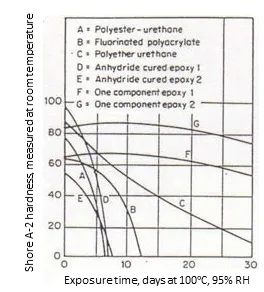
Figure 3: Materials Showing Rapid Loss of Hardness Soften Similarly After 2-4 Years in High Temperature, High Humidity Climate Zones3
Reversion is usually much faster in flexible materials because water permeates them more easily. Hydrolysis has been seen in certain adhesives like:
- epoxies,
- polyurethanes,
- polyesters, and
- cyanoacrylates
In the case of conventional construction sealants, polysulfides, polyurethanes, epoxies, and acrylics have all shown various degrees of sensitivity to moisture. Hydrolysis causes the breaking of bonds within the sealant. Thus, the bond strength decreases, and cohesive failure results. However, before this occurs the sealant usually swells and may cause deformation or bond failure before hydrolysis can completely take action.
Permeability of the adhesive or sealant
The water ingress properties of various polymers can be assessed by values of their permeability coefficient and the diffusion constant of water. Certain hydrophobic polymers such as polybutylene and polybutadiene have relatively low diffusion rates. Hence, they are less susceptible to moisture attack than most other polymers. As a result, these materials are used in adhesive and sealant formulations where resistance to moisture is essential.
Adhesion Properties at the Interface
It is well known that moisture will also result in the weakening of the interface between the substrate and the adhesive. This is usually evident from the mode of failure going from one of cohesion to one of adhesion after aging in a moist environment. Moisture can also enter by:
- wicking along the adhesive-adherend interface or
- wicking along the interfaces caused by reinforcing fibers and the resin
Several investigators have set out to determine if this is a result of hydrolysis or the partitioning of water between the adherend surface and the adhesive matrix. The results of these experiments have shown that chemical hydrolysis such as might occur in the bulk polymer is not the prevalent mechanism for the degradation of an adhesive joint in a moist service environment4, 5.
Most researchers have now concluded that the interface is degraded mainly by water permeating the adhesive or sealant and preferentially migrating to the interfacial region. This partitioning effect of water displaces the bulk adhesive material at the interface. This mechanism is illustrated in Figure 4. It is recognized as the most common cause of adhesive strength reduction in moist environments. Thus, even structural adhesives that are not susceptible to the reversion phenomenon may also lose adhesive strength when exposed to moisture.
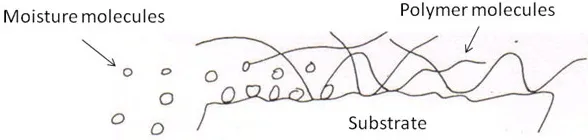
Figure 4: Water Molecules Penetrate a Polymer and Preferentially Displace it at the Interface
The degradation curves of an adhesive joint strength show that the mode of failure in the initial stages of moisture aging is usually cohesive. After some time, the failure becomes one of adhesion. It is expected that water vapor permeates the adhesive through its exposed edges. The water molecules are absorbed into the adhesive and preferentially concentrate on the metal adherend. Thereby, displacing the adhesive at the interface.
This effect is greatly dependent on the type of adhesive and the adherend material. Certain adhesive systems, based on hydrophobic polymers, are more resistant to interfacial degradation by moist environments than other adhesives.
Another way moisture can degrade the strength is through hydration or corrosion of the metal oxide layer at the interface. Common metal oxides, such as aluminum and iron oxides, undergo hydration. The resulting metal hydrates become gelatinous, and they act as a weak boundary layer as they exhibit very inadequate bonding to their base metals. Thus, the adhesives or sealants used for these materials must be compatible with the firmly bound layer of water attached to the surface of the metal oxide layer.
Conclusion
Moisture poses significant challenges for bonded and sealed joints through multiple degradation mechanisms. Hydrolysis permanently affects the bulk polymer properties. However, the most common cause of joint failure is water molecules preferentially migrating to and weakening the interface. Understanding the mechanisms of moisture-induced degradation and selecting materials with high resistance to hydrolysis and water ingress is crucial. This ensures long-term stability and reliability in demanding environments.
- Comyn, J., Adhesion Science, Chapter 10, Royal Society of Chemistry, Cambridge, 1997
- Schneberger, G. L., "Polymer Structure and Adhesive Behavior", in Adhesives in Manufacturing, G. L. Schneberger, ed., Marcel Dekker, New York, 1983
- Bolger, J. C., "New One Part Epoxies are Flexible and Reversion Resistant", Insulation, October 1969
- The role of the Substrate in the Hydrolytic Stability of Adhesive Joints", Int. J. of Adhesion and Adhesives, Vol. 12, No. 3, July 1992, pp. 164-170.
- Bowditch, M.R., et. al., "The Relationship Between Hydrolytic Stability of Adhesive Joints and the Equilibrium Water Content", Int. J. of Adhesion and Adhesives, Vol. 11, No. 3, July 1991, pp. 163-169