
How to Monitor Curing of Adhesives and Sealants?
Last update on Sep 30, 2024
This article was originally published in 2005 and updated in 2024.
A partially cured or incompletely cured adhesive may contain unreacted compounds. This can result in reduced bond strength and poor environmental resistance and durability.
These unreacted compounds can also be a source of contamination as they can migrate out of the "cured" adhesive over time. Such contamination is especially detrimental to electrical, electronic, and optical applications.
Cure monitoring of adhesives is the efficiency of processing, for quality assurance, and to study the curing process. The use of cure monitoring has become common because it can provide several important functions including:
- Prevent waste due to short working life or incorrect processing procedures
- Control aging the use of an incorrect mixing ratio
- Determine improper mixing
- Determine cure point to apply pressure for optimum properties
- Measure the effect of external environments such as humidity, substrates, etc. on the cure properties of the adhesive
- Assure batch-to-batch uniformity
Knowledge of the degree of cure is essential concerning the final properties the adhesive joint is expected to have. The cure rate is an important factor when the expense of jigs and fixturing equipment is high or fast production rates are critical. It is also used as a quality control test to determine if the curing mechanism within the adhesive has changed from lot to lot or if it may have been spoiled by storage, moisture contamination, etc.
There are many different test methods that are used to measure the reactivity or cure rate of the epoxy adhesive. Some of these, such as working life, are very practical and are used to plan the production process. Others, such as exotherm, are used to determine reaction kinetics. Yet others such as thermal analysis, rheology, and dielectrometry are used to characterize the epoxy network as it cures for the purposes of determining the degree of crosslinking and the rheological properties of the curing adhesive.
These cure monitoring techniques can generally be separated into two broad categories: indirect methods and direct methods. They can also be performed either on an adhesive test joint, on the actual production joint, or on the bulk adhesive material.
Let's review the indirect and direct methods of cure monitoring of adhesives in detail.
Indirect Methods of Assessing Degree of Cure
Structural adhesives usually require curing in three ways. First is by the application of heat, second by the addition of a catalyst, and third by the addition of pressure. A combination of the three is sometimes required. Indirect methods of monitoring the cure of an adhesive include:
Tests on prepared specimens
Mechanical and durability tests are used to determine the joint strength after various periods of cure. The measured bond strength values are compared with that of a joint that is known to be fully cured.
- Mechanical tests relate to the inherent cohesive strength of the adhesive system.
- Durability tests relate more to the chemical resistance and toughness of the adhesive system.
The main mechanical and durability tests are shown in Table 1.
| Mechanical Tests | Durability Tests | ||
| Test Method | ASTM | Test Method | ASTM |
| Single lap shear | D-1002 | Wedge | D-3762 |
| Double lap shear | D-3528, D-3165 | Fatigue | D-3166, D-896 |
| Peel | D-3167, D-903 | Creep | D-1780, D-2293 |
| Double cantilever | D-1062 | ||
ASTM D-1144 provides a recommended practice for determining the rate of bond strength development for either tensile or lap shear specimens. However, peel and cantilever tests can also be used effectively. These tests are commonly used to determine when an adhesive is fully cured or when the system reaches a "handling" strength so that the assembled product can be moved with moderate care.
The measured bond strength values of partially cured test specimens are compared with that of a reference (i.e., fully cured adhesive joint) to assess the extent of cure. This method may suit some applications, but it is limited in accuracy because it does not directly measure the degree of cure in the adhesive and the effect of the joint design and substrates may override the effect of cure development.
Working life
The working life or pot life of an adhesive is characterized by:
- The time from when the adhesive is ready for use (i.e., mixed and ready to apply to a substrate).
- The time the system is no longer usable because the setting mechanism has progressed to such an extent that the adhesive is no longer workable.
ASTM D-1338 establishes two procedures for determining working life. One method uses viscosity change, and the other uses shear strength tests as the criteria for determining when the effective working life has expired.
Working life is usually determined on a volume of adhesive or sealant materials that is practical and normally used in production. The mass of the tested material must be defined in the test report because many adhesives and sealants have a working life that is dependent on sample mass.
Cure rate is very important for sealants as well as adhesives. Often the sealant will be required to function as a barrier or resist the movement of substrates very soon after it is applied. With construction sealants, for example, it may not be possible to delay the environmental conditions until after the adhesive cures. Thus, curing time becomes a critical parameter in selection of the sealant. ASTM C 679 is a method for determining the time that a mechanic can work the sealant into the joint before the sealant starts to skin or solidify.
Simple chemical tests
The simplest test method to determine the extent of cure is to rub a cotton swab that has been soaked in a suitable solvent (e.g., methyl ethyl ketone) against the surface of the cured adhesive. If the adhesive softens, it is very far from a fully cured condition, and the degree of softness is a very gross indication of the degree of cure.
The cotton swab will remove any uncured material. The contents of the swab can be analyzed for traces of unreacted material. Solvent extraction can be used to chemically remove unreacted components from the swab for analytical measurement.
Hardness
The hardness of the adhesive or sealant itself may be used as an indication of a cure. It may also be used as a quality control check on certain substrates. Hardness may be determined in several ways:
- Resistance to indentations
- Rebound efficiency, and
- Resistance to scratching or abrasion
The first method is the most commonly used technique. There are several ways of measuring indentation, but they only differ based on the type of equipment used. Basically, they all measure the size of the indentation produced by a hardened steel or diamond tool under a defined pressure.
A durometer is an instrument for measuring hardness by pressing a needle-like instrument into the specimen. Durometers are available in several scales for measuring relatively hard, brittle materials to soft elastomers. The two types appropriate for most cured adhesives and sealants are: Shore Type A and Shore Type D.
ASTM C 661 offers a method for measuring the indentation hardness of elastomeric-type sealants.
- Lower hardness readings than expected may be an indication of under-cure or a formulation change in the adhesive. It may also be an indication of entrapped air in the adhesive or sealant or an unwanted chemical reaction with the environment.
- Higher hardness readings than expected may be an indication of over-cure.
A simple, but not very quantitative, hardness test has been used for hundreds of years - the fingernail indentation test. The indentation that a fingernail makes on the edge of an adhesive bond or the body of a sealant can often be used as an approximate indication of the hardness of the material.
Direct Methods of Assessing Degree of Cure
The test methods described above are indirect methods for measuring the degree of cure. They are generally used for simple quality control tests. For more sophisticated analysis, direct methods are used to measure the degree of cure of adhesives. These direct methods include:
Spectroscopy
The most common methods of direct monitoring the cure of an adhesive include:
- Nuclear magnetic resonance (NMR)
- Infrared spectroscopy (IR), and
- Raman spectroscopy
Each technique produces a unique profile or spectrum of the investigated materials. Features in the spectrum of the adhesive (normally peaks or shoulders) are monitored for specific changes related to the formulation of new chemical bonds or the disappearance of functional groups. These features are seen to grow, shrink, or move position on the spectrum. The distance over which the change occurs is measured to provide a quantitative measure of the state of the cure.
The main disadvantage of spectroscopic methods is that it is destructive. A sample must be removed from the "cured" joint. Bulk samples can also be used, but these often do not reflect the actual curing conditions. This is because of the absence of the substrate (thermal conductivity, exposure to air, etc.) and the thick specimens (exotherm).
Rheological measurements
Rheological measurements can also be made to determine the curing rate of certain adhesives. The viscosity will change over time. The change in viscosity is measured as a function of the resistance to rotation of a sample placed between two plates. Cone and plate rheometry using disposable plates are used to monitor the loss and storage modulus of adhesive as a function of curing time. This method is more suitable for the early stages of cure.
The rotational viscosity method described above to measure working life or pot life is a form of rheological measurement of cure. However, cone and plate rheometry is preferred for accurate measurements because the specimen size and geometry are similar to that which occurs in an adhesive joint.
Thermal analysis
The thermal analysis techniques generally used to monitor the cure of adhesive systems are:
- Differential scanning calorimetry (DSC)
- Thermal mechanical analysis (TMA), and
- Dynamic mechanical analysis (DMA)
DSC and TMA are used to measure the glass transition temperature (Tg) of the test specimen. DSC is used to measure the exotherm generated by the material on curing. A DSC analysis of a typical epoxy adhesive is illustrated in Figure 1.
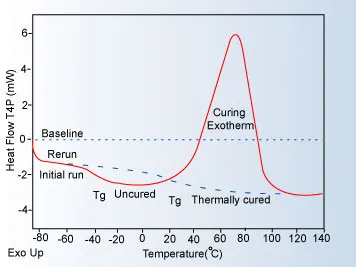
Figure 1: DSC of an Epoxy Adhesive1
Most polymers have a characteristic glass transition temperature (Tg) which in simple terms, is the temperature at which the material begins to soften and then flow (if a thermoplastic). Near the glass transition temperature, the materials have enough thermal energy that the molecules will start to easily slip by one another. In general, the greater the extent of cure, the higher the Tg.
The amount of heat generated during cure is also often used to determine the extent and, more often, the consistency of cure. The crosslinking polymerization reaction generally results in a heat flow due to the chemical bond formation in the curing process. Higher heat flow is indicative of greater reactivity. Lower exothermic temperatures than usual can be a sign of inhibition, improper mix ratios, or some other factor.
Acoustical analysis
Cure of adhesives can also be characterized by various acoustical methods. Pulse-echo modes show changes in acoustic parameters during cure. It has been claimed that changes in the curing agent/resin mix ratio and adhesive's microstructure can be measured using these techniques.
A project was conducted at the Imperial College (London) investigating novel acoustic instrumentation for cure monitoring during adhesive bonding in the automotive assembly processes. The project addresses three ultrasonic techniques for the assessment of cure in a process environment.
- The use of wire-guided waves to track the cure of the adhesive when placed in situ in a structure undergoing high-temperature cure.
- The use of ultrasonic compression waves in pulse transmission mode to assess the cure state in a cooled structure after the cure cycle.
- The use of ultrasonic compression waves in single transducer pulse-echo mode to assess the cure state in a cooled structure after the cure cycle but where access for two transducers is not possible due to test geometry.
Dielectrometry
Dielectric cure monitoring involves measuring the changes in viscosity and cure state of a thermosetting resin system through changes in the dielectric properties of the material. Fundamentally all dielectric measurements are made by measuring the voltage and current between a pair of electrodes. This is done to determine the conductance and capacitance between those electrodes.
- Conductance is a measure of the dissipation of energy of the material (dissipation factor).
- Capacitance is a measure of the storage of energy of the material (dielectric constant).
Almost all materials contain ions, which are electrons, charge atoms or charged molecular complexes. The application of a voltage between a pair of electrodes will create an electric field. This forces the ions to move from one electrode to the other (Figure 2).

Figure 2: Dipolar and Ionic Behavior of an Uncrosslinked Adhesive in an Electric Field2
The mobility of these ions is a direct result of the viscosity of the system and the extent to which a reaction occurs to tie up the ions. This mobility can be measured by the conductivity of the system. Increasing polymerization affects ionic motion, so dielectric measurements retain sensitivity past the time when ion and physical viscosity deviate. Thus, dielectric measurements are useful through the entire cure cycle, whereas, most other direct cure measurements are effective mostly at the earlier stages.
As the adhesive cures, its measured dielectric constant and dissipation factor change. Generally, the dielectric constant gradually decreases until the adhesive finally cures. At this point, the dielectric constant remains constant with cure time.
The dissipation factor generally goes through an early peak during cure. This represents the process of the liquid adhesive, becoming lower in viscosity due to cure temperature or exotherm effects. The viscosity later increases until gelation. The dissipation factor then gradually decreases until full cure is achieved as ionic and polar groups become restricted through crosslinking.
Figure 3 illustrates the typical response of capacitance and dissipation factor in an epoxy adhesive as a function of the cure cycle. Notice that the increase in capacitance is related to the viscosity of the adhesive. As the viscosity reduces because of the cure temperature, the capacitance increases. Then as crosslinking occurs the capacitance decreases. Full cure is generally indicated where both capacitance and dissipation factors level out.
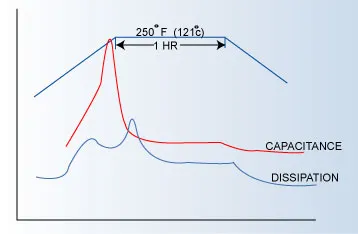
Figure 3: Dielectric Response for an Epoxy Adhesive Film3
Dielectric test methods are generally used to measure the cure of epoxy adhesives between two conducting electrodes. This method is especially appropriate for measuring the strength development of metal-to-metal joints because the substrates themselves can be used as the electrode. The adhesive is treated as a capacitor during the test. Its response over a range of electrical frequencies is measured as a function of curing time. By using substrate/electrodes, measurements can be made in actual processing environments such as presses, autoclaves, and ovens.
Dielectric monitoring has been used to determine the optimum time at which pressure can be applied on adhesives and composites that are very pressure-dependent during cure. This is especially important for films and prepregs that have a high degree of retained solvent. Optimum pressure should not be applied until the solvent has had a chance to escape the adhesive when it is in the liquid state. Pressure is then applied when the solvent has escaped and the viscosity of the adhesive is high enough to prevent squeeze out from the joint.
Dielectric analysis has taken its place next to the other thermal analytical methods. Dielectric cure monitoring systems are commercially available (Netzsch Instruments, Inc.) Dielectric sensors are available in a wide variety of configurations including implantable and reusable sensors. Measurement of the changes in dielectric properties under curing conditions is specified in ASTM E 2038 and E 2039. This provides valuable information about the polymer:
- Viscosity
- Cure rate, state, and time
- Degree of cure
- Glass transition and other polymer transitions
- Diffusion properties, aging, and decomposition effect
Conclusion
Cure monitoring is crucial for ensuring optimal bond strength, durability, and quality control in adhesives and sealants. Both indirect and direct methods offer valuable insights into the curing process.
Among these, dielectric analysis stands out as a versatile technique that provides real-time monitoring throughout the entire cure cycle. This makes it particularly useful for optimizing adhesive performance in diverse manufacturing environments.
- Cassel, B., "Enhanced DSC Instrumentation Design and Characterization of Adhesives", Adhesives and Sealants Industry, January 31, 2002.
- Netzsch Group, Netzsch-Geraetebau GmbH.
- Lawless, G.W., "Some Aspects of Dielectric and Phaseometric Monitoring of Commercial Adhesives", Adhesives for Industry, Technology Conferences, El Segundo, CA.