
Sealants for Building and Construction - An Ultimate Reference Guide
Last update on Jul 18, 2025
No sealant type is superior or inferior - it all comes to evaluating performance properties and developing the best suitable sealant to achieve desired results in the final application.
Sealants Used for Building Joints
The building and construction industry employs multiple materials, like metals, concrete, etc. as well as many prefabricated parts, such as:
- Sandwich panels
- Windows and doors (made of metals, wood, PVC, etc.)
- Partitions (often made of plasterboard)
- Prefabricated concrete slabs for floors and exterior walls, etc.
Sealants are employed to connect and join the various parts and materials to the main structure and to themselves. They help in closing the gaps between the elements and surfaces of the construction and thus, prevent fluids and other substances from passing through surfaces and mechanical joints.
Sealants serve the following basic functions in the building and construction industry:
- Filling the gap between two or more components
- Providing a protective impermeable barrier, through which substances cannot pass
- Maintaining their sealing properties through their expected lifetime, under the service conditions and environments for which they are specified
Also, another important requirement for sealing compounds is the high flexibility in order to tolerate movements between different materials used. These movements can happen due to:
- Expansion or shrinkage because of thermal variations,
- Dimensional variations due to variations of moisture content,
- Deflections under loads,
- Wind pressure, etc.
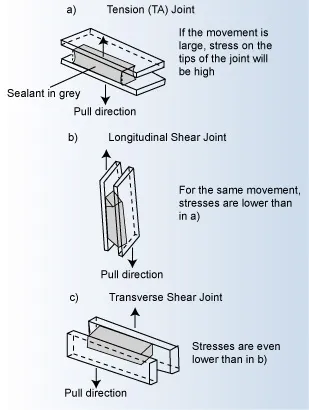
Various Types of Movements of the Joints and Sealants
These movements usually occur due to the different thermal coefficients of expansion of materials as shown in the table below.
| Material | Coefficient of Linear Expansion (m/m-°C x 10-6) |
| Clay, masonry (Brick, clay or shale) | |
| Brick, fire clay | 5 to 6 |
| Tile, clay or shale | 6.0 |
| Tile, fire clay Material | 4.5 |
| Concrete | |
| Gravel aggregate | 10.0 |
| Lightweight structural | 8.1 |
| Concrete, masonry | |
| Cinder aggregate | 5.6 |
| Dense aggregate | 9.4 |
| Expanded-shale aggregate | 7.7 |
| Expanded-slag aggregate | 8.3 |
| Volcanic pumice & aggregate | 7.4 |
| Cellular concrete | 11.0 |
| Metals | |
| Aluminum | 23.8 |
| Brass, red 230 | 18.6 |
| Copper | 16.5 |
| Iron | |
| Cast gray | 10.6 |
| Wrought | 13.3 |
| Lead, common | 29.3 |
| Monel | 14.0 |
| Stainless steel | |
| Type 302, 304 | 17.0 |
| Structural steel | 11.5 |
| Zinc | 36.0 |
| Glass, plate | 8.0 |
| Plaster | |
| Gypsum aggregate | 13.7 |
| Plasterboard | 12.0 |
| Plastics, composites | |
| Acrylics | 80.0 |
| Lexan® (Polycarbonate) | 67.0 |
| Flexiglas® | 70.0 |
| Polyesters, glass reinforced | 18-25 |
| PVC | 59.0 |
| Natural stones | |
| Granite | 8.0 |
| Limestone | 6.5 |
| Marble | 13.0 |
| Basalt | 9.0 |
Coefficients of Linear Expansion of Common Building Materials
Therefore, to achieve the desired performance & functions, it is necessary to match the most suitable sealant to the substrate materials that will be joined, i.e. one that will have adequate bonding properties and be flexible enough to tolerate anticipated movement, and so on.
Types of Construction Sealants
Generally, sealants are classified according to:
- Their chemical types, such as polyurethanes, polysulfides, silicones, acrylics, etc.
- Their elasticity, such as the caulks (which cannot withstand deformation), the plastomeric sealants and the elastomeric sealants,
- Their form, such as those supplied in cartridges which are extruded on-site, the preformed sealants (supplied as dry tapes, ribbons, or extruded shapes), or the hot-melt sealants.
Let study each class separately.
- Traditional Caulks or Putties
- Sealants Based on Synthetic Polymers and Rubbers
- Acrylic Sealants
- Elastomeric Sealants
- Impregnated Foam Sealants
- Back-up Materials
Traditional Caulks or Putties
Earlier (before 1950s), joints between different materials, such as between glass, metals, wood, concrete, etc. were filled with some traditional caulks, based on:
- Oleoresins, such as linseed oil, or
- Bitumen and tar in civil engineering work.
These formulations could only withstand a few percent elongation at break, and moreover they had a bad resistance to weathering.
| Material | Properties |
| Linseed oil putties |
|
| lmproved oleoresinous putties or caulks |
|
Bitumen based formulations - ln civil engineering applications, the gaps between parts or works may be quite high, so high performances polymers would be too expensive to fill large volumes. Also, civil engineering people were accustomed to use bitumen and tar.
Therefore, many applications still use bitumen or tar sealants, but the formulations have been often improved, starting in the seventies, by adding rubbers, styrenic polymers such as SBS, or polyurethanes, in small amounts. The pure bitumen or tar compounds may only withstand a few percent elongation at break, and the best-modified formulation may go up to 10 -15% and the movement capabilities in service are only 20 - 25% of the elongation at break to be safe.
The fast development of prefabricated parts in the construction and development of new synthetic polymers resulted in the disappearance of these caulks from the market in the years 1950 to 1975.
Sealants Based on Synthetic Polymers and Rubbers
Synthetic polymers allow to manufacture high performances sealants with very high elasticity and long durability and could be "tailor-made" to any specific requirement through adequate formulation. Some of the polymer classes are discussed in the table below.
| Material | Properties |
| Polybutene |
|
| Polyisobutylene (PIB) |
|
| Butyl rubber |
|
| Butyl and polyisobutylene hot melt sealants |
|
Acrylic Sealants
There are 2 types of acrylic sealants:
- Emulsion-based
- Solvent-based
Acrylic Emulsion Sealants
They display good adhesion to the absorbing materials such as wood, concrete, plaster, and they also have fairly good adhesion to metals and glass, although not as good as silicones on glass.
They are only plastomeric, with a maximum movement capability in service of 10 to 15%.
Dry solids vary from 80 to 85% so that they show 10 to 20% shrinkage during drying through the evaporation of the water that they contain.
They have fair to good weather resistance because they are sensitive to water. One can expect 15 years of durability for outside use.
They have very good resistance to UV and discoloration, and may be formulated in a large variety of colors in order to match the colors or the materials (brown like wood, white for plastic windows or tiles, grey like concrete or aluminum like the windows).
Solvent-based Acrylic Sealants
Acrylic solvent-based sealants have outstanding adhesion to many materials, such as concrete, aluminum, steel, wood etc. They have excellent weather resistance, resist to UV and staining.
Acrylic solvent-based sealants are only plastomeric, their movement capability is only 10% for long-range service outdoor. They are generally used for joints, such as:
- Curtain walls joints, exterior sidings,
- Masonry prefabricated panels,
- Metal to concrete joints such as joints between metal windows and concrete,
- Wood to concrete joints (between wood windows and concrete).
In these sealants, the base polymer is usually an 80% solids acrylic dissolution which accounts for 50% of the total weight of the formula. There is also some 50% of fillers (mainly calcium carbonate, plus some pyrogenated silica, magnesium silicate and/or talc or clay), a small amount of plasticizer may be added such as DOP, DBP, pine oil may be added as a filler dispersant, and some solvent is added in order to adjust viscosity.
The maximum solids content is usually 85% so that there is some shrinking during drying, therefore it is necessary to start with an elastomeric acrylic polymer and to add some plasticizer so that the shrinkage will not bring too much stress at the interface between the sealant and the materials to be jointed.

Common Additives Used in Acrylic Sealants
- Fillers reinforce and increase the volume of the sealant and lower the cost. Common fillers used are calcium carbonate, clays, barium sulfate and fumed silica. Fumed silica, a thixotropic filler, reduces the sag and improves gunnability.
- Plasticizers, such as phthalates, dibenzoates, propylene glycol alkyl phenyl ether, etc. increase flexibility and elongation, and reduce the glass transition temperature which improves low-temperature flexibility.
- Dispersing aids improve the incorporation of fillers and improve also the viscosity and package stability (if there are no dispersing aids, the fillers will slowly absorb the polymer at its surface and consequently the viscosity will increase during the shelf life). Low molecular weight polycarboxylic acid salts may be used as dispersing agents.
- Silanes may be used also to improve the adhesion to impervious substrates such as metals and glass. The acrylic sealants which contain small proportions of silanes are often called siliconized acrylics.
» Get Inspired to Formulate Acrylic Sealants using Starting Point Formulations
Elastomeric Sealants
The 4 chemical types of sealants which display elastomeric properties are the following:

high capabilities of movement, service elongation from 15 to 40%.
Polysulfide Sealants
These sealants have been developed in the sixties in the USA by THIOKOL Corporation, and they were the first elastomeric sealants. They are based on polymers with -SH end groups with an average molecular weight of 4000.
One such example is THIOKOL LP® 32 which has the following formula:
Properties of Polysulfide Sealants
Curing - Curing proceeds by converting the -SH termination into disulfide bonds. This is achieved by oxidizing agents like peroxides, PbO2 and MnO2. It is accelerated by an alkaline environment.
One component polysulfide has limited package stability. A dry to the touch skin will form after 30 minutes to 1 hour at 20°C and 50 to 60% RH, and then the cure will progress into the depth of the sealant at a speed which depends on the thickness of the joint, the temperature and the humidity of ambient air. The cure of polysulfide is slow: it takes one week to reach 50% of ultimate strength. Shrinkage after cure is negligible.
Hardness – Depending on the formulation, hardness may vary from Shore A 20, equal to soft rubber, for vertical joints such as curtain walls, to 50, (hard rubber hardness) with heavily filled formulations, for floor and concrete joints or aircraft runways, where the joints must resist penetration and traffic.
Solvent, fuel and oil resistance – They have excellent resistance, this is the reason why polysulfides have been used widely and are still used for airport runways joints.
Water resistance and weathering - Polysulfide sealants have excellent resistance to water, oxidation, sunlight and weathering. They maintain excellent adhesion after UV and water exposure. A durability of 20 years outside in normal conditions may be expected. Polysulfides are waterproof to water vapor so that they are used for double insulated windows for the exterior seal.
Modulus, Ultimate elongation, Service elongation - Most Polysulfide have high modulus and fairly high elongation at break (100 to 200%). Because modulus is high, these sealants will develop high stresses when elongated, so the recommendation is to use polysulfide only at 15 to 25% service elongation. They have poor puncture resistance.
Creep and stress relaxation - Creep test is a recording of elongation versus time at a constant load. Figure 1 shows a typical creep curve for polysulfide sealants. We can see that the behavior of polysulfides is partly elastic and partly viscous or plastic, and after unloading there is an irreversible deformation resulting from the plastic creep. Elastic recovery is only 60 to 80%.
Application of Polysulfide Sealants: Because they are not 100% elastic and their prices are fairly high, polysulfide sealants are less and less used, and have been replaced by silicones and polyurethanes. However, some jobs still use it:
- In Construction: floor joints between concrete and/or metal elements, expansion joints, curtain walls joints, joints between prefabricated panels (concrete panels…), double insulated windows.
- In Civil engineering: joints between concrete slabs in airport runways, joints in concrete bridges.
» Explore All Polysulfide Polymers Suitable for Sealants!
Silicone Sealants
Silicone sealants are based on polydiorgano siloxanes polymers, which have the following general formula:
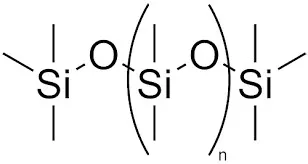
For example, PDMS:
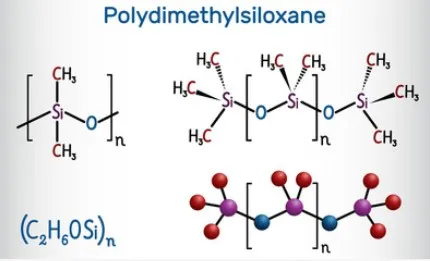
Two main types of silicone sealant are following:
One component silicone sealant is formulated by mixing and reacting in anhydrous conditions the silanol-functional polysiloxane with an excess of hydrolyzable trifunctional silane RSiX3 as shown here under

When the sealant is extruded, the atmospheric moisture reacts with the hydrolyzable groups, and the silanol condenses. This reaction continues until a 3-dimensional network is formed. The by-products which result from the cure may be acetic acid (which gives a typical smell), oximes, amides, alcohols.
Two components silicones are used only for architectural glazing because this glazing is made in the factory to obtain preglazed windows and panels.

These sealants are 2 components products with neutral cure, which have:
- Very good adhesion to glass and metals,
- Tensile strength up to 1 MPa,
- Excellent tear resistance,
- Moderate elongation at break (100 to 160%),
- Shore A hardness ranging from 35 to 45,
- Excellent resistance to ozone, UV, aging, heat (service temperature from -40° to +150°C).
The sealing operation can only be made in the factory prior to installation on-site, in order to guarantee excellent bonds for maximum safety.
because users do not want to mix 2 components on-site, and
there are different types of 1 component silicones

Silicone Sealants for Architectural Glazing
Silicone sealants are the most successful sealants since the seventies because they display a combination of many excellent and important features, such as:
- Excellent resistance to water, chemicals, weathering, aging, heat, temperature cycles (heat and cold), and consequently excellent durability up to 40 years.
- Modulus may be low or higher according to the formulations, elongation at break is very high, up to 500%, so that the service elongation may reach 25 to 50% which are the best values achievable for all sealants.
- Price is now very moderate because they are produced in very large quantities.
Polyurethane Sealants
There are 2 types of polyurethane sealants:
- The single-component sealants which are terminated by isocyanate groups -NCO and react with the ambient humidity,
- The 2 components sealants where part A is a polymer with -NCO terminal groups and Part B a polymer with hydroxyl -OH terminal groups, these 2 groups reacting together in several well-known modes and reactions.
By varying polymer composition, NCO/OH ratio, catalyst, a wide range of products and properties may be obtained.
General Properties of Polyurethane Sealants
All PU sealants have:
- Good elongation at break: 250 to 600%,
- Low to high modulus: 0.25 to 1 MPa
- Excellent elastic recovery higher than 90%
- Excellent abrasion resistance and tear strength, their resistance to indentation makes them the best sealants for floor joints,
- Service elongation range from 12 to 25% according to formulations
- Excellent adhesion to a wide variety of substrates: concrete, metals (preferably with a primer), wood, PVC
- Fair resistance to water (some formulation may be sensitive to hydrolysis), excellent aging resistance, a 20 years durability can be achieved or expected
The only drawbacks include:
- Slow cure (skin over time 5 to 20 minutes at 20°C and 50% RH, complete cure after 2 to 7 days at a speed of 2 mm/day)
- Resistance to UV is only fair
- Moderate resistance to chemicals, oils, solvents, acids and alkalis, and moderate resistance to hydrolysis
Some Uses of Polyurethane Sealants in Construction
- Pourable sealant for floor joints
- One component sealant for curtain walls joints
- One component sealant for concrete prefabricated panels
- Other utilization for one component PU sealants are: installation of wood and metal windows into the masonry, sealing roofs, expansion joints in masonry.

» Related Read: A Comprehensive Guide to Polyurethane Resins (PU) for Adhesives & Sealants
MS Polymers Sealants
These are relatively new products. These are polyethers terminated with silyl groups. Most of these sealants are one component that is cured by reaction with ambient air humidity. They cure at a speed of 3 mm/day, faster than one component PU. Their key properties and applications are listed below.
| Properties | Applications |
|
|
Impregnated Foam Sealants
These are polyurethane polyester foam strips which are impregnated with various sealing tacky compounds (butyl, PIB...) in order to have a sealing tape which must be compressed between the parts to be sealed.
It is used for sealing of prefabricated concrete panels, curtain walls, installation of windows (wood, aluminum, or PVC), wood panels.
Back-up Materials
Back-up materials are usually foam strips round or rectangular sections which are inserted at the bottom of the joints, before application of the sealant. This has 2 purposes:
- To control the depth of the sealant in the joint
- To provide support for the sealant in horizontal joints
The sealant should not stick to the backup material and the solvents of the sealant should not affect the backup material.
Back-up materials are usually polyurethane or polyethylene foams, sometimes neoprene foams, and other materials.
Foams may be open cells or closed cells: the choice between these two depends on the type of sealant used and the job site conditions. Users will refer to the sealant supplier for advice.
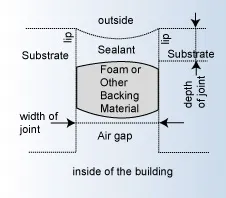
Various types of movements of the joints and sealants
Technical Characteristics of Sealants by Use
A sealant when it is delivered in the original packaging (cartridges or sometimes drums) is a paste. This paste is applied into the gap between 2 parts of the construction, then it must be leveled, then it will dry or cure at ambient temperature and it will become plastic or elastomeric joint having the required properties: gap-filling, elasticity, adhesion to the substrates, water resistance, etc.
We will study these properties in chronological order as they appear on-site during the installation.
Temperature and Humidity During Application
Construction sealants are applied on-site, at various temperature, according to the climate and the time of the year. Most sealants will not cure properly if the outside temperature is too cold (less than 5 to 10°C) and they will dry or set to fast if the temperature is too high (more than 40°C). Thus, the worker should respect the manufacturer's instructions for working conditions.
PUR sealants are the only ones that would accept some humidity on the surface of /or inside the substrate because PUR reacts with humidity. For other sealants, this humidity will be detrimental because it will prevent adhesion.
Viscosity, Non-sagging Properties or Slump Resistance
The wall sealants should be non-sagging because as they are applied on walls they should stay in place without any deformation or flow or sagging. European standard EN 27390 or ISO 7390 provides a test method for the resistance to vertical sagging, and stipulate that it should be less than 3 mm in this specific test.
Floor sealants must flow into the joints, but just enough to fill the joint, because anyway they will be forced into the joint by the worker with the proper tool.
On the other hand, the sealant must be easily extrudable from the hand cartridges, by using a handgun or sometimes an air-powered gun.
Sealants are heavy, thick pastes, and therefore their viscosity (usually in the range 80000 to 400 000 m.Pas) is not meaningful to the end-user.
Therefore, the sealants manufacturers use a test in order to measure the flow rate: ASTM C 603 standard measure this by extruding 200 grams of sealant through a 5 mm hole under 3 bars pressure, at various temperatures.
Mode and Time of Setting/Curing
Most of the modern sealants used in construction are now one component sealants that will set and cure by a chemical reaction with humidity in the air. This is the case of silicone, PUR and MS polymers sealants. This reaction progresses at a speed of 1 mm inside the mass of the sealant in a few hours, and it will thus take 1 to several days to get a full cure in the whole thickness of the joint. These sealants are of the elastomer (rubber-like) type.
Some sealants are plastic polymers which set by drying only, such as acrylic water-based sealants, or the older oleoresinous, or rubber/solvent-based sealants. Here the drying comes from the evaporation of the water or the solvent, so that the surface of the sealant will be dry to the touch after 30 to 60 minutes, and then the drying will progress slowly into the depth of the joint.
In construction, 2 components sealants may be used, but very seldom, (PUR or silicones or thiokols) because they are not convenient to use on-site. They cure faster than the one-component sealants. They have a limited "pot life", which is the maximum time the worker can wait between mixing and application.
The past oleoresins or bitumen sealants had 100% solids and they would remain plastic until they would become oxidized by aging in the air and become harder. Then they would eventually crack.
Preformed putty sealants are plastic polymeric dry products, based on butyl or oleoresins, 100% solids, shaped by the manufacturers as ribbons, cords or ropes, from 5 to 15 mm diameters. They do not cure or dry, they always remain plastic, and have only a fair resistance to aging due to their formulation.
The last type is the preformed rubber gaskets which are pressed also between the parts to be sealed: this is often used to install window glass panels into windows frames. We will not study these gaskets here, because these are not sealants.
Cross Section and Width of the Sealant
Some sealants are elastomeric and will accept wide variations of the joint width, some are only plastic and do not withstand wide movements.
Therefore, in order to accommodate movements of the joint, it is advisable to have wide joints.
Depth of the Sealant
The depth of the sealant should be always less than its width in order to minimize the stresses resulting from the deformation of the surface of the sealant.
The following rules are used:
- Minimum dimensions are 5 x 5 mm,
- For width from 5 to 12 mm, the depth should be slightly less than width,
- For width from 12 to 25 mm, the depth should be 8 to 12 mm,
- For width higher than 25 mm, the depth should be 12 to 18 mm according to the chemical type of joint and should be preferably half of the width.
The depth of joints is adjusted using a backup material, which is usually a foam strip inserted and compressed between the two lips of the joint.
Consumption
It depends on the cross-section of the joint and the specific gravity
"Dry to the Touch" Time
We have explained above that after application the sealant will dry or cure on the surface after a certain time and it will become dry to the touch: this may take from 20 min to 1 or 2 hours depending on the type of sealant, mode of curing, temperature and humidity.
ASTM C 2377 - 84 provides a test for measuring tack-free time of sealants and caulking compounds.
Shrinking
When the sealants are cured by chemical reactions and have 100% solids, they do not show any shrinkage on curing.
But other sealants which dry by evaporation of water or solvents and have much less than 100% solids will show some shrinking during drying because the departure of volatile compounds will cause a reduction of the volume.
The ASTM standard C 733 may be used for measuring shrinkage.
Physical and Mechanical Characteristics of Sealants
Adhesion to the Substrates
The adhesion of the sealants to various substrates depends on the sealant type and substrates.
- PUR sealants have very good adhesion to many different materials: metals, concrete, cement, wood, glass, plastics such as PVC.
- With silicones, primers may be necessary to get good adhesion to some metals and plastics, adhesion to glass is always excellent. Silanes primers are used.
Sealants manufacturers should indicate clearly in their technical data sheets the adhesion of their sealants on the various materials used in construction and civil engineering, with and without primers.

Refer to the chemical types section to get detailed information on the adhesion of various types of sealants on various substrates.
Test Methods to Measure Adhesion
When the sealant is stressed during the increase of the width of the joint, if the sealant has a high modulus, the bonds to the lips of the joint are submitted to high tensile stresses, and this may break the bond. Therefore, standard test methods have been developed to measure the adhesion on substrates under tensile stress. Let us mention for instance the European standards:
- ISO 9046 or EN 29046: measurement of adhesion and cohesion at a constant temperature,
- ISO 9047 and EN 85 519: measurement of adhesion and cohesion at variable temperature.
This tensile test must also be performed after water immersion and artificial weathering (for instance with an equipment called weather-o-meter in which several cycles are realized: water spray at different temperatures, UV light, drying and again water spray…).
Let us mention here again some ISO and US standards:
- ISO 10591, Determination of tensile properties after water immersion,
- ISO 10590, Determination of tensile properties at maintained extension after immersion in water,
- ASTM C 1135 Determination of tensile adhesion properties of structural sealants.
The tensile test may be realized until the bond failure (ISO standard 28339), and it is agreed that the sealant should only be stressed up to 25% of this stress at failure, but we will see that ISO standard 11600 has set specific requirements and classification of the sealants, according to maximum service elongation.
Modulus of Elasticity or Tensile Modulus
Figure below shows typical curves of stress versus deformation.
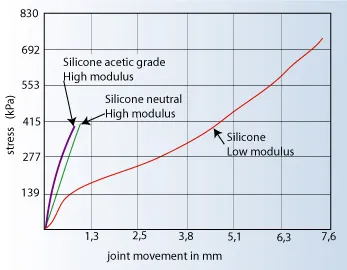
Curves stress/strain for different chemical types of chemical sealants
(test specimen steel or Aluminum 25 x 9.5 mm joint thickness 1.4 mm tested in shear)
Usually the elasticity modulus is defined as the stress measured at 50 or 100% elongation. Modulus is measured by ISO standard 8339: Determination of tensile properties. Modulus gives a very useful indication of the stresses which act on the lips of the joint when it is elongated.
To reduce these stresses, it is recommended to use low modulus sealants, such as the low modulus silicone shown in the figure.
In the ISO standard, DIS 11600 elastomeric sealants are classified according to their secant tensile modulus, besides other specifications, as we will discuss hereunder.
| Classes | Test Method | ||||||||
| Properties | 25LM | 25HM | 20LM | 20HM | 12.5E | 12.5P | 7.5 | ||
| Elastic recovery, % | ≥70 | ≥70 | ≥60 | ≥60 | ≥40 | - | - | ISO 7389 | |
| Tensile properties | |||||||||
| Secant Tensile Modulus | at 23°C, MPa | ≤0.4 | >0.4 | ≤0.4 | >0.4 | - | - | - | ISO 8339 |
| at 20°C, MPa | ≤0.6 | >0.6 | ≤0.6 | >0.6 | - | - | - | ||
| at an extension of, % | 200 | 200 | 160 | 160 | - | - | - | ||
| Elongation at break, % | - | - | - | - | - | ≥200 | ≥120 | ISO 8339 | |
| Adhesion/cohesion properties | at variable temperature | nf | nf | nf | nf | nf | - | - | ISO 90547 |
| at constant temperature | - | - | - | - | - | nf | nf | ISO 90546 | |
| Tensile properties at maintained extension | nf | nf | nf | nf | nf | - | - | ISO 8340 | |
| Tensile properties at maintained extension after water immersion | nf | nf | nf | nf | nf | - | - | ISO 10590 | |
| Tensile properties after water immersion Elongation at break, % | - | - | - | - | - | ≥100 | ≥20 | ISO 10591 | |
| Loss of volume, % | ≤10 | ≤10 | ≤10 | ≤10 | ≤25 | ≤25 | ≤25 | ISO 10563 | |
ISO/DIS 11600 Requirements for Construction Sealants
*Maximum 25 % change of volume (upon cure) for water-based latex sealants
For detailed specification of test conditions see ISO/DIS 11600
Failure mode: nf: no failure (all three specimens pass the test) A specimen has failed the test if the sum of the adhesive and cohesive failures exceed 5% of the sealant/substrate interfacial area (600 mm2). There is an ongoing discussion in ISO TC 59/SC8 on how to define failure criteria. It is likely that for the cyclic movement tests (ISO 9046 and ISO 9047), the 5% value will serve as a limit for the failure after the first movement cycle. Specimens that have passed the first movement cycle are considered to have failed the test, if the sum of additional adhesive or cohesive failures in subsequent movement cycles exceeds 100%.
Elastic Recovery and Plastic Flow
When the stresses which caused elongation are withdrawn, the sealant may come back to its initial width (full recovery) or may display only partial recovery. This is called elastic recovery and it is measured with the ISO 7389 and NF EN 27389 (July 1991): Sealants, determining elastic recovery.
ISO 7389 and ASTM C 736-82 test standards can be used for determining elastic recovery and measuring extension recovery and adhesion of latex sealing compounds after artificial weathering.
Good elastomeric sealants like silicones and PUR return almost completely to their original dimension. On the other hand, the plastic sealants (such as butyl, acrylic…) do not return to this original dimension at it is shown in the figure and they show some plastic flow and residual deformation.

Typical plastic flow curve
ISO standard 11600 considers that sealants are elastomeric if their elastic recovery, according to standard ISO 7389 is higher than 60%. Usually, to measure the relaxation of stresses, the sealant is elongated by 25 or 50%, then the test specimen is maintained at this elongation and the stresses are measured against time, which gives the curve as shown in the figure below.

Stress relaxation typical curve for a sealant
Elongation at Break
The elastomeric sealants such as silicones may withstand very high elongation at break up to 400 to 500%. Thus, the elongation at break is used, in ISO 11600, only to differentiate the various plastic sealants. Elongation at break is measured according to ISO 8339.
Maximum Service Elongation
This is the service elongation that a given sealant may withstand for a long-term exposure outside, by taking into account a safety factor for the weathering/aging effects. The European and ISO standard 11600 have defined up to 7 classes of construction sealants, according to the maximum service elongation, and also according to 9 other properties, those which we studied above.
Resistance to Compression
This test evaluates the behavior of the sealant under compression: it should not flow out of the joint during compression. The curve "deformation against compression stress" is plotted.
ISO 11432 is used to measure the compression properties.
Hardness and Resistance to Indentation and Tearing
This is important for the floor sealants which should withstand traffic. ASTM C 661 is used to measure hardness with a durometer according to Shore A or D hardness.
Resistance to Heat, Cold and Temperatures Cycles
The exterior sealants must withstand variations of temperature, according to the climates and countries where they are installed. Heat, rain and sunlight may degrade the sealants through oxidation, exudation of low molecular weight content, extraction of additives such as plasticizers, etc. in these cases the sealant will harden, degrade and eventually crack.
Several standards have been designed to measures the effects of these agents:
- French standard NF P 85-512 measure the diffusion of some constituents of the sealant,
- ASTM C 793-80 Test for effects of accelerated weathering of elastomeric joint sealants,
- ISO 10563: Determination of change of weight and volume,
- ASTM C 765-84, test for low-temperature flexibility of preformed sealing tapes, etc.
Durability
Resistance to water - Of course, all the modern polymers which are used for sealants have good resistance to water for outside exposure to rain. But water may penetrate between the sealant and the substrate and if this substrate is cement the alkaline conditions plus water may degrade the adhesion of the sealant. The user should ask the sealant manufacturer about its resistance in such conditions, which primers should be used.
We have indicated above the standards which are used for measuring adhesion/cohesion after water immersion. ASTM C 1247 may be used to measure the durability of sealants exposed to continuous immersion in liquids.
Resistance to weathering - ASTM C 793-80 provides a test for measuring the effects of accelerated weathering on elastomeric sealants.
Resistance to sunlight, UV - The old sealants and putties such as oleoresins and the butyl sealants have poor resistance to sunlight, UV and outside aging. They oxidize in the air, become brittle and eventually crack.
Modern sealants (PUR, silicone, thiokol) all have a long-term resistance to outside exposure.
ISO standard 11431 and ASTM C 718-83 provide test methods to measure adhesion and cohesion after exposure to light, through the glass. ASTM standard C 718 also allows to measure the UV resistance of the sealants
Mold growth resistance - Sealants must have protection against mold growth included in the formulation.
Resistance to hot-cold cycles - These alternated cycles can damage the sealant after a number of cycles. Refer to the same standards which have been mentioned above. To summarize let us say that durability during outside exposure may be estimated approximately by combining some of the above tests. The best sealants may last up to 40 years on outside exposure, or even more but we have not yet such a longer experience.
Design of the Joints Key Considerations
Whatever be the movements, the sealant must withstand it without failure, and therefore it must be elastic as we have seen in properties above. Therefore, the design of the joints and the selection of sealant type in order to meet these movements requirements is very important.
Usually, the architect, the designer or the contractor prescribe 2 or 3 starting and basic requirements:
- The dimensions and shapes of the building and its components: frame, panels, prefabricated panels, floors, partitions, doors, windows, etc.
- The types of materials to be used: poured in place or prefabricated concrete, masonry or metal or wood structures, concrete or metal floors, metal, PVC or wood windows and doors, bricks or plasterboard partitions, etc.
- The shapes of the joints which may be square or rectangular sections, or a different section in order to adapt it to the shapes of the construction components and the contact surfaces.
Starting from these requirements, the joints contractor must:
- Compute the maximum expected joint movements,
- Select the type of sealant which will be able to withstand such movements,
- Design and compute the joint dimensions so that the sealant will not be overly stressed and strained.
on the expected movements and also on the elasticity of the selected sealant.
Depth of Joints
The maximum stresses are located at the junction between the substrates and the sealant, and at these junctions, stresses may be 2 to 4 times higher than deeper into the sealant. Also, it is very important to note that a thin sealant strip will give much lower stresses than a thick sealant.
Therefore, there is a rule which states that the thickness or depth of the sealant should not exceed 50 to 70% of its width.
The general rules regarding the depth of joints are following:
- Minimum dimensions of joints are 5 x 5 mm,
- For joint width from 5 to 12 mm, the depth should always be less than width,
- For width from 12 to 25 mm, the depth should be around 12 mm,
- For a width higher than 25 mm, the depth should be preferably less than half of the width.
A back up material (e.g. foam) is used in order to control the joint depth.
The sealant should stick only on the 2 substrates and not on the bottom of the joint so that it will change freely its shape. If it would stick on three sides, this would increase the stress and it would tear. Therefore, a release tape should be installed prior to extruding the sealant, as indicated in the figure.

The sealant should stick only to the 2 sides of the joint:
a) No back-up tape: When the joint enlarges, the sealant will tear off
b) With a release back-up tape: The sealant strip may change freely in shape; less stress and no risk of tearing.
It is also important to note that there are many rules according to the kinds of jobs, the countries and the techniques which one should also consider while designing joints.

Adhesives for Construction - Know More

Key Applications
Sealants serve by filling the gap between two or more components, provide a protective impermeable barrier through which substances cannot pass and maintain the sealing properties in the building and construction industry. Thus, this industry involves numerous applications for sealing compounds which are discussed below.
As mentioned in detail above, sealants are commonly used to fill cracks and openings and seal joints as well as provide a barrier to air, water, moisture, gas, noise, dust and smoke. The building and construction industry, thus, involves numerous applications for sealing compound. The key application areas are discussed below.
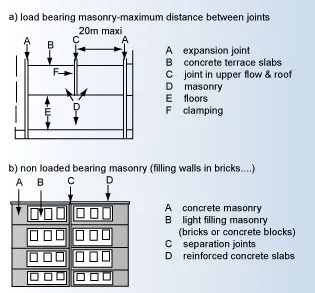
Joints in Traditional Masonry
Sealants for Masonry
Masonry may be made with concrete, bricks, concrete blocks, sometimes cellular concrete, according to the construction techniques in favor of each country. Although these materials do not have high coefficients of expansion, the movements of the joints may become high when the parts of the construction (panels, complete walls, high rise structures…) are large.
There are several types of joints in masonry:
- Expansion and shrinkage joints
- Separation joints
- Floor joints in slabs and screeds
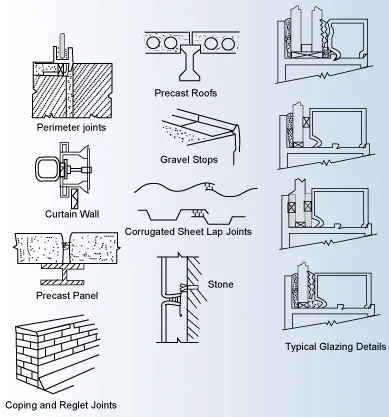
Some Typical Uses of Sealants
When a concrete wall or floor has very large dimensions, cracks would appear resulting from shrinking of the concrete after complete drying and expansion resulting from water intake would be also a problem. Thus, it must be split into smaller sections, separated by voids or joints so that the concrete may change in dimensions without adverse effects. These joints must be filled with a suitable sealant.
Sealants for Precast Concrete Panels and Slabs
Prefabricated or precast concrete elements (panels, floor slabs) are installed with void joints between the elements.
These precast concrete elements are not very large: only a few meters width and height, consequently their movements are limited and require only plastic sealants such as butyl, PIB, acrylics.
However, if the building is very large, expansion and shrinkage of each element must be added together so that the total movement may become large, and in this case it will be necessary to use elastomeric sealants such as polyurethanes or MS polymers, which have a very good adhesion to concrete.

Sealants for Precast Concrete Panels and Slabs
Sealants for Joints Related to Curtain Walls
Here, there are many different types of joints:
- Vertical and horizontal joints between sandwich panels or decorative siding panels and the structure, between 2 panels, between sandwich panels and windows. In these cases, the materials are frequently quite different as far as thermal linear expansions are concerned: for instance in joints between glass panels and metal panels.
- Joints between curtain wall and floors (these latter may be of concrete or steel in high rise buildings)
- Joints between metal wall sidings and the structure (which may be steel or concrete)
These joints involve large movements therefore only high performance elastomeric sealants may be used.
Roof Sealants
Roofs, whether flat or inclined, are subjected to rain, snow which may stagnate on the flat roof terraces, therefore the waterproofing must be excellent, and the sealants must be selected according to the climate and the expected movements.

Roofs may be built with different components and materials (tiles, slates, shingles, metal panels, roofing waterproofing materials, gutters, sheds, velux windows, chimneys) that must be sealed together.
- Concrete roof slabs - The joints between roof concrete slabs must be sealed according to the masonry techniques. On top of these slabs there are roofing materials which are also sealed by different techniques:
- Roofing sheets and insulation panels may be bonded and sealed with bitumen or bitumen compositions reinforced by the addition of elastomers,
- Roofing membranes made of PVC, EPDM, hypalon are bonded carefully together with adequate adhesives (rubber-based adhesives, PUR) supplied by the roofing membranes suppliers,
- The whole surface of the terrace may be coated with a thick waterproofing coating, applied by spraying, usually polyurethane coatings.
- Waterproofing between emerging parts and roofs - Emerging parts such as chimneys, sheds, ventilation metal ducts, must be sealed with plastic or elastomeric sealants. Polyurethanes and MS polymers, which display excellent adhesion to many materials, are the best choice.
- Waterproofing and sealing of corrugated roof panels - Here 2 types of products may be used:
- Butyl or PIB preformed tapes, which must be compressed between the panel edges,
- Acrylic or butyl sealants: applied from cartridges in thick diameters (8 mm) the sealant bead is compressed during the installation between the 2 panels.
Sealants Used for Structural Glazing
In structural glazing, glass panels are attached strongly and durably to the metal structure of the facades of buildings. The wind load and the weight of the glass panels are transferred to the metal structure through the adhesive/sealant, which is always a silicone product. This is a very demanding application because the whole system depends on the adhesion and the internal cohesion of the adhesive/sealant, and there is a risk if the glass panel would fall from a high level.
For this reason, the bond between the glass panels and their metal frames is made in the factory in order to control carefully all parameters: cleaning of surfaces before bonding, application of the silicone product, quality controls and adhesion and durability tests.
Moreover, some mechanical fasteners are added in order to provide additional safety.
First, the designer must calculate all the stresses that will occur in the joints:
- Stresses due to the wind pressure and depression,
- Weight of the glass panels: their weight must be borne by some mechanical attachments (such as clips, shims or spacers) because the silicone adhesive/sealant is not supposed to bear this permanent load,
- Movements of the joints: the general movements of the structure must be absorbed by the metallic connections between the structure and the frames of the glass panels. The only admissible movements are those which result from the differential expansion and contraction of the glass and the metal frames. These movements will cause a shear of the adhesive/sealant.
Starting from the calculated maximum movement, the designer will select the type of sealant and its movement capability and then calculate the thickness of the structural joint (between glass and frame).
Window Glazing Sealants
This is the largest use of sealants if we include the sealing of double or triple insulated windows. The various sealing operations are to be performed for the complete installation of glass and windows.

As far as sealing is concerned, insulated glass units are double sealed (refer to figure above).
- The inner sealant is mainly polyisobutylene (PIB) or butyl sealant because these products have a very low permeability to water vapor or moisture vapor transmission (MVT): for instance, the permeability to water vapor of PIB sealants JS 780 and JS 680 from TREMCO. Is less than .02 g/m2/hour for a 2 mm thickness, measured according to the European standard EN 1279-4C.
- The other sealants are not acceptable in this respect, for instance, the MVT of polysulfides or polyurethanes ranges from 2 to 6 g/m2/day, and for silicones it ranges from 10 to 20 g/m2/day,
- The outer sealant is an elastomeric sealant which functions both as an adhesive bonding the 2 glass panels and a sealant against water, air and insects. This sealant may be based on polysulphide, polyurethanes, silicones or hot melts.

Insulated Double Glass Panel
Window frames are inserted into the main frame of the building and this requires a good sealing between the window frame, made of wood or metal or PVC, and the main frame which may be masonry (concrete, bricks or curtain walls, or sometimes, in Nordic countries and USA, wood frames).
Many different sealants may be used for that: elastomeric PUR, plastic acrylics sealants (water based or solvent based), butyl sealants and also PU foams. The differential movements are not so important because usually the windows dimensions are limited (1 to 3 meters, no more) and do not require elastomeric sealants.
The designer or the contractor should design the joint width according to the expected movements of both the main frame and the window or door frames.
Ceramic Tiles and Sanitary Ware Sealants
This is a simple and well-known application: joints between 2 tiles are usually made with cement-based grouts, but when it is necessary to seal the joint between 2 large tiled areas the sealant must be flexible enough in order to accommodate larger movements.
In bathrooms, showers, kitchens, swimming pools, etc. there is high humidity and water spilled over the floors and walls and it is mandatory to seal the tiled surface against penetration of the water into the walls and floors and then into the next rooms. This may be done by using a waterproof tile adhesive or a waterproofing coating or membrane, but anyway a waterproof joint between the tiles is also very useful.

Ceramic Tiles and Sanitaryware Sealants
Also the expansion coefficient of ceramic tiles being low, when there is a very large tiled surface (larger than 10 m2 for instance), this surface acts as a monolithic surface, and at the joint between 2 tiled sections there might be some movements, for instance, when the wall or partition is made of particle boards or plasterboard which have a larger expansion with humidity. Some cracks may then occur at the joint on drying and therefore the joints must be filled with an elastomeric sealant which will forbid water to penetrate these cracks and joints.
ln this case, silicone sealants are the best choice because they combine high water resistance, tolerance to large movements, long term durability, they may be formulated with many different colors that can match the tiles and sanitaryware colors, their colors do not change with time, and they are easy to apply even by nonprofessional users.
However, the silicone sealant should resist mold growth which may become fast due to the use of hot water in bathrooms. Some grades are formulated with anti-mold growth compounds for this use.
Sealants for Civil Engineering Works
In civil engineering, some parts of the construction may be quite large, for instance, segments of concrete bridges, dams, or even road or airports concrete slabs which may reach 10 meters in length.

Therefore, the expected movements may be also large and thus, civil engineering contractors use sealants which are different from those used in Building, because the width and section of joints here are higher. They prefer the following sealants types:
Rubber-modified Asphalt and Bitumen Sealants
- A rubber-modified asphalt sealants are cheap.
- These products are hot poured at temperatures from 150 to 200°C.
- These mastics start to creep at 40°C.
- 85% of all roads and airport runways are still jointed with rubber-modified asphalt.
- They must meet American specifications ASTM D 3405 and federal specs SS-S 1401 B.
Tar - PU Compounds
- These are PU sealants to which the manufacturer adds tar in order to lower its cost.
- These have good performances and relatively cheaper price which is quite acceptable.
- They have a good resistance to kerosene and to the hot air exhaust of jet aircraft so that they may be used for airports runways even at the start of the runway where the pilot tries the full blast of the motors.
PVC Plastisol - Tar
Hot poured at 150°C, more expensive than the rubber modified asphalt but higher performances (resist to kerosene but not to hot jet exhaust, withstand 10 to 15% elongation), they meet American specification SS-S 1614, and in the USA they have 5% of the civil engineering market and are used for airports runways, roads and buses terminals.
Silicones
One component silicones have only 5% of the market, they are used for airport runways and some bridges, when the customer require high performances such as low modulus, high elongation, long term durability. 2 component silicones are seldom used.
Note: In some cases, contractors may be wrong in using a cheap sealant because it will need a much larger joint and, because the cost of application is the same, high performance sealants may turn out to be quite competitive with the cheap ones or even cheaper for the total cost.
Elastomeric Rubber Profiles and Preformed Seals
- These are used when the joint width is very large: 2 to 10 cm, (for instance for large bridges, reservoir dams…) and when the 2 sides of the joint are perfectly parallel and flat.
- They are compressed between the 2 lips of the joint so that their width should be approximately double the average width of the joint.
- They are usually quite expensive for instance 10 euros per linear meter for a 5 cm width.
Epoxy Bonding and Sealing Products
These are not really sealants but rigid adhesives which bond and seal the concrete to concrete joints, such as for instance in the segmental bridges where concrete hollow segments are bonded and sealed together with epoxy adhesives, or epoxy resins used for repair of cracks by injection.
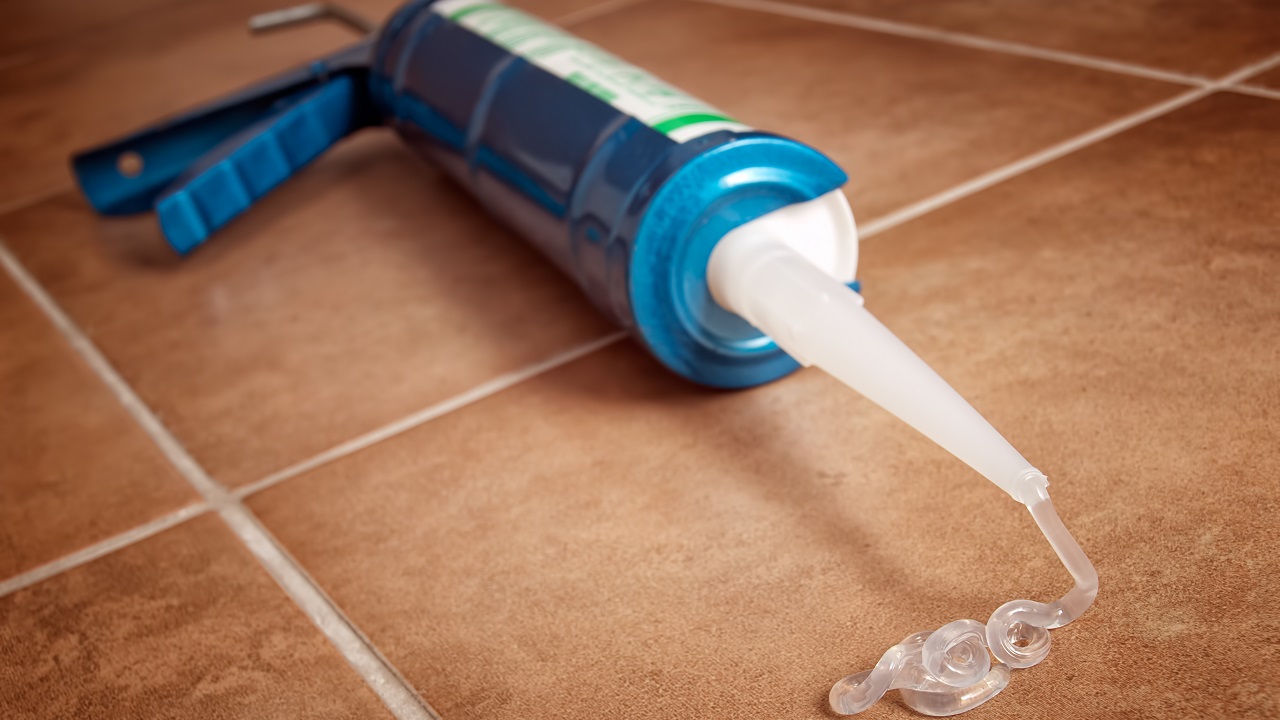
Silicone sealants and used to join ceramic tiles

PU sealants are used in sealing roofs

Sealants serve basic functions in the building and construction industry