

How to Formulate Water-resistant Emulsion Adhesives?
Last update on Dec 16, 2024
This article was originally published in 2007 and updated in 2024.
Waterborne adhesives are hailed as eco-friendly and safer alternatives to their solvent-based counterparts. They help reduce the emissions of volatile organic compounds (VOCs) and meet regulatory guidelines. Yet, achieving equivalent performance to solvent-based adhesives remains a challenge — particularly in terms of moisture resistance.
Moisture sensitivity is one of the greatest challenges in adhesives. For waterborne emulsion adhesives, exposure to high humidity can:
- compromise adhesion,
- reduce shear strength, and
- lead to whitening or delamination
Despite these hurdles, the drive to improve water-based formulations persists. With growing demand across industries — from medical tapes to outdoor applications — the focus is shifting towards innovative approaches that enhance moisture resistance while retaining the benefits of waterborne systems.
By understanding the underlying mechanisms of degradation, formulators are finding ways to improve the durability and applicability of water-based emulsion adhesives. One of the ways to mitigate the issue of sensitivity to moisture is to employ surfactants and stabilizers in the formulation. Thus, uncovering how this pursuit is shaping the future of solvent-free adhesive solutions.
Let's get more details.
Impact of Water on Emulsion Adhesives
It is well-recognized that high humidity is one of the most severe environments for any adhesive, especially when heat is added. Water may be considered to attack the bond:
- either at the interface of the adhesive and substrate,
- or within the bulk adhesive material to weaken its cohesive properties
Emulsion-based adhesive formulations are particularly susceptible to performance loss when exposed to moist service environments. UV-cured adhesives and hot-melt adhesives are better than water-based adhesives in this respect. However, still not equivalent to high-quality solvent-based systems.
Most base polymers and resinous additives used in the manufacture of water-based adhesives are considered water-insoluble. However, the water resistance of dried adhesive films is determined by the emulsifier systems used in the production of emulsions. The moisture sensitivity is directly related to the type of emulsifier system employed.
There are several ways that moisture can affect water-based adhesives, and these are described in Table 4. It is important to understand which type of effect will be most prevalent in a specific application. Manufacturing emulsions or formulating with surfactants requires careful selection and testing. Improvements in quality must be compared against any possible changes that could affect the water-based adhesive's relative position against its alternatives. Following are the different ways in which moisture can affect an emulsion-based adhesive.

Adhesion: Loss of adhesion and cohesion under humid conditions and under contact with water elevated temperatures will increase water sensitivity.

Whitening: An optical performance quality that is shown when the adhesive layer comes into contact with moisture.

Swelling: Water uptake could result in a loss of shear strength because the cohesive forces in the adhesive film are reduced.

Delamination: May occur if water enters the boundary between the adhesive and substrate. This is an adhesion failure mode.

Tack: Migration surfactant will reduce the tack properties of the dried adhesive film.
Generally, emulsion adhesives suffer from excessive whitening and peel adhesion loss upon exposure to high-humidity environments. Additionally, the adhesive failure mode becomes one of the transfer of the adhesive to the substrate. This situation is considered unacceptable for most applications1.
Ingredients Improving Water Resistance in Emulsion Adhesives
The emulsion adhesives are susceptible to several issues due to the presence of base polymers, water-soluble surfactants/emulsifiers, and other water-soluble additives. These are necessary during the emulsion polymerization process. They can serve to soften the adhesive and lead to dramatic performance losses in the areas of cohesive strength and adhesion to certain substrates. Let's understand the role of certain additives that help improve water resistance in emulsion adhesives.
Base polymers
The choice of base polymer influences the water resistance of emulsion polymers used in their synthesis. Different base polymers possess varying degrees of hydrophobicity and polarity. These directly affect their interaction with water molecules. Several factors of base polymers that affect the water resistance are explained below:
- Polarity: Hydrophobic polymers repel water due to their non-polar chemical structure, preventing water from penetrating the adhesive. This enhances water resistance. Examples include, acrylic emulsions, styrene butadiene emulsions, etc. Hydrophilic polymers attract and absorb water due to their polar functional groups. Thus, they can reduce water resistance. Examples include, acrylic acid, vinyl acetate, etc.
- Polymer composition: The ratio of hydrophobic to hydrophilic monomers in the polymer impacts water resistance. Higher proportions of hydrophobic monomers lead to better water resistance.
- Crosslinking: Crosslinked polymer chains can improve water resistance. This reduces the number of free chain ends that can interact with water molecules.
- Particle size and distribution: Smaller particle sizes and narrower particle size distributions can enhance water resistance.
- Emulsifier type and concentration: The type and concentration of emulsifier can influence the stability of the emulsion and thus, the water resistance of the resulting film12.
Surfactants/emulsifiers
Surfactants or emulsifiers are surface-active agents that can be added before the emulsion polymerization process or to already manufactured emulsions to further improve their properties. A mixture of anionic and non-ionic emulsifiers is generally used. A series of surface-active agents available are:
- anionic,
- water-soluble/dispersible nonionic,
- cationic
The overall properties of surface-active agents are summarized in Table 2.
| Properties | Emulsifier Types | ||
| Anionic | Nonionic | Fatty Acid | |
| Wetting ability | Good | Fair | Fair |
| Resistance to rewetting or moisture | Poor | Fair | Good |
| Resistance to foaming | Poor | Fair | Poor |
| Shear stability | Best | Fair | Good |
| Chemical stability | Good | Best | Poor |
| pH stability | Good | Best | Unstable below pH 8 |
| Discoloration resistance | Good | Good | Poor |
| Resistance to microorganisms | Fair | Fair | Poor |
Table 2: Properties of Surface Active Agents Used in Adhesive Emulsions2
Emulsifiers perform several important functions in emulsion polymerization. These include:
- Formation of micelles, where the polymerization reaction takes place.
- Protection of the polymer particles from coalescence. This is important at the stage when all the monomers have migrated to polymer-monomer particles that are soft and can coalesce upon contact.
- Decreasing surface tension or improvement in wetting characteristics on low-energy substrates.
Emulsion adhesive films prepared with conventional surfactants can show increased weight by up to 120%. This is due to water uptake, especially at high surfactant concentrations. The water uptake leads to general degradation in both the adhesive and cohesive properties of the emulsion film.
In addition to an increase in water sensitivity, surfactants may migrate if incompatible, to the adhesive surface, causing a decrease of tack. Migration will also cause cloudiness at the surface and other undesired effects3. Fatty acid soaps such as oleates, lauryl sulfates, and stearates migrate rapidly even at low concentration levels, and cause loss of tack. Surfactants that are compatible with the adhesive generally act as plasticizers. They may increase tack and peel adhesion, and decrease shear resistance. Table 3 shows the effect of some surfactants on the properties of a pressure-sensitive adhesive (PSA).
| Commercial Grades of Surfactants | Amount (phr) | Surface Tension (dyne/cm) | 180° Peel Adhesion (N/m) | Shear Creep Resistance (hr) | Rolling Ball Tack (cm) |
| None | 0 | 48.7 | 426 | 11.0 | 3.0 |
| FCx138 (3M fluorocarbon) | 0.02 | 45.9 | 404 | 8.0 | 3.0 |
| Triton X-100 (Rohm & Haas) | 0.2 | 46.0 | 481 | 6.7 | 3.6 |
| Triton GR-5M (Rohm & Haas) | 0.2 | 40.0 | 393 | 6.4 | 5.9 |
Table 3: Effect of Surfactants on the Physical Properties of PSAs2
Stabilizers
Hydroxyethyl cellulose and polyvinyl alcohol (PVOH) are common polymer stabilizers used for preparing emulsions at the industrial scale. However, the inferior water resistance of PVOH-stabilized latex films has been reported. The morphology of films prepared in the presence of PVOH is "canal-like PVOH in the polymer matrix". This is opposed to "emulsifier islands in the matrix" when sodium dodecyl sulfate is used as a stabilizer. This canal-like structure allows the diffusion of water into PVOH-containing films compared to films containing anionic stabilizer. Modified PVOH can offer better water resistance than unmodified types4.
Strategies to Improve Moisture Resistance
Surfactant management in emulsion adhesives
For the successful applications of emulsion adhesives, it is important to eliminate the detrimental effect of surfactants. There are a number of ways of doing this. The most obvious approach is to use emulsion-free polymerization, and this is being utilized in some instances. The amount of surfactant used has an effect on moisture resistance and other properties. However, the major approaches have been to use surfactants that are less sensitive to moisture or less likely to migrate. This has generally followed one of two paths:
- Use of reactive or polymerizable surfactants: These become chemically bound to the polymer particle. The idea behind the development of reactive or polymerizable surfactants is to prevent migration of the stabilizer by attaching it to the particle surface by covalent bonding. Reactive stabilizers are generally incorporated in PSA formulations. Because these stabilizers are attached to the particles' surface, they may offer better latex stability. Such polymerizable surfactants contain functional groups that are capable of latex stabilization and also vinyl or other groups that can copolymerize with monomers. Such compounds are eventually incorporated into the polymer chain and cannot migrate.
- Use of fugitive surfactants: These evaporate from the coating during the drying process. Another approach is to use surfactants that are fugitive. Fugitive emulsifiers are systems that later decompose. This is because one of the components is sufficiently volatile at drying temperature. Ammonium soaps, such as ammonium laurate, have been used in synthetic rubber polymerization in order to improve the water-resistance of rubber coatings. Vinyl chloride copolymer emulsions have also been prepared employing ammonium salts of fatty acids.
One way of overcoming the drawbacks of conventional surfactants is covalently linking them to the polymer particle surface. The surfactant then remains in the film and phase separation is no longer possible. Figure 1 gives a schematic comparison of the distribution of such non-migratory surfactants and conventional surfactants in a model emulsion film.

Figure 1: Comparison of Surfactant Distribution (Left-Conventional Surfactant; Right- Non-migrating Surfactant)5
There are several possibilities for the fate of surfactants in dried adhesive films.
- Surfactants may be compatible with the polymer. Thus, they will be uniformly distributed throughout it.
- They may form a separate phase with the film but be distributed in it.
- Finally, surfactants may tend to concentrate at the free surface of the adhesive or at the adhesive-substrate interface.
Wherever the surfactant resides, it generally degrades the adhesive performance properties. Several non-migrating surfactants have been proposed, but there is no universal solution. The main reason is the complexity of the synthesis and the compatibility, which is dependent on the type of monomer used. The selection or development of a non-migrating surfactant requires an understating of both surfactant chemistry and polymer science.
Nonionic surfactants based on acetylenic glycol have been proposed for use with PSA latexes. These surfactants are nonfoaming. They effectively reduce the surface tension and do not increase water sensitivity because of the presence of a hydrophobic acetylene glycol group. Peel adhesion remains constant on aging and after immersion in water11.
Examples of emulsifiers for improving moisture-resistance
The patent literature also contains numerous examples of emulsifiers for improving moisture-resistant properties.
- Ionic alpha-beta ethylenically unsaturated polyalklyenoxy surfactants (available under the trade name Maxon SAM 211) were used to prepare acrylic copolymers. The polymers are said to have good water resistance without any added hydrophobic oligomeric species6.
- Emulsion adhesives were developed that are particularly adaptable to human skin. A copolymerizable surfactant is included in the reaction mixture. The resultant PSAs are said to have good moisture resistance and are used to produce surgical tapes, which adhere well to human skin under both dry and wet conditions7.
- Copolymerizable surfactants were used in the emulsion polymerization of acrylate monomers8.
- The emulsion polymerization of acrylic acid esters in the presence of a copolymerizable surfactant resulted in low viscosity, good wetting characteristics, and improved moisture resistance9.
- Vinyl unsaturated homopolymerizable emulsifier monomers are surfactants having both, a hydrophobic and a hydrophilic moiety in the emulsion polymerization of acrylate monomers10.
- Croda (formerly Uniqema) has developed a series of non-migrating surfactants under the Maxemul™ trade name. They are able to copolymerize with unsaturated vinyl monomers. They can be described as reactive or copolymerizable surfactants. Results have shown improved water resistance (Figure 2) with improved appearance (less whitening) and higher adhesive strength properties.

Figure 2: Surfactant Effect on Water Uptake for PSA Formulations (Butyl Acrylate)5
Maxemul™ 6112 by Croda
ISO - Conventional Surfactant
Binary latex systems for improved moisture resistance
Stabilizers are not the only pathways to improving the moisture resistance of emulsion adhesives. An obvious way of reducing problems with surfactants is to investigate ways of reducing surfactant concentration by using unique emulsion technology. The selection and blending of base polymer emulsions are also important. Polymer emulsion suppliers can improve water resistance and PSA performance by paying close attention to these parameters.
Collbaugh and Lombardi (ICI) developed a binary latex system using proprietary acrylic emulsion that met several target criteria as a PSA on untreated polyester film1. The binary system showed:
- improved humidity resistance (approximately 50% peel retention after 7 days in a high-humidity environment),
- good film clarity before and after humidity aging,
- no transfer failure mode, and
- good cohesive strength
The resulting adhesive properties are shown in Table 5.
| Adhesive | Shear Resistance (hrs) | Loop Tack (kN/m2) | 180° Peel Strength kN/m | ||||
| 15 min | 24 hr | 7 days | |||||
| Dry | Wet | % Retention | |||||
| Control | 100 | 9.1 | 0.34 | 0.58 | 0.76 | 0.01 | 2 |
| Blend A | 190 | 10.3 | 0.39 | 0.6 | 0.73 | 0.15 | 21 |
| Blend B | 1000+ | 9.5 | 0.37 | 0.63 | 0.84 | 0.40 | 49 |
| Control: Conventional acrylic emulsion Blend A: Control emulsion and proprietary emulsion (80:20 by weight of latex) Blend B: Control emulsion and proprietary emulsion (60:40 by weight of latex) | |||||||
Table 4: Adhesive Properties of Acrylic Emulsion Pressure Sensitive Adhesives1
Which Emulsion Polymer Wins the Water Resistance Battle?
During the 1970s when the first major push was on to replace solvents in adhesive systems, formulators believed that waterborne formulations should eventually become available. This is because they have properties equivalent to conventional solvent-based systems. Unfortunately, this is not the case, although significant advancements in performance properties have been made. As a result, hot-melt and UV-curable adhesives have taken much of the spotlight away from the waterborne systems.
Waterborne adhesives are derived from emulsion polymerization processes. They are susceptible to performance loss on exposure to high humidity conditions. The achievement of performance properties similar to solvent-based adhesives has been the "holy grail" of waterborne adhesive formulators for a long time.
The interest in solventless adhesive systems continues to increase for several reasons including environmental and economic factors. Thus, the market for water-based emulsion adhesives has increased in recent years. However, many end-users still require that the performance of these new systems be equal or exceed those of the traditional solvent-borne systems.
The development of moisture-insensitive emulsion adhesives is a very desirable goal. Since the use of adhesives expands, the severity of the environment to which they may be exposed will also increase. With suitable improvement in moisture resistance, emulsion adhesives could find greater use in many applications. This includes weather sealing tapes, outdoor advertising, medical tapes, label stock, diapers, etc. Below is the summary of the characteristics of alternatives to solvent-based systems.
Water-based adhesives
- Performance: Water-based adhesives can withstand wide temperature ranges. They generally have a lower peel, low shear strength, and lower moisture and heat resistance.
- Production: They can be purchased, premixed, or mixed on-site. Higher oven temperature may be necessary for drying and curing. An increase in oven capacity and energy consumption may be necessary because of water's higher heat retention capacity. They may require more time to reach ultimate properties.
- Cost: A 1996 study indicates that annually environmental and energy costs of water-based adhesive coating lines are one-third less than solvent-based adhesives. Conversion to water-based adhesives may require retrofit and installation of corrosion-proof storage, mixing, and piping systems.
- Environmental/safety: Reduced solvent content greatly reduces VOC emission and may eliminate associated permitting and control costs. Explosion risk, hazardous waste generation, and clean-up costs are minimized. However, wastewater may require treatment.
Radiation-cured adhesives
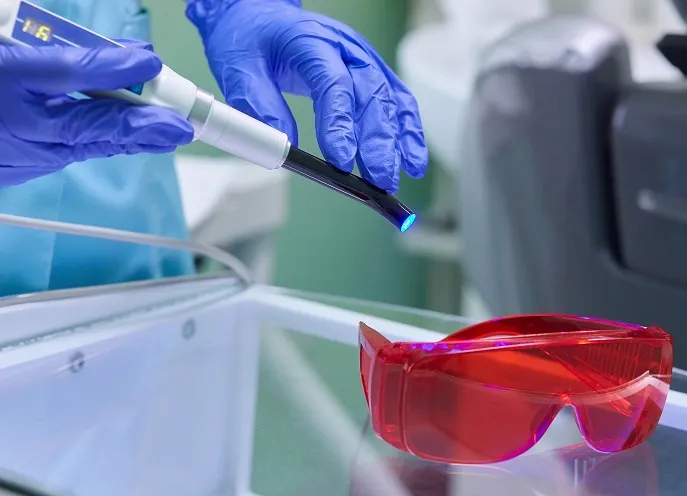
- Performance: UV-cure may not be suitable for substrates with complex geometries, and UV does not penetrate thick, dark coatings well. Adhesive strength and resistance to heat and moisture are generally superior to water-based and hot-melt adhesives due to the crosslinking process.
- Production: Radiation curing can take place in seconds, an advantage for high-volume production. Proper setting of the radiant energy source is vital. They have significantly reduced factory space compared to water-based systems. Radiation-cured adhesives have longer shelf lives.
- Cost: They are more expensive than solvent-based adhesives, however, on a weight-based less radiation-cured adhesive is required for an equivalent coating thickness. Lower energy costs than water-based adhesives.
- Environmental/safety: Generally does not contain solvents, avoiding the cost of air permitting, emission controls, etc. Explosion risks are minimized. Workers must be protected from radiant energy sources.
Hot-melt adhesives

- Performance: Hot melts set in seconds. They have low solvent, heat resistance, and low creep resistance. Moisture resistance depends on base polymer, but is generally better than water-based adhesives.
- Production: They have shorter set times allow for faster production. Their factory space is minimized.
- Cost: These cost more per pound than solvent-based adhesives, however, less hot-melt is required to obtain the same coating thickness. Ovens are not needed, however, heated tanks, hoses, guns, etc., are required.
- Environmental/safety: Hot-melts have no solvent or VOCs. Hazardous waste management and disposal costs are reduced. Risk to workers of possible burns is high.
Conclusion
The future of water-resistant emulsion polymers focuses on sustainability and enhanced performance. There is a shift towards bio-based monomers, low-VOC formulations, and recyclable/biodegradable polymers. These materials not only offer improved water resistance but also improve mechanical properties. With these new trends, the market applications of water-resistant emulsion polymers are expanding from construction to packaging.
- Collbaugh, T.S., and Lombardi, R.A., "Water Borne Acrylic Pressure Sensitive Adhesives with Improved Humidity Resistance, J. of Plastic Film and Sheeting, Vol. 5, July 1989, pp. 179-185.
- Satas, D., "Coating Additives", in Handbook of Pressure Sensitive Adhesive Technology, 2nd ed., D. Satas, ed., van Nostrand Reinhold, New York, 1989.
- Taylor, M.A., "Synthesis of Polymer Dispersion", in Polymer Dispersions and Their Industrial Applications, D. Urban and K. Tackamura, eds., Wiley-VCH, Weinheim, 2002, pp. 15-40.
- Nakamae, M, et.al., "Preparation of Polymer Emulsions Using a Polyvinyl Alcohol as Protective Colloid", Colloid Surface, Vol. 153, 1999, pp. 367-372.
- Howe, D., and Grade, J., "Surfactants with Sticking Power" Adhesives Age, June 2002, pp. 28-31.
- WO 89-12618, assigned to PPG Industries, Inc., December 28, 1989.
- EP 194,881, March 13, 1986.
- U.S. Patent 3,925,442 and 3,983,166, assigned to Kendall Company.
- U.S. Patent 5,013,442, assigned to Exxon.
- U.S. Patent 3,645,711 and 4,629,663, assigned to 3M Company.
- Morell, S.P., "The Role of Acetylinic Glycols in Water Based Pressure Sensitive Adhesives", Proceedings of the Technical Meeting on Adhesive Coating Technology, Pressure Sensitive Tape Council, Rosemont, IL, June 1981, pp. 55-75.
- Progress in process parameters and mechanism research of polymer emulsion preparation