

How to evaluate tackiness of adhesives?
Last update on Apr 2, 2026
The word “tack” is unique in the adhesives industry. Most people understand what tack or tackiness means through experience. However, it is hard to define clearly or measure in absolute units. This is because tack is not a single property. Instead, it comes from several physical effects working together. While this makes tack difficult to describe, it also reflects its true nature.
Tack usually refers to the instant stickiness of an adhesive in a liquid or semi-liquid state when it touches a surface. Even though the term is widely used, it is not easy to compare or quantify. To improve adhesive formulations, manufacturers rely on standard test methods to evaluate tack rather than one exact measurement.
In this guide, learn more about tack and standard methods to measure it. You can also find out adhesive ingredients that help support tackiness of adhesives in our Master Catalog.
What is Tack?
The word "tack" is unlike others in the adhesives industry. Most of us know what "tack" or "tackiness" refers to, but we have difficulty in defining it explicitly or in absolute units. The elusive nature of the word and the concept stems from the fact that "tack" results from a composite of several physical observations, parameters, and concepts. This is not necessarily a serious flaw, since indeed this is the case.
Definition
Tack is the property of an adhesive that allows it to adhere to another surface on immediate contact. It is the "stickiness" of the adhesive while in a fluid (e.g., paper cement) or semi-fluid (e.g., pressure sensitive adhesive) state.
There are two stages that must be considered with this concept.
- The first is the wetting stage where the tacky material must wet the substrate or a probe's surface (the most common probe being the human thumb). This initial stage is controlled by physical-chemical properties, such as critical surface tension, viscosity, adhesive thickness, etc.
- The second stage is that of debonding the probe from the surface, and here rheological properties of the adhesive come into play.
According to the ASTM standard, tack has been defined as the property that enables an adhesive to form a bond of measurable strength with the surface of another material upon brief contact and under high pressure. Implicit is that the adhesive separates cleanly from the surface, without any macroscopic residue.
In other words, tack is defined by the test used to measure it. So, it is very important to know what kind of tests are used, what kind of information is given and their limits. Related standards are published by national groups such as ASTM, and also by professional associations like European Pressure Sensitive Manufacturers' Association (EPSMA), or FINAT.
Normalized tests are well defined and require equipment that is easily available. They are a bridge between laboratories, users, distributors, and all the other partners involved in this industry. It is logical (and highly recommended) to use these methods if they are related to your problem.
Adhesive ingredients increasing tackiness
Pressure-sensitive adhesives (PSAs) are important in the adhesives industry & in our everyday life. They are the main components of labels, tapes and decals. They are available in dry form, show instantaneous adhesion, and are easy to apply. They have a large panel of adhesion capacities (force, substrates), which is essential indeed.
The high tack of PSAs results from carefully designed formulations. Although many formulations exist, they typically contain only a few key components that directly influence tackiness including:
- Polymers provide cohesion required to sustain tack during debonding. Low glass transition temperature (Tg) polymers allow rapid chain mobility and surface wetting.2,5
- Tackifying resins are low-molecular-weight resins that increase instant stickiness. This is done by improving surface wetting and reducing elastic recovery at short contact times.1,2,3
- Rheological additives control adhesive flow and viscosity during application. They enable better contact with the substrate. They support tack by optimizing wetting and application behavior.4,5 For example, paraffin or wax.
The art of the formulator is based on the right selection of raw materials and additives. Each of these materials has its own advantages and drawbacks when they are blended. Find the best compromise to improve the desired parameters and create synergies in your PSA formulation.
In order to optimize a formulation (and the efforts needed to obtain it), it is necessary to use specific tests for the evaluation of tack. But before that let's understand tack.
Factors influencing tack
One can easily understand that the tack property is greatly influenced by the experimental parameters. It depends on:
- The nature of the PSA
- The adherend
- The pressure, and
- The time of contact
Moreover, because the response is a viscoelastic one, the temperature and the rate of debonding play a key role in the strength measured.
Methods to measure tackiness
Tack tests are designed specific for the application. The results will heavily depend not only on the conditions of the adhesive & adherend, but also on the way contact & separation is achieved. Tack measurements are also dependent on the time during which the substrates were joined.
Of course, such parameters are very application specific, and that is why many different tack tests have been constructed and are in use. The table below summarizes several common methods of measuring tack.
Organization | Test Method | Common Name | Note |
ASTM | D2979 | Probe Tack | |
ASTM | D3121 | Rolling Ball Tack | Identical to PSTC 6 |
TLMI | LIB 1 LIB 2 | Loop Tack | LIB1 uses a specially designed tester; LIB2 uses a modified tensile tester |
PSTC | 5 | Quick Stick | Similar to AFERA 4015 |
PSTC | 6 | Rolling Ball Tack | Identical to ASTM3121 |
FINAT | FTM | Loop Tack | Similar to TLMI methods except uses glass rather than stainless steel as the substrate |
AFERA | 4015 | Quick Stick | Similar to PSTC 5 |
ASTM - American Society of Testing and Materials TLMI - Tag and Label Manufacturers Institute PSTC - Pressure Sensitive Tape Council FINAT - European Association of the Self-Adhesive, Labeling Industry AFERA - Association des Fabricants Europeens de Rubans, Auto-Adhesifs | |||
Tack, therefore, is not a true physical property of an adhesive, such as viscosity, modulus, or specific gravity. It is a composite property that has broad and somewhat qualitative meaning, but one that is very useful in practice. Quantitative meaning can only be defined through specific application.
Let's discuss each method in detail...
Rolling ball tack test
In this procedure, a rolling object (a steel ball according to this standard, but other geometries and materials are also possible) is placed at the top of an inclined track pursued by a horizontal, upward-facing adhesive. The ball is rolling down, and the relevant measurement is the distance the ball travels along the adhesive tape.
This simple, but frequently used test is probably one of the oldest. Despite its simplicity, it gives a good idea of the adhesive behavior and is readily understood. This distance is inversely proportional to tackiness: the greater the distance, the less tacky the adhesive.
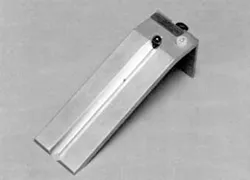
But this test can only be applied as an internal comparative test because there is no information about the adhesive surface or bulk parameters. And different attempts to summarize bibliographic data (using balls of different sizes, composition, texture) have not given (for instance) a good mechanical model, reliable measurement and adhesive properties.
Practically, the measurement needs to be performed several times to obtain average values and a significant result.
For many adhesives, a wide range of results are obtained; moreover, the maximum prescribed distance in the standard is often lower than the experimental one. The method by itself is low cost and easy to use but often needs to be adapted to the parameters of the real system (temperature, tack capacity). It is also a good quality control for tapes, for example.
Tack Rolling Ball Testing (Source: ChemInstruments)6
Loop tack test
In this test, tape samples are circular loops caught in the upper jaw of a tensile tester. This pear or teardrop is brought into contact with a horizontal surface (model or real system) for a short conventional time and then peeled off.
As for the rolling ball test, variations near this scheme are possible for example shape of the substrate & pressure applied. The main advantages of this test are:
- It is easily and quickly performed
- Does not require specific equipment (a standard tensile tester is sufficient), and
- The reproducibility is in most cases acceptable
When equipped with an environmental chamber, one can also vary contact conditions, and in this way, study their influence. But drawbacks are originated from the method itself. Contact time and peel angle are difficult to reproduce, and the stiffness of the tape backing is also strongly influent.

In summary, the loop tack test is a good means of measuring the tack of labels or tapes when the applications are confined to the experimental conditions.
Loop Tack Testing (Source:ChemInstruments)7
Peel tack test
Derived from the standard peel test (but time and pressure of contact are lower), it can be compared with the previous test (but in this case, the operator itself puts the adhesive on the adherend surface).
The equipment required is the same as that for the loop tack test, except that a reproducible pressure must be applied. If it is slightly less quick to carry out, a better reproducibility is achieved because of a better control of contact conditions and peel angles. It really becomes possible to compare peel measurements at different contact times & pressure and to extrapolate at zero time of contact to obtain an "absolute" value.

Nevertheless, the stiffness of the backing is also influent, and the results depend not only on adhesive tackiness but also on the tape modulus. To summarize, peel tack test can be interesting, but one can be far from a real tack test if pressure and time of contact are too high; as with other tests, one must be as near as possible to the usual conditions.
Peel Testing (Source: Instron)8
Probe tack test
The simplest equipment to evaluate tack properties is a thumb. Brought into contact with a slight pressure and, after a short delay, pulled away from the adhesive, the sensation of tackiness felt by the operator can be reported on a scale of, by example, 0 (no tack) to 5 (very aggressive tack). But it is obvious that this method is not reproducible - each operator has his own appreciation, varying according to the day or his own senses.
So, although more precise sensors and more reproducible probes are preferred, the idea is the same. Mechanical probe tack testers bring a probe (ball or cylinder of various material) into contact at controlled rate and pressure, wait a given delay, and measure the force needed to pull away at a specified rate. Most systems allow each individual parameter involved in the bond formation to vary (the ASTM D2979-00 is related to the first experimental equipment, called "Polyken Probe Tack").

One can obtain this figure, reporting the measured force during the experiment.

It is very interesting to understand the phenomena observed during the separation between a tacky adhesive and an adherend.
- The stress increases linearly with the probe displacement
- The stress slowly increases and is no longer linear, because a nucleation phenomenon occurs (apparition of voids at the interface)
- The force goes up to a maximum, when the nucleation stops
- Cavities start to grow perpendicular to the interface, involving a decrease of the stress; at this stage, the shape of the curve depends on the rheological properties of the adhesive and on interfacial interactions between the adhesive and the probe; there are two possible ways for debonding to occur:
- Voids can grow until coalescence occurs: in this case the failure is adhesive and the stress decreases to zero
- Cavities can grow to reach a critical size, and fibrillation appears. Fibrils can lead to adhesive failure (f2) or cohesive failure (f1)
In this method, the experimental parameters are the same as during a real bonding process:
- Contact pressure
- Contact time
- Temperature
- Rate of separation
- Probe used (shape, material), and
- Adhesive system (thickness, backing, roughness)
Although the results are more difficult to analyze, this method is a precious one. The use of a dynamometer gives high precision and the parameters (forces at different contact times, but also energies of debonding) can lead to a better understanding of the PSA behavior.
ASTM D 2979 tack of adhesives using an inverted probe (Source: Mecmesin)9
Roll ball vs. Loop vs. Peel vs. Probe test: When to choose what?
The table explains the different adhesive tack test methods, highlighting their strengths, limitations, and typical uses. It helps choose the appropriate test based on required precision, cost, and whether the application is production control or research.
| Method | Advantages | Disadvantages | Applications |
| Roll ball test |
|
|
|
| Loop test |
|
|
|
| Peel test |
|
|
|
| Probe test |
|
|
|
- Benedek & Feldstein. (2009). Technology of Pressure-Sensitive Adhesives and Products. CRC Press.
- Chang. (1997). Viscoelastic properties of pressure-sensitive adhesives. Journal of Adhesion, 60(1–4), 233–248.
- Dostal. (2015). Adhesives and Sealants: Fundamentals and Applications. Wiley-VCH.
- Mittal. (2003). Adhesion Measurement of Thin Films, Thick Films, and Bulk Coatings. ASTM International.
- Satas. (1999). Handbook of Pressure Sensitive Adhesive Technology (3rd ed.). Springer.
- ChemInstruments. (2015). Tack Rolling Ball Testing. YouTube. https://www.youtube.com/watch?v=9UpO8JwQcl8
- ChemInstruments. (2015). Loop Tack Testing. YouTube. https://www.youtube.com/watch?v=y4Wo-z__RiI
- Instron. (2022). What is Peel Testing? YouTube. https://www.youtube.com/watch?v=aQJ51U0D3wQ
- Mecmesin. (2019). ASTM D 2979 tack of adhesives using an inverted probe. YouTube. https://www.youtube.com/watch?v=U65CAhx5o8c