

Joining of Plastics by Adhesive Bonding - What Needs to be Considered
Last update on Jan 23, 2020
We live in a world where plastics are omnipresent and can be found in almost every product of everyday life. There are many reasons for this - for example, their simple processing and low density. They are also inexpensive and often require less energy than alternative materials in their manufacturing and processing. In a large number of cases, however, a product does not consist of just one (plastic) part but is composed of components made from different materials.
In order to form the ready part, components need to be joined together. Modern bonding technology is the predestined process for joining different materials. But, for every joining technique, the necessary technical characteristics must be fulfilled and at the same time high productivity, quality and reliability must be ensured.
Therefore, it is important to have an in-depth understanding of the interaction between the plastic parts to be joined and the adhesive required to form a reliable bond.
First, let's start by understanding the parameters to be taken into account while designing a bonding process.
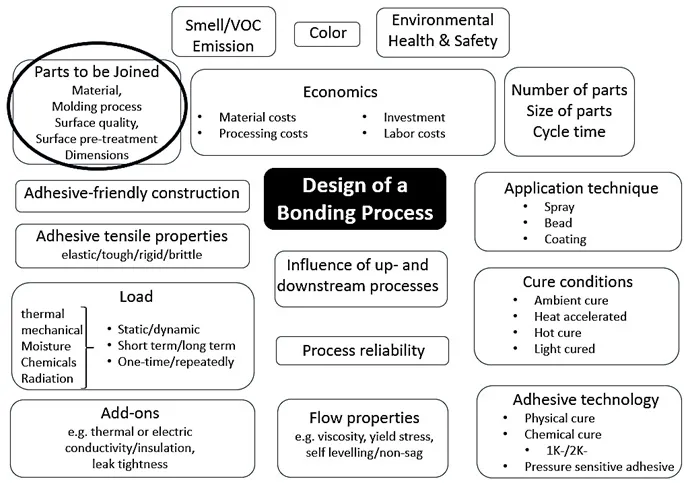
Overview of the Various Parameters to be Taken into Account When Designing a Bonding Process
What Influences the Bondability in Plastics?
A large number of plastics available on the market which are in use for various applications in different industries do not allow any general statement regarding the bondability of plastics. Undoubtedly, bondability depends on the type of polymer, but there are other factors that must be taken into account as well.
The formation of adhesive forces is a question of surface properties of the part which needs to be bonded. The adhesive forces, which ultimately determine whether an adhesive provides sufficient adhesion to a plastic surface, show only a very short range of less than 1 nm. These can be polar or polarizable molecule groups that are capable of forming hydrogen bonds or allowing for the so-called Van der Waals forces.

Dipole-dipole Interaction Resulting in Adhesion Forces Between
Part Surface and Adhesive and Cohesion within the Adhesive
Having the short range of such forces in mind; it is obvious that adhesive and part surface has to come in close contact to allow interaction.
- A prerequisite is a good wetting of the surface by the adhesive, which requires that the surface tension of the part surface needs to be higher than the one of the adhesives in a liquid state.
- In addition, it is required that the functional groups on the part surface can interact with those present in the adhesive - surface and adhesive have to match each other.
Let's dig a little deeper in this topic and explore more on what affects bondability in variety of plastics.
Polymer Additives
As already mentioned, the type of base polymer plays an important role. But, plastics as synthetically produced materials are typically formulated for different reasons with a wide variety of additives which can be:

- Pigments
- Fillers or fibers
- Internal release agents
- Plasticizers
- Antistatic agents
- Antioxidants
- UV stabilizers, and
- Flame retardants or processing aids like:
- Defoamers
- Rheology control agents, and
- So forth
These additives play an important role in regard to surface tension (wettability) and formation of adhesion - especially when they are present on the surface.
Degree of Bondability: Thermosets v/s Thermoplastics
In most cases the selection of the polymer type for the part is not driven by how easy they are to bond, but by the required properties, like:
- Thermal and mechanical properties
- Resistance against chemicals, and last but not least
- Material and processing costs
Thermosets often have chemical groups that allow good wetting and reaction with the adhesive. Most of them have a chemical composition similar to or even identical to that of typical reactive adhesives like epoxies or polyurethanes. All of this suggests abetter bondability, which is partly the case.
In the group of thermoplastics, both those with and without functional groups are found. Plastics likepolypropylene (PP) and polyethylene (PE) are due to the very similar tendency of hydrogen and carbon atoms to attract electrons and non-polar nature and characterized by a low surface energy of max 30N/m. This results in apoor wettability and a lack of interaction with corresponding groups of adhesives, which at the bottom of the line makes itdifficult to bond to.
Replacing one hydrogen atom at every second carbon atom in PE by a chlorine atom leads to polyvinylchloride (PVC). With the chlorine atom having a much higher tendency to attract electrons, PVC is somewhat polar and characterized by a significantly higher surface tension of about 40N/m which improves wettability.

Molecular Structure of Polyethylene (L) and Polyvinylchloride (R)
The polar groups are capable to interact with polar groups of the adhesive and allow the formation of adhesion forces between substrate and adhesive. This could be clearly seen from the table below showing surface tension of some common materials:
| Material | Surface Tension [N/m] | Material | Surface Tension [N/m] |
| Steel | (2500*) / 30-60 | Polycarbonate | 34-37 |
| Aluminum | (1200*) / 30-50 | PMMA | 33-44 |
| Glass | (290*) / 40-70 | Polyethylene | 31 |
| Epoxy | 47 | Polypropylene | 29 |
| Polyamide 66 | 46 | Natural Rubber | 24 |
| PVC, rigid | 40 | Silicone | 24 |
| ABS | 35-42 | PTFE | 18 |
| *Theoretical value, real values are significantly lower | |||
Surface Tension of Common Materials
Elastomers
The world of elastomers is very diverse and ranges from those based on natural rubber to thermoplastic elastomers, silicones and polyurethanes. From a bonding point of view, they are similar to thermoplastics and thermosets. A big difference lies in the high flexibility, which can lead to relative movements in the adhesive joint and thus to a special mechanical load.
Now it is the case that every component surface has a layer-like structure. Each of these layers has a specific composition with resulting characteristics that one way or the other might have an effect on bondability.
The base material determines mainly the thermal and mechanical properties as well as it's resistance against weathering and chemicals. As just mentioned, it also influences bondability.
Structure of Polymer
The figure shows schematic structure of a plastic surface:

Schematic Structure of Plastic Surface
- Boundary Layer - The deformed boundary layer adjoining the base material consists of the same material as the base material. However, the micro-structure differs from that due to the molding process. It may show differences in the polymer structure, like orientation of the individual polymer chains leading to the differences in functional groups if present, degree of crystallinity, filler and fiber content. Additives contained in the plastic formulation can also accumulate in the boundary during the molding process showing a detrimental effect on bondability.
- Reaction Layer - The reaction layer following the boundary layer consists of reaction products of the base material. For metals, it is typically oxides but also polymers show such a layer with a compositional difference to the base material.
- Adsorption Layer - Indicated already by the name, the adsorption layer consists of substances adsorbed from the environment: Typically, the surrounding air, the part has been exposed to. Although the thickness of this layer is usually just a few nanometers; the effect on bondability is due to the short range of the adhesion forces that are quite significant. The adsorption layer prevents the direct interaction between groups of the adhesive and those in the boundary or reactive layer forming adhesion. The adsorbed substances have a much higher binding energy and are therefore harder to remove than the substances in the contaminant layer.
- Contaminant Layer - The contaminant layer as the outermost layer contains different substances that have accumulated on the component over time, e.g. during storage, transport or up-stream processes. These substances can be dust, but also substances from fumes or aerosols, fingerprints, release agents, etc. For obvious reasons contaminants have to be removed prior to bonding as they are typically not strongly attached to the surface and / or show release properties.
Adhesion Properties in Plastics - Role of Additives
Here, we will focus on effects on adhesion properties that are caused by additives used in plastics by auxiliary materials during molding or by inadequate change of molding conditions.
1. Plasticizer
Plasticizers are often used to increase flexibility and durability of plastics. They decrease the attraction between polymer chains to make them more flexible. These are relatively small molecules and since they are not chemically bound to the polymer matrix; they are able to migrate especially when exposed to elevated temperature.
- In accordance with the principle of nature that differences in concentration should be compensated as far as possible; the plasticizers show a tendency to migrate into the boundary layer between substrate and adhesive. Thereby, the adhesion-determining interactions are disturbed.
- Plasticizers can also migrate into the adhesive itself weakening the adhesive's cohesive strength.
Both effects result in a reduced load bearing capacity of the bond. This is because the tendency to migrate, removing plasticizers from the part's surface prior to bonding does not really solve the problem.
A good example is PVC as explained above, PVC has about 40 N/m of surface tension, which in general indicates good bondability. This is true as long as we concern rigid PVC, not containing plasticizer. If we talk about soft, plasticized PVC; usually a good initial strength can be achieved as well. But depending on the adhesive used, there is a high risk of bond failure after some time due to the described plasticizer migration effect.
Overcoming Plasticizer Problem
The plasticizer problem can be overcome by plasticizer selection. Polymeric plasticizer, due to the larger size of the molecule; show a reduced tendency for migration. Selecting an adhesive which tolerates a certain amount of certain plasticizers will further improve bond durability. Best is switching to reactive plasticizer, which becomes the part of the polymer network and therefore, loses the ability to migrate.
2. Release Agents
In order to allow for an easy removal of the molded plastic components from the mold, it is usually necessary to use either internal release agents or external release agents. Release agents are substances used to prevent other materials from bonding to surfaces.
Example: During the molding process of a plastic part, an external release agent is applied to the surface of the mold. And since, internal release agent is an additive, it goes directly into the resin formulation and migrates during the molding process to the interface between part and surface of the mold. In general, both types have to be considered as critical for downstream bonding processes as the mold release is not able to differentiate between the surface of a mold and an adhesive. This is expressed in a more or less pronounced adverse effect on the build-up of adhesion between adhesive and part surface.
Overcoming Release Agents Problems
- In recent years, there have been numerous developments to reduce the required proportion of release agent in order to reduce the adverse effect on bonding. Adhesives have been developed that are to some extent, able to tolerate certain release agents.
In many cases, heat-assisted cure of the adhesive supports the absorption of release agent into the adhesive and thus its removal from adhesive layer. However, it is difficult to generalize, so that in each individual case; it must be checked to what extent under certain process conditions, a sufficient adhesion for the respective application is achieved. In many cases release agents must be removed by a pre-treatment prior to bonding the components.
- A new most recent development of a separating film that no longer transfer release agents to the component offer new ways for FRP parts manufactured by a prepreg, (vacuum) infusion as well as wet layup processes. The so called FlexPLAS® film1 is a deep drawable film with differential release properties of its two sides. The film is inserted with the good separating side to the mold surface and therefore, allows an easy removal of the part from the mold. The film itself remains on the molded part as a protective film and is only removed immediately before further processing with no release agent residues remaining on the surface. An additional positive side effect of such films is the protection of the surfaces of the parts against contamination with anti-adhesive substances. This ensures bonding without any further pre-treatment with high reliability.
A further effect of the use of release agents is on the alignment of polar groups present in the respective polymer. True to the motto "similar similibus solvuntur" (similar substances will dissolve similar substances). The polymer chains align themselves during the molding process in such a way that non-polar groups orient themselves towards the non-polar release agent, i.e. towards the surface.
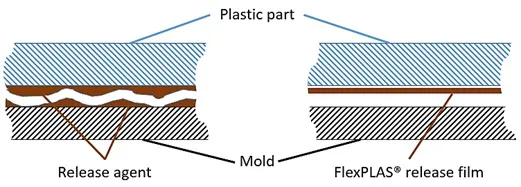
Release Agent Distribution during Demolding Using Conventional Release Agents (L)
and the Separating Film Technology (R)
The polar groups on the other hand, orient themselves away from the surface. As a result, even in the case of plastics containing polar groups, their availability on the part surface is limited. The sum of the resulting adhesion forces is therefore often not sufficient to meet the strength requirements for the bonded part.
3. Fillers
Plastics often contain fillers, with fibers playing a special role. Both, short and long continuous fibers are used. The correspondingly modified plastics are then calledfiber-reinforced plastics - FRP in short.
Glass, carbon and aramid fibers are mainly used as fibers, but a wide variety of natural fibers (e.g. flax, jute and cotton) are also used. The purpose of the fibers is usually mechanical reinforcement of the plastics. But partly, they are also responsible for the adaptation of the coefficient of thermal expansion to other components and adjustment of the direction of dimensional changes by external influences.
Since, the fibers improve the mechanical properties of the plastics and the fiber reinforced plastic is often used in high-quality products, this means that the adhesive connections are subject to significantly higher requirements. This concerns both:
- The initial strength, especially the durability (resistance against alternating mechanical loads, temperature and exposure to moisture and chemicals), as well as
- The quality and reproducibility of the adhesive bond
As a result, the development and qualifying effort for adhesive joints with FRP substrates is often higher than for "normal" plastic adhesive joints.
Overcoming Filler Problem
Since the fibers primarily reinforce the plastic parallel but not perpendicular to the surface, failure between the fibers layers, i, e. parallel to the surface, can occur already at a relatively low mechanical load. In order to avoid this effect the bond should be located at a sufficient distance from the edge of the part to be joined. It must also be considered that the FRP layer structure may be weakened as penetrated, for example by moisture through unsealed cut edges.
Influence of Molding Process Parameters on Bondability of Plastics
The parameter of the molding process has an influence on the surface properties of the part to be produced; in particular bondability of boundary and the reaction layer is influenced. In injection molding, for example:parameters - Temperature, pressure as well as the number and position of injection points have to be considered. After changing molding conditions, a previously achieved good cohesive bond failure may change to an adhesive failure at a reduced strength level. Particularly in the case of high-strength adhesives it can also lead to a fracture within the boundary or reaction layer of the part, again at a reduced strength level.
M. Stege from Volkswagen has reported in a paper about a fender made from PUR-RIM2. The fender consists of a PUR-RIM outer skin and fastening elements, made of PUR-RIM bonded to the inside of the outer part as shown in figure below:

Results of Surface Tension Measurements on the Inner Surface of PUR-RIM Fender
The 2-component PUR-RIM raw material contains the reactive resin components, filler and internal release agent as well as various other additives. At a first glance, it was surprising that the good result of lap shear testing (high strength level with a mix of cohesive and substrate failure) could not be achieved consistently in all areas of the part.
Good adhesion was achieved in the area close to the A-pillar. But, an adhesive failure at a significantly lower strength level was observed in the area of the headlamp. Surface tension measurements in the bonding areas revealed a roughly equal total surface tension, but the polar fraction relevant for the formation of adhesion showed significant differences.
In accordance with the different bonding results, the polar fraction showed significantly 39 N/m higher values in the area of the A-pillar connection than in the area of the headlamp (just 32 N/m). With just one injection point in the lower area of the A-pillar connection, the internal release agent migrating to the surface has been pushed by the PUR-RIM material into direction of the headlamp, which results in a significantly thicker layer of release agent and the poor adhesion.
Adhesion Problems in Case of Thermosets
In the case of thermoset materials, in which a cross-linking reaction occurs during the molding process, a reduction of molding temperature or cycle time may lead to incomplete cross-linking with residual monomers in the molded part. This can result in a bond failure as shown in the figure below:

Observed Failure Pattern on SMC, Caused by an Incomplete Cure
And the Resulting Presence of Unreacted Styrene which during the Heat Accelerated Cure of the Adhesive,
Evaporates Preventing the Formation of Adhesion
Overcoming Adhesion Problems in Thermosets
In this case bonding of SMC (thermoset glass fiber reinforced polyester) has been done by a2K-polyurethane adhesive. In order to achieve a short cycle time the cure of the adhesive took place in a heated fixture. The typical failure pattern of the 2K-polyurethane adhesive (green) on SMC after destructive testing is fiber tear. But after a cycle time reduction of the part's molding process, the unusual failure pattern at a far reduced strength level was observed.
The relatively high amount of residual styrene in the molded part was identified as the cause for the unusual failure pattern. During cure of the adhesive, the parts to be joined are heated from the outside to heat up the adhesive and to accelerate its cure.
The heating of the SMC causes the excessive residual styrene to evaporate, which diffuses out of the SMC forming a separating layer between SMC surface and the adhesive and thus prevents the build-up of adhesion forces. Some bubbles can be seen very clearly from the figure above. In this case, the expanding styrene has actually led to a separation of the adhesive layer from the surface.
Surface Treatment Processes
Most of the technically and economically significant plastics are difficult to bond as a result of the effects described above. But a few thermoplastics mainly PVC, which are soluble or at least swellable in certain solvents, can easily be bonded with special solvent-based adhesives. In this process, known as "solvent bonding", the resulting boundary surface layer is the result of a reciprocal diffusion of polymer molecule segments of the surface of the join part and the adhesive molecules to form a substance-locking bond.
As this process is limited to a small number of plastics, the bonding of plastics usually requires surface treatment in order to allow adhesive bonding. This ranges from simple cleaning process with the objective to remove surface contamination to chemical or physical processes for activating the surface by incorporating polar groups into the part surface.The common goal is to provide a suitable, defined surface for the subsequent bonding process, which of the numerous processes is the most suitable. It must be determined according to the specific application, taking into account:
- The joining component material, the adhesive
- The type and quantity of contamination
- The requirements placed on the bonded component with regard to its mechanical, thermal and media resistance
- The required load-bearing capacity and, last but not least
- The costs for each individual case
The figure below shows the numerous surface treatment processes:
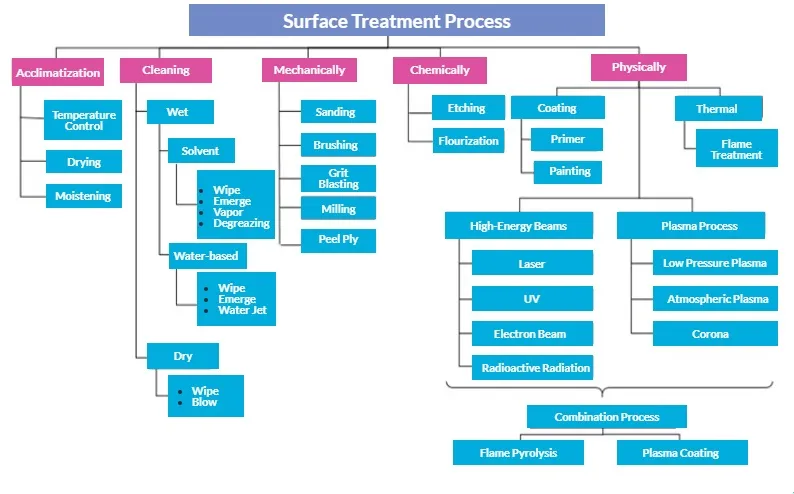
Surface Treatment Processes
A description of the various processes, their fields of application and the details to be observed with regard to the quality of bond would go beyond the scope of this type of article. Regardless of the process the following needs to be observed:
- The effectiveness of the surface treatment needs to be verified. Since the suitability of the respective process depends on the type of contamination, it is recommended to run regular in-process tests, especially if a change in the kind of contamination is possible
- Any re-contamination of the surface must be avoided, including - additional contamination caused by the use of unsuitable cleaning materials. Example: Contaminated solvents (denatured ethanol is not suitable, the chemical added for denaturing may not evaporate and, may remain on the part surface causing adhesion problems), used abrasives, chemically treated paper or textile wipes not being lint free, compressed air that is not free of water or oil
- It is important to ensure that the plastic is not damaged by the process (e. g. stress corrosion cracking e.g. caused by the solvent used for surface cleaning or as part of a primer)
- That there is no dragging of contamination - depending on the degree of surface contamination e.g. cleaning wipes or abrasives should be changed sufficiently frequently
- In the case of physical processes, an over-treatment with a resulting deterioration of the adhesive properties might happen
Measuring Effectiveness of Surface Treatment
The measurement of surface tension can be used as an in-process test for the effectiveness of surface treatment. This can be done relatively easily using test inks (series of liquids at gradual surface tension values) which are applied as a line on the surface to be tested. If the line of ink stays unchanged for at least 2 seconds without turning into drops, the surface energy of the material is the same or higher than the surface tension of the test ink.
Surface tension testing by test inks does have two significant disadvantages:
- In this process, bonding should not take place in the area the test ink has been applied to; it is not a non-destructive test.
- It does not differentiate between disperse and polar part of surface tension and may lead to an incorrect interpretation of test result, in case there is a different distribution into polar and disperse fractions for the same sum. This differentiation can only be achieved by more complex contact angle measurement. However, this method requires a relatively flat surface, which is not always present on real parts.
A relatively new contactless and non-destructive method for in-line process control of surface quality is the so-called bonNDTinspect® Bondability Test.For testing the surface quality an ultrasonic nozzle wets the surface of the part to be bonded with an extremely fine mist of ultrapure water. In the same process step, a camera takes an image of the droplet pattern before the water evaporates again from the surface to be bonded quickly and without leaving any residue.
The captured droplet pattern is analyzed by image processing software. The system is using the same physical principle as the contact angle test, but instead of measuring contact angle of a single drop, it analyzes the size and distribution of thousands of defined micro-droplets per cm², from the top view - dramatically increasing the statistical significance.It is a reference-based inspection system. This means that the bondability of the parts being tested is determined quickly, reliably and non-destructively by comparing the droplet characteristics with those of a defined good part.6
Selecting Adhesives for Joining Plastics
Though the parameters while selecting an adhesive system have been mentioned earlier, the other parameters that must be taken into account are:
- Required adhesion and strength level in the relevant temperature range, and
- Aging behavior and the mechanical properties of the respective parts to be joined
Elasticity Should be Kept in Mind Too
In particular, the strength and deformation of the parts to be joined as well as their dependence on temperature need to be mentioned here. It can be assumed that the adhesive must have an appropriate elasticity in order to compensate for the stress peaks occurring during loading.
The modulus of elasticity describing the mechanical properties of the respective plastics has several orders of magnitude lower than the modulus of elasticity of metals. In addition, it continues to decrease as the temperature increases and vice versa. This must be taken into account when selecting the adhesive and in most cases a different adhesive should be used than for bonding a similar metal part.
The number of adhesives offered by the various adhesive manufacturers seems almost unlimited. So, it is not easy to choose the most suitable adhesive for a particular application. Because of new products constantly appearing in the market, this information would only be a snapshot. Therefore, the different adhesive technologies, characterized by their basic chemistries, are discussed below with regard to bonding of plastics.
Classifying the Adhesives Based on their Hardening Mechanism
The figure below shows a classification of the adhesives according to their hardening mechanisms together with examples of adhesive classes. A basic distinction is made between adhesive technologies which harden by a physical process (e.g. evaporation of a solvent including water, cooling of a melt or gelling process) or by a chemical reaction with participation of reactive components contained in the adhesive.

Classification of Adhesives According to Hardening Mechanisms
In this system, the group of self-adhesive articles (e.g. double-sided adhesive tape) is somewhat special as they offer a fair strength after joining but do not undergo a hardening process.
- In case of the physically hardening and non-hardening adhesives, the adhesive polymers are already present in their final size and shape when delivered
- In the case of chemically hardening adhesives, these are formed from smaller building blocks in the adhesive joint during the curing reaction
The group of physically hardening adhesives is further differentiated by the respective physical process and the group of chemically curing adhesives by the respective reaction mechanism.
All of the different adhesive technologies do have their pros and cons. Selecting the best is not an easy task and requires not just to consider strength and durability properties and the parameters mentioned above, but also:
- Requirements from the manufacturing process
- EH&S properties
- Resulting cost per part
Validating Adhesive Bonding Process
The relatively new German standard DIN 2304-1: Adhesives Bonding Technology - Quality Requirements for Adhesive Bonding Processes – Part 1, explained the essential requirement of load capacity along with four different ways to verify the same:
Obviously the verification needs to be done stepwise considering all the individual processes, like:
- Part design: Especially bond line design according the requirements of adhesive bonding
- Material of the parts to be bonded: Dimensional tolerances, surface quality and cleanliness as well as surface pre-treatment method if any
- Selection of adhesives considering adhesion properties: Mechanical properties, temperature dependency of mechanical properties, durability, dispensing process technology, cure conditions, etc.
- Process planning and implementation including preparation of work instructions
- Definition of quality assurance measures
- Re-work/repair
- And more!
For the validation of the entire bonding process in its totality, all parameters including those of up-stream and down-stream processes, including those which are taken place at suppliers or customers have to be considered and defined.
It is highly recommended to agree with customers about a list of requirements to be fulfilled by the bonded part and with suppliers on an appropriate specification for all purchased materials and parts .This should take into account the parameters explained in this article which are or might be of influence to bond quality. Strictly no change should be implemented in production without re-validation assuring that the change does not have any adverse side effect on bond quality.
A sufficient qualification of the personnel involved in bonding processes is of high relevance too, along with along with all general requirements4,5.
Conclusion
Plastics are involved in many product launches some way or the other.They can often only be joined reliably by using adhesive technology - especially when it comes to joining different plastics with each other or plastics with other materials. In order to achieve successful results, the processor should also have a basic knowledge about the plastics to be joined. In order to avoid adverse effects and a potential bond failure, knowing how plastics and adhesives influence each other is important.
Considering plastic and adhesive material properties from the very beginning, helps to avoid bonding defects and at the bottom of the line enables those responsible to sleep soundly.
- FlexPLAS® Film https://www.ifam.fraunhofer.de/en/Profile/Locations/Bremen/Adhesive_Bonding_Surfaces/Plasma_Technology_Surfaces/Web_Film_Technologies/Release_Film.html accessed 28.11.2017
- M. Stege, R. Jozwowicz at 6th Annual and 3rd European Expert Conference “Adhesive Bonding in Automobile Production”, October 2002, Bad Nauheim, Germany
- H. Gleich: Zusammenhang zwischen Oberflächenenergie und Adhäsionsvermögen von Polymerwerkstoffen am Beispiel von PP und PBT und deren Beeinflussung durch die NiederdruckPlasmatechnologie. Doctoral thesis University Duisburg-Essen (2004)
- DIN 2304-1:2016 Adhesives bonding technology – Quality requirements for adhesive bonding processes – Part 1: Adhesive bonding process chain – Beuth Verlag Berlin
- A. Gross, H. Lohse: New DIN 2304 standard and its use in practice, adhesion ADHESIVES & SEALANTS 4/2015 Springer Fachmedien, Wiesbaden 2015
- http://www.automationwr.de/en/solutions/surface-inspection/2d-surface-inspection/bonndtinspect/index.html accessed 28.11.2017
This article was originally published on Nov 28, 2017 and updated in January 2020.