

Low-outgassing adhesives: Preventing contamination in harsh environments
Last update on Jul 24, 2024
This is a sponsored article by Master Bond.
In the realm of engineering and manufacturing, the integrity and reliability of component assembly are paramount, particularly when operating within environments where contamination and material degradation can lead to significant failures and operational challenges.
Preventing the contamination of sensitive components can be particularly challenging, and as such engineers must carefully consider not only the mechanical and thermal properties of materials but also their chemical behaviors in various environmental conditions.
Low-outgassing adhesives are specially formulated to minimize the release of volatile organic compounds (VOCs) that can condense on sensitive surfaces, thereby degrading optical clarity, electronic functionality, or mechanical integrity.
- They have emerged as a crucial solution in maintaining performance standards in critical conditions.
- They can play a pivotal role in addressing engineering challenges that range from maintaining cleanliness in sensitive optical and electronic systems to ensuring material stability in the harsh environments of outer space.
This article will help you address the challenges faced while using outgassing adhesives. Thus, allowing you to choose the right low-outgassing adhesive offered by Master Bond without compromising on the functionality of the final product.
An introduction to low-outgassing materials
What is outgassing?
Outgassing refers to the release of gases that were previously trapped, dissolved, or absorbed in some material. This phenomenon occurs in a variety of environments, but it is particularly significant in the space industry, where the extreme environment can cause conventional adhesives to outgas. In more technical terms, outgassing can involve the release of water vapor, carbon dioxide, volatile organic compounds, and other gases from materials like plastics, adhesives, metals, and composites.
What are low-outgassing adhesives?
Low-outgassing adhesives are specialized bonding materials designed to release minimal amounts of volatile compounds when exposed to the vacuum and temperature extremes of space. These adhesives are critical for aerospace applications, particularly for use in satellites, spacecraft, and space-based instruments, where any contamination from outgassed molecules can impair the function of sensitive optical and electronic systems.
Characteristics of low-outgassing adhesives
- Minimal volatile organic compounds (VOCs) release: These adhesives are formulated to emit very low levels of VOCs, which include a variety of chemicals that can vaporize at room temperature or under the mild heat of electronic components.
- Compliance with ASTM E595 testing: To be classified as low-outgassing, adhesives must meet the criteria set by ASTM E595, a standard test method developed to screen materials for their outgassing properties. The test measures total mass loss (TML) and collects volatile condensable materials (CVCM) when the adhesive is heated in a vacuum.
- Durability and performance in vacuum: In addition to low-outgassing properties, these adhesives must also maintain other performance properties necessary to meet specific application requirements.
Applications of low-outgassing materials
Although more commonly used in aerospace, electronics, and optical industries, the truth is that low-outgassing adhesives can find utility in many other applications. From medical manufacturing and packaging to automotive, microelectronics, and clean energy systems, low-outgassing adhesives can support maintaining clean, stable, and uncontaminated environments with chemical stability and minimal emissions.
Key sectors where low-outgassing adhesives can play a crucial role are:

Medical
Devices such as MRI machines, surgical instruments, and implants need materials that do not release harmful volatile organic compounds (VOCs). Their use also extends to the packaging of sensitive materials, where the products need to be kept free from any contaminants and a sterile environment needs to be guaranteed.

Automotive
As vehicles increasingly incorporate advanced electronics and optical components (like sensors for autonomous driving and heads-up displays), the need for adhesives that do not degrade these components becomes crucial. Low-outgassing adhesives can be used in the assembly and installation of these sensitive components.

Semiconductors and microelectronics
In the production of semiconductors, maintaining a clean environment free from contaminants is essential for the manufacturing process. Low-outgassing adhesives are used to avoid contamination that can lead to defects in the chips.
Photonics and lasers
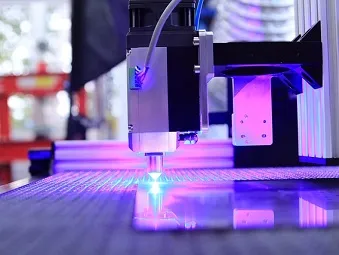
Equipment in this field often requires high precision with minimal contamination. Low-outgassing adhesives are crucial in the assembly of components that are sensitive to chemical deposits, which could interfere with light paths and signal integrity.

Vacuum chambers and clean rooms
These environments are used in a variety of scientific research and industrial applications, where any contamination can compromise the accuracy of experimental results or product integrity. Low-outgassing adhesives help maintain the cleanliness and functionality of the equipment used in these settings.

Clean energy systems
In solar panels and other renewable energy technologies, these adhesives are used to ensure that no outgassing materials interfere with the efficient operation of energy-converting materials.
The list here is non-exhaustive, but it highlights their broad utility and their success in maintaining the functionality and reliability of components and systems across a diverse range of technologies and environments.
Selecting the right adhesive for your application
Engineers may face several unique challenges in various industries where low-outgassing adhesives can provide effective solutions. Through the use of a highly structured approach that covers every element to consider, and methodically addresses each step, engineers can effectively select the right adhesive that not only meets the specific requirements of their applications but also contributes to the durability and functionality of the final product.
| Adhesive Chemistries | ||
|
| UV Curing Compounds
|
| Performance Properties | ||
Strength
| Mechanical
| Electrical
|
Thermal
| Chemical Resistant to:
| Optical
|
| Processing and Handling Considerations | ||
| Cure Time | Cure Temperature | Viscosity |
| Applications | ||
| Bonding | Coating | Impregnating/porosity sealing |
| Sealing | Potting/encapsulating | Casting |
Table 1: Considerations for choosing the right adhesive
Master Bond’s customized approach to adhesives
Master Bond offers an extensive array of low-outgassing epoxies, silicones, and UV/LED light curable systems. These can also be further customized based on your application and desired outcome.
| Product | Chemistry | Applications | Properties | |||||
| Bonding/ Sealing | Coating | Potting/ Encapsulation | Electrically Conductive | Thermally Conductive | Optically Clear | Cryogenic | ||
| EP3HTS-TC | One-part epoxy | ✓ | ✓ | - | - | ✓ | ✓ | - |
| EP4S-80 | ✓ | ✓ | - | - | ✓ | ✓ | - | |
| EP17HTDA-1 | ✓ | - | - | ✓ | - | ✓ | - | |
| Supreme 10HT | ✓ | - | - | ✓ | - | - | - | |
| EP21TCHT-1 | Two-part epoxy | ✓ | ✓ | - | ✓ | - | ✓ | ✓ |
| EP21TDC-2LO | ✓ | ✓ | ✓ | ✓ | - | ✓ | ✓ | |
| EP29LPSP | ✓ | ✓ | ✓ | ✓ | - | - | ✓ | |
| EP30-2 | ✓ | ✓ | ✓ | ✓ | - | - | ✓ | |
| EP37-3FLFAO | ✓ | ✓ | ✓ | ✓ | - | ✓ | ✓ | |
| Supreme 121AO | ✓ | ✓ | ✓ | ✓ | - | ✓ | - | |
| MasterSil 920-LO | One-part silicone | - | ✓ | - | ✓ | - | - | - |
| MasterSil 151S | Two-part silicone | ✓ | ✓ | - | - | ✓ | ✓ | - |
| MasterSil 323AO-LO | ✓ | - | - | ✓ | - | ✓ | - | |
| UV16 | UV curing | ✓ | ✓ | - | ✓ | - | - | - |
| UV22DC80-1 | UV (dual) curing | ✓ | ✓ | ✓ | ✓ | - | - | - |
NOTE: All products in the above list meet the following standards:
| ||||||||
Table 2: Master Bond's product offering
Conclusion
In conclusion, any material that successfully meets NASA's low-outgassing criteria is suitable for a wide range of applications and industries. Master Bond's selection of low-outgassing adhesives showcases exceptional performance and reliability across a diverse array of sectors, ranging from aerospace to medical.
These specialized adhesives meet stringent NASA low-outgassing criteria, ensuring minimal VOC release and maintaining integrity and functionality under the most demanding conditions. The versatility and robustness of Master Bond's adhesives are not just about adhering components; they play a pivotal role in enhancing system reliability and operational longevity by preventing contamination and maintaining chemical stability.
As industries continue to evolve and demand more sophisticated material solutions, Master Bond's commitment to innovation and customization in adhesive technology positions them as a leader in solving complex engineering challenges. By choosing Master Bond, companies are not just selecting an adhesive; they are investing in the future of their products' performance and sustainability.


Discover Master Bond's product offerings – View all documents
DISCLAIMER: All tables used in this article are the copyright of Master Bond.