

How to Select Diluents for Epoxy Formulations?
Last update on Jan 20, 2025
This article was originally published in 2005 and updated in 2025.
The primary function of a diluent in an epoxy resin formulation is to reduce its viscosity. This in turn makes it easier to compound with fillers, improves filler loading capacity, and application properties. The viscosity of epoxy adhesive formulations can also be lowered by solvents, curing agents, and flexibilized epoxy resins.
However, this is not their primary function. Lower viscosity is important when applying the adhesive. This is because it determines the type of mixers and dispensers required and if the epoxy can be trowled, brushed, or sprayed. Lower viscosity is also important in achieving good adhesion as it allows greater penetration of porous substrates and faster wetting of the micro-roughness on non-porous surfaces.
Diluents also increase the working life of the catalyzed epoxy system. This is done either by increasing the time that the mixture's viscosity is below a workable limit or decreasing the reactivity of the curing agent primarily because of dilution of the resin.
In addition to lowering the viscosity, diluents also affect the performance properties of the adhesive. They generally lower the degree of crosslinking and degrade the physical properties of the cured epoxy. This reduction in crosslink density increases the resilience of the adhesive. However, it reduces tensile strength, heat, and chemical resistance. These effects are more pronounced at elevated temperatures than at room temperature. The degree of these effects will depend on whether:
- The diluent is incapable of reacting with the epoxy system (non-reactive diluents)
- The diluent has epoxy functionality (reactive diluents)
Most diluents decrease the reactivity of the epoxy system. However, reactive diluents may increase the exotherm because of the heat release of the high number of epoxy groups per gram in the diluent. Diluents containing alcoholic hydroxyl groups accelerate the curing rate in the presence of amine curing agents. However, when low percentages of diluent are used these effects on reactivity and exotherm are generally minor.
Both types of reactive and non-reactive diluents should be used sparingly if the properties of the cured system are to be preserved. An amount of 5 to 10 parts per hundred is best and generally provides a sharp reduction in viscosity. Concentrations greater than 20 parts per hundred are seldom used in adhesive formulations.
Diluents are generally not as much of a problem as solvents in causing skin irritation. However, they are low viscosity, relatively high vapor pressure compounds, and could lead to irritation in certain applications. Many of the diluents, especially those containing epoxy groups, are more severe skin irritants than the epoxy resins themselves. This is due to their lower molecular weight and high vapor pressures. The viscosity reduction capability (and skin irritation tendency) for the diluents is directly related to their molecular size. With the larger molecules the skin hazard potential is less, but so is the viscosity reducing efficiency.
Let's understand the different types of diluents used in epoxy formulations.
Non-reactive Diluents: Key Features and Examples

Non-reactive diluents do not react with the resin or curing agent. Thus, they generally dilute the final physical properties of the epoxy structure. In addition to lowering viscosity, they are often used to balance the mix ratio proportions in certain epoxy systems. Non-reactive diluents can be thought of as plasticizers.
As non-reactive diluents are relatively mobile they can be more easily driven off on heating or vacuum degassing. If this occurs during cure, the result is greater shrinkage and the appearance of vapor bubbles. This results in reduced adhesive strength because of the internal stresses created in the joint. Entrapped non-reactive diluents can also migrate out of the cured adhesive during service conditions thereby causing a change in properties.
Non-reactive diluents have not been widely accepted in epoxy adhesive technology. This is because most of them are incompatible with the cured resin and similar effects can be achieved by proper selection of a long-chain curing agent.Since non-reactive diluents do not enter into the crosslinking reaction they can be lost due to volatilization. This especially happens when exposed to the elevated temperatures of the exotherm or curing process. If vaporization occur, a high degree of shrinkage or bubbles in the adhesive film can result in internal stresses being generated within the joint. These internal stresses will reduce the degree of adhesion that is realized on the final cure.
Most non-reactive diluents are used in concentrations of 5-20 by weight of the epoxy resin. The general effect of incorporating non-reactive diluents into an epoxy resin system is to increase pot life and decrease peak exotherm. The effect on cured properties is generally negative, although at low additions the effect is relatively small.
In the cured resin, non-reactive diluents will lead to an increase in adhesion and impact strength but a decrease in thermal and chemical resistance and tensile strength. Non-reactive diluents do not generally increase the flexibility or elongation of the cured resin systems. However, they do tend to reduce tensile strength and hardness.
Some of the examples of non-reactive diluents are explained below.
Dibutyl phthalate
Dibutyl phthalate is a commonly used non-reactive diluent because it does not exhibit migratory tendencies on aging. It is also used as a plasticizer in many thermoplastics, such as polyvinyl chloride. It is generally incorporated into the DGEBA epoxy with heating. When used at about 17 parts per hundred (pph) the viscosity of the resin can be reduced from 15000 to 4000 cps. Dibutyl phthalate also provides added flexibility by virtue of its side chains and resulting reduction in crosslinking density of the resin.
The improved flexibility results in improved adhesion and thermal shock resistance, but, at the expense of elevated temperature performance. A TETA-cured epoxy (EEW=190) plasticized with 17 pph of dibutyl phthalate exhibited a heat distortion temperature of only 52°C and a tensile strength of 7100 psi1. The pot life of this system is 55 mins at room temperature; whereas without the dibutyl phthalate, it would have been on the order of 20-30 mins.

Figure 1: Dibutyl Phthalate
Nonyl phenol
Nonyl phenol and furfural alcohol are also common non-reactive diluents for epoxy systems. Nonyl phenol can be added to DGEBA epoxy resins in concentrations up to 40 pph. It is different than dibutyl phthalate in that the phenolic groups can accelerate the epoxy amine curing reaction. Nonyl phenol is most commonly used with aliphatic primary amine and polyamide curing agents where they reduce the viscosity of the system and accelerate the curing reaction. The gel time is reduced and the exotherm increases with the addition of nonyl phenol to the DGEBA resin.
Figure 2 shows the effect of nonyl phenol (3-pentadecyl)-phenol concentration on the viscosity and gel time of DGEBA epoxy resin. Similar to dibutyl phthalate, nonyl phenol reduces the tensile strength and hardness of the cured resin.
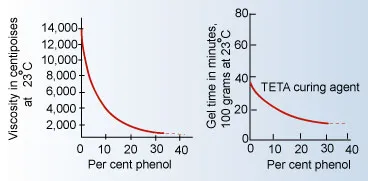
Figure 2: Viscosity vs. Nonyl Phenol Concentration in DGEBA Epoxy (Left); Gel Time vs. Nonyl Phenol Concentration in Catalyzed DGEBA Epoxy (Right)2
Other examples
Some non-reactive diluents have been used to impart special properties on the cured epoxy in addition to lowering the viscosity of the uncured system. High boiling solvents such as xylene can be used as a non-reactive diluent. However, this is not normally done because of the high vapor pressure of the solvent and the probability that the remaining solvent after cure could degrade physical properties and adhesion. Thus, higher molecular weight organic compounds are more appropriate as non-reactive diluents in epoxy formulations.
Coal and pine tar are examples of common non-reactive diluents from natural substances. They are relatively low in cost and are often used as extenders in epoxy systems to reduce the cost. Coal tar is widely used because of its excellent compatibility with epoxy resins and relatively small sacrifice in cured properties.
Chlorinated diluents have been used with antimony oxide to impart flame resistance to cured epoxy systems. A typical formulation of this type based on DGEBA employs about 15 pph chlorinated phenol and 5 pph antimony oxide to produce a self-extinguishing system. Polymethyl acetals may be used to improve adhesive strengths in room temperature curing formulations5.
Reactive Diluents: Key Features and Examples
Reactive diluents enter into the polymerization reaction of the epoxy resin and the curing agent. In this way, the final adhesive characteristics are determined by the reaction product of the binder and the diluent. Reactive diluents are generally preferred over non-reactive diluents because they are chemically linked to the epoxy network. However, they still degrade the physical properties because their functionality is lower than that of the resin.
Most reactive diluents are mono- or difunctional. They are made by reacting epichlorohydrin with an alcohol, a phenol, or a polyol to produce a mono- or polyglycidyl ether resin. However, there are some non-epoxy diluents that are used as well. These non-epoxy diluents generally react with the curing agent or other functional groups in the epoxy chain.
The most common reactive diluents used for epoxy adhesive formulations are shown in Table 1.
| Diluents | Viscosity, cps at 25°C |
| Butyl glycidyl ether | |
| 2-Ethylhexyl glycidyl ether | 1-4 |
| t-Butyl glycidyl ether | 2-5 |
| Phenyl glycidyl ether | 4-7 |
| o-Cresyl glycidyl ether | 2-10 |
| C12-C14 alkyl glycidyl ether | 6-10 |
| Diglycidyl ether of 1, 4 butanediol | 14-16 |
Table 1: Reactive Diluents for Epoxy Adhesives3
In addition to viscosity reduction, the presence of a reactive diluent generally leads to a faster rate of cure and a higher crosslink density than with an undiluted resin. This is because the lower the viscosity the more mobile the molecules in the early stages of cure and the more reactive the system. Table 2 shows the effectiveness of various reactive diluents as viscosity reducers for DGEBA epoxy resins and also the effect of reactive diluents on the heat distortion temperature of cured specimens.
| Reactive Diluents | Amount (weight %) to Achieve 800 cps* | Heat Distortion Temperature (°C) for 800 cps** | |
| m-Phenylenediamine | Diethylenetriamine | ||
| None | - | 143 | 118 |
| Butyl glycidyl ether | 11 | 101 | 74 |
| Diglycidyl ether | 38 | 128 | 104 |
| Phenyl glycidyl ether | 18.5 | 105 | 82 |
| Butadiene dioxide | 10 | 162 | 127 |
| Vinylcyclohexene dioxide | 20 | 148 | 108 |
| *Amount required to dilute original DGEBA epoxy resin of 12,400 cps **Stoichiometric amount, cured 4 hrs at 150°C | |||
Table 2: Viscosity Reducing Power of Reactive Diluents and Their Effect on Heat Distortion Properties4
Monofunctional epoxy diluents
The primary reactive diluents are monoepoxy low molecular weight epoxy resins. These may be used at rather high concentrations with little effect on cured properties. They are often employed to make selective improvements on certain properties like adhesion, thermal cycling resistance, and impact strength. Some lower-viscosity commercial epoxy resins are already reduced with these diluents.
The monofunctional epoxy diluents are "chain stoppers" since they inhibit crosslinks from forming. The extent to which the cured properties are affected is directly dependent on the concentration of the diluent added to the epoxy resin. The general effect is to reduce viscosity and improve the impact and thermal shock resistance while slightly reducing the thermal resistance. The thermal expansion of the cured resin is increased by the presence of a reactive diluent as it is with a non-reactive diluent. This can lead to internal stress on the bond line, depending on the thermal expansion of the substrate material.
Monofunctional epoxy diluents are used primarily with DGEBA epoxy blends. The most common monofunctional diluents are:
- butyl glycidyl ether and
- phenyl glycidyl ether
The effect of these and other reactive diluents on the viscosity of epoxy resin is shown in Figure 3. Because the monofunctional diluents reduce crosslink density they are used at relatively low levels to avoid degrading heat and chemical resistance or other properties of the adhesive.

Figure 3: Effect of Various Diluents on the Viscosity of a Standard DGEBA Liquid Epoxy Resin
The reaction of polyols with epichlorohydrin produces polyglycidyl ethers, such as butanediol digylcidyl ether. These are only slightly less effective viscosity reducers than butyl glycidyl ether, but they are less volatile and contribute less to worker irritation problems. They also produce less loss in physical properties.
Difunctional epoxy diluents
Difunctional epoxy diluents are low viscosity and low molecular weight epoxy resins. These diluents may be used at very high concentrations and they do not greatly affect the properties of the cured resin. In some instances, the difunctional epoxy diluents will actually improve properties. These materials include butadiene dioxide, vinyl cyclohexane dioxide, and diglycidyl ether or resorcinol.
Long-chain polyether polyols such as polypropylene glycol when reacted with epichlorohydrin produce a diepoxy resin with an internal polyether chain. This decreases viscosity and increases flexibility. Other reactive diluents that provide flexibility to the cured epoxy structure can be synthesized from reacting epichlorohydrin with an organic acid or polybasic acid to form glycidyl esters.
Reactive diluents without epoxy groups
There are also several reactive diluents that do not contain epoxy groups. These are represented by:
- Triphenyl phosphite: The phosphite is a low-viscosity colorless liquid, which is sensitive to moisture. It reacts with hydroxyl groups in the epoxy resin.
- Butyrolactone: It is a very effective viscosity reducer. It can reduce the viscosity of a liquid DGEBA from about 15000 to 2000 cps with only 10 pph.
In the curing reaction with amines, lactones react with the formation of an amide, which can then crosslink with the polymer via the hydroxyl groups. Other non-epoxy containing diluents may be:
- co-curing agents,
- unsaturated molecules,
- active hydrogen-containing molecules,
- materials that are capable of promoting transesterification with available hydroxyl groups, and
- materials capable of reacting with the curing agents
These will affect properties as they influence crosslink density and system functionality. It should be pointed out that diluents are not the only way to lower the viscosity of filled epoxy resin systems. Surface-active agents can be added to the system as well to provide for better wetting of the filler by the epoxy resin matrix. This can lead to substantial viscosity reduction for systems having equivalent filler concentration. The surface-active agent, in turn, could result in formulations with higher filler loading at equivalent viscosity.

- Potter, W.G., Epoxide Resins, Springer-Verlag, New York, 1970, p. 110.
- Lee, H. and Neville, K., Handbook of Epoxy Resins, McGraw-Hill, New York, 1967, p. 136.
- Skeist, I., Handbook of Adhesives, van Nostrand Reinhold, New York, 1990, p. 355.
- May, C. and Tanaka, Y., Epoxy Resins: Chemistry and Technology, Marcel Dekker, New York, 1973, p. 299.
- Russel, Epoxy Resin Composition, U.S. Patent 3,050,474, 1962.