
Curing / Vulcanizing Agents: How to select the right grade for adhesives?
Last update on Jun 30, 2025
But how cross-linking affects the mechanical strength of a sealant? What are there important factors that need to be considered for selecting the right curing additive for adhesives?
Explore the chemistry behind cross-linking in detail and learn the criteria of selecting the right curing agent/vulcanizing agent for your adhesive formulation.
Importance of Crosslinking or Curing of Formulation
Cross-linking or curing is the formation of chemical links between molecular chains to form a three dimensional network of connected molecules.
The cross-linking or curing agent is the formulation component that causes this reaction to take place. These terms are generally used with all polymeric materials that are capable of forming a thermosetting structure.
The cross-linking of rubber with sulfur is called vulcanizing agents for rubber. Cross-linking bonds the chains together to form a network. The term 'Vulcanizing Agent' is generally used with rubber or elastomers.
Cross-linking agents in polymers are multi-functional chemical compounds. They react with functionality of the molecular chains in the base polymer and thereby form a thermoset of three-dimensional polymeric materials.
The curing agents are of di- or higher functionality, and they become an integral part of the final thermoset material except for materials lost in a condensation Cross-linking process. These cross-linking agents can range from low molecular weight to polymeric materials.
Cross-linking causes changes in physical and chemical properties. It causes changes in:
- Hardness
- Tensile strength
- Modulus
- Elongation
- Solution
- Swelling and
- Other properties
The resulting product is called a thermoset, because it does not flow on heating. Cross-linking increases the thermal stability and mechanical properties of the polymer. It provides important effects on both the curing features and on the fundamental properties of the adhesive or sealant system.
The figure below illustrates a crosslinked resin and shows how the number of crosslink sites, the length of the cross-linking agent molecules, and the distance between cross-links on the base polymer affect the properties of the final adhesive.
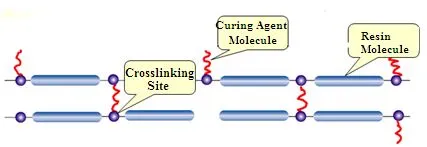
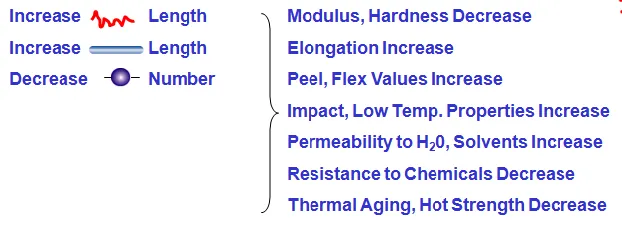
Effect of Cross-linking on the final properties of the adhesive / sealant
Functionality of Polymer - Role in Curing
The functionality of a polymer is the number of bonds a molecule can form with other molecules in a reaction. Only reactions between polyfunctional monomers can lead to thermosetting polymers. Reactions between monofunctional monomers can double in size but they do not grow to large polymers with repeating units. Because of their Cross-linking, thermoset polymers are infusible, insoluble, and dimensionally stable under load. These properties make thermoset polymers useful as load bearing structural adhesive.
Thermoset polymers consist of a continuous network of polymer chains that are crosslinked. The cross-links are formed by reaction of one polymer molecule with another or with a second polymer. These reactions can occur either at room or elevated temperatures, and there are catalysts that can accelerate the reaction mechanism.
Basically, cross-linking can be achieved either by:
- Applying radiation to the polymer, or
- Adding agents into the mix to promote chemical cross-linking.
The connecting chains of the thermoset polymer are held together with the same primary covalent bonds as are the atoms in the main chain. Thus, the molecules are interlocked and do not slip easily by one another.
Curing agents are, therefore, an important group of additives that influence both end-properties and curing. They can initiate the cure by catalyzing and promoting, or they can control the cure by accelerating or retarding it.
Selecting the Right Curing Agent
A number of common curing agents are known but each one has a unique chemical and physical properties along with their applications. Shown below are some curing agents and their applications:
| Curing Agent | Features & Applications |
| Acrylates / Methacrylates |
|
| Amines / Amides |
|
| Anhydrides |
|
| Azridines |
|
| Carbodiimides |
|
| Diols / Triols |
|
| Isocyanates |
|
| Peroxides / Persalts |
|
| Silanes |
|
| Vinyl / Allyl Compounds |
|
| Vegetable-based |
|
The appropriate curing agent selection process is dependent on:
- The base polymer
- The compounding processes used by the formulator
- The processing (curing) conditions employed by the end-user, and
- The physical and chemical service requirements of the application
Find out which curing agent chemistry is best for your formulation according to base polymer, end use application, reactivity, industry and available physical form below.
Curing Agents & Base Polymer Compatibility
The curing agent must be compatible with the base polymer and other ingredients in the formulation. It must react with the functional groups provided on the base polymer. Tables shown below provide a guide that matches the appropriate curing agent family with the base polymer that is used in the formulation.
Note that this guide only facilitates the formulator to getting into the right ballpark. Within each family there are numerous derivations, and these various materials will affect the formulation even though they are within the same chemical family.
| Base Polymer ↓ | Curing Agents | |||||||
| Acrylates / Meth-acrylates | Amines / Amides | Anhydrides | ||||||
| Aliphatics | Amido-amines | Cyclo-aliphatics | Aromatics | Dicyano-amines | Poly-amines | |||
| Acrylics and acrylic copolymers | ✔ | |||||||
| Epoxies(EP) | ✔ | ✔ | ✔ | ✔ | ✔ | ✔ | ✔ | |
| Polyamide | ✔ | ✔ | ||||||
| Polychloro-vinyls (PVC, PVDC) | ✔ | |||||||
| Polyesters | ✔ | ✔ | ||||||
| Polyimides | ✔ | |||||||
| PU - prepolymers | ✔ | ✔ | ✔ | ✔ | ||||
| PU - isocyanates | ✔ | ✔ | ✔ | ✔ | ||||
| PU - thermoplastics | ✔ | ✔ | ✔ | |||||
| PU - dispersions | ✔ | ✔ | ✔ | |||||
| PU - polyols | ✔ | ✔ | ✔ | |||||
| Sulfone polymers | ✔ | ✔ | ||||||
| Base Polymer ↓ | Curing Agents | |||||||
| Azridines | Carbodi-imides | Diols / Triols | Isocyanates | Peroxides / Persalts | Silanes | Vinyl / Allyl Compounds | Vegetable Based | |
| Acrylics and acrylic copolymers | ✔ | ✔ | ✔ | |||||
| Amines | ✔ | |||||||
| Aminoplasts / Phenoplasts (UF, MUF) | ✔ | |||||||
| Epoxies (EP) | ✔ | ✔ | ✔ | |||||
| Ethylene copolymers - emulsions (VAE, EVC) | ✔ | |||||||
| Natural polymers | ✔ | |||||||
| Natural rubbers (NR) | ✔ | ✔ | ||||||
| Polyamide | ✔ | |||||||
| Poly-caprolactones | ✔ | ✔ | ||||||
| Poly-chlorovinyls (PVC, PVDC) | ✔ | ✔ | ✔ | ✔ | ||||
| Polyesters | ✔ | ✔ | ✔ | ✔ | ||||
| Polyimides (PI) | ✔ | ✔ | ||||||
| Polyolefins (PO) | ✔ | ✔ | ✔ | |||||
| Polysulfides (PS) | ✔ | |||||||
| Polyurethane - prepolymers | ✔ | ✔ | ✔ | ✔ | ||||
| PU - isocyanates | ✔ | ✔ | ✔ | |||||
| PU - thermo-plastics | ✔ | |||||||
| PU - dispersions | ✔ | ✔ | ||||||
| PU - polyols | ✔ | ✔ | ||||||
| Polyvinyl acetate emulsions (PVAc) | ✔ | |||||||
| Polyvinyl alcohols (PVOH) | ✔ | |||||||
| Silicones (Si) | ✔ | ✔ | ||||||
| Silyl modified polymers (SMP) | ✔ | |||||||
| Styrene copolymers (SBR, SBC) | ✔ | |||||||
| Synthetic-rubbers | ✔ | ✔ | ✔ | ✔ | ||||
Curing Agents Selection Based on Type of End-Use Product
The selection of curing agent will depend on the type of adhesive / sealant that is being formulated. These end-uses include hot melt, solvent based, waterborne, reactive (100% solids), radiation curing (UV/EB), anaerobic and film / web.
Table below provides the various types of adhesives or sealants that are generally formulated with curing Agents:
| Base Polymer ↓ | Curing Agents | |||||||
| Acrylates / Meth-acrylates | Amines / Amides | Anhydrides | ||||||
| Aliphatics | Amido-amines | Cyclo-aliphatics | Aromatics | Dicyano-amines | Poly-amines | |||
| Solvent-based | ✔ | ✔ | ||||||
| Water-borne | ✔ | |||||||
| Reactive | ✔ | ✔ | ✔ | ✔ | ✔ | ✔ | ✔ | ✔ |
| Radiation curing (UV/EB) | ✔ | |||||||
| Anaerobic | ✔ | |||||||
| Film / web | ✔ | ✔ | ✔ | ✔ | ||||
| Adhesive Type ↓ | Curing Agents | |||||||
| Azridines | Carbodi-imides | Diols / Triols | Isocyanates | Peroxides / Persalts | Silanes | Vinyl / Allyl Compounds | Vegetable Based | |
| Solvent-based | ✔ | ✔ | ✔ | ✔ | ||||
| Water-borne | ✔ | ✔ | ✔ | ✔ | ✔ | |||
| Reactive | ✔ | ✔ | ✔ | ✔ | ||||
| Radiation curing (UV/EB) | ✔ | ✔ | ||||||
| Hotmelt | ✔ | ✔ | ||||||
| Film / web | ✔ | ✔ | ||||||
Curing Agent Selection According to the Reactivity
Curing agents have various reactivities. Some can cure at room temperature, some require elevated temperature cures, and others are suited for radiation cure. Once added to the formulation, pot life can be an issue depending on the type of application.
The pot life must provide sufficient time for application and mating of the substrates before the bond begins to cure. There are also latent curing agents that become activated only on application of temperature. With these systems, the pot life can be very long until the curing agent becomes activated by temperature.
Table below shows the various reactivities that are associated with common curing agents:
| Reactivity ↓ | Curing Agents | |||||||
| Acrylates / Meth-acrylates | Amines / Amides | Anhydrides | ||||||
| Aliphatics | Amido-amines | Cyclo-aliphatics | Aromatics | Dicyano-amines | Poly-amines | |||
| Room temperature | ✔ | ✔ | ✔ | ✔ | ✔ | |||
| Elevated temperature | ✔ | ✔ | ✔ | ✔ | ✔ | ✔ | ✔ | ✔ |
| Radiation cure (UV/EB) | ✔ | |||||||
| Pot life (< 1 hr) | ✔ | ✔ | ✔ | ✔ | ✔ | |||
| Pot life (> 1 hr) | ✔ | ✔ | ✔ | ✔ | ✔ | ✔ | ✔ | |
| Latent (temperature activated) | ✔ | ✔ | ||||||
| Reactivity ↓ | Curing Agents | |||||||
| Azridines | Carbodi-imides | Diols / Triols | Isocyanates | Peroxides / Persalts | Silanes | Vinyl / Allyl Compounds | Vegetable Based | |
| Room temperature | ✔ | ✔ | ✔ | ✔ | ✔ | ✔ | ✔ | ✔ |
| Elevated temperature | ✔ | ✔ | ✔ | ✔ | ✔ | ✔ | ✔ | ✔ |
| Radiation cure (UV/EB) | ✔ | |||||||
| Pot life (< 1 hr) | ✔ | ✔ | ✔ | |||||
| Pot life (> 1 hr) | ✔ | ✔ | ✔ | ✔ | ✔ | |||
| Latent (temperature activated) | ✔ | ✔ | ||||||
Curing Agents Selection According to Industry
Certain curing agents have found significant use in specific industries. This is primarily related to the base polymer that is used, but it also depends on the reactivity, form, etc. of the curing agent.
Table below shows the curing agents that are generally approved in various adhesives / sealant industries:
| Industry ↓ | Curing Agents | |||||||
| Acrylates / Meth-acrylates | Amines / Amides | Anhydrides | ||||||
| Aliphatics | Amido-amines | Cyclo-aliphatics | Aromatics | Dicyano-amines | Poly-amines | |||
| Adhesives | ✔ | ✔ | ✔ | ✔ | ✔ | ✔ | ✔ | ✔ |
| Sealants | ✔ | ✔ | ✔ | ✔ | ✔ | |||
| Automotive | ✔ | ✔ | ✔ | ✔ | ✔ | ✔ | ✔ | |
| Building & construction | ✔ | ✔ | ✔ | ✔ | ✔ | ✔ | ✔ | ✔ |
| Consumer / household / office | ✔ | ✔ | ✔ | |||||
| Electrical & electronic | ✔ | ✔ | ||||||
| Footwear & leather | ✔ | ✔ | ✔ | |||||
| Industrial assembly | ✔ | |||||||
| Labels / signs / decals | ✔ | |||||||
| Medical | ✔ | ✔ | ||||||
| Non-woven | ✔ | ✔ | ||||||
| Paper and packaging | ||||||||
| Tapes | ✔ | |||||||
| Transportation (excluding automotive) | ✔ | ✔ | ✔ | ✔ | ✔ | ✔ | ||
| Industry ↓ | Curing Agents | |||||||
| Azridines | Carbodi-imides | Diols / Triols | Isocyanates | Peroxides / Persalts | Silanes | Vinyl / Allyl Compounds | Vegetable Based | |
| Adhesives | ✔ | ✔ | ✔ | ✔ | ✔ | ✔ | ✔ | ✔ |
| Sealants | ✔ | ✔ | ✔ | ✔ | ✔ | ✔ | ||
| Automotive | ✔ | ✔ | ✔ | |||||
| Building & construction | ✔ | ✔ | ✔ | ✔ | ✔ | |||
| Consumer / household / office | ✔ | ✔ | ✔ | |||||
| Electrical & electronic | ✔ | ✔ | ||||||
| Footwear & leather | ✔ | ✔ | ||||||
| Industrial assembly | ✔ | ✔ | ||||||
| Paper and packaging | ✔ | ✔ | ✔ | |||||
| Tapes | ✔ | ✔ | ||||||
| Transportation (excluding automotive) | ✔ | ✔ | ||||||
| Wood and related industries | ✔ | ✔ | ✔ | ✔ | ||||
Available Physical Forms of Curing Agents
Curing agents come in a variety of forms, from powder and liquids to filler supported products. The selection of form is generally dependent on the mixing conditions and processes employed by the compounder.
Table below shows the various forms that are commercially available for the curing agents discussed in this guide:
| Form ↓ | Curing Agents | |||||||
| Acrylates / Meth-acrylates | Amines / Amides | Anhydrides | ||||||
| Aliphatics | Amido-amines | Cyclo-aliphatics | Aromatics | Dicyano-amines | Poly-amines | |||
| Beads | ✔ | |||||||
| Crystals | ✔ | |||||||
| Dispersions /Emulsions | ✔ | |||||||
| Flakes | ✔ | |||||||
| Granules | ✔ | ✔ | ||||||
| Liquid | ✔ | ✔ | ✔ | ✔ | ✔ | ✔ | ✔ | ✔ |
| Paste | ✔ | |||||||
| Powder | ✔ | ✔ | ✔ | ✔ | ✔ | |||
| Solid | ✔ | ✔ | ✔ | ✔ | ||||
| Various | ✔ | |||||||
| Form ↓ | Curing Agents | |||||||
| Azridines | Carbodi-imides | Diols / Triols | Isocyanates | Peroxides / Persalts | Silanes | Vinyl / Allyl Compounds | Vegetable Based | |
| Crystals | ✔ | |||||||
| Dispersions / emulsions | ✔ | |||||||
| Water soluble | ✔ | |||||||
| Solvent based | ✔ | ✔ | ||||||
| Flakes | ✔ | ✔ | ||||||
| Liquid | ✔ | ✔ | ✔ | ✔ | ✔ | ✔ | ✔ | ✔ |
| Pellets | ✔ | ✔ | ||||||
| Powder | ✔ | ✔ | ✔ | |||||
| Solid | ✔ | |||||||
| Spheres | ✔ | |||||||
| Various | ✔ | ✔ | ✔ | ✔ | ||||