

Polyethylene Terephthalate (PET): How to select the right grade?
Last update on May 1, 2026
Curious about what makes so many products in your daily life both durable and eco-friendly? Let’s talk about polyethylene terephthalate, or PET, a standout in the polyester family. This semi-crystalline material is tough, resisting impacts, moisture, alcohols, and solvents with ease.
So, what makes PET a go-to for everything from bottles to high-tech parts? And how does it deliver top-notch performance while staying cost-effective? Here’s why PET shines:
- It’s a staple in packaging, textiles, films, and components for industries like automotive and electronics.
- It’s recyclable, making it a sustainable choice for countless everyday items.
Polyethylene Terephthalate (PET): Definition and production
What is PET plastic?
Polyethylene Terephthalate (PET or PETE) is a general-purpose linear semicrystalline thermoplastic polymer. It belongs to the polyester family of polymers. These resins are known for their excellent combination of properties. These properties include mechanical, thermal, and chemical resistance as well as dimensional stability. Its chemical formula is C10H8O4)n.

Molecular structure of Polyethylene Terephthalate
How is PET produced?
Polyethylene terephthalate is an aliphatic polyester. It is obtained from the polycondensation reaction of the monomers obtained either by:
- Esterification reaction between terephthalic acid and ethylene glycol, or
- Trans-esterification reaction between ethylene glycol and dimethyl terephthalate
 | 
| 
|
 | ||

| ||
PET polycondensation process
The reaction produces PET in the form of a molten and viscous mass. This can be directly spun into fibers or extruded or molded into almost any shape. Chemically, Polyethylene terephthalate is very much similar to Polybutylene Terephthalate.
Select from 2,800+ PBT grades in our master catalog and request samples at ease!
Polyethylene Terephthalate (PET): Properties and limitations
What properties assist in PET selection?
Polyethylene terephthalate is highly flexible, colorless and semi-crystalline resin in its natural state. Depending upon how it is processed, it can be semi-rigid to rigid. It shows good dimensional stability, resistance to impact, moisture, alcohols and solvents.
Key features include:
- Higher strength, heat distortion temperature (HDT) and stiffness than PBT
- Very strong and lightweight & hence easy and efficient to transport
- Good gas (oxygen, carbon dioxide) and moisture barrier properties
- Excellent electrical insulating properties
- Broad range of use temperature, from -60°C to 130°C
- Low gas permeability, particularly with carbon dioxide
- Suitable for transparent applications, when quenching during processing
- It doesn't break or fracture. It is practically shatter-resistant and hence, a suitable glass-replacement in some applications.
- It is recyclable and transparent to microwave radiation.
- It is approved as safe for contact with foods and beverages by the FDA, Health Canada, EFSA & other health agencies. Access technical data for all food-contact approved PET grades on our platform »
- Chemical properties
- Excellent resistance to alcohols, aliphatic hydrocarbons, oils, grease and diluted acids
- Moderate resistance to diluted alkalis, aromatic & halogenated hydrocarbons
The glass transition temperature of PET varies depending on the degree of crystallinity. It has a Tg of 65-80°C. It has a melting temperature of 240-270°C. Amorphous PET has a Tg of 65°C. The Tg increases with an increasing degree of crystallinity.
Crystallization occurs with a maximum crystallization rate of 178°C at:
- the temperature range of 10°C above its Tg, and
- up to 10°C below its melting temperature.
It normally reaches a crystallinity of 40-50%. It can also be polymerized to a co-polymer that cannot crystallize.
The addition of fillers improves impact strength, surface finish, and several other benefits. It also reduces warpage. Some filler examples include glass fibers, CNTs, etc.
 |
What are the limitations of PET?
PET plays a big role in daily life, but the polymer still has a few practical limitations.
Crystallized PET:
- Exhibits lower impact strength
- Shows reduced moldability
These limitations arise from PET’s relatively slow crystallization rate compared to PBT.
- Amorphous PET: This form is more susceptible to environmental and chemical degradation. It can be affected by:
- Boiling water, alkalis, and strong bases
- Ketones, aromatic and chlorinated hydrocarbons, and diluted acids and bases at temperatures above 60°C
Improving performance: To address these weaknesses, many molded parts use crystalline PET polyester so the material can better withstand aggressive chemicals and elevated temperatures.
Crystalline PET formulations often include additives such as nucleating agents, fillers, or reinforcements. This expands the polymer’s use beyond conventional packaging.
Searching for the right grades? Watch this video to learn how to navigate our platform and make the most of our Master Catalog: Exploring, filtering, and comparing grades step by step for a faster, more confident selection process.
Ever wondered how PET transforms from raw material into everything from bottles to high-performance parts? Let’s explore its types and processing!
Polyethylene Terephthalate (PET): Types and processing
What is PETG?
PET-G stands for Glycol modified polyethylene terephthalate. It is the copolymer form of polyethylene terephthalate homopolymer.
Features of glycol modification of PET through copolymerization include:
- It improves processability (faster elongation rates and higher elongations).
- It lowers the glass transition and melting temperature of PET.
- It decreases the crystallization temperature and rate.
- It is a polyester with good toughness and chemical resistance.
- It also differentiates the properties of polyethylene terephthalate (PET).
As a technical material, PETG provides good mechanical properties. It also improves chemical and thermal behaviors with similar ease of use. All these comparisons are made with respect to PLA.
The common modifiers which replace ethylene glycol or terephthalic acid to produce PETG are cyclohexane dimethanol (CHDM) and isophthalic acid respectively. These modifiers interfere with crystallization and lower the polymer's melting temperature.

How is polyethylene terephthalate (PET) processed?
Polyethylene terephthalate can be easily processed by injection molding and extrusion. It is generally extruded to produce films and sheets and can be later thermoformed. Blow molding is generally used to produce transparent bottles.
Recommended drying time is 2-4 hours at 120°C before processing. Up to 25% regrind can be used.
Blow molding
The blow molding process works by reheating a pre-molded PET preform. It is then automatically positioned into a mound.
Extrusion- and stretch blow molding can be used to fabricate polypropylene bottles. They are used for packaging products such as:
| Extrusion Blow Molding | Stretch Blow Molding |
|
|
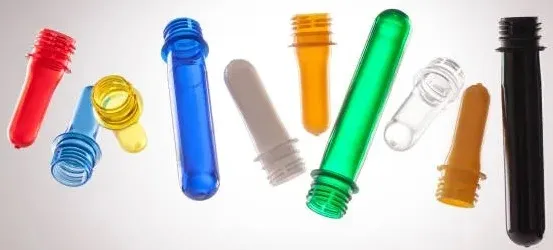
PET bottle preform for blow molding
Injection molding
PET injection molding is one of the very important technologies for plastic processing. Since it is a hygroscopic material, it must be dried to a moisture content of 0.05% or less. This allows it to create a non-crystalline transparent preform.
If the moisture content is too high, the PET molecular chains can thermally decompose. This reduces the physical and mechanical properties as well as the crystallization rate. This thereby impacts the quality of the product.
This polyester is a heat-sensitive material with a narrow forming temperature. During the process, if the temperature is:
- Too low – It is not good to make plastic parts. Depression and lack of material defects can occur.
- Too high – It can cause a spill, nozzle salivation, and deep color change. It can also decrease mechanical strength and cause degradation.
- Barrel temperature (unreinforced grades): 240~280°C
- Barrel temperature of glass fiber reinforced PET: 250~290°C
- Nozzle temperature: Should not exceed 300°C
- Melt temperature: 280-310°C
- Mold temperature: 140-160°C to obtain a crystalline PET (for technical applications)
- Screw with an L/D ratio of 18-22 is recommended
- For transparent applications, mold temperature should lie between 10 and 50°C
Extrusion
Polyethylene terephthalate is generally extruded to produce films and sheets. After extrusion, they can be thermoformed for food packaging applications. Its extrusion temperature ranges between 270-290°C. Select PET grades suitable for extrusion from our master catalog.
3D Printing
PET and PETG filaments are known to produce 3D Printed objects. These filaments have high flexibility and toughness. PETG filament is easier to print than ABS. It offers:
- higher strength,
- lower shrinkage, and
- smoother finish.
The material also benefits from great thermal characteristics. This allows the plastic to cool efficiently with almost negligible warpage.
- Recommended hot end temperature: 240 and 260°C
- Bed temperature: 100°C
- Retraction speed slow at 30mm/s or less
PET packaging accounts for more than 50 percent of total plastic waste. This extends its lifetime by reusing it as feedstock. This in turn offers a broadly available alternative to virgin raw materials. More recycled PET filaments are developed to produce unique designs and new products.
Select PET grades suited for 3D printing from our master catalog and access technical data!
Check out our upgraded Master Catalog! With smart filters, finding the right product is faster and easier. Start your search now!
 |  |  |  |
What happens when PET blends with other polymers?
Polyethylene terephthalate blends with thermoplastics or thermosets to tailor new materials. Blending materials have improved performance with beneficial cost profiles. It opens up the potential for new markets without much investment and development.
The following thermoplastics, thermosets and rubbers are used to produce blends with PET.
| Thermoplastics | Thermosets | Rubbers |
- PET modified with polyolefins are often glass fiber reinforced. They are used in injection-molded automotive and industrial applications.
- Applications with PET/PC blends require a combination of properties such as:
- excellent toughness, chemical and heat resistance
- along with high impact, tensile and flexural strength
- Blending PET with PBT offers a great influence on mechanical properties like impact strength. These blends combine the fast crystallization rate of PBT with the low cost of PET.
- Blending thermosets with PET improves thermal, mechanical, impact resistance, and flame-retardant properties. Used for the production of automotive, aeronautic, and electronic components.
The main objective of developing these blends is to improve cost-effectiveness, mechanical strength, flame retardancy, toughness, processability, etc.
Let’s now move to PET’s safety and sustainability to see how it stays both reliable and eco-friendly.
Polyethylene Terephthalate (PET): Safety and sustainability
Which class of polyester to choose?
Key applications

PET is used for refillable water bottles

PET offers good electrical insulating properties
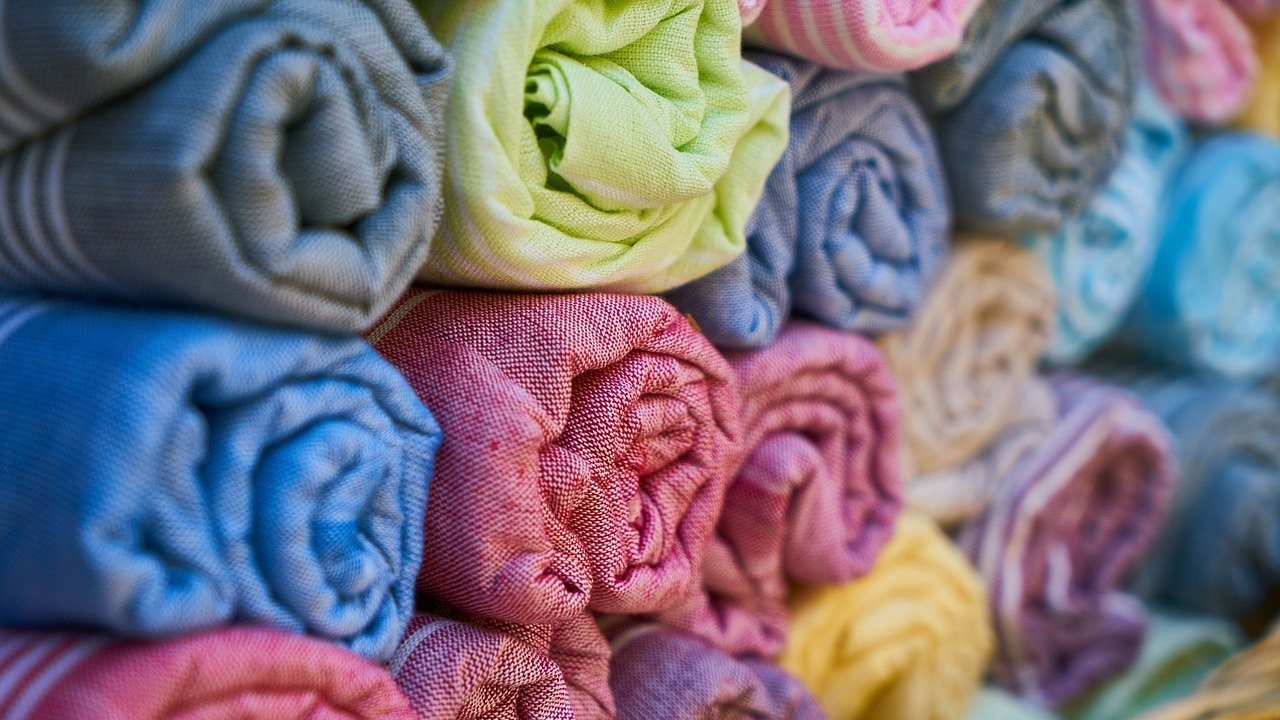
PET has wide applications in textile industry