

How can CoatOSil™ Additives Replace PFAS-Containing Materials in Coatings?
Last update on Sep 24, 2024
An Interview with Kadriye Hieronymi and Dr. Yogesh Tiwary from Momentive Performance Materials®
The push for sustainability has led to the development of materials that pose neither a threat to health nor the environment. Momentive is leading the charge in this regard, replacing PFAS-containing materials with their CoatOSil™ silicone-based products.
CoatOSil™ additives by Momentive are excellent candidates for use in coatings for wood, plastic, glass, metal, and masonry substrates. Their key features include:
- increased hydrophobicity,
- enhanced stain resistance,
- excellent durability and weatherability,
- improved adhesion and corrosion resistance,
- low surface energy
From water-repellent masonry sealers to stain-resistant and durable coatings & paints, CoatOSil™ products improve both performance and sustainability. In select applications, CoatOSil™ solutions have outperformed their PFAS counterparts.
We interviewed Kadriye Hieronymi, Product Stewardship Business Partner for CAS/PE at Momentive, and Dr. Yogesh Tiwary, Coatings Technology Leader at Momentive. They share how the CoatOSil™ brand has become a go-to choice for sustainable PFAS-free materials in the coatings industry.
#1. Can you provide an overview of Momentive and its role as a PFAS-free coatings additive solutions supplier?
Momentive, a global leader in silicone and silane specialties, strives to create Solutions for a Sustainable World™. We are a global organization with manufacturing, technical, and development capabilities in key regions to prioritize speed, communication, and support for our customers.
At Momentive, we develop innovative products that solve sustainability challenges for our customers and society. For example, identifying alternatives for Per- and Polyfluoroalkyl substances (PFAS) is a critical challenge faced in many applications and Momentive is pioneering sustainable replacement solutions.

#2. Give us an overview of the CoatOSil™ products as replacements for PFAS-containing materials and their primary applications in the coatings industry.
Momentive has several products that can match or exceed the performance of PFAS-containing additives like fluorosurfactants in waterborne masonry sealers and coatings applications.
Masonry substrates:
Momentive has excellent water repellents and penetrating sealers.
- CoatOSil™ Prim-2: A silane and silicone emulsion that is very effective in penetrating porous substrates and blocking water ingress. It gives excellent reduction in water absorption and improves efflorescence resistance.
- CoatOSil™ DRI: A specialty silicone emulsion that can be considered for masonry treatment to deliver excellent early and durable water repellency after application.
CoatOSil™ 2059: A functional silicone emulsion can be used in combination with CoatOSil™ Prim-2 or CoatOSil™ DRI to boost oleophobicity and oil-based stain resistance.
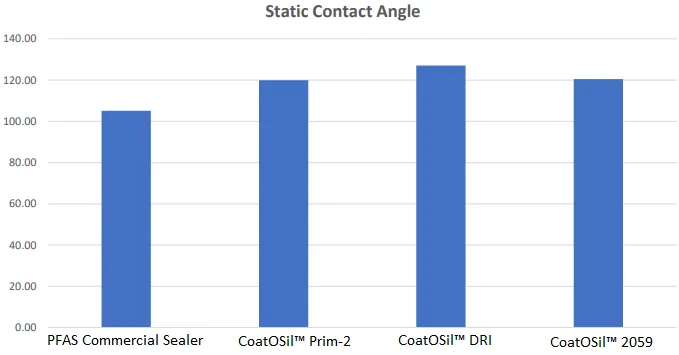
CoatOSil™ Prim-2, CoatOSil™ DRI, and CoatOSil™ 2059 Show Better Hydrophobicity Compared to PFAS Commercial Sealer as Measured by Static Contact Angle
(Source: Momentive Performance Materials)
Coating additives:
Momentive has developed a new multi-functional silicone additive CoatOSil™ SE 620 that is an excellent candidate to replace PFAS-containing materials while retaining or enhancing anti-blocking, slip, and stain resistance performance in waterborne systems.
- Hydrophobicity and water beading of CoatOSil™ SE 620 containing paints is superior vs. those containing PFAS surfactants.
- CoatOSil™ SE 620 improves UV stability and reduces color fading, which PFAS surfactants are not known to deliver.
- Overall, CoatOSil™ SE 620 can outperform PFAS surfactants by delivering multiple performance enhancements in waterborne paints.
#3. Why should silicones be considered alternatives to PFAS-containing materials?
Both academic and industry experts consider silicones as the next-best alternative to PFAS-containing materials. Reducing the surface energy is a fundamental feature of PFAS-containing materials that gives rise to excellent release properties. PTFE is known to have one of the lowest surface energies of approximately 18-20 mJ/m2.
Traditional silicone elastomers/resins can reach a surface energy of approximately 20-24 mJ/m2. Other plastic materials typically have surface energies close to or higher than 30 mJ/m2. Silicones come closest to matching the lower surface energies that PFAS-containing materials provide. Momentive is exploring new solutions to further reduce the surface energy of silicones by using synergistic chemistries.
Silicones have multiple decades of proven weatherability, waterproofing, and thermal resistance in the real world, which makes them an ideal choice when excellent durability is desired.
#4. What challenges do you face replacing PFAS-containing materials with silicone-based materials?
To replace PFAS-containing additives like fluorosurfactants, Momentive has excellent functional-silicone alternatives that could deliver low-surface energy, hydrophobicity, anti-blocking, stain resistance, and substrate wetting for both waterborne and solvent-borne coatings. However, silicones may not be a 'drop-in' or 'one-to-one' replacement for fluorosurfactants and some formulation optimization may be needed.
Compared to fluorosurfactants, silicones may need a slightly higher loading but could still have an equal to or better cost-performance balance. In some cases, one or more functional-silicone additives may be preferred to match or exceed performance benefits delivered by PFAS-containing additives. Momentive is also working on enhancing the oleophobicity of our silicone-based solutions, where we still have some gaps vs. PFAS-containing additives.
#5. In general, how do silicones impact the environment compared to traditional PFAS-containing materials?
PFAS-containing materials have been under the microscope for decades. They are one of the substances that can be seen as 'forever chemicals' and take significantly longer to degrade when compared to silicones. Silicones also tend to be less bio-accumulative and toxic to humans and the environment. However, it is important to note that both types of materials have environmental, health, and safety considerations, and use and disposal per the safety data sheet is always recommended.
#6. What future developments or innovations can we expect from Momentive in the realm of sustainable solutions?
Momentive's tagline is Solutions for a Sustainable World™ and the future innovation plans are aligned with that. The company is on target to reach its goal of achieving 75% of new product sales that deliver sustainability improvements by 2025. Momentive is committed to continuously reducing the carbon footprint of its products by optimizing the supply chain and further enhancing sustainability practices in its manufacturing plants by reducing waste, and utilizing energy from renewable sources, etc.
Lower VOC, PFAS- and hazard-free solutions are the primary criteria for all ongoing R&D efforts. For the coatings market, Momentive is focusing on developing innovative solutions for waterborne, solvent-free, and high-solids systems that can match the performance of traditional solvent-borne counterparts. We are also exploring bio-based and renewable raw materials in developing new chemistries and products.
Finally, to replace PFAS-based resins like PVDF and FEVE for super-durable coatings, silicone-based resins are well known to deliver:
- excellent UV durability,
- thermal stability,
- adhesion to multiple substrates, and
- resistance to corrosion/chemical/water
Similar to PFAS-based resins, silicone-based resins are mostly supplied in solvents, but Momentive has been working on replacing these with new waterborne solutions. Silicone resins typically need thermal curing to achieve optimal performance. Developments to achieve curing at room temperature are ongoing.


|
DISCLAIMER: All images and graphs used in this article are copyright of Momentive Performance Materials.