

Innovative Raw Materials for Polyurethane Adhesives and Sealants
Last update on Oct 21, 2020
The adhesive and sealant market are expected to grow globally at a rate of 5% cumulative average growth rate during the next 5 years, with rising demand for bio-based PU hot-melt adhesives.
Overall, adhesive and sealant companies are in a race to develop improved adhesive and sealant products having:
- Greater longevity
- Stronger bond and tensile strength
- Reduced dust pick-up, and
- Improved sustainability
Two of the key drivers for developing improved sustainability raw materials are:
- The global need to mitigate global warming by using products that sequester carbon dioxide.
- The reduction of plastics in the environment.
In response, sustainability has become a key corporate goal for virtually every major polyurethane raw material supplier.
Meanwhile, consumers are demanding improved performance in the polyurethane adhesive and sealant products that they use every day. Polyurethane scientists are being challenged to innovate new sustainable products with high performance more than ever before.
Let's review some of the recent innovations in raw materials for polyurethane adhesives and sealants by leading suppliers.
Polyols Based Upon PLA from NatureWorks
NatureWorks has recently revealed that polyester polyols can be produced using bio-based lactide, bringing the properties of PLA to these polyols. In this work[1], polylactic acid polyols were produced by the ring-opening polymerization of NatureWorks' Vercet™ M700, meso-lactide using the initiators propylene glycol, 1,6-hexanediol, 1,12-dodecanediol, or pentaerythritol.

Ring-opening polymerization of NatureWorks' Vercet™ M700
The resulting polyols demonstrate excellent adhesion to metals, high hardness, and good resistance to solvents, while at the same time providing a sustainable option for the formulator's toolbox.
Dimerized Fatty Acid Polyester Polyols & Self-healing Polyols from Croda
Bio-renewable content dimerized fatty acid polyester polyols from Croda provide:
- Extreme hydrophobicity
- Low color
- Good flow
- Wetting properties and durability
When converted into moisture cure prepolymer adhesives, Croda's Priplast™ polyols provide high strength bonding to plastic substrates as shown in the figure below.

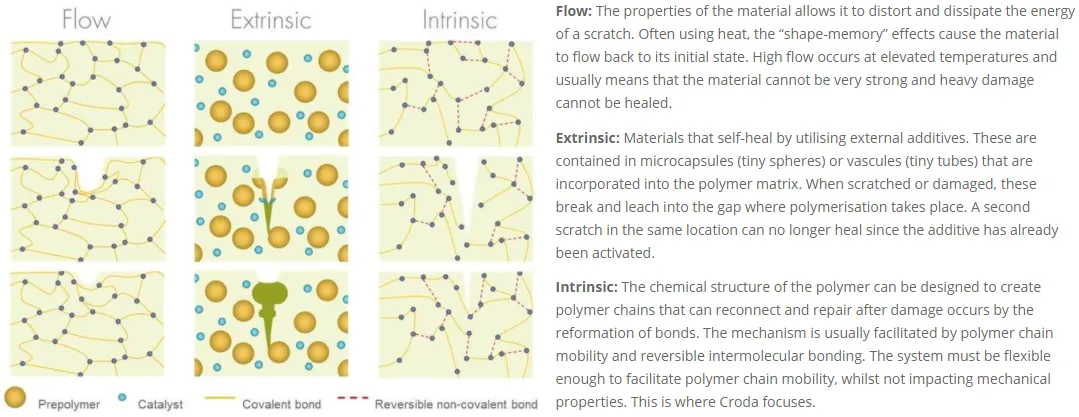
In the rapidly growing arena of self-healing polymers, Croda has developed a sustainable, self-healing polyol, which when matched with the right polyisocyanate and properly formulated, provides self-healing performance in coating applications.
Croda is translating the promising results of the new self-healing polyols from coatings into adhesives and sealants applications, potentially improving fatigue resistance and the longevity of bonded articles.
Related Read: Bonding Solutions for Low Surface Energy Substrates
Bio-based Polyester Polyols from Elevance
Elevance C18™ Polyols are prepared using olefin metathesis, a Nobel Prize-winning technology. Based on Elevance patents[6,7], it is believed that methyl oleate is isolated from vegetable oils, metathesized to form a C18 dimethyl ester, and then hydrogenated to form the fully saturated dimethyl C18 ester. This ester may then be used to produce polyester polyols via transesterification with various diols.
Some of these unique polyester polyols have sharp melting points that are useful for hot-melt adhesives and shape-memory polyurethanes as shown in the DSC thermograms for the polyols, below[5].
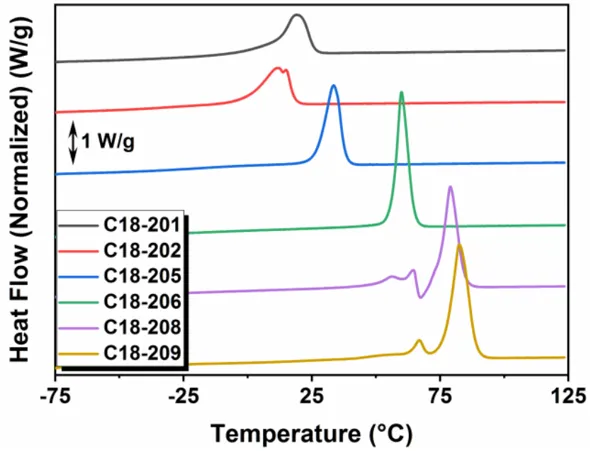
DSC thermograms of Elevance C18™ Polyols
The bio-based polyols are highly hydrophobic.
- They have good hydrolytic stability, high tear and tensile strengths and have chemical, oxidative and solvent resistance.
- They can be used to prepare high solids waterborne coatings with low or no solvent usage.
Bio-renewable Farnesene Polyols from TOTAL Cray Valley
TOTAL Cray Valley now supplies a bio-renewable polyol based on Amyris' trans-beta-farnesene under the tradename Krasol® F 3000. Amyris produces farnesene in commercial quantities using Brazilian sugar as the fermentation feedstock.
The company uses anionic polymerization to polymerize farnesene to form unique diols that impart:
- High degree of moisture resistance
- Low temperature flexibility, and
- Excellent impact resistance
In addition, the low viscosity of these innovative polyols allows for the preparation of low viscosity polyurethane prepolymers[3,4].

Chemical Structure of TOTAL Cray Valley Polyfarnesene Diols
Bio-renewable 1,5-Pentanediol from Pyran
Pyran Company has been in the news quite a bit in the past few years, being named as a:
- Finalist for the 2020 Wisconsin Innovation Awards, and
- Winning the 2019 Biotech World Congress Startup Competition
A spin-off from the University of Wisconsin-Madison, Pyran has discovered a route to producing 1,5-pentanediol (1,5-PDO) out of corn cobs[8], a bio-renewable agricultural waste product. The reaction scheme for producing the bio-based glycol is provided below[9].

Reaction Scheme for Production of 1,5-PDO From Furfural Sourced from Corn Cobs
The company claims[10] that the bio-based 1,5-pentanediol costs $3000/metric ton versus about $6000/metric ton for petroleum-based 1,5-pentanediol and $4500/metric ton for petroleum-based hexanediol (1,6-HDO).
Additionally, the bio-based glycol offers excellent hydrolysis stability and thermal stability when converted into polycarbonate polyols, and polyols containing mixtures of 1,5-PDO with 1-6-HDO yield liquid resins versus solid resins at room temperature when 1,6-HDO is used alone (see table below). This feature could be of benefit to adhesive and sealant applications where low temperature performance is required.
| Polycarbonate Polyol Type | MW (g/mol) | OH Value (mgKOH/g) | Acid Value (mgKOH/g) | Viscosity (cps @ 75°) | Melting Range (°C) | Appearance |
| HDO Homopolymer | 2000 | 51-61 | <0.1 | 1900-2600 | 36-50 | Solid |
| PDO:HDO Co-polymer | 2000 | 51-64 | <0.1 | 1600-3400 | N/A | Liquid |
Comparison of 1,6-HDO vs Pyran 1,5-PDO in Polycarbonate Polyols

Carbon Dioxide Based Polyols from Econic Technologies
Econic Technologies supplies patented catalyst technologies that may be used at relatively low pressure to convert the low-cost greenhouse gas, carbon dioxide, into polycarbonate polyols for use in polyurethane applications (reaction scheme provided below). The technology offers:
- Reduced cost raw materials (CO2) combined with sequestration of a climate change gas
- Improved performance polyurethanes

Reaction Scheme for Production of Econic Polyether Carbonate Polyols
Reactive hot-melt adhesives made from Econic's CO2-containing polyols showed enhanced green strength, with excellent final bond strength after 1 week when the adhesives were fully cured (charts below).
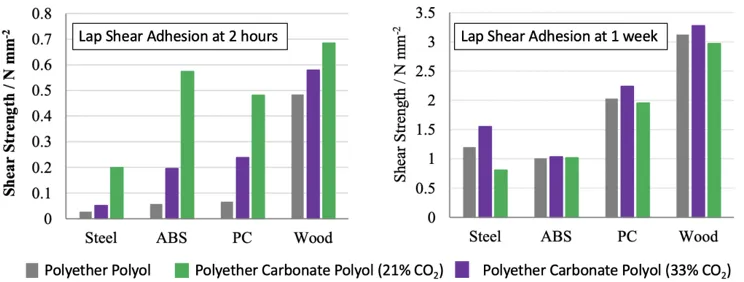
Lap Shear Adhesion Results for Polyether Polyol Vs. Polyether Carbonate Polyols in Reactive Hot-Melt Adhesives
Additionally, the polycarbonate polyols provided improved lap shear adhesion performance versus a polyether polyol benchmark. This offers a great advantage in terms of processing with the possibility for faster de-mold times in production as a result of the high green strength benefit.
Lignin Adhesives from Michigan State University
Lignin from different sources has different properties, such as:
- Molecular weight
- Chemical structure
- Functionality and degree of crosslinking
From one perspective, this means that in order for lignin to become a commodity raw material, that a lignin product must be isolated from a single plant or tree using the same process so that the quality of that lignin will be repeatable.
On the other hand, this also means that different types of lignin's convey these properties to different degrees depending upon:
- The plant or tree source (hardwood, softwood, and annual crops), and
- The isolation processes (kraft, organosolv, and soda)
Mojgan Nejad and her team at Michigan State University have characterized lignin from twenty different sources and determined that polyurethane adhesives could be developed that contain greater than 50% bio-renewable lignin content and provide improved adhesive performance (figure below) in cross laminated timber applications[12].
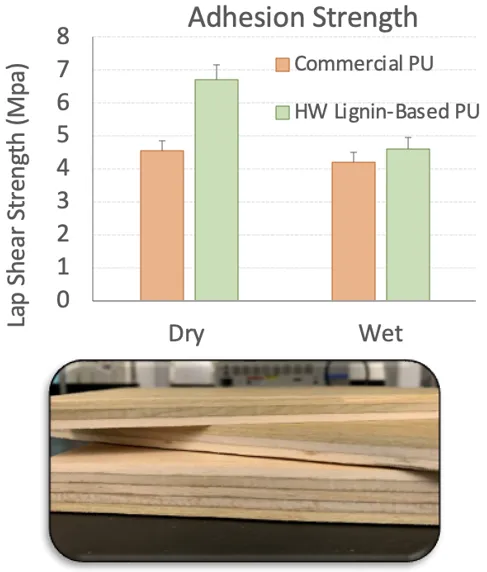
Comparison of MSU Polyurethane Lignin Vs. Commercial PU Adhesive in Cross Laminated Timber
Discover the Latest Research Activities in Lignin and Wood Biomass Derived Bio-products!
Pentamethylene Diisocyanate from Covestro
Covestro has recently launched a bio-based isocyanate, Desmodur® eco N 7300. The product is the trimer of pentamethylene diisocyanate (PDMI Trimer), which is produced using pentamethylene diamine. Pentamethylene diamine is produced using a fermentation process from biomass.
- The product provides improved dry times and formulation compatibility versus petroleum-based trimer of hexamethylene diisocyanate (HDMI trimer), as shown in the figure below.
- Other performance attributes, such as weathering resistance, pot-life and chemical resistance are comparable to the petroleum-based trimer of HDMI[13].
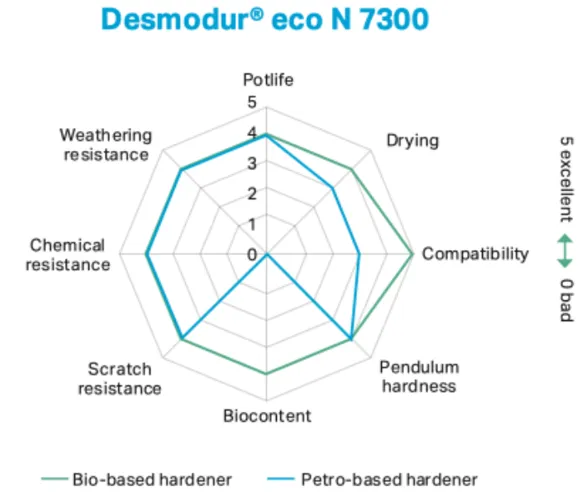
Radar Chart Comparison of Performance HDMI Trimer Vs. PDMI Trimer
Conclusion
Our efforts towards innovation in raw materials for polyurethane adhesives and sealants have seen a profound emphasis on sustainability in lock step with performance during the past decade.
Polyurethanes are an extremely versatile polymer class which will continue to play an important role in construction, packaging, transportation, energy and medical applications, just to name a few. The future of polyurethanes will undoubtedly see more developments in the areas of:
- Nanotechnology
- CO2 sequestration
- High performance composites for renewable energy applications
- Self-healing polyurethanes, and
- Fermentation-based raw materials
- W. Coggio, M. Gehrung, M. Tjosaas, “Polylactic Acid Polyols in Urethane Coatings”, PCI Magazine, Nov. 1, 2019.
- T. Yoo; S. K. Henning, “Synthesis and Characterization of Farnesene-Based Polymers”, Rubber Chemistry and Technology (2017) 90 (2): 308–324.
- Technical Update: “Krasol® F 3000 Novel Bio-Based Diol for Polyurethanes”, Obtained from http://www.crayvalley.com/docs/tds/krasol-f-3000.pdf?sfvrsn=8672c740_6, accessed on Sept. 19, 2020.
- Elevance C18™ Polyols Technical Datasheet accessed on Sept. 19, 2020 https://elevance.com/product/c18-polyols/?prod-id=424&cat-id=polymer_building_blocks-13.
- T. Snead, S. Cohen, D. Gildon, “Method of Refining and Producing Dibasic Esters and Acids from Natural Oil Feedstocks”, US 9,000,246 B2 assigned to Elevance Renewable Sciences, April 7, 2015.
- A.K. Patel, B. Pease, B.J. Breyer, Y. Viswanath, “High Purity Dibasic Acid Compositions and Methods of Making the Same”, Assigned to Elevance Renewable Sciences, Inc. on Nov. 8, 2016.
- https://pyranco.com/about-pyran/ accessed on Sept. 19, 2019. G.W. Huber, J.A. Duesic, K.J. Barnett, Z.J. Brentzel, “Production of 1,5-Pentanediol via Upgrading of Tetrahydrofururyl Alcohol”, US 10,183,904 assigned to Wisconsin Alumni Research Foundation, Jan. 22, 2019.
- https://www.pcimag.com/ext/resources/Events/CTT/2019ppt/BarnettKevin_Pyran.pdf, accessed Sept. 19, 2020.
- M. Kember, S. Tickle, M. Andrews, S. Carruthers, R. French, L. Taylor “Performance Advantages of CO2 Containing Polyols from Tunable Catalyst Systems”, 2018 Conference of the Polyurethane Industry paper.
- Email communication between Mojgan Nejal and Rick Tabor on Sept. 17, 2020.
- “Polyisocyanates and Prepolymers” technical brochure accessed from www.covestro.com website on Sept. 19, 2020.