

Surfactants in adhesives & sealants: Where to get started with selection?
Last update on Apr 22, 2026
Role of surfactants
Advantages
Surfactants are used in both waterborne and solvent-based adhesive formulations. In solvent-based systems, their primary use is as dispersing agents.
In adhesive formulations, surfactants are used to change many end properties. They are used in the adhesive formulations to provide the following characteristics without negatively impacting adhesion.
- Reduce surface tension to extremely low values for improved substrate wetting
- Help to avoid defects occurring in the adhesive coating - especially on contaminated or difficult surfaces
- Improve flow
- Promote wetting and dispersion of additives
- Optimize stability of pigments and latex particles
- Overcome foaming issues
They are also used by the latex raw material manufacturing to emulsify polymers in their liquid state and to provide the following characteristics:
- Micelles formulation, where the polymerization reaction takes place
- Protection of the polymer particles from agglomeration due to external stress (e.g., temperature during storage, high shear during application, etc.)
- Significant reduction in surface tension
- Prevent excessive foaming

Drawbacks
The major disadvantage of using surfactants is that they generally increase the water sensitivity of the adhesive. The surfactant also may not stabilize a latex in difficult situations, such as when the product is applied at high speed or when mixed with other systems.
Due to these factors and the surfactants that are commercially available, the selection process is difficult. Also, the formulator often needs to turn to trial-and-error.
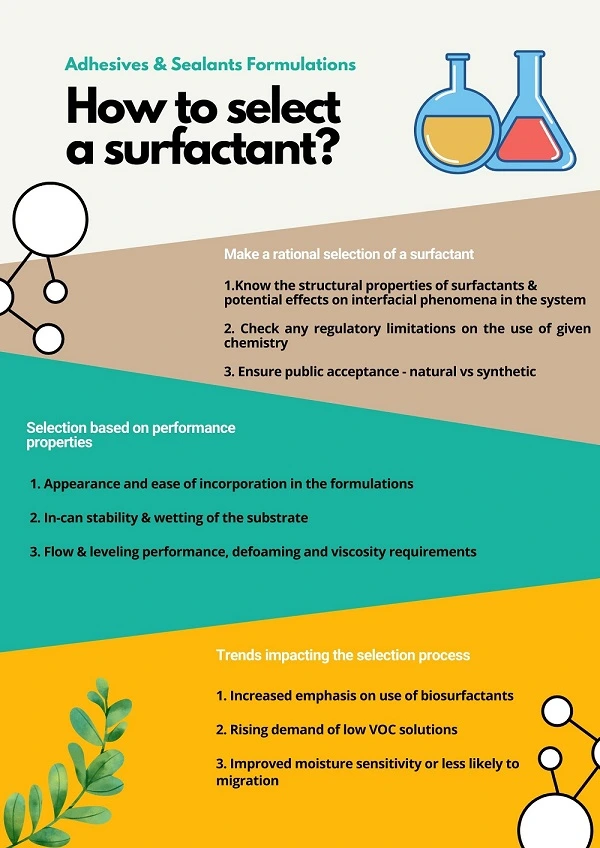
Let's discuss each and every factor you should consider while selecting a suitable surfactant for your formulation in detail.
Classification of surfactants
To understand how surfactants operate and to select a surfactant for a specific purpose, it is necessary to classify surfactants according to their structural features. From the commercial point of view, surfactants are often classified according to their use. However, this is not very efficient because many surfactants have several uses.
For example, surfactants can be used as emulsifiers in one application and as wetting agents, dispersants, or stabilizers in another. A more accepted approach to classifying surfactants is by their structure and chemistry.
Structure of a surfactant
A surfactant molecule consists of two key groups in its structure.
- Polar hydrophilic head groups – It makes the surfactant soluble in polar solvents such as water.
- Non-polar hydrophobic tail groups – It makes the surfactant soluble in non-polar solvents and oil.
The relative sizes and shapes of the hydrophobic and hydrophilic parts of the surfactant molecule determine many of its properties. The hydrophobic group in the surfactant structure is made up of hydrocarbon chains, fluorocarbon chains, and a combination of fluorocarbon and hydrocarbon chains or silicone chains.
However, surfactants are also characterized by the chemical structure of their hydrophilic groups, either ionic or non-ionic. This is depicted in the figure below. Select ideal surfactant grades, request samples and download technical data on our platform!
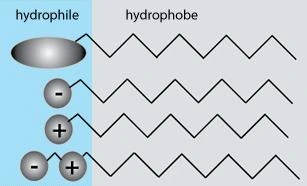
Surfactant classification according to the composition of their head:
from top to down respectively non-ionic, anionic, cationic, and amphoteric
Ionic surfactants can, unlike non-ionic surfactants, dissociate into ions in an aqueous medium. The hydrophobic part can belong to a negative or positive ion.
Surfactants can generally be classified into four types:
- Anionic surfactants – The hydrophobic part is an anion, for example I-
- Cationic surfactants – The hydrophobic part is a cation, for example Na+
- Amphoteric surfactants – They have at least one anionic and one cationic group
- Non-ionic surfactants – They have neither positive nor negative charge
The hundreds of commercially available surfactants can be divided into the basic classes described above which makes the selection process much easier. The most important classes for adhesive and emulsion formulations are non-ionic surfactants and anionic surfactants.
Let's take a deeper look at these classes.
Anionic surfactants
Anionic surfactants contain negatively charged functional groups at their head. Examples of anionic surfactants are:
- Sulfates
- Carboxylates, and
- Phosphate esters
These are the most common surfactant in general use (detergents, cleaners, etc.) and many find use in emulsion polymerization. This is because of their affinity for hydrogen bonding with the aqueous medium.
Cationic surfactants
Cationic surfactants contain positively charged functional groups at their head. Cationic surfactants are typically amine derivatives, such as quaternary ammonium compounds. Most of these surfactants are used as anti-microbials and anti-fungals. Cationic surfactants are less commonly used in adhesive formulations because of their certain limitations, such as:
- High cost
- Inefficient emulsifying capability, and
- Undesirable effects on initiator decomposition
Cationic surfactants are avoided for being applied in waterborne systems. However, they are successfully used in solvent-borne systems, for instance to support the wetting and dispersing process.
Non-ionic surfactants
Non-ionic surfactants (alcohol ethoxylate, EO/PO types, etc.) can be differentiated from ionic surfactants in important ways.
- They do not dissociate into ions.
- Since they do not dissociate into ions in water, they are less sensitive to electrolytes and pH changes.
- They are soluble in acid and alkaline medium and are compatible with ionic and amphoteric species.
- Unlike ionic surfactant, these surfactants are not preferentially adsorbed on charged surfaces.
- Their solubility decreases with increasing temperature and at the cloud point, the aqueous solution becomes turbid.
Non-ionic surfactants are commonly used in adhesive formulations. However, in emulsion polymerization, they are rarely used alone due to their inferior efficiency in creating stable emulsions in comparison to anionic surfactants. Because of this, non-ionic surfactants are usually used with anionic surfactants and impart a second method of colloidal stabilization. Latexes that require stability over large pH ranges use larger non-ionic to anionic surfactant ratios.
The main classes of non-ionic surfactants are polyglycoether derivates such as:
- Alkyl- and alkyl-aryl polyethylene glycol ether (alkyl PEG)
- Polypropylene glycol ether, and
- Block copolymers of polyethylene glycol and polypropylene glycol
Many long chain alcohols exhibit non-ionic surfactant properties.
For non-ionic surfactants, the chemistry and length of the hydrophilic chain can be varied to modify what is called the hydrophile-lipophile balance (HLB) for the surfactant. This is the ratio based on molecular weight of the oil loving (hydrophilic) to the water loving portion (lipophile). HLB affects interfacial behavior and the stabilization of emulsions and is important in selecting a non-ionic surfactant.
Considering all industries, there are thousands of surfactants that are commercially available. Within the adhesives industry non-ionic surfactants along with specialty surfactants such as fluoro- and silicone-based surfactants are the most commonly used. Anionic surfactants are also used primarily in emulsion polymerization processes.
Descriptions of >400 surfactants are contained in the SpecialChem Adhesives Additives Master Catalog. They include the various types of surfactants that are shown in table below and focused on in the remainder of this guide.
| Anionic | Cationic | Non-ionic | Other |
|
|
|
|
Types of surfactants
The description and example of commercial surfactants within types mentioned above is given in the table below,
| Surfactant Type | Characteristics | Example Product |
| Anionic Surfactants | ||
| Alkyl ether sulfates |
| Alkylaryl polyglycol ether |
| Phosphate esters |
| EO phosphoric acid ester |
| Cationic Surfactants | ||
| Alkylammonium salts |
| Anionic ammonium lauryl sulfate |
| Non-ionic Surfactants | ||
| Acetylenics |
| Acetylenics |
| Alcohol Ethoxylates |
| POE-cetyl alcohol |
| Alcohols |
| POE-tridecanol |
| Alkylphenol ethoxylates |
| Alkylphenolethoxylate |
| Amides |
| Modified polyamide/epoxy adduct |
| Amine Oxides |
| Low toxicity trifunctional amine. |
| Amines |
| Alkoxylated ethylene diamine |
| Copolymers |
| Linear EO/PO block copolymers |
| Fatty Acids |
| Formulation of surfactant and modified fatty acids |
| Nonylphenol Ethoxylates |
polar solvents and water
surfactant and latex post-stabilizer | Sodium nonylphenolether sulphate |
| Other Surfactant Chemistries | ||
| Fluorosurfactants |
| Short-chain perfluoro-based amphoteric fluorosurfactant |
| Silicone-based |
| Siloxane based surfactant |
| Polyamide / Acid Ester Salts |
| Stearic acid salt |
Description and examples of common surfactants used in adhesives and emulsions
Surface active adhesive additives are rarely mono-molecular products; they are mainly polymeric. These are preferred for reasons of providing:
- Best performance
- Best film integrity
- Low risk of being extracted from the dried film and minimal side effects
Working mechanism of surfactants
The term surfactant is the acronym of surface active agent. Surfactants are materials that lower the surface tension (or interfacial tension) between two liquids or between a liquid and a solid. The surface tension is defined as "the force which acts in a material to adapt the smallest possible surface under the set conditions".
In the general sense, any material that affects the interfacial surface tension, can be considered a surfactant. But in the practical sense, surfactants may act as wetting agents, emulsifiers, foaming agents, and dispersants. Surfactants reduce the surface tension of water by adsorbing at the liquid-air interface.
Surface activity is achieved when the number of carbon atoms in the hydrophobic tail is higher than 8.
- Surfactant activities are at a maximum if the carbon atoms are between 10 and 18 at which level a surfactant has good but limited solubility in water
- If the carbon number is less than 8 or more than 18, surfactant properties become minimal
- Below 8, a surfactant is very soluble and above 18, it is insoluble
Thus, the solubility and practical surfactant properties are somewhat related.
Micelle formation
Many surfactants can also assemble in the bulk solution into aggregates. Such aggregates are known as 'micelles'. The concentration at which surfactants begin to form micelles is known as the critical micelle concentration (CMC). When micelles form in water, their tails form a core that can encapsulate an oil droplet or polymer product, and their (ionic/polar) heads form an outer shell that maintains favorable contact with water. The formation of micelles leads to the stabilizing effect provided by surfactants in solution.
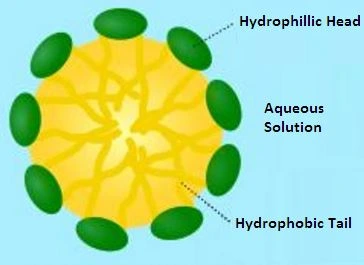
Micelles around a polymer particle provide protection
The hydrophobic tails form the core of the aggregate and the hydrophilic heads are in contact with the surrounding liquid. The shape of the aggregates depends on the chemical structure of the surfactants, namely the balance in size between hydrophilic head and hydrophobic tail. A measure of this is the HLB, hydrophilic-lipophilic balance.
Most waterborne adhesives are an emulsion of polymer particles dispersed in water. So surfactants are added by the emulsion manufacturer to lower interfacial tension and stabilize polymer particles to prevent demulsification.
Having covered what surfactants are and how they work, let’s take a closer look at the properties they affect and why it matters for your formulations.
What are the properties affected by surfactants?
Surfactants affect a wide array of physical properties in adhesive systems. Surfactants affect the behavior of the adhesive not only during the formulation and application process but also during the lifetime of the bonded joint.
For example, surfactants are used to stabilize the dispersion of polymer particles during emulsion polymerization. The addition of surfactants improves:
- Mechanical stability
- Freeze-thaw stability, and
- Shelf-life of paints
The addition of surfactants also allows the adhesive to coat and wet a surface more easily. This is because surfactants increase the wetting of a solution.
However, the addition of surfactants does not always have a positive effect on all properties. The water resistance of the coating can be decreased with surfactant addition. This is because surfactants can be very water-soluble and will easily migrate out of the adhesive bond during service. The type and amount of surfactant will determine which water properties are affected and the extent of the change.
Fluorocarbon and silicone-based surfactants
Fluorocarbon and silicone-based surfactants have a unique place in the surfactant industry. These surfactants in water and non-aqueous systems reduce the surface tension lower than the hydrocarbon chain surfactants. Both fluorocarbon and silicone chain surfactants have better thermal and chemical stability than hydrocarbons. Also, they provide excellent wetting for low-energy surfaces. However, due to their costs, these surfactants are used in limited applications.
Surfactants may be added before the emulsion polymerization process or to already manufactured emulsions to further improve their properties. A mixture of anionic and non-ionic emulsifiers is generally used.
Surface active properties of surfactants
The principal surface active properties exhibited by surfactants are listed below1. Many surfactants possess a combination of these properties.
- Wetting
- Foaming / defoaming
- Emulsification / demulsification of emulsions
- Dispersion / aggregation of solids
- Solubilization due to hydrotropic properties
- Adsorption
- Micellization
- Detergency (which is a complex combination of several properties)
- Synergistic interactions with other surfactants
In addition, depending on the chemical composition of a particular surfactant, some products may possess important secondary properties including:
- Corrosion inhibition
- Biocidal properties
- Lubricity
- Stability in highly acidic or alkaline media
- Viscosity modification
- Conformance to FDA or BGA regulations for some applications, e.g. direct/indirect food contact
From this list one can immediately see the great number of functions that a surfactant can provide. Also, the difficulty inherent in selecting a surfactant for a particular formulation or set of requirements. As a result, the formulator must know what properties need to be adjusted by the use of the surfactant additive.
Emulsion adhesive films prepared with conventional surfactants can show increased weight by up to 120%. This is due to water uptake, especially at high surfactant concentrations. The water uptake leads to general degradation in both adhesive and cohesive properties of the emulsion film.
In addition to increase in water sensitivity, surfactants may migrate if incompatible, to the adhesive surface. This causes a decrease of tack. Surfactants that are compatible with the adhesive generally act as plasticizers. They may increase tack and peel adhesion and decrease shear resistance. Table below shows the effect of some surfactants on the properties of a pressure sensitive adhesive.
| Surfactant Type | Amount, phr | Surface Tension dynes/cm | 180 Degree Peel Strength N/m | Shear Creep Resistance Hours | Rolling Ball Tack cm |
| No surfactant | 0 | 48.7 | 426 | 11.0 | 3.0 |
| Fluorocarbon | 0.02 | 45.9 | 404 | 8.0 | 3.0 |
| Non-ionic | 0.2 | 46.0 | 481 | 6.7 | 3.6 |
| Anionic | 0.2 | 40.0 | 393 | 6.4 | 5.9 |
Effect of surfactants on the physical properties of pressure sensitive adhesives
With the effects of surfactants clear, it’s important to know how to select the most suitable grade and apply it in your adhesive or sealant formulations.
Surfactant selection and formulation guidelines
Trends driving development of new surfactants
- Karsa. (2006). History and applications of surfactants. In Chemistry and Technology of Surfactants (pp. 1–23). Blackwell Publishing Ltd.
- Myers. (2005). The organic chemistry of surfactants. In Surfactant Science and Technology (3rd ed., pp. 33–79). John Wiley & Sons, Inc.
- Meng. (2007). Novel applications for fluorosurfactants in low-VOC coatings. Paint & Coatings Industry.