
Designing styrene block copolymer hot-melt adhesives for high peel strength and adhesion
Last update on Apr 7, 2026
This article was originally published in 2012 and revised in 2026.
Styrene Block Copolymer (SBC) hot-melt adhesives are widely used due to their versatility. They offer a balance of low-temperature flexibility and high heat resistance. They primarily rely on the microphase-separated structure of SBC. SBC hot-melt adhesives consist of rubbery mid-blocks and hard polystyrene end-blocks.
Sometimes, innovations emerge that force existing guidelines for formulating adhesives to be reconsidered. The principles, abilities, and limitations of using styrene block copolymers in hot-melt adhesives are well-known. However, thinking beyond the standard SBC through the use of tapered SBCs delivers additional capabilities compared to those delivered by traditional polymers and additives.
In this article, we will explore how SBC structure and formulation strategies can be optimized to enhance peel strength, tack, and elongation in hot-melt adhesives.
Structure of SBC hot-melt adhesives
Styrene Block Copolymer (SBC) hot-melt adhesives rely on the unique microphase-separated structure of SBC. This consists of two distinct segments, which are discussed in detail below.
Mid-blocks
Mid-blocks are the rubbery phase of SBC hot-melt adhesives. These are soft elastomeric segments located between the polystyrene end-blocks1. They provide flexibility, tack, and form a base for the adhesive, contributing primary adhesive properties.
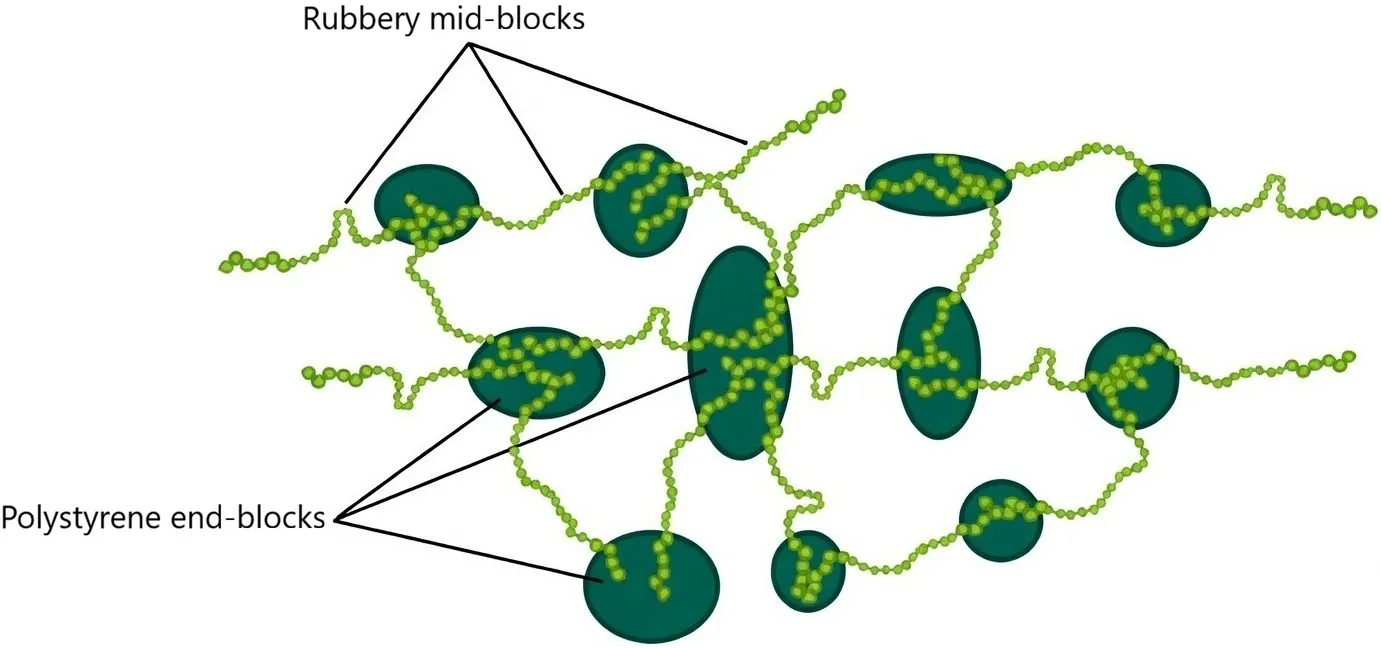
Figure 1: Structure of styrene block copolymers in hot-melt adhesives (Depicting polystyrene hard end-blocks and rubbery mid-blocks)
End-blocks
End-blocks are the styrenic phase of SBC hot-melt adhesives. They are hard polystyrene segments that form physical domains through microphase separation (Refer to Figure 1). At room temperature, they act as physical crosslinks, providing cohesion and strength. At elevated temperatures, these domains soften and dissociate. This allows the material to flow and be processed as a hot-melt. They add bulk strength to a hot-melt.

How to achieve high peel strength?
Preventing interfacial failure
The first step to accomplishing high peel strength in a hot-melt adhesive is to prevent easy interfacial failure. This requires:
- Good wet-out
- Sufficient specific adhesion
- Hot tack before the adhesive solidification
While SBCs can flow when heated, adding formulation additives is essential:
- Waxes, plasticizers, and C9 aromatic end-block compatible tackifier resins modify their melt viscosity and wet-out.
- Mid-block compatible tackifiers (e.g., C5 aliphatic resins, rosin esters, and polyterpenes) can also improve specific adhesion.
- Diblock copolymers can be mixed with tri-block polymers to increase tack at the expense of some cohesion.

Figure 2: Typical elongation and tensile strength ranges for base SBCs used in hot-melt adhesives
Ensuring the adhesive's rheology
The second step to achieve high peel strength is ensuring the rheology of adhesives. This means only high energy input during removal can cause debonding or fracture. For that, the formulator must carefully adjust the glass transition temperature (Tg) and morphology of the adhesive.
Peel strength is more closely tied to the adhesive's ability to dissipate energy than its bulk strength. That ability is linked to its loss modulus, which peaks near its Tg. For many SBCs, Tg peaks at around -50°C, but is low near room temperature service conditions2. Therefore, tackifiers are typically used to raise the Tg to enhance peel strength.
Low-molecular-weight and low Tg end-block plasticizers can lower melt viscosity by disrupting the hard styrene polymer blocks and reducing entanglement density. However, if melt viscosities are already low enough to achieve adequate wet-out, higher molecular weight, higher Tg resins can be used to reinforce and stiffen the SBC.
This can improve cohesive strength and elongation, although bonding rigid substrates also needs a sufficiently flexible, low modulus, adhesive layer where deformation will start3. Elongation also depends upon the nature of the SBC used. Standard unsaturated styrene-butadiene-styrene (SBS) and styrene-isoprene-styrene (SIS) copolymers typically offer the highest values.
Overcoming formulation trade-offs with tapered SBC
Unfortunately, some additives that improve the properties of hot-melt SBC adhesives can have both desirable and undesirable effects
For example, waxes that are often used to lower melt viscosity are non-polar4. This means that they make a poor contribution to specific adhesion with polar substrates used in paper labels and disposable soft articles such as diapers and surgical dressings.
Tapering the transition between blocks
One alternative approach was developed to lower the melt viscosity of the SBC hot-melt adhesive. This approach was to move away from copolymers with a sharp transition between mid and end blocks.
Tapering the transition between styrene end-blocks and rubbery mid-blocks lowers the processing temperature of block copolymers. Instead, tapered SBCs insert an additional block between the mid and end-block. The extra block contains a mixture of both of the monomers used in the polymer sections flanking it. It increases the level of interference between the two separate domains by reducing the "penalty" of mixing between them5.
This may seem undesirable, as completely mixing the two domains would create a random copolymer that would break down the network that gives SBCs their performance. However, this effect is similar to the styrene block disruption and entanglement lowering performed by low molecular weight end-block modifying resins.
Logically, tapered block copolymers should deliver an optimum melt flow rate where mechanical properties are at a minimum for usefulness in an adhesive. But instead, researchers have found that the best melt flow rate could be delivered at tapering ratios between the monomers in the extra block that retained desirable mechanical properties for an adhesive.

Figure 3: Tapering the transition between styrene end-blocks and rubbery mid-blocks
Production of tapered block copolymers
One approach for making tapered styrene-isobutene-styrene (SIS) copolymers for use in adhesives is using a sequential living polymerization6.
Instead of waiting for all the isoprene to be consumed by the growing mid-block, before adding the final portion of styrene is added when half of the isoprene is still in monomer form. This creates a tapered segment containing a mixture of isoprene and styrene between the mid-block and end-block.
Performance of tapered SBC-based adhesives
Recently, researchers have been exploiting tapered block copolymers. They provide hot-melt styrene block copolymer adhesives enhanced:
- tack,
- elongation, and
- peel strength7
Researchers produced a 40.5% by weight styrene content tapered SB diblock copolymer by polymerizing the first styrene block. Butadiene monomer and another portion of styrene monomer were shortly added afterwards. Adding the styrene before all the butadiene had been able to polymerize created an SB tapered diblock.
Performance of hot-melt adhesives based on conventional SBCs and formulations including a tapered diblock, with all formulations including the same amount of tackifiers, oil, and antioxidants is shown in Figure 4. Ratios shown are:
- Standard styrene-butadiene diblock
- Tapered styrene-butadiene diblock
- Standard styrene-butadiene-styrene triblock
All polymers are produced using a stepwise anionic polymerization unless noted. (H) denotes a formulation where the copolymers were half the molecular weight of those in other examples. The leftmost three formulations do not include tapered diblock, the rightmost five do.
The scientists mixed the resulting diblock with conventional SB diblocks and SBS triblocks and tested the combination in an adhesive formulation alongside three conventional block copolymers.
Each of the polymer mixtures was combined with the same amount of tackifier, plasticizer, and antioxidant to deliver a hot-melt adhesive. Most formulations provided enhanced elongation, tack, peel strength, and holding power at elevated temperatures compared to the conventional adhesives.
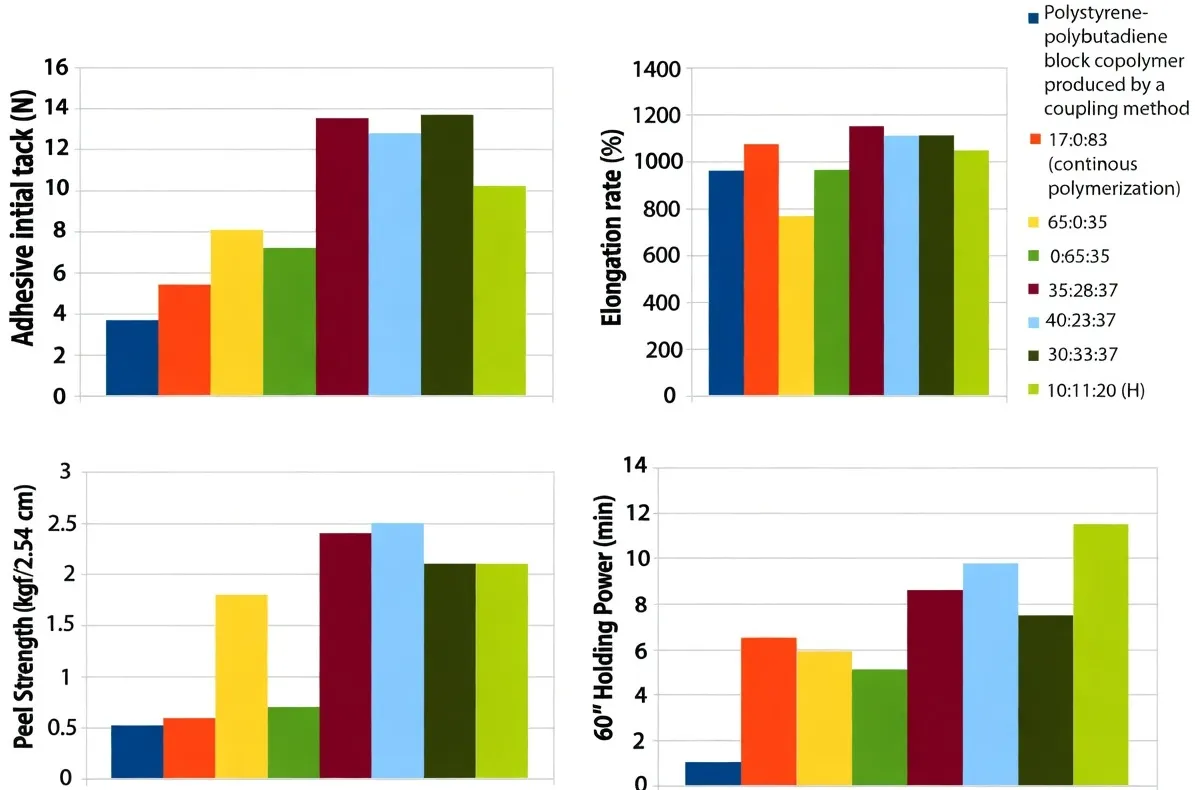
Figure 4: Performance of hot-melt adhesives based on conventional SBCs7
Industry perspective
Tackification and plasticization techniques are used to make hot-melt SBC adhesives in part because of the properties of conventional block copolymers are most commonly available.
Whether tapered block copolymers will be adopted more widely will depend on whether reducing the amount of additives used outweighs the increased cost of using a more exotic polymer.
But with tackifier prices often being a cause for concern for adhesive producers, perhaps they will indeed have a part to play.
- (n.d.). Tackifier Center Resources for Formulation. Eastman.
- Petrie, E. (2007). An Overview of Styrene Block Copolymer (SBC) Adhesives. SpecialChem.
- Dillard, D. A., Pocius, A. V., Chaudhury, M., Eds., Paul, C.W. (2002). Adhesion Science and Engineering Volume 1, The Mechanics of Adhesion/Surfaces, Chemistry Applications. Elsevier. Chapter 15.
- Extance, A. (2009). Using Waxes in Hot Melt Adhesives. SpecialChem.
- Snyder, K. (2010). Lessening the Penalty for Creating Block Copolymer Nanostructures. National Synchrotron Light Source. Brookhaven National Laboratory.
- Van Dijk, M. A.; Veurink, J. M.; Van de Vliet, B. M. L. C.; Van Westrenen, J. (1996). "Linear block copolymers, process for their preparation and adhesive composition containing them". US Patent No. 5,510,423.
- Chan, K.-H., Chen, T. H., Chiu, T. W. (2011) "Mixture Of Conjugated Diene - Vinyl Aromatic Hydrocarbon Copolymers And Adhesive Composition Having The Same". US Patent Application No. 20110152436.