

How to Formulate RTV Silicone Sealants?
Last update on Nov 23, 2024
This article was originally published in 2005 and updated in 2024.
Silicone polymers display an exceptionally wide range of chemistries and physical properties. These polymers can be low-viscosity liquids, crosslinkable elastomers, or hard solids. Adhesives and sealants represent only one major class of commercial silicone products. These versatile materials were introduced approximately 30 years ago, and many original formulations are still utilized.
Applications for silicone sealants are extremely broad including:
- construction and consumer goods
- automotive and aerospace,
- assembly and maintenance,
- electrical and electronic products
Silicone sealants often compete with other materials such as polyurethanes, polysulfides, and acrylics. However, in applications requiring long-term durability in harsh environments, silicones are generally specified.
One of the most popular subclasses of silicone sealants is the RTV (room temperature vulcanizing) product. RTV silicone products are formulated from relatively low molecular weight linear polymers. A crosslinking reaction begins at the time the product is put into use. These crosslinking reactions occur at room temperature. Hence the term "RTV", and they are generally moisture-curing reactions. Both one- and two-component RTV silicone sealants are available. Unlike many other one-component systems, RTV silicones are noted by exceptionally long shelf-life (3-4 years) without degradation of properties.
Let's get started.
Characteristics of RTV Silicone Sealants
Some of the key attributes of silicones in adhesives and sealants are listed in Table 1.
Attributes | Characteristics |
| Low surface tension | Ability to bond well to low surface energy substrates |
| High water repellence, insolubility in water | Excellent moisture resistance and applicability as a sealant |
| Large free volume, freedom of rotation around bonds | Excellent elongation |
| Low apparent energy of activation for viscous flow | Easy extrudability |
| Low glass transition temperature | Flexibility and strength at low temperatures |
| High gas permeability | Capability of efficient moisture cure mechanisms |
| High thermal and oxidative resistance | Good elevated temperature and outdoor aging characteristics |
| Low reactivity | Excellent chemical and UV resistance |
| High silicone - oxygen bond energy | Very high temperature resistance |
Table 1: Key Attributes of Polymeric Silicone Adhesives and Sealants1
Why choose RTV silicone sealants over adhesives?
RTV silicone sealants offer superior durability in most environments. These materials bond readily to many substrates and provide excellent elongation. They bond well to many low-surface energy plastics due to the relatively low surface tension of the RTV silicone formulations.
However, these products do not have a high degree of tensile strength or tear and abrasion resistance as epoxies and polyurethanes. For this reason, RTV silicone formulations are more commonly used as sealants than as adhesives. Although they are also often utilized as coatings and soft potting compounds. Typical physical properties of several RTV silicone formulations are shown in Table 2.
Property | Low Modulus | Medium Modulus | High Modulus |
| Tensile strength, psi | 100-200 | 200-600 | 600-1200 |
| Elongation, % | 100-1200 | 100-700 | 300-1000 |
| Hardness, Shore A | 10-30 | 20-60 | 24-60 |
| Tear strength, lb/in | 10-20 | 20-80 | 80-200 |
RTV silicone sealants also offer excellent reliability. The compounds are simple to apply and do not contain flammable or toxic solvents. They can be applied over a very wide temperature range (-40°C to +65°C). Cure rates can be adjusted through formulation, thereby allowing flexibility in the application. Both one and two-component curing types are available. Fully cured RTV sealants can be used for extended periods up to 220°C and for shorter periods up to 270°C.
Figure 1 illustrates the peel strength of an RTV sealant on aluminum as a function of heat aging. The low temperature limit for these products is generally limited to -60°C, because of crystallization that can occur at that temperature. The formulations are generally soft and compliant. Silicone sealants have a high range of movement capability, from +100% to -50%. They have good chemical and environmental resistance. Their resistance to heat, water, and UV is excellent.

Uses of RTV sealants
Construction industry: RTV sealants have a very low shrinkage on cure and excellent gap-filling capabilities. This makes these sealants valuable in many construction applications. They are expected to perform for extended periods of 20-30 years or more.
Sealing applications: These sealants can bond, waterproof, and electrically insulate. RTV silicone compounds have been used for formed-in-place4 gaskets and potting compounds. They are more conventionally used to seal exterior joints, metal-to-glass, and expansion joints. They are also used in other substrates where a high degree of movement is expected.
- Other applications:
- RTV sealants have outstanding chemical and moisture resistance. This makes them ideal for bathrooms and kitchens as well as marine applications.
- These sealants have high-temperature resistance. Hence, they provide useful sealants in automotive engine applications, high-temperature appliances (e.g., ovens) and industrial processes.
- These sealants can be applied easily and have relatively quick curing capability. This makes them useful in electrical/electronic and appliance applications.
Pros and cons of RTV sealants
The advantages and disadvantages of RTV silicone sealants are summarized in Table 3. They have relatively few disadvantages. Paint or conventional adhesives do not adhere to silicone sealants. Certain types of silicone sealants will produce acetic acid as a byproduct of curing. This could be of concern in applications where the acid may corrode metallic components that are near the sealant.
Advantages | Disadvantages |
| Low temperature extrudability | Poor unprimed adhesion to masonry |
| Glass adhesion | Dirt pickup |
| UV and ozone resistance | Poor tensile strength and tear resistance |
| Fast cure | Short tooling time |
| No shrinkage on cure | Certain types have corrosive byproducts |
| 20 year durability | Paint will not adhere well to silicone |
| High elongation: +100% to -50% movement capability | |
| Resistance to high temperatures and chemicals |
Technologies Supporting RTV Silicone Sealants
The base component for formulating RTV silicone sealants is silicone polymers. Additionally, other modifiers can also be added to tweak your formulation. Common additives include fillers, crosslinking agents, and catalysts. The selection of raw materials depends on the application and performance properties required of the end product.
Silicone base polymer
The fundamental building block of a silicone sealant is polymeric siloxane. This is often represented by poly(dimethylsiloxane) as shown in Figure 2. These siloxanes typically have viscosities in the 2,000 to 150,000 cps range. However, as with other sealants, RTV silicones tend to be highly formulated systems.
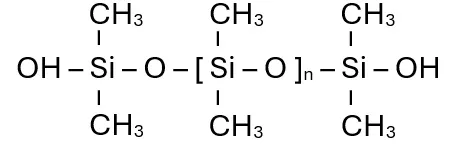
Note: The synthesis of silicone polymers is a multistep process that begins with elemental silicon. The manufacture of silicone polymers is outside the scope of this article.
The silicone polymer has a siloxane (Si-O-Si), with alkyl and alkoxy or acetoxy pendant groups. The latter is readily hydrolyzed to silanol groups (SiOH) that form larger chains. This is done by condensation and loss of a byproduct such as alcohol or acetic acid. The silanol (-OH) terminated silicone polymer (Figure 2) is the basis for formulating:
- one component,
- moisture curing RTV silicone sealants, and
- two-component, condensation-curing RTV silicone compounds
Additionally, cure or platinum-cure formulations are also available with silicone polymers. However, these formulations generally require elevated temperatures for effective crosslinking. Therefore, addition cure silicones are not typically considered to be "RTV". They deliver fast, well-defined properties usually with a cure temperature between 85°C and 110°C and cure times of 10-20 minutes. They are generally used when high throughput conditions are required.Several two-part platinum cure systems that can be cured at room temperature have recently been developed.5 However, these sealants are often difficult to use. This is because the working time is short (on the order of 15 mins) and the cure times at room temperature are relatively long (4-10 hrs).
The finalized silicone polymer is neither organic nor inorganic. It is rather a unique combination of both chemistries.
- The silicon-oxygen part of the molecule is the inorganic part. It provides inherent chemical resistance, high-temperature characteristics, and environmental stability.
- The methyl side group is the organic part of the molecule. It provides the elongation necessary for a sealant.
Both these parts and properties are characteristics of RTV silicone adhesives and sealants. When special properties are needed, other organic functional groups can be substituted for the methyl groups present in the polysiloxane. In this way, silicone polymers have been synthesized having lower brittle points (-90°C as compared to -60°C) and greater fuel resistance via the substitution of diphenyl groups and cyanoethyl groups respectively.
Crosslinking agents
The crosslinking agent used in RTV silicone systems consists of a species that can be represented as:
- R-Si-X3 - Typically used in one-component systems
- Si-X4 - Typically used in two-component systems
The R is an organic group such as a methyl, ethyl, or vinyl, and the X is a moisture hydrolyzable group. A simplified cure mechanism for a one-component silicone RTV sealant is shown in Figure 3.

Repeated hydrolysis and reaction of resultant polymer end groups lead to full cure with elimination of HX as a byproduct of the condensation reaction. Examples of byproducts and crosslinking agents are given in Table 4 along with the conventional terminology used for the specific silicone cure systems.
Byproduct Group (HX) | Crosslinker | RTV Silicone Cure System |
HOC(O)CH3 | CH3Si[OC(O)CH3]3 | Acetic acid (acetoxy) |
HOCH3 | CH3Si(OCH3)3 | Alcohol (alkoxy) |
HONC(CH3)(C2H5) | CH3Si[ONC(CH3)C2H5]3 | Oxime |
CH3C(O)CH3 | CH3Si[OC(CH2)CH3]3 | Acetone |
HN(CH3)C(O)C6H5 | CH3Si[N(CH3)C(O)C6H5]3 | Benzamide |
The acetoxy cure system is the most common RTV system and it has been used for the longest period of time. However, the byproduct is acetic acid and this could be corrosive to metal substrates or undesirable because of the odor. The alkoxy cure systems produce a byproduct that is noncorrosive and has an unobjectionable odor. The acetoxy, alkoxy, and oxime chemistries are the most prevalent today. The characteristics of these cure systems are summarized in Table 5.
RTV Cure System | Characteristics |
Acetoxy | Relatively fast cure and short tack-free time. Good adhesion. |
Alkoxy | Longer tack-free time and slower cure than acetoxy. Byproduct produced is noncorrosive and without objectionable odor. Adhesion is not as good as acetoxy. |
Oxime | Low corrosion behavior but somewhat longer tack-free and cure times than acetoxy or alkoxy. |
In one-component systems, the crosslinker is added to the filled polymer and immediately reacts with the polymer as indicated in (Figure 3.1) The reaction results in the formation of two moisture-hydrolyzable reactive sites at each end of every polymer chain. Once reacted in such a manner, the product is ready for packaging. It must be kept away from moisture or vapor to avoid the subsequent curing steps and to provide long shelf life.
Once applied and exposed to ambient moisture, two adjacent polymer chains will react through the hydrolyzable reactive sites as shown in Figure 3.2. The crosslinking will continue until all crosslink sites have been completely consumed. The resulting molecule is a highly crosslinked network with good elasticity.
A wide variation of curing and performance properties is available with both one-component and two-component RTV silicones. Generally, trifunctional silanes are used as crosslinking agents although tetrafunctional silanes are also used. Select 110+ silane crosslinkers compatible with silicone polymers.
Catalysts
The cure of an RTV two-component silicone sealant occurs similarly. Most often an alkoxy crosslinking agent and a catalyst are packaged together leaving the siloxane as the second part. A reactive metal catalyst such as dibutyl tin dilaurate is generally used to begin the curing reaction. The components must, of course, be kept dry to provide adequate shelf life. Once the two components are mixed, the hydrolysis reaction begins. After this occurs, the crosslinking reaction may be accelerated by exposure to slightly elevated temperatures.
Crosslinking of either one-component or two-component RTV silicone systems at room temperature may be accelerated by the use of catalysts at low levels. Examples of catalysts include:
- Tin octoate
- Dibutyl tin dilaurate
- Metal carboxylates - carboxylic salts of lead, zinc, zirconium, and antimony
The rate of crosslinking is a function of catalyst concentration and its chemical nature. Catalyzed systems are especially useful in forming quick, dry skin that is often desirable in outdoor applications where the weather and elements cannot be controlled.
Moisture requirement
The reaction rate of the moisture cure materials depends primarily on their formulation, relative humidity, and temperature. Figure 4 shows the relationship of cure time at different relative humidity and temperature for a typical RTV silicone sealant.

Generally, the fastest tack-free times (0.25-0.75 hrs) and cure times (12-24 hrs) are provided by the acetoxy and octoate cure systems. Alkoxy and amine cure silicones exhibit much slower cure rates (2-3 hrs tack free time and 48-72 hours for full cure).
Geometry of the joint
Because of the moisture cure reaction, the geometry of the joint is also very important when considering the cure rate. The RTV silicone products cure from the surface toward the center as atmospheric moisture contacts the materials and diffuses inward. Polymeric silicones are characterized by a relatively high moisture vapour transmission rate. They, therefore, cure more quickly than other moisture-curing polymers such as polyurethanes.
Influence of diffusion process on the joint geometry
The diffusion process will be dependent on the geometry of the joint.
- A ¼ inch diameter bead of RTV silicone will take approximately 24 hrs to completely cure at 25°C and 50% RH.
- A ⅛ inch diameter bead of the same material will cure in 12 hrs under the same conditions.
Because of the need for moisture, one-component RTVs should not be used in joint designs where the adhesive/sealant is more than ¼ inch from an air interface. Thus, a non-porous adhesive joint should not overlap by more than ½ inch or else the center of the joint will require an unacceptably long time for a complete cure to occur.
RTV silicone systems can be accelerated by increased relative humidity and/or temperature. However, caution must be observed. The acceleration is mostly effective when there are thinner cross-sections and when acetoxy or octoate cure mechanisms are employed. It is also important that sufficient moisture be present to initiate the crosslinking mechanism. Humidity is always necessary to effect a cure. Exposure of uncured material to a temperature in excess of 65°C should be used with extreme caution because of:
- lowering of the relative humidity and
- unwanted reaction mechanisms
Fillers
Fillers are generally employed with both one and two-component RTV silicone formulations. They provide improved application and physical properties and often reduce system costs.
- High surface area inorganic fillers are used to provide reinforcing characteristics. Some examples include fumed silica or carbon black. Fumed silica will also provide thixotropy that is necessary in many sealant applications.
- Non-reinforcing calcium carbonate is often used as a low-cost filler for RTV silicone formulations. They can be used either with or without surface treatment.
- Silica-filled RTV silicones can be pigmented to any desired color. This is often required because the cured silicone cannot be painted.
- Typical pigments are titanium dioxide, carbon black, and a wide variety of metal oxides, chromates, sulfates, etc.
- Non-creative silicone oils are used as plasticizers. They improve the extrudability of the resulting paste. For example, polydimethyl silicone.
Other fillers, both inorganic and organic, are used for specific purposes. However, inorganic fillers are less commonly used. This is because they will detract from the outstanding physical and chemical properties of the base silicone polymer.
Starting Formulations of RTV Silicone Sealants
Once the application and property profile of the RTV silicone sealant are defined, the formulation can be initiated. One and two-component RTV silicone formulations include a reactive polymer, crosslinker, catalyst and possibly additives. Typical components are shown in Table 6. In one-component silicone sealants, excess crosslinker is usually compounded into the formula. This prevents premature crosslinking of the uncured sealant in its package.
Component | Typical Chemical | Function |
Polymer | Molecule backbone | |
Reinforcing fillers | Thixotropic reinforcing agents, adjustments of viscosity and mechanical properties | |
Non-reinforcing fillers | Reduce cost; adjust rheology | |
Crosslinkers | Acetoxy, alkoxy, etc.; see Table 4 | Crosslinking of the polymeric component |
Catalysts | Organic complexes of Sn, Ti, Pt, Zn, Rh | Cure the network and control the rate of cure |
Adhesion promoter | Enhance adhesion | |
Other additives | Prolong shelf life Color Adjust extrudability, bead, etc. Fungus growth resistance |
Table 7 provides starting formulations for a basic high modulus RTV silicone sealant based on acetoxy crosslinker. This is an example of one of the oldest and most common RTV silicone sealants.
Component | Percent by Weight |
Silanol polymer (20 Mcs) | 80-85 |
Fumed silica (treated or untreated) | 6-10 |
Acetoxy crosslinker | 5-7 |
Tin catalyst | 0.05-0.1 |
Properties | |
Skin-over time, mins | 5-10 |
Tack free time, mins | 10-20 |
Hardness, Shore A | 25-35 |
Tensile strength, psi | 175-300 |
Elongation, % | 200-400 |
100% modulus, psi | 75-125 |
Tear strength, lb/in | 35-70 |
Utilization of an oxime crosslinker increases the skin-over time and tack-free time. It has little effect on the cured physical properties. The oxime crosslinker will provide lower corrosive behavior than acetoxy systems. Table 8 shows starting formulations for both high-modulus and medium-modulus oxime RTV silicone sealants.
Component | High Modulus | Medium Modulus |
Percent by Weight | ||
Silanol polymer (20 Mcs) | 80-85 | |
Silanol polymer (80 Mcs) | 60-80 | |
Silicone plasticizer | 5-20 | |
Fumed silica (treated or untreated) | 6-10 | 2-6 |
Calcium carbonate (treated or untreated) | 20-30 | |
Oxime crosslinker | 5-7 | 5-7 |
Tin catalyst | 0.05-0.1 | 0.05-0.1 |
Properties | ||
Skin-over time, mins | 10-20 | 20-30 |
Tack free time, mins | 20-30 | 30-60 |
Hardness, Shore A | 25-35 | 20-30 |
Tensile strength, psi | 175-300 | 125-200 |
Elongation, % | 200-400 | 400-700 |
100% modulus, psi | 75-125 | 50-75 |
Tear strength, lb/in | 35-75 | 20-40 |
RTV silicone sealants are often defined and characterized by the modulus. Their modulus can be high, medium, and low. The following guidelines are generally employed in the formulation of each type.
| Modulus Type | Silanol Polymer | Fillers/Chain extenders | Crosslinker | Plasticizer |
| High modulus | Low viscosity | High fumed or treated silica | Tetra- or greater functionality | - |
| Medium modulus | Medium to high viscosity | Medium to high silica levels | - | Silicone plasticizer |
| Low modulus | High viscosity | Polymeric chain extenders decreases crosslinking density Zero to low silica levels High calcium carbonate level | - | Silicone plasticizer |
Table 9: Guidelines to Formulate High, Medium, and Low Modulus RTV Silicone Sealants
Conclusion
The future of RTV silicone sealants is promising. It focuses on getting smarter and greener day by day. New technologies include self-healing materials and biobased ingredients. Scientists are focusing on creating sealants that reduce environmental impact while lasting longer. The push for clean energy is helping create stronger, more flexible sealant solutions.
- Lower, L.D., and Klosowski, J.M., "Silicone Adhesives and Sealants", Handbook of Adhesive Technology, A. Pizzi and K.L. Mittal, eds., Marcel Dekker, New York, 1994.
- Dean, J.W., "Silicone Adhesives Sealants and Abhesives", Handbook of Adhesives, I. Skeist, ed., van Nostrand Reinhold, New York, 1990.
- Silastic RTV Silicone Rubber, Dow Corning Technical Bulletin 61-015a.
- Petrie, E.M., "Form-In-Place Gasketing", SpecialChem4Adhesives.com, June 30, 2004.
- Riegler, B., et.al., "Accelerating Cure of Silicone Adhesives", Adhesives and Sealants Industry, August 2005.
- Lindyberg, J.V., "RTV Silicone Adhesive Sealants", Adhesives in Manufacturing, G.L. Schneberger, ed., Marcel Dekker, New York, 1983.
- Elias, M., "Silicone Sealant Technology, Markets Continue to Grow", Adhesives Age, May 31, 1986.