

Solderable electronic film opens FPC niche
Last update on Aug 25, 2025
This article was originally published in 2007 and revised in 2025.
The substitution of rigid printed circuit boards with new flexible circuit carriers is an important aspect in the development of lightweight, miniaturized electronic solutions. The German Research Foundation (DFG) has sponsored research work at the University of Erlangen. They aim to develop high-temperature-resistant films as a new base material for flexible printed circuit (FPC) boards.
The Erlangen investigations focused on the high-temperature thermoplastic (TP) polyetheretherketone (PEEK). PEEK offers outstanding properties, such that films made from this material have a high potential to replace polyimides as a basic material for FPCs. Provided that the adherence of copper to PEEK can be markedly improved.
This article explores how PEEK is emerging as a high-performance alternative to PI in flexible printed circuits. It also highlights the benefits, challenges, and adhesion solutions of PEEK.
PEEK: An alternative base material for FPCs
While polyimide (PI) is presently the standard material for most FPCs, this thermosetting material cannot be processed by film extrusion. Additionally water absorption of PI is very high, and its chemical resistance to alkaline materials is quite poor. PEEK is an environmentally friendly, recyclable polymer. Films from this material can be manufactured by continuous extrusion processes.
PEEK offers the following benefits:
- a high continuous use temperature,
- excellent chemical stability,
- superb mechanical properties, and
- low water absorption, and
- an intrinsic non-flammability
With these properties, the semicrystalline, thermoplastic polymer offers excellent potential as an alternative base material for FPCs. However, as a consequence of its outstanding chemical resistance, PEEK's adhesive properties are poor.
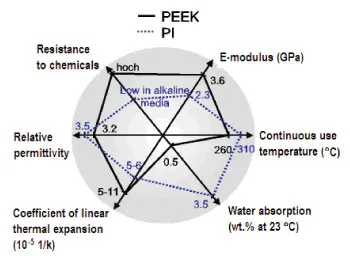
Property comparison: Polyetheretherketone (PEEK) versus polyimide (PI)
(Source: University of Erlangen)
Glue vs. direct metallization for PEEK laminates
The low metallization adhesive strength achieved with PEEK has prevented this polymer from being used as the base material for FPCs. Erlangen researchers found, however, that surface activation by either of two different pretreatment methods could improve the adhesion strength of PEEK/metal laminates.
The standard method of laminating PEEK and copper films involves the use of glue. Alternatively, direct metallization by physical vapor deposition (PVD) can be used. The adhesive strength demanded for this application (0.6 N/mm) was measured by a peel force test. This was in accordance with DIN 60249. This can be achieved and/or exceeded by an appropriate surface pre-treatment of the PEEK film, either by surface etching with chromic sulfuric acid or oxygen plasma treatment.
When glue is used, the failure mode changes from interfacial failure at the interface between the adhesive and the polymer for the untreated sample to an interfacial failure between the adhesive and copper. Both plasma treatment and surface etching with chromic sulfuric acid resulted in the incorporation of oxygen groups. This created an increase in secondary bonds between the polymer surface and the adhesive.
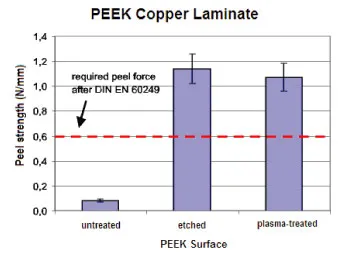
Adhesive strength of PEEK copper laminate
(Source: University of Erlangen)
With its outstanding properties, the PEEK FPC substrate can be soldered in standard reflow processes using lead-free solder alloys and can also be used under extreme conditions (high temperature, aggressive media, and dynamic load). Aged PEEK-copper-laminate also showed excellent results.
Even after storage for 250 hours at 200 °C in an air atmosphere, sufficient adhesive strength with the metallization was maintained (0.7 N/mm). The long-term stability of the adhesive strength proved to be better than that of a commercial PI-based FPC material.
Research affiliation | Key contact info | Comments/Areas of interest |
Friedrich-Alexander University of Erlangen-Nuremberg, Institute of Polymer Materials (LSP) of the Department of Materials Science | Prof. Dr.rer.nat. Helmut Münstedt, Head LSP (Lehrstuhl für Polymerwerkstoffe); Martensstrasse 7, D-91058 Erlangen Phone: +49-9131-85-27604; Email: helmut.muenstedt@ww.uni-erlangen.de | Interests include high-temperature-resistant polymer films for PCBs; solderable electromechanical components made of polymer materials. |
Friedrich-Alexander University of Erlangen-Nuremberg Institute for Manufacturing Automation and Production Systems (FAPS - www.faps.uni-erlangen.de) | Prof. Dr.-Ing. Klaus Feldmann, FAPS Head, Phone Erlangen: +49 9131 85-2 75 69; Phone Nuremberg: +49 911 58058-11; Fax: +49 9131 302528; Email: feldmann@faps.uni-erlangen.de | FAPS is a subdivision of the Department of Mechanical and Manufacturing at Erlangen with a special focus on the assembly of devices with electronic and mechanical components, i.e., towards mechatronic devices. Interests include electronic component production, flexible circuit carriers (foils), and Molded Interconnect Devices (3D-MID) and related new materials and processes. |
Electronic device research organizations
(Source: PlastiSource, Inc.)