

Extrusion - Equipment, processing techniques & troubleshooting
Last update on Apr 27, 2026
We would like to acknowledge PFFC, An In-Depth Look at Extrusion - Part 1 and Part 2, for providing the technical information needed to develop this guide.
What is plastic extrusion?
Plastic extrusion is a continuous manufacturing process used to produce uniform plastic products by melting raw thermoplastic material and forcing it through a specially designed die to form a fixed cross-section. The molten plastic is shaped, cooled, and cut to produce items such as pipes, tubing, sheets, films, profiles, and insulation coatings. The machine that performs this process is known as an extruder.
Plastic extrusion is commonly applied in industries such as packaging, construction, automotive, medical, and consumer goods. Variations of the process include single-screw extrusion, twin-screw extrusion, and co-extrusion. Each process is selected based on material type, compounding requirements, and product complexity.
Steps involved in the extrusion process
Below are the key process steps involved in the plastic extrusion process.

Material feeding
Thermoplastic pellets or granules are loaded into a hopper and fed into the extruder barrel. Additives such as colorants, stabilizers, or fillers may also be blended at this stage to achieve desired performance properties.

Melting and plasticizing
Inside the heated barrel, a rotating screw conveys the material forward. External heaters combined with mechanical shear from the screw generate heat. This melts the polymer into a homogeneous molten state. Proper temperature control is critical for melt quality.

Pressurization and mixing
As the screw rotates, it builds pressure and ensures uniform mixing. In twin-screw extrusion systems, enhanced mixing improves compounding and material dispersion.

Shaping through the die
The molten plastic is forced through a precision-engineered die. This determines the product’s cross-sectional shape (e.g., pipe, sheet, film, or profile).

Cooling and solidification
The extrudate passes through a cooling system, such as water baths or air cooling, to solidify while maintaining shape accuracy.

Cutting and finishing
Finally, the continuous product is cut to length, wound, or further processed depending on application requirements.
Looking for extruded polymer grades for your next formulation?
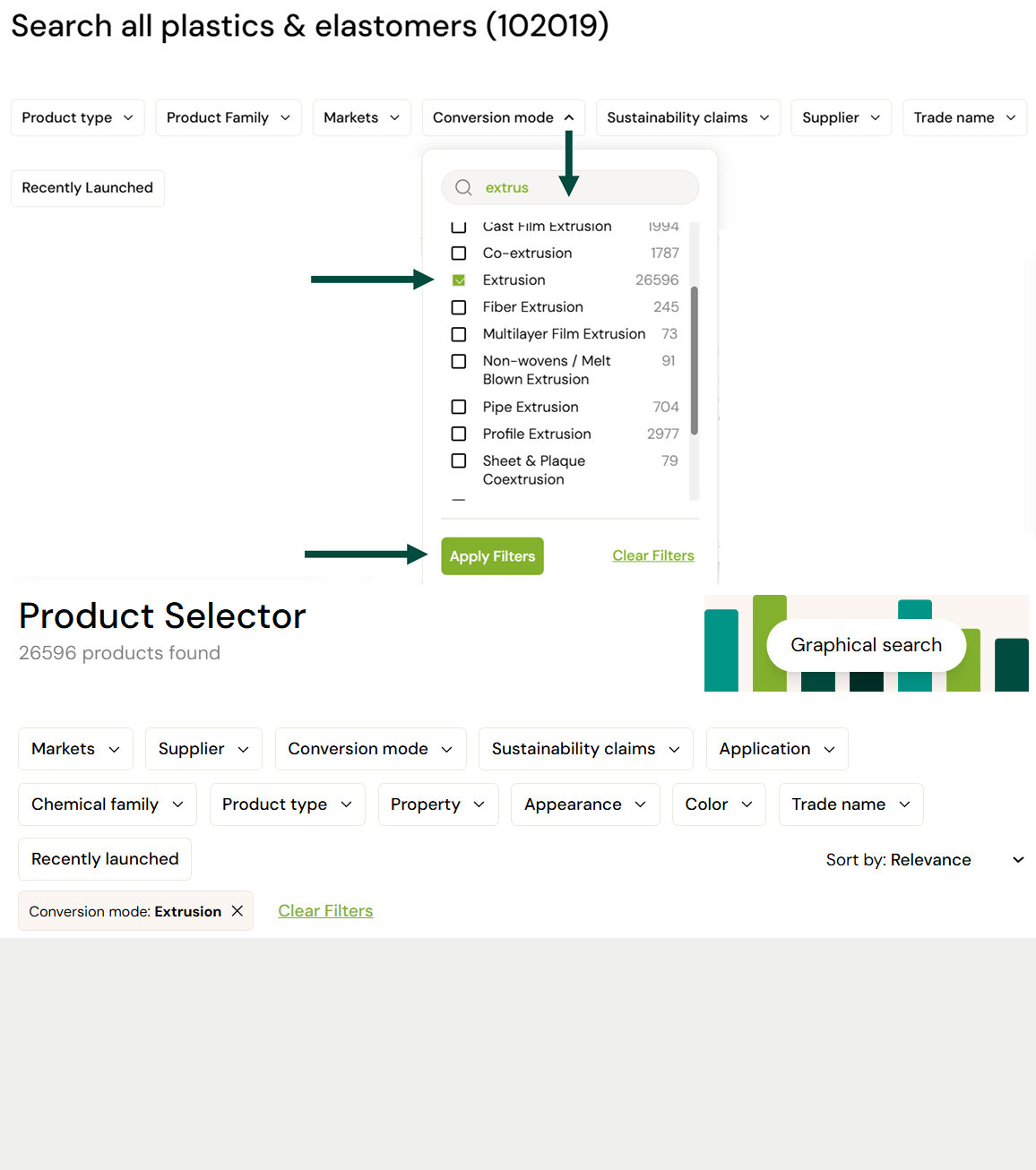
Our Master Catalog features 2700+ extruded polymers, helping you pick the best fit for your need. Narrow down your search using the advanced filters on our platform for Markets/Applications/Sustainability claims, etc. Instantly access technical datasheets and order samples in seconds.
 |
Let's understand how these components work together to deliver consistent melt quality and output. The following section explains the design of extrusion equipment and the fundamental operating principles behind its performance.
Extrusion equipment and operating principle
Extrusion, as we know, is more than 100 years old. Early extruders were used to extrude rubber, an elastic material. As material development progressed, synthetic viscoelastic materials were developed for extrusion.
These materials behaved differently, and the extrusion equipment was modified to accommodate the new materials. Original rubber screws utilized constant depth/variable pitch to compress the rubber material. Whereas, the screws for polymers used a variable depth/constant pitch to provide the compression necessary to generate pressure.
Extruders are complex machines that consist of the following components:
| Motor | Barrel |
| Drive system to control the motor | Screw |
| Gearbox | Die |
| System for heating and cooling various machine components | Feed system to introduce plastic pellets into the barrel |
| Filtration system, including a break plate and a screen changer | Instrumentation such as temperature, pressure, and thickness measurement |
| Various ancillary equipment, such as co-extrusion, ozonizing, and corona treating | |

(a) Schematic illustration of a typical screw-extruder
(b) Geometry of an extruder screw
Mechanics of plastic extrusion
The motor turns the gears in the gearbox, which is coupled to the extruder screw. Once the extruder reaches operating temperatures, the screw turns and brings the plastic pellets supplied by the hopper into the barrel. The pellets are conveyed forward by the pushing action of the screw flight. The volume of the first flight times the bulk density of the pellets times the RPM gives the output per minute.
As the pellets move forward, they encounter a restriction at the compression (or melt) section of the screw. In this section, the channel depth (H) of the screw flight diminishes, causing pressure to rapidly increase in this area. The pressure forces the pellet against the barrel wall. Here friction between the pellet and the barrel wall increases the temperature of the pellet, causing it to melt.
The frictional forces acting on the pellet determine what is called the solids conveying angle. This ultimately determines extruder output. All air between the solid plastic pellets must be eliminated before melting begins. Failing to do so will convey air forward, which will contribute to the formation of gels, a generally undesirable defect in the finished product.
As the plastic moves downstream, the average temperature increases and more and more pellets become molten. High shear sections may be added to the screw design to ensure complete melting prior to exiting the extruder barrel.
There is a tremendous energy transfer from the screw to the pellets in the compression zone. The pressure within that zone can easily reach 400 bar (~6,000 psi). The energy to pump and the melted plastic pellets ultimately come from the motor, which is transmitted through the gearbox and the extruder screw.
Once the plastic leaves the compression section, pressure generation ceases, and pressure consumption begins. Enough pressure must be generated to convey the viscous molten plastic out of the extruder, through the filtration system, piping, coextrusion adapters, and die. This ensures a uniform flow exits the die along its circumference or width, depending on geometry. It is the job of the screw designer to design a screw that will provide the required output and melt temperature.
The purpose of the extruder
The screw and the barrel that contains it are the core of the extrusion process. All other components of the extruder support the screw and barrel. When a new screw design is needed, the designer will request extrusion of the resin, the desired melt temperature, and output. Screw design technology is quite sophisticated today. Also, the designer usually does a good job of providing the user with a workable screw design. However, deviations from the target melt temperature, output, and resin will alter screw performance.
Unmelted resin is not typically seen today because one or more mixing sections are common on most extruder screws. However, old-fashioned single-stage screws with no mixing head operated at high speeds can pump unmelted particles out of the extruder.
Let's review the first, and probably the most critical, function of the extruder screw, namely feeding, compacting, and melting.
The purpose of the extruder, of course, is to convey, melt, and pump plastic to the die. The extruder is more or less indifferent to the downstream equipment. This first step quite often determines the output, output stability, and melt quality at the discharge end of the extruder. Single-screw extruders are generally divided into three sections.
- Feed section: It brings plastic pellets (or powder) into the extruder barrel. The volume of the first flight times the screw speed times the bulk density times 60 is the output per hour.
- Transition section: It is where melting theoretically begins and contains both solid and liquid polymer.
- Metering section: In this section of the screw, melting is theoretically complete, and the molten polymer is simply pumped out of the extruder into the die.
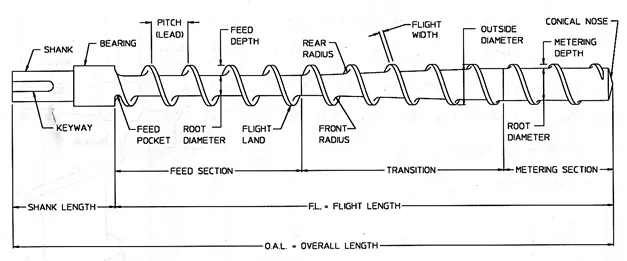
Three sections of the single screw extruder1
Optional zones not shown in the figure are a vent zone, a dispersive mixing zone, and a distributive mixing zone.
A hopper rests on the barrel above the first flight, and the feed pocket brings the plastic pellets into the extruder barrel. This conveys them downstream to the transition section. The channel depth steadily decreases in the transition section. This reduces channel volume, which in turn causes a restriction in the forward path of the pellets.
This restriction simultaneously compacts the pellets closely together until there is no free volume between them, to what is called 'the solid bed'. Tremendous pressure is created during this compression section of the screw. The solid bed moves as one mass, creating intense friction between the solid bed and barrel wall. The coefficient of friction (COF) between the pellets/solid bed is largely responsible for the solids conveying angle in non-grooved, single-stage, square-pitch screws.
Variants of extrusion process
Equipment-based variants
Based on equipment, extrusion can be of two types, as explained below.
Single screw extrusion process
The configuration of an extrusion line depends on whether there is a substrate or not. The figure below shows the essential components of a blown film line, including:
|
|
The rotating tower assembly, thickness gauge, corona treater, and winder are not shown.

Alpha marathon 77-layer nanofilm blown film line
Twin-screw extrusion
Twin-screw extruders are widely used in compounding and material preparation. However, they can also be integrated upstream of film or sheet extrusion lines when enhanced mixing or reactive processing is required. Twin-screw extrusion uses two intermeshing screws rotating inside a single barrel. The rotation of the screws can be in the following directions:
- same direction (co-rotating) or
- opposite directions (counter-rotating)
Compared to single-screw systems, twin-screw extruders provide superior mixing, compounding, and material dispersion. This technology is used when processing filled polymers, reinforced plastics, blends, or heat-sensitive materials.
The intermeshing screw design enables better control of shear, temperature, and residence time. It also allows the incorporation of additives, fillers, colorants, and reinforcements with improved uniformity. Twin-screw extrusion is commonly applied in compounding, masterbatch production, reactive extrusion, and engineering plastics processing.
Key advantages include:
- Enhanced distributive and dispersive mixing
- Improved control over melt homogeneity
- Efficient devolatilization and venting
- Greater flexibility in screw configuration
Process/product-based variants
Based on process or product variations, three types of extrusion processes are explained below.
Blown film process
In the blown film process, the extruder(s) melt plastic pellets and pump the hot, viscous polymer melt into the die, which forms a circular film. As the film exits the die, it is called by an air ring and transported upwards to the collapsing tower, and then onto the winder. Blown film line speeds are typically limited to a few hundred feet per minute (100-200 m/min).
Cast film lines
The cast film lines differ from blown film lines in that the die is flat instead of round, the web is cooled with a chill roll instead of an air ring, and the web is transported horizontally instead of vertically. The two processes yield films with vastly different properties due to the cooling methods and resins used.
The figure below shows a complete small cast film/extrusion coating line:

The SAM, NA pilot laboratory in Phoenix, New York
Included in this line are all the components normally associated with an extrusion coating line, namely:
|
|
The nip roll on this laboratory line can be substituted with an air knife and vacuum box to convert from an extrusion coating configuration to a cast film configuration. Line speeds on this type of equipment frequently exceed 365 m/min (1200 ft/min) and can be as fast as 760 m/min (2500 ft/min).
Flat sheet extrusion dies are not limited to thin coatings, but can also produce thick sheets for subsequent thermofoming, for example, as shown in the figure below. The extruder itself, as well as the process conditions, essentially can remain the same. This is because the varying end-product thicknesses are governed by the take-off speed at a given extruder output and width.

Extrusion of a 6.35 mm (0.250') thick 3-layer coextruded ABS sheet out of a
4 meter (10 foot) wide multi-manifold die into a 3-roll calendar stack
The line speed in this process is about 1 meter per minute (3 feet/minute)
Co-extrusion process
Co-extrusion is a variant of extrusion in which two or more extruders feed different polymer melts into a single die. It produces a multilayer structure in one continuous process. The individual melt streams are combined either in a feedblock before entering the die or within a multi-manifold die design.
This process enables the production of films or sheets with tailored performance characteristics, like improved barrier properties, enhanced mechanical strength, surface gloss, sealability, or cost optimization through layer structuring.
Co-extrusion is widely used in blown film, cast film, sheet extrusion, and extrusion coating applications. Multilayer structures can range from simple 3-layer constructions to highly engineered nanolayer films exceeding dozens of layers.
Key benefits include:
- Material efficiency through layer distribution
- Functional layering (barrier, tie, structural, surface layers)
- Reduced need for lamination
- Process integration and high productivity
TIP: With 2700+ grades at your fingertips, our advanced platform brings you the Conversion mode for you to isolate the exact extrusion process your project demands. Download technical data sheets instantly or request free samples to evaluate performance firsthand.
 |  |  |
Relation of COF between the pellets and barrel
Melt mechanism and root causes of defects
- Plastics Components 2000, Spirex, p 6
- Bezigian, Extrusion Coating Manual, 4th Edition, TAPPI Press, 1999, p 38