

Polyetheretherketone (PEEK): How to select the right grade?
Last update on Dec 17, 2025
Polyether ether ketone is often abbreviated as PEEK. This high-heat polymer is known for its exceptional mechanical, thermal, and chemical properties. This is why you'll find it in aerospace, automotive, medical, and electronics industries.
But the real question is what makes PEEK different from other high-temperature plastics? Why do engineers specifically choose PEEK over alternatives?
In this guide, we'll walk you through how PEEK is made and what happens at the molecular level. Then, based on your specific requirements and applications, we'll help you select the ideal PEEK grade on our platform.
PEEK: Definition, chemical structure, & synthesis
What is PEEK plastic?
Polyetheretherketone (PEEK) belongs to the polyketone family of polymers (PEK, PEEK, PEEKK, PEKK, PEKEKK). Amongst them, PEEK is the most widely used and manufactured on a large scale.
PEEK is an acronym that tells you everything about its chemical backbone:
- Poly: many repeating units (it's a polymer)
- Ether: oxygen linkages in the chain
- Ether: another set of oxygen linkages
- Ketone: carbonyl group (C=O) connections
This specific arrangement of chemical bonds is what gives PEEK its exceptional properties. Commercially available from Imperial Chemical Industries (ICI) since the early 1980s that later became Victrex PLC. PEEK is fully recyclable plastic.
In our master catalog, we provide you with commercial PEEK grades, its top suppliers, and most popular brands. You can filter grades, compare them, and search graphically for a seamless sample ordering experience. Start searching now!
 |  |  |
Chemical structure of PEEK
Molecular composition
At the molecular level, PEEK consists of aromatic rings (benzene-like structures) connected by ether linkages and ketone groups. Here's what that structure looks like:
CAS Number: 29658-26-2
Chemical name: poly(oxy-1,4-phenyene-oxy-1, 4-phenyene)
Chemical formula: (C19H14O3)n

Structure of Polyether ether ketone (PEEK)
The repeating unit contains:
- Three aromatic rings (provide rigidity and thermal stability)
- Two ether linkages (–O–) (provide flexibility and toughness)
- One ketone group (C=O) (enhances chemical resistance and strength)
The aromatic rings create a stiff, heat-resistant backbone. The ether linkages add just enough flexibility to prevent brittleness. The ketone groups contribute to chemical resistance and high-temperature performance. This precise combination is what separates PEEK from other polymers.
Semi-crystalline nature
PEEK is a semi-crystalline polymer. Its internal structure has two regions:
Region | Benefits |
Crystalline regions Ordered, tightly packed molecular chains |
|
Amorphous regions Random, loosely packed chains |
|
Synthesis of PEEK
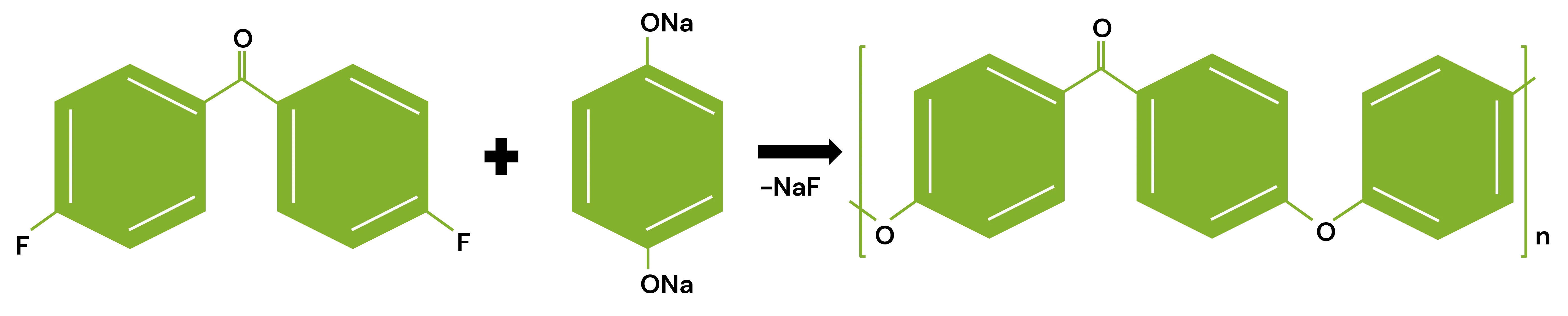
PEEK polymers are obtained by step-growth polymerization by the dialkylation of bisphenolate salts.
Monomer preparation
The two primary monomers involved are:
- 4,4'-difluorobenzophenone or 1,4-bis(4-fluorobenzoyl) benzene
- Hydroquinone
This reaction takes place in the presence of alkali carbonates. Hydroquinone is treated with a strong base (like sodium carbonate) to form its sodium salt.
Polymerization
- The sodium salt of hydroquinone reacts with 4,4'-difluorobenzophenone in a polar aprotic solvent (like diphenyl sulfone) at high temperatures (around 300°C).
- This reaction is a nucleophilic aromatic substitution, where the sodium phenoxide attacks the fluorine atoms in the difluorobenzophenone, leading to the formation of ether linkages.
- The polymerization process continues, forming longer and longer polymer chains.
Isolation and purification
- The resulting polymer solution is cooled and precipitated into a non-solvent (like water) to separate the PEEK polymer.
- The polymer is then washed and dried to remove impurities.
The polymer exhibits the highest thermal transitions among other commercial polymers. This is because of its stiff aromatic polymer backbone. Hence, they can be used at temperatures as high as 240°C.
Properties of PEEK vs. other high-heat polymers
PEEK offers a unique combination of mechanical, chemical, electrical, and thermal properties. Knowing the distinctive features of PEEK is critical to help you select the right grade for your application. Let's take a look at the unique features of PEEK polymer.
Physical properties
- PEEK is a semi-crystalline, high-performance engineering thermoplastic.
- Crystallinity imparts excellent resistance to a wide range of liquids. It also offers superb fatigue performance.
- PEEK is insoluble in all common solvents and does not undergo hydrolysis.
- Used for 1000 hours in steam or high-pressure water without significant property degradation. Hence, PEEK has an excellent sterilization resistance at high temperature.
- Peek has good dimensional stability, inherent purity, and biocompatibility.
Mechanical properties
PEEK polymer shows excellent mechanical properties.
- PEEK exhibits exceptional tensile properties, high strength, and toughness.
- The polymer also exhibits excellent creep resistance. When combined with flexural & tensile characteristics, it provides an excellent balance of properties. For example, where the material is required to withstand high loadings for long periods at high temperatures without permanent deformations.
- PEEK has a good flexural modulus at very high temperatures.
- Manufacturing parts made with PEEK are lightweight. They can survive longer in harsh environments.
Thermal properties
PEEK and its composites are suitable for high-temperature applications. These include aerospace, automotive, structural, electrical, and biomedical applications. The thermal properties which PEEK polymer exhibits include:
- High Melting Point (Tm), 343°C
- High Glass Transition (Tg) temperature, 143°C
- High continuous service temperature, up to 260°C
Electrical properties
- PEEK polymer exhibits high volume resistivity and surface resistivity.
- PEEK maintains good insulating properties and environmental changes in a broad temperature range.
Flammability
- PEEK has a V0 flammability rating down to 1.45 mm.
- PEEK has a Limiting Oxygen Index (LOI) of 35%.
- Its smoke emission and toxic gas generation is extremely low.
Reinforcements
Adding reinforcement to the PEEK polymer can improve the creep and fatigue resistance. It can further improve the thermal conductivity and heat distortion temperature. Some examples include:
- Flexural modulus of the polymer can be improved by adding glass fibers and carbon fibers.
- Tensile strength of 29000 psi can be achieved when reinforced with carbon fibers retaining properties at 299°C.
The table below lists the properties of unfilled vs. filled PEEK grades.
| Property | Unfilled | 30% carbon fiber | 30% glass fiber |
| Dielectric Constant | 3.2 | 3.2 - 3.4 | 3.3 - 4.2 |
| Dielectric Strength (kV/mm) | 20 | 18.5 - 19 | 15 - 24 |
| Volume Resistivity (x 1015 Ohm.cm) | 16 - 17 | 1 - 8 | 15 - 16 |
| Elongation at Break (%) | 30 - 150 | 1 - 3 | 2 - 3 |
| Flexural Modulus (GPa) | 3.7 - 4 | 13 - 19 | 9 - 10 |
| Young Modulus (GPa) | 3.5 - 3.9 | 13 - 22.3 | 9 - 11.4 |
| Notched Izod Impact at Room Temperature (J/m) | 80 - 94 | 85 - 120 | 95 - 130 |
| Density (g/cm3) | 1.26 - 1.32 | 1.4 - 1.44 | 1.49 - 1.54 |
| Thermal Conductivity (W/m.K) | 0.25 | 0.9 - 0.95 | 0.43 |

PEEK vs. other high-heat polymers
Polyether ether ketone shows remarkably exclusive properties than other high-heat polymers.
- In comparison to fluoropolymers, PEEK shows superior tensile strength, HDT, operating temperature, bonding, processing, and toxic gas emission. However, they are inferior in terms of chemical resistance, cost, toughness, and UV weathering.
- When compared to PPS, PEEK has markedly superior thermal resistance, toughness, and flashing.
- PEEK has much higher temperature performance, wear resistance, chemical resistance, and fatigue performance when compared to PES.
- PEEK is not normally blended with other polymers. However, it forms miscible blends with a range of other polyketones and PEI. PEEK/PEI blends have higher Tg. Its blends with PES and PPS are highly compatible.
Addressing the limitations of PEEK plastic
While selecting the PEEK grades for your application, you must consider the following limitations.
- Expensive, applicable for highly demanding application
- Processing at high temperatures
- Attacked by concentrated sulfuric, nitric, & chromic acids. Find out how to protect your plastics from chemical attack.
- Attacked by halogens and sodium. Select halogen-free PEEK grades.
- Low resistance to UV light. Know more about UV light resistance.
PEEK: Physical forms & processing techniques
Polyetheretherketone is processed via many conventional methods as explained below. The processing conditions used to mold PEEK can influence crystallinity and mechanical properties. As a linear thermoplastic, PEEK can be melt processed in the temperature range (370 to 420°C). While processing Polyetheretherketone, no corrosive gases are evolved.
Forms of PEEK
Various forms of PEEK polymers impact the efficiency of the finished plastic parts. Selecting PEEK grades on this basis avoids operational disruptions and unnecessary capital investments. Some physical forms of PEEK commercially available are:

Before processing PEEK, drying is recommended for 3 hours at 150°C or 2 hours at 180°C. This is done to avoid any molding defects.
Ways to process PEEK
PEEK is processed using the following conventional methods. The processing guidelines for each process are described below.
Injection molding
- A mold temperature of 160-190°C is recommended to obtain good crystallization and minimize warping.
- Post crystallization at 200°C is possible but it is not recommended for applications requiring high dimensional stability.
- PEEK is suitable for injection molding of very small parts with tight dimensional tolerances.
- Injection pressure: 70-140 MPa
- Mold shrinkage: Unfilled – 1.2-2.4%, Filled – 0.1-1.1%
Extrusion
- Cooling temperature has a strong influence on crystallinity and then on performance.
- For film and sheet extrusion, cooling cylinders at 50°C lead to transparent amorphous material.
- Cooling cylinders at 170°C lead to opaque and highly crystalline material.
- It is also possible to produce oriented or bioriented films by the process of extrusion.
Select PEEK polymers processed using extrusion, request samples and get access to technical datasheets with just a simple click.
 |  |  |
3D printing
Thanks to the unique properties of PEEK, 3D printing allows the construction of almost any complex design geometry, which cannot be manufactured using other technologies. FDM or FFF methods are used for 3D Printing with PEEK filaments.
- Nozzle temperature: 360-400°C
- Heated bed: 120°C
It is an excellent candidate for fused filament fabrication. This is due to its low moisture absorption as opposed to other common FFF materials, such as Acrylonitrile Butadiene Styrene (ABS).
PEEK and Sustainability
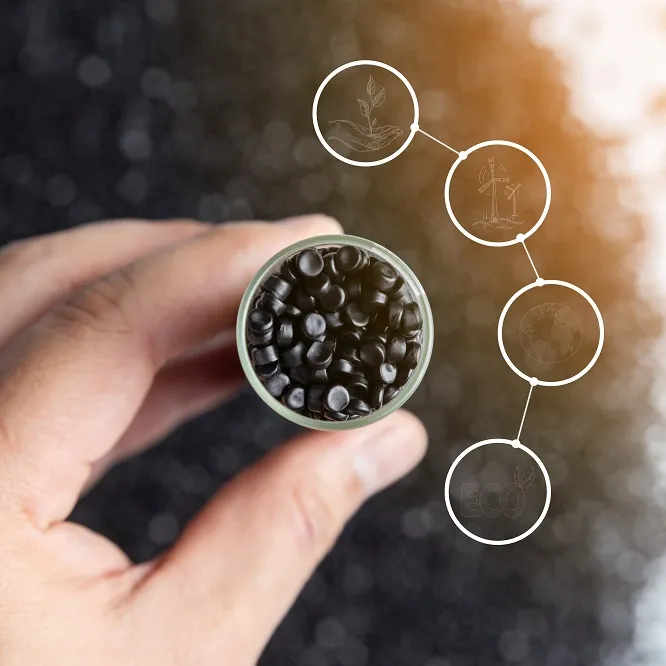
Here are the key aspects you should consider while selecting sustainable PEEK grades.
- Recyclable: PEEK is a fully recyclable plastic. But it's a complex process due to the material's high-performance characteristics and cost. Some common recycling methods include mechanical and chemical recycling.
- VOC emissions: The manufacturing process of PEEK uses high-temperature melt polymerization. This reduces the need for solvents that could contribute to low VOC emissions. The raw materials used in PEEK production are also relatively stable. As a result, they don't tend to outgas during processing.
- Biobased versions: Achieving 100% biobased versions of PEEK is not yet available on a large scale. However, there have been significant developments in this area. Some companies are working on achieving partially bio-based versions of PEEK. These versions tend to show similar performance to petroleum-based alternatives.
- Renewable feedstocks: Some innovators are producing sustainable renewable or biobased MDA. Also known as 4,4'-methylene dianiline, it is a precursor used in the PEEK manufacturing process.
- Regulations: PEEK is considered safe for food contact applications following FDA regulations. Many PEEK grades are also REACH and RoHS compliant.
- PFAS-free: PEEK's chemical structure does not contain fluorinated compounds. This makes it an attractive option for applications that need PFAS-free PEEK materials.
Applications of Polyether ether ketone (PEEK)
PEEK is used in the aerospace, automotive, electrical, and medical industries. Because of its robustness, it is used to fabricate items the chemical and engineering industry. Common examples include bearings, piston parts, pumps, HPLC columns, compressor plate valves, and cable insulation. Explore some of its applications in detail.
Automotive
With the growing trend of miniatured engine compartments, PEEK offers a solution to replace metals and offer weight reduction, noise reduction and functional integration.
The most important performance benefits of Polyetheretherketone are enhanced dry and lubricated surface interaction, outstanding mechanical performance over a wide temperature range, ease of processing and excellent fatigue properties. The main automotive applications of PEEK include:
- Under-the-hood piston units
- Seals
- Washers
- Bearings
- Various active components used in transmission, braking and air-conditioning systems
 |  |
Aerospace
PEEK polymers and its composites are replacing aluminum and other metals in several aircraft parts. Huge numbers of large volume components with fine tolerances can be cost-effectively formed and used without assembly or modification. PEEK finds use in aerospace market like:
- Critical engine parts as the polymer can withstand high temperatures and the tribological interaction of dry and lubricated material contacts
- In aircraft exterior parts, PEEK provides excellent resistance to rain erosion
- In interior components, its inherent flame retardancy and low smoke and toxic gas emission reduce hazard in the event of a fire
- The polymer is used for manufacture of convoluted tubing to protect wires and fiber optic filaments for aircraft electrical systems
 |  |
Medical and Healthcare
Polyetheretherketone provides cost-effective, innovative parts with excellent wear, heat, electrical and chemical resistance. Its applications in healthcare mainly consist of dental instruments, endoscopes and dialyzers
- PEEK is replacing aluminum for the handles on dental syringes and sterile boxes that hold root canal files.
- The polymer can withstand up to 3,000 autoclave sterilization cycles in which temperatures typically reach 134°C.
- It maintains outstanding mechanical strength, excellent stress cracking resistance and hydrolytic stability in the presence of hot water, steam, solvents and chemicals.
- It offers improved biocompatibility of load bearing implants.
 |  |
Electrical / electronic
Polyetheretherketone possesses excellent electrical properties, which makes it an ideal electrical insulator. It is used in electrical markets and electronic applications.
- PEEK provides parts with long-term operating reliability over widely fluctuating ranges of temperature, pressure and frequency.
- Its inherent purity, combined with excellent mechanical and chemical stability, minimize contamination and maximize safety during the handling of silicon wafers.
- Outstanding thermal properties enable PEEK polymer parts to withstand the elevated temperatures associated with soldering processes.
Some interesting examples of current applications include coaxial connector jacks used in hands-free telephone kits, surface-mounted trimming potentiometers, which are electro-mechanical devices, known as SMDs, designed to correct voltage or resistance errors in printed circuit boards, and as insulators for connector pins on under-sea environment control equipment.
 |  |
Other key markets
- PEEK polymers outperform metals and other materials in many components used in the industrial, chemical and processing industries.
- PEEK polymers are now finding use in food contact applications, following approval from the US Food and Drug Administration.
- PEEK is replacing stainless steel in impeller wheels for regenerative pumps. It provides a significant reduction in wear, reduced noise levels and more consistent running properties.
- Polyetheretherketone also offers increased application potential in pipe and hose couplings in modern connector technology. They can withstand exposure to pressures as high as 25,000 psi and to temperatures upto 260°C.
See if your application is listed in our visual guide below, then click it to get the exact PEEK grade for your needs from our master catalog.
 |  |  |  |
 |  |  |  |
Wasn’t your application listed above? Use the “markets” and “application” filter on our advanced platform to find your perfect match in seconds.


PEEK offers a solution to replace metals and offer weight reduction, noise reduction and functional integration in automotive applications

PEEK polymers and its composites are replacing aluminum and other metals in several aircraft parts

PEEK polymers are now finding use in food contact applications, following approval from the US Food and Drug Administration