

Injection molding: The complete guide to precision plastic manufacturing
Last update on Apr 2, 2026
Understand in detail the injection molding process, its types, and the design and manufacturing of mold. Dive deep to know more about the advantages and disadvantages of injection molding polymers, and more.
What is injection molding?
Injection molding is a manufacturing process used to produce plastic parts in large volumes. It is one of the most common methods for mass-producing plastic components with high precision and consistency. The process involves:
Step 1: Injecting molten plastic material into a mold cavity
Step 2: Allowing it to cool and solidify
Step 3: Ejecting the finished part from the mold

Types of injection molding
There are several types of plastic injection molding processes that are commonly used. They depend on the specific requirements of the part being produced. Each process can offer unique advantages and is chosen based on factors such as:
- Part design
- Material properties
- Production volume
- Cost considerations
Listed below are the type of injection molding processes along with their definition.
| Types of Injection Molding | Description |
| Conventional injection molding | Molten plastic is injected into a mold cavity under high pressure, and it is suitable for producing a wide range of plastic parts with complex shapes and precise details. |
| Two-shot or multi-shot injection molding | In this method, two or more materials are converted into the mold to create a part with multiple colors, materials, or components. It eliminates the need for secondary assembly operations and enables the production of more complex parts. |
| Insert molding | It combines plastic injection molding with the insertion of pre-formed components, such as metal inserts or other plastic parts, into the mold cavity. The molten plastic material encapsulates the inserts during the molding process, creating a strong bond between the insert and the plastic part. |
| Overmolding | It is similar to insert molding but involves molding a second layer of plastic material over an existing part or substrate. This process is often used to add a soft-touch grip, improve aesthetics, or enhance functionality. |
| Gas-assisted injection molding | A controlled amount of inert gas, typically nitrogen, is injected into the mold cavity after the initial injection of plastic material. The gas pushes the molten plastic towards the walls of the mold, improving part quality, reducing material shrinkage and warpage. |
| Co-injection molding | This method is also known as sandwich molding or multi-component molding. It involves injecting two or more different plastic materials simultaneously or sequentially into the mold cavity. It is commonly used to create parts with a combination of rigid and flexible materials or to achieve specific material properties, such as improved strength or reduced cost. |
| Micro-injection molding | Used to produce extremely small and precise plastic parts with dimensions in the micrometer range. It requires specialized machinery and tooling to handle the high precision and tight tolerances required for micro-scale components. |
| Liquid silicone rubber molding | Liquid silicone rubber is the material, which is injected into the mold cavity and cured to produce flexible, durable, and heat-resistant parts. It is often used for applications that require excellent sealing properties or biocompatibility, such as medical devices or automotive components. |
Table 1: Various Types of Plastic Injection Molding Processes
Automatic or manual: Which one to choose?
Automatic mode requires high-volume production runs with complex part designs and stringent quality.
Manual mode is more suitable for low-volume production or prototyping applications. This mode needs flexibility and operator control.
The choice between automatic and manual plastic injection molding depends on several factors.
- Production volume
- Part complexity
- Required precision
- Desired automation
- Initial investment budget, and
- Available skilled labor
Find out the polymers processed using different injection molding processes in our Master Catalog. Request samples and download technical datasheets with ease.
Injection molding – Thermoplastics | Injection molding – Thermosets |
Components of injection molding machine
Each part of the injection molding machine plays a critical role in melting, shaping, and forming the final product. Understanding these components helps manufacturers maximize product quality and efficiency. A schematic diagram of an injection molding machine is given below.

Figure 1: Components of injection molding machine
Let's explain the components of injection molding machine in detail.
Feeding systems
The feeding system is responsible for supplying raw plastic material into the machine for processing. It typically includes the hopper, where plastic pellets are stored, and the mechanism that guides them into the barrel for melting. A consistent and controlled feeding system ensures uniform material flow. Based on the feeding system, injection mold can be classified as follows:
Hot runner injection mold feeding system
Hot runners can be internally or externally heated with coils or rods. This type of feeding system is encased within a stationary manifold plate. They remain permanent within the plate, preventing them from ejecting with the part. As a result, the molded part will come out clean without any extra plastic waste.
- Advantages: It produces less waste. It eliminates any additional processes to remove or recycle the runners. When combined with multi-cavity molds, it helps with large volumes of complex and fine shapes.
- Disadvantages: It is expensive and difficult to ensure that it is clean. It is challenging to work with heat-sensitive materials.
Cold runner injection mold feeding system
In a cold runner, the molten plastic is injected into the injection molding cavity using unheated runners.
- Advantages: It is easier to clean, maintain and work with an extensive range of materials.
- Disadvantages: It produces lots of waste for each cycle.
Insulated runner mold feeding system
This mold is more like the traditional cold runner molds. However, they use cartridge heaters or other forms of heating to create a surrounding layer of molten plastic. As a result, they form insulated 'culls' to create similar effects to the hot runner systems.
- Advantages: It is less expensive. This is because a temperature controller is not required besides easy and faster changing of materials and colors.
- Disadvantages: It is not suitable for demanding engineering-grade plastics.
Nozzle: Connecting the barrel to the mold
In plastic injection molding, the nozzle is one of the critical components of the injection molding machine. It connects the barrel to the mold. It is responsible for delivering the molten plastic material from the barrel into the mold cavity. There are different types of nozzles used in plastic injection molding. Each of them is designed to meet a specific requirement. The selection of the appropriate nozzle type depends on various factors. These include:
- Type of material being processed
- Part design
- Molding parameters, and
- Specific requirements of the injection molding process
Customized nozzle designs or variations can be implemented based on their specific needs and applications.
- Open nozzle: An open nozzle is the most basic and commonly used type of nozzle. It consists of a simple channel that connects the barrel to the mold cavity. Open nozzles are typically used for general-purpose applications and materials with low viscosity.
- Shut-off nozzle: It is designed to provide better control over the material flow. It prevents drooling or stringing. They incorporate a valve or shut-off mechanism at the nozzle tip that closes when the injection process is complete. This leads to sealing off the flow of molten plastic. The shut-off nozzle helps to reduce part defects and material waste.
- Valve gate nozzle: It is also known as hot runner nozzle. It is used in hot runner systems. These systems keep the molten plastic at a consistent temperature throughout the injection molding process. This eliminates the need for the plastic to solidify and re-melt each cycle. They have a valve pin that controls the opening and closing of the nozzle. This precisely controls the flow of plastic into the mold cavity.
- Multi-tip nozzle: It consists of multiple nozzle tips. These are arranged in a single assembly. They are used for multi-cavity molds where several identical parts are produced simultaneously. Multi-tip nozzles allow the efficient filling of multiple cavities. This is done with a single injection molding machine which reduces cycle time and increases productivity.
- Mix-head nozzle: It is used for injection molding processes that involve mixing multiple components or colors. These nozzles have separate channels for each component. Here the materials are mixed within the nozzle before being injected into the mold. They are commonly used in applications like multi-color parts or parts with special effects.
Screws: Injecting plastics into the mold cavity
The screw used in plastic injection molding is a crucial component of the machine. It plays a significant role in melting and conveying plastic material. It also injects the plastic into the mold cavity. There are several types of screws used in plastic injection molding. Each of these is designed to meet specific requirements. The selection of the appropriate screw type depends on the following factors:
- Type of plastic material being processed
- Part design requirements
- Desired melt quality, and
- Molding parameters (injection speed, cycle time, etc.)
Manufacturers may also use customized screw designs or variations. These are based on their specific needs. A few different injection molding screws are summarized below.
- Standard general-purpose screw: This is the most common type of screw used in injection molding machines. It has a gradual taper and a constant pitch along its length. They are suitable for processing a wide range of thermoplastics with average melt properties.
- Barrier screw: This is designed to improve melt homogeneity and mixing. This is particularly for heat-sensitive materials. They feature a section with a barrier flight. This creates a barrier between the feed and melt sections of the screw. Thus, enhancing melt quality and reducing melt temperature.
- Mixing screw: It is used for materials that need enhanced mixing. For e.g., color concentrates, additives, or materials with different melt viscosities. They incorporate specific flight designs. For e.g., mixing elements or distributive mixing sections. This helps to achieve better dispersion and material blending.
- Ball check valve screw: It features a valve at the tip of the screw. This prevents the backflow of the molten plastic during the injection phase. This design helps maintain precise control over the injection volume. Thus, eliminates issues like drooling or stringing.
- High-speed screw: It is designed for fast cycling and high injection rates. They have shorter flight depths and increased feed channels. This helps in quicker melting and higher plasticizing rates.
- Low compression screw: It is used for processing materials with low melt flow properties or shear-sensitive materials. These screws feature a larger feed channel and a longer transition section. This is to minimize shear and improve melt quality.
- Venting screw: It is designed to evacuate trapped air or gases from the mold cavity during injection. It features grooves or channels along the screw flights. This allows the air to escape and reduces the chances of air entrapment in the molded part.
Mold: Design and manufacturing

An injection molding mold is also known as a tool or die. It is a crucial component in the plastic injection molding process. It is responsible for shaping and forming the molten plastic into the desired part. Usually, steel or aluminium is used to create the mold components.
- Mold is produced often in collaboration with mold producers and customers. This ensures that the molds meet their specific requirements in terms of:
- Design
- Fabrication, and
- Production of injection molds
- Computer-aided mold design is used as a first step in mold manufacturing to create 2D and 3D designs of molds. This is based on the customer's requirements including:
- Part geometry
- Material characteristics
- Cooling requirements
- Ejection mechanisms, and
- Mold lifespan
- Once the mold design is finalized, the mold maker proceeds with fabricating the mold. The mold maker ensures that the mold does not have air traps, warpage, or part defects. Mold also needs to be maintained and repaired throughout its lifespan by regular cleaning, lubrication, and inspection. They are conducted to prevent wear and damage.
Types of mold cavities
Based on the number of parts that can be produced in the injection mold system, it can be classified as follows:

Single cavity injection mold
Single cavity molds produce one part per injection cycle.
- Advantages: It is less expensive and more affordable for low-volume productions. This is because tooling cost for this mold type is lower than other options. It also enables better control of the molding process.
- Disadvantages: It leads to slow production.

Multi-cavity injection mold
This allows to create multiple identical parts in one injection cycle.
- Advantages: It is suitable for large-volume productions. The production speed is faster and the cost for a unit part is lower.
- Disadvantages: Initial cost for the injection mold tooling is usually higher than single cavity molds.

Family injection mold
This has multiple cavities like the multi-cavity mold.
- Advantages: It usually reduces the overall production cost. It can be used to make several parts in one cycle and save a lot of time and operation cost. This is because one family mold can be useful for various components.
- Disadvantages: It is expensive and a simple multi-cavity mold can only produce one iteration in one cycle. It is only suitable for components made from the same material and color.
Types of mold plate systems
As plates make up the entire mold cavity for adequate part production, the mold system can be classified as follows:
Two-plate injection mold
Due to the low tooling cost, it is the most common mold type. It is compatible with any runner system but is best combined with single-cavity molds. A two-plate injection mold has one parting line where the core plate and cavity plate meet. The gate, runner, and parting line must also align in this type of injection mold.
Three-plate injection mold
The additional plate in three plate injection mold gives it two parting lines. This is placed between the cavity and core plates. This automatically separates the runner system from the molded part. This ensures faster production as there is no need for manual separation or recycling of the runner system. The main drawback of this type of mold is the overall high tooling cost. This is because of the precise cutting to be matched with the other two plates.
Stack injection mold
Stack injection mold can contain two, three, or four levels of plates. This makes the process more efficient. Stacked molds require lesser clamp tonnage per cycle. This type of mold has a higher upfront cost because it takes much longer to build. However, the less clamp tonnage requirement reduces the operating costs. The mold can even be designed to accommodate several materials at once.
Unscrewing injection mold
Unscrewing injection mold is the best mold for making threaded components such as bottle caps. They are automated molds with drive systems made up of rack and pinion, electric motors, and hydraulic motors. It is often difficult to remove the molded parts with the standard knock-off method based on the draft angle. Therefore, the unscrewing injection mold helps carry out the removal without damaging the threads.
Types of clamping systems
Injection molding machines use different types of clamping systems. This helps to securely hold the mold in place during the injection molding process. The two most common types of clamping used in injection molding are:
- Hydraulic clamping
- Toggle clamping
Both hydraulic and toggle clamping systems have their advantages and are chosen based on the specific requirements of the injection molding application. Factors that influence the selection of the appropriate clamping system are:
- Size and weight of the mold
- Desired clamping force
- Cycle time, and
- Machine specifications
Steps of injection molding process
For any given machine and mold, the melt flow index and density will affect the injection dwell and cooling times in the cycle. Following are the different steps of injection molding process:
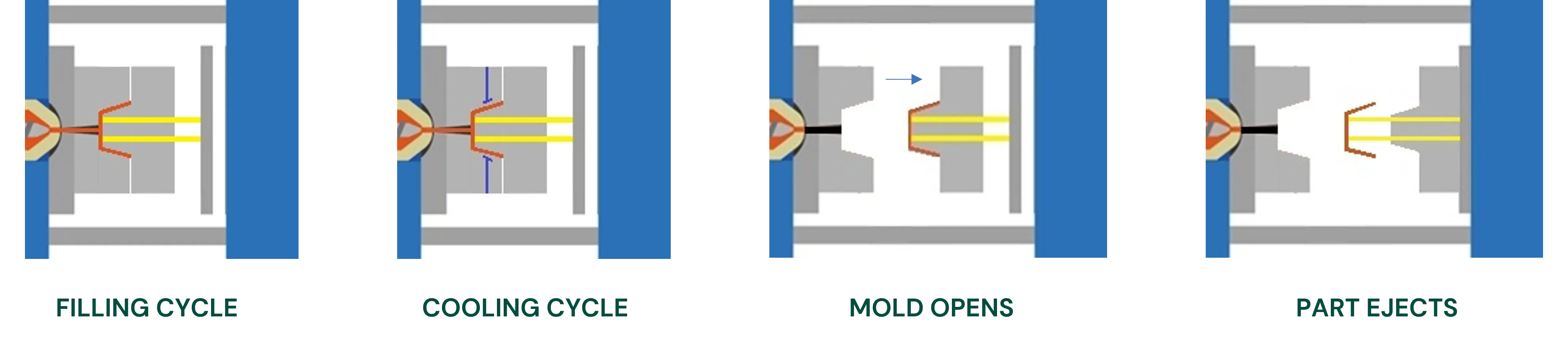
Figure 2: Step-wise Injection Molding Process
- Filling/melting stage: The plastic pellets are converted into a molten state. This is done by applying appropriate heat and shear. Thus, the molten plastic can be used to mold.
- Injecting/packing stage: The screw pushes the molten plastic into the mold cavity. This completely packs the molten plastic with adequate holding pressure. Part size and cavitation will determine the injection molding press size. This is required to pack the plastic melt. The injection molding process normally operates at pressures up to 200 MPa. The 'high pressure' injection molding machines, operating at 500 MPa, are currently under investigation. Injection molding machines are classified according to the locking force of the platens. It can vary from 1-3000 tons.
- Cooling stage: Mold is cooled to solidify the molten plastic before being ejected. This is highly important as the cooling phase is the most time-consuming stage of the injection molding cycle. This is due to plastics' insulating properties. When the plastic cools and solidifies, it shrinks (referred to as "mold shrinkage"). Shrinkage is generally between 0.4-2% and must be taken into account by the mold design.
- Ejection stage: Once molten plastic is cooled in the mold, the mold opens, and the plastic part is ejected by the mold's built-in ejector pins. The mold will then reclose to repeat the process.
- Post-ejection stage: It is the last stage where the machine operator has to break off the sprue, runner, or gate from the molded part. This is done by twisting or cutting it off manually, depending on the mold design. A hot runner system actually eliminates runners and sprue, which also eliminates waste. Unfortunately, hot runners will make the tool more expensive.
It has been claimed that by reducing the floor cycle time from 25 to 24 seconds, 2 weeks of production time per year can be saved. Cycle times for reinforced thermosets are usually longer than for thermoplastic polymers. But, it is 30% better than in compression molding and resulting in less porosity.
Variables of the injection molding process
Listed below are the parameters to be kept in mind while using injection molding machine.
- Melt temperature: Increased melt temperature can increase the melt flow but increasing too high melt temperature could cause degradation.
- Moisture content: Polymer drying temperature and time are important key factors for good products in our production.
- Mold temperature: Uniform mold temperature reduces the effects of warpage.
- Residence time: A longer residence time could degrade the polymer.
- Injection speed: Injection speed affects the viscosity of the molten material.
- Injection pressure, pack pressure, and clamp tonnage can also play important factors in successful injection molding of parts.
Maximizing performance and production efficiency
Now, how can you maximize performance and production efficiency in injection molding? Start by understanding what affects quality and cost. Know the common defects that can disrupt production. Converting them into the right solutions can reduce waste and rework. It is also important to weigh the pros and cons of the process to make better decisions.
Effective solutions to reduce injection molding defects
Most defects in injection molding are related to either the flow of the melted material or its non-uniform cooling rate during solidification.
Defects/Issues | Causes | Solutions |
Brittle moldings | Sharp corners, notches | Increase radii |
Excessive orientation | Increase melt temperature | |
Inadequate thickness | Increase thickness of molding | |
Burn marks because of carbonized material at end of flow path | Insufficient venting | Increase venting |
Injection speed too high | Reduce injection speed | |
Melt temperature too high | Reduce barrel and nozzle temperature settings | |
Delamination | Incompatible masterbatch | Ensure compatible masterbatch is used |
Contaminant | Check feed for contamination | |
Material freezing prematurely | Increase temperature settings, increase gate size | |
Demolding difficulties | Poor design, insufficient draft angles | Increase draft angles, incorporate 'slip'additive |
Over packing | Reduce injection speed and/or second stage time/pressure, use higher flow polymer | |
Excessive second stage | Reduce second stage pressure and/or time | |
Distortion | Molded in stress/orientation | Use increased melt flow index grade of polymer |
Increase melt temperature | Employ more, but thinner ribs to impart stiffness | |
Ribs too thick | Use ribs for varying thickness rather than solid walls | |
Variation in thickness | Increase cooling channels in difficult to cool areas | |
Variation in mold cooling | Increase second stage pressure and or time | |
Sink marks gate freezing off too quickly | Increase gate size | |
Flashing | Inadequate clamp force | Increase clamp force |
Excessive vent size | Reduce venting | |
Polymer melt flow index too high | Change to a low flow grade of polymer | |
Excessive injection speed | Reduce injection speed | |
Streaky surface | Gate inappropriately positioned resulting in snake-like jetting | Position gate so that the material is forced to change direction immediately upon entering the mold |
Melt disturbance resulting | Increase melt temperature | |
Matt-gloss pattern | Reduce injection speed | |
Moisture | Dry the polymer or masterbatch | |
Incompatible masterbatch | Change masterbatch to one with a compatible base | |
Poor color homogenization | Back pressure too low | Increase back pressure |
Masterbatch not compatible | Ensure base polymer based masterbatch is used | |
Barrel size too small, insufficient shots in barrel | Move to a larger machine | |
Masterbatch add rate too low | Use masterbatch with lower pigment concentration at higher add rate | |
Temperature too low | Increase temperature settings | |
Short shots (incompletely filled moldings) | Polymer melt flow index too low | Change to higher melt flow index grade |
Melt temperature too low | Increase melt temperature/mold temperature | |
Inadequate vent size | Increase venting | |
Inadequate thickness | Increase thickness | |
Insufficient injection speed | Increase injection pressure | |
Insufficient gating | Increase gate size or number | |
Weak weld lines | Melt temperature too low | Increase temperature settings |
Flow of polymer too low | Use higher melt flow grade | |
Injection speed too low | Increase injection speed | |
Gate(s) too far from weld line | Move gate or increase number of gates or redesign the mold | |
Warping | Certain sections cool faster than others | Uniform cooling the mold |
Parts with non-constant wall thickness | Keeping constant wall thickness, lower polymer melt temperature | |
Air traps | Air gets absorbed into the finished part | Shorten cycle time, increase injection pressure, select low viscosity materials |
Jet effect | Molten polymer is pushed at speed through a small area, such as the injection nozzle or gate, to access a much larger area. | Reduce injection speed in areas of abrupt area change. Use of 'tab gate' or 'fan gate' type inlet gates. |
Table 2: Common Injection Molding Problems & Possible Solutions
Operational challenges for plastic formulators
Injection molding offers numerous advantages. It is essential to consider the specific requirements and constraints of each manufacturing project. This determines the suitability of the process.
| Advantages | Disadvantages |
|
|
|
|
|
|
|
|
|
|
|
|
|
|
Table 3: Advantages and Disadvantages of Injection Molding
Markets served by injection molding plastics
Injection molding is a flexible, efficient, and versatile process. It is used in various industries. It is a preferred choice for manufacturing many products across various industries. Explore various applications of the injection molding process on our platform. Get a detailed view of how injection molding has proven to be the process of choice.
- Automotive industry: Dashboards, interior trims, door panels, bumpers, various under-the-hood parts and smaller parts like clips, fasteners, switches, and connectors.
- Consumer goods: Electronic enclosures, appliance components, kitchenware, toys, packaging containers, cosmetic cases, bottle caps, closures, and disposable cutlery.
- Medical and healthcare: Syringes, IV components, surgical instruments, medical connectors, drug delivery devices, sterile, precise, and biocompatible parts, meeting the stringent requirements of the healthcare industry.
- Electronics and electrical industry: Electronic and electrical components such as connectors, housing for switches, sockets, cable assemblies, and control panels.
- Packaging industry: Containers, caps, closures, packaging components, bottles, jars, tubs, trays, and blister packs.
- Construction and building materials: Pipes, fittings, drainage systems, insulation panels, and window frames.
- Aerospace and defence: Aircraft interiors, seat parts, control panels, housings, and connectors.
- Industrial equipment and tools: Industrial machinery, tools, equipment, gear components, handles, knobs, housings, enclosures, and tooling inserts.
- Energy and utilities: Solar panels, wind turbine components, electrical insulation materials, and battery casings.

- Blow molding parts: Injection blow molding is a manufacturing process that combines injection molding and blow molding. It is used to produce hollow plastic objects. For e.g., bottles or containers, with a wide range of shapes and sizes.
The steps of injection blow molding process include:
- The process involves injecting molten plastic into a mold cavity to form a preform.
- The preform is a hollow tube-shaped object that resembles the final product but is smaller in size.
The ejected preform is then transferred to a blow molding station. Here it is inflated to the desired shape of the mold cavity. This is done manually or automatically using robotic systems.
The blow-molded part may require further trimming or secondary operations depending on the specific application.
Uses of injection blow molding include:
- It ensures high production efficiency.
- It has precise control over wall thickness.
- It offers excellent repeatability.
- It has the ability to produce complex shapes and intricate details.
- It is commonly used in the packaging industry.
- It is used to manufacture bottles, containers, and other hollow plastic objects.
- The process is particularly suitable for:
- small to medium-sized production runs and
- products that require tight dimensional tolerances and consistent quality.
- Rosato, Rosato, Rosato. (2000). Injection Molding Handbook. Sringer.
- Johannaber. (2008). Injection Molding Machines – A User's Guide. Hanser Verlag.
- Bryce. (1996). Plastic Injection Molding – Manufacturing process fundamentals, Society of Manufacturing Engineers.
- Osswald, Turnig, Gramann. (2008). Injection Molding Handbook. Hanser Verlag.
- Potsch, Michaeli. (2008). Injection Molding An Introduction. Hanser Verlag.

Injection molding finds application in automotive industry

Caps, bottles, and other products used for packaging can be produced using injection molding process

In healthcare industry injection molding is used to manufacture surgical equipments, medical connectors, and more