
Hardness - Introduction
Last update on Jul 11, 2025
Hardness of plastics measures a material's resistance to indentation, scratching, and abrasion. It serves as a key indicator of durability and surface damage resistance in countless applications. This property directly influences a plastic's suitability for specific uses—from soft, flexible materials for cushioning and seals to rigid, hard polymers for wear surfaces and structural components.
Various scales measure plastic hardness (Shore A for soft elastomers, Shore D for rigid plastics, Rockwell for harder engineering polymers), allowing precise material selection based on application requirements. Hardness testing provides a quick, non-destructive quality control method that helps manufacturers verify material consistency, detect processing variations, and ensure products meet specifications.
In this guide, you will find the appropriate hardness testing method for different polymer materials.
What is the hardness of plastics?
The hardness of plastics is defined as the resistance to penetration of plastic by a harder body. The harder material wears or scratches the softer material. It is a dimensionless property.
What materials show good hardness?
What are the advantages of hardness?
- It is a key engineering parameter for constructing devices, consumer products, or industrial parts. This becomes evident when considering cosmetic effects. These effects include scratching or loss of surface gloss. This can happen from the rubbing of two materials or due to wear from moving parts.
- It enables testing material properties. For example, surface quality, strength, wear resistance, and heat treatment of the material.
- It helps to determine if a material or treatment is suitable for the purpose.
- It helps to eliminate the chances of failure of a specimen before its use.
What scales measure hardness of plastics?
There are a number of empirical hardness scales that have been constructed over time. They try to replicate conditions of scratching, rubbing, and wear between two materials. These methods aim to give a relative ranking of the hardness of two materials. There is no underlying theory for how they work. Here, we will be discussing the two most frequently used hardness scales.
Rockwell hardness scale
The Rockwell hardness scale is based on indentation hardness of a material. It has different scales. They are denoted by a single letter, that use different loads or indenters. The result is a dimensionless number. Higher numbers represent harder materials.
Rockwell E, Rockwell M, and Rockwell R are generally chosen to test harder plastics. For example, PA, PC, PS, etc.
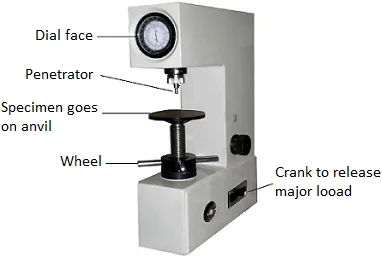
Instrument to Measure Rockwell Hardness (Source: ResearchGate)
Shore hardness scale
Shore hardness is a measure of the resistance a material has to indentation. This is measured by the shore durometer. There are different shore hardness scales for measuring the hardness of different materials. The result is a dimensionless number.
Shore A and Shore D hardness scales are used for rubbers/elastomers and softer plastics. For example, PP, PE, PVC, etc.
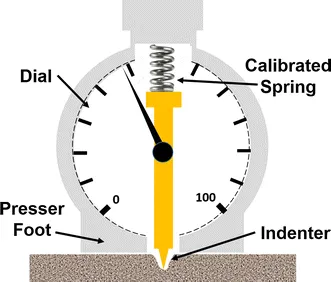
Basic Scheme of Shore Durometer (Source: ResearchGate)
Which hardness scale should be used?
The different hardness scales have more popularity in different:
- parts of the world,
- industries, and
- disciplines.
For someone just beginning to become interested in 'HARDNESS' as a key indicator of performance, it is suggested to examine data sheets and literature references for the relevant industry, disciple, or geographical region. When making comparisons for purposes of promoting a product or material, one has to speak the language of one's peers. There are a multitude of possibilities each having a different rationale that goes beyond this comparative treatise.
Here is a correspondence table between the most common methods. It gives an idea of the order of magnitude, but we do not recommend conversion between the scales.

What standard test methods measure hardness of plastics?
- ISO 2039-1:2001 — It determines the hardness of plastics. It uses the ball indentation method.
- ISO 2039-2:1987 — It determines the hardness of plastics. It uses the Rockwell hardness scale.
- ISO 7619-1:2010 — It determines the indentation hardness of vulcanized rubbers and thermoplastics. It uses the shore hardness scale.
- ASTM D785-08(2015) — It determines the hardness of plastics and electrical insulating materials. It uses the Rockwell hardness scale.
ASTM D2240-15(2021) — It determines the hardness of rubber. It uses the durometer for the measurement.