
Extrusion screws for thermoplastic composites
Last update on Sep 5, 2025
This article was originally published in 2007 and revised in 2025.
There are two different areas of screw design for thermoplastic composites:
- The screw design that is being used to make the thermoplastic compound
- The screw design that is used to process the compounded thermoplastic
The use of various fillers and additives, which are compounded into thermoplastic resins, has become more prevalent in recent years in the plastics industry. The addition of fillers such as talc, mica, calcium carbonate, and nanoclays can increase the stiffness and/or strength and the utilization of various plastics. These fillers have also affected the performance and life of the equipment that processes them.
In this article, we will discuss the latter of the two types of screw, but many of the issues are pertinent to both. We will also learn the issues that these composites have on the screw design, in addition to the screw and barrel wear.
Tackling the issues in screw design
Most screws used in the extrusion of thermoplastic resins primarily deal with the issues of feeding, melting, and pumping of the resin.
Feeding the polymer
In the feed section of the screw where solids conveying takes place, the feeding mechanism for a thermoplastic composite may be quite different from that of the very same thermoplastic polymer without filler.
In the solids conveying function of the screw, the most critical phenomenon is the relative coefficient of friction (COF) of the polymer. In the feed section, there are three different coefficients of friction at work:
- COF between the pellet and the barrel wall,
- COF between the pellet and the screw root, and
- COF between pellet and pellets
Although a given polymer may feed very well in the neat, or unfilled state, the addition of fillers often causes a considerable change in its COF. Therefore, it leads to a change in the screw's solids conveying performance.
For example, any time mica is the filler or additive in the base material, the COF drops dramatically. Therefore, the screw may need to have a longer feed section of constant depth. This is in order to develop enough feed pressure before material enters the transition section or barrier section.
Also, to enhance the solids conveying of such a material, changing the temperature profile might be required. This is done by raising the temperature in the first barrel zone to increase the COF between the pellet and the barrel wall.
This would allow the polymer to start to tackify or stick to the barrel so that it can be conveyed forward. Poor or unstable solids conveying will translate directly into low throughput rates and cause significant surging of the process.
Melting the polymer
The most important aspect of screw geometry affecting melting is the volumetric compression ratio. This is determined by the change in channel volume that takes place in the transition section or barrier section of the screw. This is typically located directly after the feed section of the screw.
When fillers are added to resins, they increase their specific gravity. For example, a neat or unfilled 2 MFR polypropylene has a specific gravity of 0.92, whereas the same polymer with 40% talc filler has a specific gravity of 1.24. This is an increase of 35% in density and also a 40% reduction in the amount of polymer that needs to be melted during processing. Since the filler is taking up volume in the screw channels and does not melt, compensations must be made in screw design.
As mentioned, since the filler does not typically compress or change its volume due to temperature change, the channel depths must take that fact into account. For example, the screw for an unfilled polypropylene typically has a volumetric compression ratio in the 3.5 to 3.75:1 range, versus 2.75 to 3.25:1, depending on screw size for a 40% talc-filled polypropylene. In the case of a barrier-type screw, for a thermoplastics composite, the design must take into account not only the channel depths but also the barrier flight clearance.
On a barrier-type screw design, as the polymer melts along the barrel wall, it must freely flow through the barrier flight gap. This is because it leaves the solids channel and is collected in the melt channel of the barrier section. Again, since the composite polymer has noncompressible fillers in its matrix, the barrier gap needs to be more generous to allow the free flow of the melted material. Otherwise, high pressure differentials between the solids channel and melt channel will occur and could, in turn, cause barrel temperature override in the middle barrel zones.

Figure 1: Extrusion screws
Pumping the polymer
Pumping in an extrusion screw is also very critical because of its effect on process stability. In injection molding, the screw pumps melted polymer through a non-return valve to accumulate the next injection shot. Whereas the extrusion process requires steady, stable, and consistent output.
Yes, it is important that the resin is fed consistently and is melting uniformly. However, it is in the metering section of the screw where the pumping has to be steady.
Typically, resins that have fillers have a higher viscosity than the same resin without fillers. Increased viscosity actually helps pumping, but it also generates higher head pressure if the extrusion die has not been designed for the more viscous polymer compound.
Barrel temperature override
If a screw designed for "neat" or unfilled resin is used to process a filled resin, it may appear to be processing the material acceptably. However, inside the barrel, other things happen.
Normally, the first sign of problems will be temperature overrides in the barrel zones. This is due to the non-compressibility of the filler. The cause of the temperature override is typically due to the viscous heating taking place in a particular area of the screw. Therefore, in turn, causing the barrel zone to overheat.
Typically, whenever a barrel zone temperature overrides due to viscous heating, the basic cause is that the material is still too stiff or viscous to flow smoothly through that portion of the screw channel.
Normally, the first processing technique that should be used is to increase all of the barrel zones before the zone that is overriding. This should help raise the temperature of the resin and lower its viscosity. This, in turn, allows it to flow more easily through the portion of the screw where the temperature override was happening. In most cases, this is only a temporary fix, and a long-term solution needs to be implemented with a properly designed screw.
By correcting the screw design so that the geometry takes into account the amount of filler in the thermoplastic compound, temperature overrides can be eliminated, and screw wear can be reduced.
Controlling wear in composite thermoplastics extrusion
Screw and barrel wear are two areas of concern in the use of composite thermoplastic resins.
Screw wear
The other evidence of improper screw design for composite thermoplastic resins is in the area of screw wear. If the volumetric compression ratio has not been optimized for the composite thermoplastic, extreme wear will be evident in the root of the screw channel.
Abrasive wear
Different fillers cause the wear to occur in different areas of the screw. The type of screw wear caused by fillers is abrasive wear, as shown in Figure 2. Fillers like mica and fiberglass will cause aggressive wear in the feed section of the screw. Normally, this wear will start to be seen in the third and fourth turns of the screw. The abrasive wear extends into the third, fourth, and fifth turns of the transition.

Figure 2: Abrasive wear
Root wear
Typically, the root wear is on the push side of the flight and appears as the image shown in Figure 3. The main reason that the majority of the wear takes place in the areas mentioned is that the resin is still in a pellet form in this portion of the screw.
The composites are, in turn then near the outer surface of the pellets. They are rubbing against the unprotected steel root of the screw. Once the resin starts to melt, a film of melted material begins to lubricate the area between the pellets and the root of the screw.

Figure 3: Abrasive wear
Methods to prevent root wear
Nitriding
Typically, an inexpensive method to reduce this type of root wear is to have the screw nitrided. Nitriding totally case-hardens the root and sides of the flight to a depth of 0.015 to 0.020 and to a hardness of 60 Rc. The one downside to nitriding a screw is that since the thickness is only 0.015 to 0.020, in due time, it too will wear away. When it does, the composite thermoplastic will erode the base metal like "a hot knife through butter." The problem with this is that the operator will not be able to tell when this will happen unless that screw is pulled from the extruder regularly and visually examined.
This type of wear is repairable. The only problem will be in the area where the newly welded material meets the original base metal that has been nitrided, because many pinholes will appear. These are caused by nitriding gases boiling out of the base metal during the welding procedure. There is basically nothing that can be done to prevent such pinholes. They are mere cosmetic imperfections and do not affect the processing performance of the screw.
J-groove welding
Another method of helping to prevent premature wear on the push side of the flight is to have the feed section and beginning of the transition section using a J-groove weld in the problem area. This type of procedure is schematically shown in Figure 4.

Figure 4: J-groove
Encapsulation
The encapsulation method protects the root of smaller screws by coating them with tungsten carbide. Such protection can be applied by several different methods, such as High Velocity Oxy-Fuel (HVOF ) or spray-welded and fused. Both of these methods protect the root of the screw better than the nitrided coating. Even though this is a better means of protection, it does not come without an additional cost.
New, larger screws can be protected by J-groove welding or by totally encapsulating their root. This is done by machining the original screw channel profile deeper than the final finish geometry and then building up the root and the sides of the flight with a harder material. Figure 5 shows encapsulation.
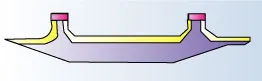
Figure 5: Encapsulation
The above schematic figure shows two different materials applied to the base metal of the screw. The yellow area in the figure represents a hardfacing that is easier to machine, such as Stellite 6, which has a hardness of 38-42 Rc. The red area represents a screw tip hardfacing such as Xaloy® X830, which is a tungsten-carbide material in a corrosion-resistant base matrix.
Spray welding and fusion
The final method of screw protection covered here involves spray welding and fusion with a tungsten carbide suspended material, such as the patented Xaloy® X8000 (US Patent 5,198,268). This application is shown in Figure 6.

Figure 6: Screw protection with spray welding and fusion
All of the mentioned forms of screw protection will have additional costs to the purchase of the new screw, but the extended and consistent longevity they provide greatly outweigh their initial cost.
Barrel wear
As mentioned, with screw wear, abrasion wear also occurs with the barrel liner of the extruder. With today's bimetallic technology that is used to spin-cast the bimetallic liners onto the barrel base metal, improved barrel durability can be obtained. In today's technology, bimetallic liners can have tungsten-carbide particles suspended in the bimetallic base metal. This can be seen in Figure 7.
The small particles seen in this photo are small pieces of tungsten-carbide. This technology was originally patented by Xaloy Inc. under the US Patent 3,836,341. The incorporation of tungsten-carbide into the bimetallic liner material will increase the life of the barrel by 4-5 times. This is in comparison to the older original bimetallic liners, which were available to the plastics industry 20 years ago.
These types of barrels allow for the extrusion of more highly filled polymers. They also allow the extruders to be operated at much higher screw speeds, which can also cause high barrel and screw wear.

Figure 7: Barrel wear
Conclusion
When extruding thermoplastic composite materials, screw design and screw, and barrel construction are crucial considerations. Addressing them properly up front makes the processing of thermoplastic composite materials successful. The main lesson to learn here is that if the proper research is done up front when considering processing thermoplastic composite materials, the learning curve will be much quicker.
- Chung, "Extrusion of Polymers - Theory and Practice", Hanser Gardner Publishing, Inc., Cincinnati, Ohio.
- Bernhardt, "Processing of Thermoplastic Materials", Robert E. Krieger Publishing Company.
- Rauwendaal, "Polymer Extrusion", Hanser Publishers.
- Tadmor and Gogos, "Principles of Polymer Processing", John Wiley and Sons, New York.