
Ethylene Tetrafluoroethylene (ETFE): How to select the right grade?
Last update on Jul 8, 2025
Become an expert by learning some basic information about ETFE, what are the key features & properties, its popular applications and conditions to process this polymer material!
What is Ethylene Tetrafluoroethylene (ETFE)?
Fluoropolymers is the class of polymer materials which contain fluorine atoms in their chemical structure. There are two types of fluoropolymers:
- Perfluoropolymers – In this polymer type, all the hydrogen atoms in the analogous hydrocarbon polymer structures were replaced by fluorine atoms
- Partially Fluorinated polymers – While, in such polymers there are both hydrogen and fluorine atoms in the polymer structures
After successful development and commercialization of several fluoropolymers i.e. PTFE, PCTFE, FEP, PVDF, ECTFE… In 1973, the Ethylene Tetrafluoroethylene (ETFE) was commercialized by DuPont. ETFE is a partially fluorinated copolymer of ethylene and Tetrafluoroethylene (TFE).
TFE and ethylene have a strong tendency to alternate during polymerization, thus, ETFE resins are composed mainly of alternating sequence of the two monomers and have following structure:
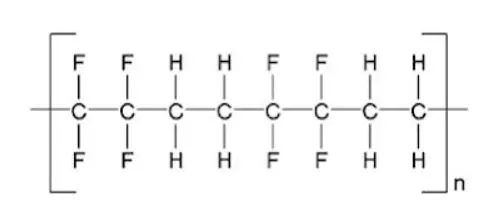
The crystallinity of ETFE ranges from 40% to 60%, and it has a melting temperature of 225–300°C depending on the comonomer ratio and the processing method. Further, the ratio of the two monomers are varied to obtain several grades of ETFE with optimized properties for specific end applications.
ETFE copolymers are basically alternating copolymers, and in the molecular formula, they are isomeric with polyvinylidene fluoride (PVDF) with head-to-head, tail-to-tail structure.
ETFE has excellent electrical and chemical properties. ETFE is especially suited for applications requiring:
- High Mechanical Strength
- High Chemical Resistance
- Superior thermal and electrical properties
The mechanical properties of ETFE are superior to those of PTFE and FEP (perfluoroalkoxy resins). It is also important to note that to modified ETFE copolymers are superior to PVDF with the exception of PVDF's remarkable piezoelectric and pyroelectric properties.
Typical Characteristics and Properties of ETFE
ETFE has the best of all fluoropolymers the wear resistance, the impact toughness and radiation resistance. ETFE is melt processable. The mechanical properties of ETFE are similar to those of fully fluorinated polymers.
ETFE [poly(ethene-co-tetrafluoroethene); CAS: 25038-71-5] has:
- Excellent resistance to extremes of temperature
- Excellent chemical resistance
- Good mechanical strength with excellent tensile strength and elongation. It has superior physical properties compared to most fluoropolymers
- With low smoke and flame characteristics, ETFE is rated 94V-0 by UL
- It is odorless and non-toxic.
- Exhibits outstanding resistance to weather and aging, Exception UV transmission
- Excellent dielectric properties.
- Its radiation resistance is high with the advantage of being cross-linked by high-energy radiation. The radiation cross-linked ETFE wire insulation can be continuously used at 200 °C.
ETFE is less flexible than PTFE, but has superior impact strength, abrasion and cut through resistance. Addition of a third component to the chemical structure creates a modified ETFE. For example, ETFE modified by glass fiber reinforcement is tougher and stiffer and has higher tensile strength than PTFE, PFA or FEP. ETFE has a working temperature range of -200°C to 150°C.
Let's check out property comparison between different fluoropolymers:
| Fluoropolymer | Produced First in | Melting Temperature °C | Tensile Modulus MPa | Elongation at Break % | Dielectric Strength kV/mm | Use Temperature % |
| PTFE | 1947 | 317-337 | 550 | 300-550 | 19.7 | 260 |
| PCTFE | 1953 | 210-215 | 60-100 | 100-250 | 19.7 | 200 |
| FEP | 1960 | 260-282 | 345 | ~300 | 19.7 | 200 |
| PVF | 1961 | 190-200 | 2000 | 90-250 | 12-14 | 110 |
| PVDF | 1961 | 155-192 | 1040-2070 | 50-250 | 63-67 | 150 |
| ECTFE | 1970 | 235-245 | 240 | 250-300 | 80 | 150 |
| ETFE | 1973 | 254-279 | 827 | 150-300 | 14.6 | 150 |
| THV | 1996 | 145-155 | 82-207 | 500-600 | 48-62 | 93 |
Although, ETFE has some limitations:
- High cost
- Maximum use temperature lower than other fluoropolymers (150°C)
- Attacked by oxidizing acids, amines and sulfonic acids
- High density
- Toxic smoke emission
- Limited number of grades available
How is ETFE Made?
ETFE is a partially fluorinated straight-chain polymer with very high molecular weight. It is produced by free-radical polymerization mechanism in a solvent or a hybrid (a solvent/aqueous mixture) media, using an organic peroxide initiator. Copolymerization of TFE and ethylene proceeds by an addition mechanism. It normally includes an additional termonomer to increase the flexibility required in commercial applications.

Due to the risk of explosive decomposition reaction, the copolymerization of ethylene and TFE must be conducted in special vessels at low pressure.
Suspension polymerization is generally carried out in an inert chlorofluorocarbon solvent using fluorinated peroxides as initiator and methanol as a chain transfer agent.
Methods to Process ETFE
ETFE can be easily processed by all standard thermoplastic processing methods such as injection molding, compression molding, blow molding, rotational molding, extrusion, and wire coating.
Process equipment for fluoropolymers must be made from corrosion-resistant alloys because of the corrosive compound that may be produced when they are heated above melting points.
- Processing temperature: 290 to 340°C
- Drying is recommended but not necessary
- Injection Molding: A mold temperature of 65-150°C is recommended
- Extrusion: Extruder barrels should be long, relative to diameter, to provide residence time for heating the resin to approximately 345°C
Watch Free Video Today!
Key Applications
ETFEs are only used for relatively high-performance applications related to heat, low temperature, chemical internes, and electrical insulation. Because ETFE is a semi-transparent material, it can also be used as a viable replacement for glass or traditional plastic. ETFE is an attractive replacement for glass because it maintains 1% the weight of glass, yet transmits 25% more light and is less expensive to install.
ETFE is also extremely suitable for use in architectural structures. The superior transmission of UV and long wave radiation also leads to it being used extensively in outdoor constructions.
There are several well-known buildings that have used ETFE in their construction, including:

More applications of ETFE include:
| Application of ETFE |
 Automotive: |
 Electrical & Electronic: |
 Engineering: |
 Medical: |
 Films: |
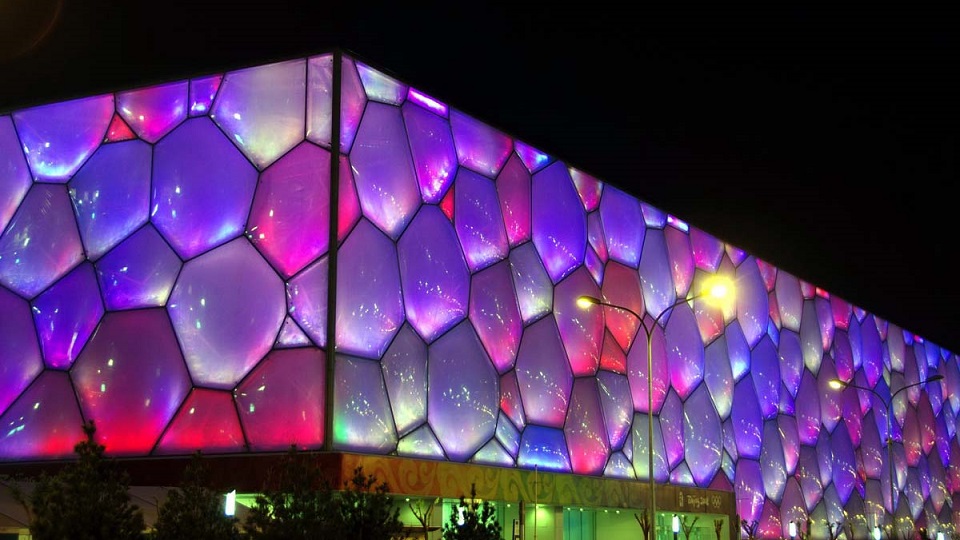
Water Cube - The World's Largest ETFE Application Project; ETFE Fabric facade can be used in all commercial building

ETFE is nearly chemically inert, thus, it is suited to chemical fluid handling and analytical applications

Another key use of ETFE is for the covering of electrical and fiber-optic wiring