

Recent Advances in Piezoelectric Films and Sensors
Last update on Feb 15, 2018
 Piezoelectricity is the appearance of a voltage across the sides of a crystal when it is subjected to mechanical stress or squeezing. A piezoelectric sensor is a device that uses the piezoelectric effect to measure changes in pressure, acceleration, temperature, strain, or force by converting them to an electrical change.
 Recently, piezoelectric polymer sensors have become one of the fastest growing technology areas in the global sensor market. Currently, they are used as versatile tools for the measurement of various processes.
Let's understand what makes piezoelectric films suitable for numerous applications and the possible solutions to further improve their performance:
Key Features of Piezoelectric Film
There are numerous situations where a piezoelectric film has been considered for use in the sensor solution. Among the areas that piezoelectric sensors are currently used are, in:
- Medical
- Aerospace
- Nuclear instrumentation, and
- Touch parts of mobile phones as a pressure sensor
In the automotive industry, piezoelectric elements are used to monitor combustion when developing internal combustion engines. Since the discovery of piezoelectric polymers, the technology has advanced significantly and is being adopted on a larger scale than previously.
In general, piezoelectric films that are used in piezoelectric sensors are strong, lightweight and flexible. They come in a wide range of thicknesses and areas. Piezoelectric films can usually be molded into unique designs and can be glued with commercial adhesives. Some general features of piezoelectric films include:
|  |
Polymers Exhibiting Piezoelectricity
Four critical elements exist for all polymers that possess piezoelectric features, regardless of the morphology that is present in the polymers. These essential elements are:
- The presence of permanent molecular dipoles
- The ability to orient or align the molecular dipoles
- The ability to sustain the dipole alignment once it is achieved, and
- The ability of the material to undergo large strains when it is mechanically stressed
Among common polymers, poly vinylidene fluoride (PVDF), PVC and nylon are examples of materials that exhibit piezoelectric behavior.
PVDF to Have Won the Race
For the materials that were already mentioned, PVDF has been found to exhibit high levels of piezoelectricity. The other polymers, such as PVC and nylon, do not match the high piezoelectric effect that is observed with PVDF and its copolymers.
 | The manufacturing process of piezoelectric PVDF material consists of stretching the PVDF sheet at a temperature that is close to the melting point of about 175°C. This causes a polymer chain packing of the molecules into a piezoelectric crystalline phase. The stretched polymer is exposed to a high electric field to generate the piezoelectric properties in the material.
|
Piezoelectric Potential - Polymer v/s Ceramics
In addition to polymers, certain ceramic materials can be used to produce piezoelectric films. Some naturally occurring crystals, such as: quartz and topaz exhibit piezoelectricity. Lead zirconate titanate or PZT, a man-made ceramic material, is the most common ceramic piezoelectric material in use today.
Both the ceramics and piezoelectric polymers offer certain advantages and disadvantages when used in piezoelectric films.
- Piezoelectric polymer films have low acoustic impedance, which is closer to that of human tissue, water and organic materials than ceramic films. Such a close match of the impedance allows for the efficient transduction of acoustic signals in both tissue and water.
- Piezoelectric polymer films also display excellent sensitivity and low density.
- When piezoelectric polymers are extruded into thin films, they can be joined to a structure without affecting the mechanical motion. In general, piezoelectric films are ideal for use in strain sensing applications, which demand high sensitivity and wide bandwidths.
However, when compared to ceramic films, polymer piezoelectric films make for a relatively weak electrochemical transmitter, especially in low frequency and resonance applications. Also, PVDF is not suitable for usage or storage at temperatures above about 100°C.This limits its performance in relatively high temperature applications. In addition, when the electrodes of the film are exposed, the sensor has a tendency to be quite sensitive to electromagnetic radiation.
Major Applications of Piezoelectric Films
#1. Pinball Machine Switch
Currently, piezoelectric films are used in a variety of sensor applications. One of the applications is shown below:
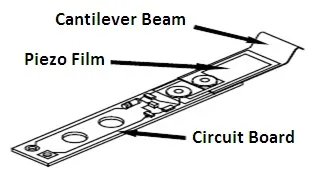
Switch for Pinball Machine
- In general, contact switches have a low reliability factor. This is because; the accumulation of dust, moisture and other contaminants tends to affect the contact points.
- On the other hand, piezoelectric films provide excellent reliability due to their structure.
- Also, they are not sensitive to other standard switch failure modes.
- The application that is shown in Figure 1 for use in a pinball machine is one of the most challenging of all switch applications.
#2. Piezoelectric Film in Impact Printer
Another application for piezoelectric films is in impact printers. An example of that application is displayed in figure below:

Piezoelectric Film in Impact Printer
The sensors that are based on these materials are integrated within the printer platen. They help to monitor the impact timing and force of the group of print heads and the data are relayed back to the controller.
In order to accommodate slight changes in the timing of the print head, the actuator timing is automatically adjusted. The high speed of the embossed steel ribbon demands a quick switch response.
However, the impact forces that are associated with the print head tend to destroy conventional impact switches. But, switches that are based on the use of piezoelectric films overcome these complications and issues, thus allowing for their use in this very demanding application.
#3. Non-Destructive Testing of Materials
A final application for which piezoelectric films are finding uses is in the non-destructive testing of materials, including composites. In general, composite materials have excellent strength and are also lightweight.
Further, they are non-magnetic in nature. Sheets of piezoelectric polymer transducer arrays are very suitable for non-destructive testing. One example of that application is the use of piezoelectric films to perform the non-destructive testing of aerospace engine parts.
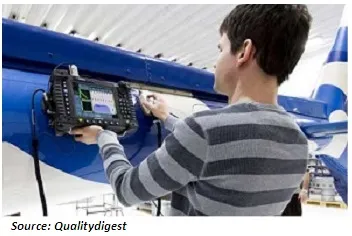
Non-Destructive Testing of Aerospace Engine Parts
Improving Piezoelectric Films with New Materials
There are several new developments that are currently ongoing with piezoelectric films. One issue that is being addressed is the limited thermal performance that is available with the current PVDF materials as has already been noted; the PVDF cannot be used at temperatures above about 100°C.
This is to be contrasted with ceramic materials that can be utilized at much higher temperatures. There is an interest in having polymer-based piezoelectric films that can provide higher temperature performance that is provided by the current PVDF materials.
In order to solve that problem, copolymers of PVDF with several different co-monomers are being investigated. The main purpose of the co-monomer is to increase the temperature at which the PVDF-based material can be utilized. The idea is to maintain the excellent piezoelectric properties of the PVDF while simply increasing the thermal performance. The development of such materials is expected to extend the use of piezoelectric films to more demanding applications.
Emerging Field of Applications
In addition to these new materials developments, there are also new applications that are currently being examined for piezoelectric film products. Among these are uses in musical instruments, machine monitoring and ultrasound applications.
Further, the products are being considered for utilization in energy harvesting uses. For those uses, the mechanical properties of PVDF can be tuned over a wide range of values. Those developments provide a promising route toward the development ofself - powered implantable devices.
Areas to Focus R&D on!
Among the developing applications for which piezoelectric sensors need an enhanced temperature performance compared to current PVDF materials are structural health monitoring uses.Also, there's a need for non - destructive evaluation and testing of product components in:
- Next generation turbines
- More efficient jet engines
- Steam and nuclear / electrical power plants
Due to the high temperatures that are associated with those products, the piezoelectric sensors need to have operational features at elevated temperatures. Currently, the operation temperature range of smart transducers is limited by the sensing capability of piezoelectric materials at:
- High temperature
- Increased conductivity and mechanical attenuation, and
- Variation of the piezoelectric properties with temperature
Materials that are based on copolymers of PVDF other than co-monomers are a step in the right direction. But, further developments of new materials for use in piezoelectric sensors will continue to be needed as applications become more severe. These new applications will continue to drive the need for piezoelectric polymer materials that allow for the potential operation at extreme temperatures and in harsh environments.
Conclusion
Current piezoelectric films are lightweight and have a high dielectric strength, high mechanical strength and impact resistance. They also have:
- High elastic compliance
- Wide dynamic range, and
- Low acoustic impedance
All of these features make piezoelectric films extremely suitable for use in a wide range of applications.
However, novel applications are driving the development of new materials for use in piezoelectric sensors. Many of those new uses require the piezoelectric materials to have higher temperature performance than is provided by current materials.