

Latest Developments in the Bioplastics Green Revolution!
Last update on Jul 11, 2023
Recent bioplastics activity globally is seeing collaborations to move these materials further into the mainstream, while simultaneously modifying their properties. As bioplastic demand has grown, so has research into more . This ongoing research spans the gamut from finding new raw material sources to developing new applications.
Take, for example, a world-first bioplastic, lounge armchair exterior shell. MAIP Compounding's IamNature's totally natural origin-based PolyHydroxy Alkonate (PHA) bioplastic has been used by leading Spanish furniture designer Andreu World in their 'Nuez' brand lounge chair.
PHA is viewed as a high-grade, natural wood replacement material. The PHA injection molded, sculptured chair shell compound is composed of additives of a vegetable and/or an organic nature. IamNature's PHA is made by bacterial fermentation of sugar-processed scrap. The PHA bioplastic chair shell is:
- Colorfast stable with molded textured surface ranges available, thus eliminating traditional secondary surface finishing and painting, inherent in wood products.
- Dimensionally stable, has a good surface hardness, mechanically tough, and thermally resistant to everyday artificial light/sunlight.
Also of environmental interest, 'Nuez' seat fabrics are produced from textile waste and recycled PolyEthylene Terephthalate (PET) bottles.

Andreu World's 'Nuez' Brand Lounge Bio Armchair
Global production of bioplastics represents less than 1% of the more than 367 million tons of plastic produced annually. Development is driven by rising demand combined with the emergence of more sophisticated applications and products.

Global Production of Bioplastics
Let's now turn our attention to reviewing five bioplastics innovations.
CJ Bio & NatureWorks' Bioplastic Resins for Compostable Food Packaging
To start with, Korea-based CJ Bio and U.S.-headquartered NatureWorks recently created a partnership to develop materials based on their respective PolyHydroxy Alkanoate (PHA) and PolyLactic Acid (PLA) bioplastic resin portfolios. CJ Bio is a division of a major Korean food company as well as a leading PHA producer. In addition, CJ Bio is the world leading supplier of fermentation bioproducts for animal and human nutrition, with 13 worldwide manufacturing plants.
Both companies plan to combine CJ Bio's PHAct marine biodegradable polymers with NatureWorks' Ingeo™ biomaterials technology. Of primary importance, CJ Bio is the only producer in the world of amorphous PHA (aPHA), having very recently introduced its first PHAct® branded PHAct® A1000P grade. Amorphous PHA (aPHA) is:
- a softer, rubberier version compared to the more traditional crystalline and semi-crystalline PHA variants, and
- certified as compostable in ambient soil and marine environments.
Compounding aPHA into PLA improves PLA mechanical toughness and elastic ductility, with material clarity remaining unchanged. The ultimate goal here is to develop home compostable food packaging, eating service ware, and personal care products, in addition to agricultural uses such as mulchable, in-place crop protection films.
Property Name | Unit | Test Method | PHA Types | ||
| cPHA (crystalline) | scPHA (semi crystalline) | aPHA (amorphous) | |||
| Specific gravity | g/cc | ISO 1183 | 1.23 | 1.23 | 1.23 |
| Flexural strength | MPa | ISO 178 | |||
| Charpy impact strength | kJ/m2 | ISO 179 | 3 | 5 | N/A |
| Tensile strength | MPa | ISO 527 | 30 ~ 40 | 1 ~ 30 | |
| Heat deflection temperature (HDT) | °C | ISO 75-2 | 100 | 90 ~ 100 | - |
| Glass transition temperature (Tg) | °C | DSC | 0 ~ 5 | -15 ~ -5 | -15 ~ -20 |
| Melting temperature (Tm) | °C | DSC | 180 | 130 | N/A |
CJ Bio's Physical Properties for Crystalline (L), Semi-crystalline (C), and Amorphous (R) PHA Grades
Cathay Biotech's Bio-based PA for Sporting Goods Footwear
Next, China-based Cathay Biotech has commercialized a bio-based PolyAmide (PA, or nylon) elastomer. This elastomer has a hard PA segment providing high strength and crosslinking capability that works in tandem with a polyether soft block contributing elasticity. It is injection moldable and foamable within a broad range of 30 to 65 Shore D hardnesses. Cathay Biotech's elastomer processes are similar to:
- Arkema's market-leading and partially bio-based polyetheramide elastomer, as well as
- Celanese's (formerly DuPont) recently acquired Hytrel® copolyester.
Applications are primarily targeted at sporting goods footwear, with automotive, telecom, and medical tubing in longer-term development. They selected Arkema's Pebax® 7233 as a key reference material for their PA5X-65D, with both elastomers having excellent and comparable Taber abrasion resistance, as well as similar tensile stress and elongation at break capabilities.
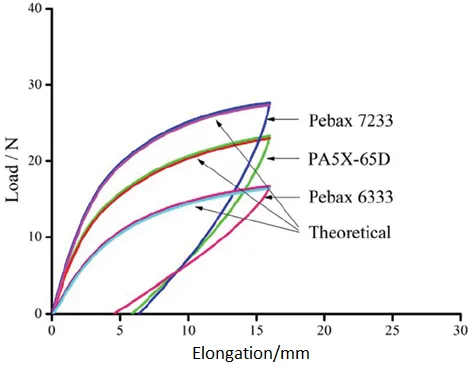
Cathay Biotech's PA5X Elastomers' Elastic Recovery Properties
The above graph shows both theoretical and actual elastic recovery performance of three ThermoPlastic Elastomers (TPEs) namely two Arkema's Pebax® 7233 and Pebax® 6333 grades, and one Cathay Biotech PA5X-65D resin under identical strain conditions. Generally speaking, when the load is removed, recovery will follow the same path as elongation.
However, displacement of the polymer chains leads to dissipating energy, which ultimately results in permanent deformation. Load to achieve a particular elongation is a direct function of the elastomer's hardness. The hardness of Cathay Biotech's PA5X-65D falls between Arkema's Pebax® 7233 and Pebax® 6333 grades, as does its elastic recovery.
SabioMaterials' PHA Brands for Durable & Disposable Applications
Delving further, Italian start-up company SabioMaterials has developed PolyHydroxy Alkonate (PHA) branded BIODURA® and Terralix® bioplastics compounds.
- BIODURA® compounds are targeted at higher-end durable applications such as designer furniture, electronics, outdoor sports, and related consumer products.
- Terralix® compounds are focused on low-impact, disposable applications across agriculture, forestry, and aquaculture end uses.
SabioMaterials' specialty compounding expertise uniquely centers on compounding a broad range of PHA materials using novel additive ingredients including plant origin-based constituents, novel formulations, and ultimately thorough end-use application prototyping.
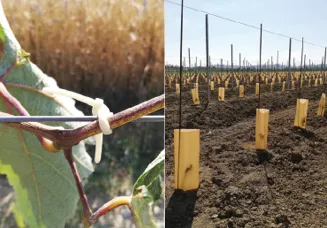
SaboMaterials' Terralix® PHA Bioplastic Compound for Grapevine Bind/Protect Components
Terralix® has driven new agricultural disposal applications where it is used to bind and protect new plants, with a current special emphasis in wine vineyards, and it is advancing rapidly in disposable mulch and seasonal irrigation systems that do not need to be removed after use.
Rohm's Renewable PLA Film for Food & Non-food Packaging
Continuing, Germany's Rohm has developed a first-ever, renewable content, thermoformable PolyLactic Acid (PLA) film, aimed at food and non-food packaging, decorative insert molded film, and printing on graphic panel applications.
- Rohm's Europlex Film LJ 21123/123 is 92% light transparent, high-gloss, and has not been biaxially stretched. Thus, it can be thermoformed at 55°C.
- It is a certifiable compostable PLA as per U.S. ASTM D6400 and European EN 13432 standards.
- It has high tensile strength, competitive flexibility, can be stamped/cut/printed on, and is available in 53 to 500-micron thicknesses at 200-millimeter widths.

Rohm's Thermoformable PLA-based Food Contact Film
Cortec's Biodegradable PLA Film for Packaging Applications
Finally, Cortec has received industrial composability certification for its PolyLactic Acid (PLA)-based Eco Film. It is targeted at replacing traditionally used, non-compostable, fossil fuel-based, Low-Density PolyEthylene (LDPE) and High-Density PolyEthylene (HDPE) films. Eco Film is certified compostable by the globally recognized TUV Austria testing group and complies with the industrial compostability guidelines outlined in the European EN 13432 standard, and the equivalent U.S. ASTM D6400 method. It will easily biodegrade within a few months' time.

Cortec's Eco Film Has Found Use in a Number of Composting Programs
Typical Cortec Eco film applications include mail, toy and parts packaging, garbage, mulch, and grocery bags, food and yard waste containers, and community composting programs. In a recent program at a U.S., Minnesota state zoo that used Eco Film, 370 tons of recycled material was produced, while simultaneously composting 600 tons of waste over the first year. The composted material is being used as a soil mulching additive to maintain existing zoo turf areas. Cortec is also in the process of launching a second-generation Eco Film II Backyard Compostable that can be discarded into backyard composting bins, thus reducing bags sent to industrial composting facilities.
