
Top 5 Trends Revolutionizing the Bioplastics Market
Last update on Jul 30, 2024
 The global bioplastics market was estimated at US$12.4 billion in 2023 and is forecasted to double by 2030. The latest business strategies of major resin suppliers feel it will grow at a rate of around 15% a year. This is due to global regulations and increasing customer demand.
Responding to these market drivers, many material companies have started collaborations to enable advances in the properties of bioplastics like PolyLactic Acid (PLA) and PolyHydroxy Alkanoates (PHA), and biobased versions of standard polymers such as PolyPropylene (PP). They have also increased the use of natural fibers as fillers and reinforcements.
Target areas for are broadening. In addition to single-serve coffee pods and packaging items, there are durable injection molding applications and automotive parts.
Artificial Intelligence (AI) has entered bioplastics. Yes, it's true! For example, the U.S. National Renewable Energy Laboratory's (NREL) PolyID (Polymer Inverse Design) software tool. NREL is using AI to identify bioplastics with better functionality. The PolyID algorithm is based on an approach defined as 'group-contribution theory.'
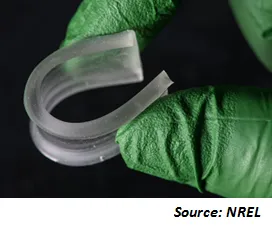
NREL PolyID screened more than 15,000 plant-based polymers in search of biodegradable alternatives to conventional plastic food packaging film like High-Density PolyEthylene (HDPE). It created a list of 7 polymer designs that could be made from biomass. After lab testing, the NREL scientists confirmed the tool's predictions. Here, all 7 polymers withstood higher temperatures and generated lower net greenhouse gas emissions. Thus, keeping food fresh for longer.
Let's now turn our attention to reviewing two bioplastic materials, one process, and two application innovations respectively.
CJ Biomaterials' aPHA Technology Revolutionizes Eco-friendly Packaging
South Korea's CJ Biomaterials has created proprietary PolyHydroxy Alkanoate/PolyLactic Acid (PHA/PLA) blends based on their amorphous PHA (aPHA) technology. This is for use in cosmetics company Riman Korea's Incellderm skincare products packaging. These PHA/PLA blends will increase biorenewable content. It is being used to package Riman's Incellderm Active Cream EX, Dermatology First Package Booster EX, and Vieton Oil Mist. These account for sales of more than 5.4 million units per year.

CJ Biomaterials' PHA/PLA for Premium Cosmetic Packaging
(Source: Riman)
CJ Biomaterials has also teamed up with Dongil Platech to develop a drinking straw. This uses PLA and its PHACT marine biodegradable bioplastic. The use of plastic straws and their presence in the environment is causing concern around the world. This is generating interest in alternative solutions.

CJ Biomaterials' PLA Bioplastic Extruded Drinking Straws
(Source: Dongil Platech)
Recently, CJ Biomaterials was awarded a German Red Dot Design Award for a PHA Head-Up Toothbrush. It was developed with the Australian eco-designer company Revelop. The toothbrush was a winner in the 'Sustainable' category within the Design Concept discipline.

CJ Biomaterials' PHA Head-Up Toothbrush
(Source: Revelop)
CJ Biomaterials is the only producer worldwide of amorphous PHA (aPHA), a more rubber-like version of PHA. It offers different performance characteristics to the conventional crystalline or semi-crystalline PHA forms.
Avient's Biobased Polyolefins Reduce Product Carbon Footprint

Avient's Maxxam™ BIO formulations are based on PolyPropylene (PP) and PolyEthylene (PE) resins. They can be blended with glass, minerals, impact modifiers, colorants, and stabilizer systems. This provides customized solutions to meet more specific application needs. This customization makes Maxxam™ BIO compound formulations suitable for use across many industries including:
- transportation,
- industrial,
- consumer,
- electrical/electronic, and
- building/construction
Besides sustainability benefits, bio-based fillers improve lightweighting compared to polymers filled with talcum, calcium carbonate, or glass fiber. Cellulose fiber-filled grades possess several properties like:
- good gloss and surface finish,
- easy to color,
- superior mechanical properties, and
- performance properties like scratch, mold/fungi/bacteria, and UltraViolet (UV) resistance
The performance properties are useful for automotive applications such as decorative parts, trunk side liners, and pillars.

Maxxam™ BIO 40% Cellulose Fiber Filled Polyolefins for Automotive Interiors
(Source: Avient)
Maxxam™ BIO polyolefins
are formulated with both bio-based resin and/or filler from natural sources such as olive seed powder. The portfolio now includes newly added grades with up to 40% filler from cellulose fiber. They can be based on either prime or biobased resin. Incorporating a biobased resin with a natural filler further enhances sustainability and reduces the product's carbon footprint compared to fossil fuel-based feedstock alternatives.
Nissei Group & Negri Bossi Unveils PLA Bottle Injection Molding System
Japan's Nissei company acquired Italy's Negri-Bossi in 2019. Nissei Group and Negri Bossi have developed an injection molding manufacturing system for PolyLactic Acid (PLA) bottles. Nissei separately developed the PLA molding grade. Negri Bossi does not require a special blow molding machine, commonly used for molding bottles. Instead, it uses a general-purpose injection molding machine outfitted with a special mold. Negri Bossi produced the bottle on its recently introduced 5th-generation Nova5eT series of electric machines, specifically in a single cavity mold on a Nova5eT 180 model.

Nova5eT 180 PLA Injection Molding Machine
(Source: Negri Bossi)
Features of the Nova5eT 180 include:
- a 15% smaller footprint compared to previous series models,
- a flat clamp mechanism that generates uniform, optimum contact pressure,
- a dynamic toggle for faster open/close speeds with automatic force adjustment,
- an injection unit designed for reduced heat-up time and shorter plasticizing times, and
- a Tact V controller that easily connects with other devices allowing precise overlapping machine movements for reduced cycle times

Molded PLA Bottles
(Source: Nissei/Negri Bossi)
Negri Bossi partnered with Spanish mold maker Molmasa Industrial de Moldes to make the special PLA bottle mold. An in-mold labeling system, with labels from the supplier La Prensa, was incorporated into the automated system.
Benvic & Partners' PLA Breakthrough for Eco-engineered Automobile Parts
Benvic, BASF, and Röchling launched Plantura PolyLactic Acid (PLA) based compounds for durable applications. Benvic's Plantura compounds are a solution for engineered automotive parts. Automotive Tier 1 German molder Röchling is currently focusing on several products based on Plantura biobased compounds. This includes filter boxes, active grille shutters, exterior grilles, air intake ducts, tanks, and degas bottles.
- Degas bottles are used in automotive engine cooling systems. They remove air entrained in coolant fluid, which can cause overheating.
- Grille shutters will benefit from Plantura's PLA rheology to fill out mold cavities quickly. This will in turn optimize cycle times.

Automotive Intake Air Duct Grille Shutters Using Benvic's Plantura Compound
(Source: Röchling)
Furthermore, the Plantura grades are:
- well suited in thin-walled applications,
- easily recyclable, and
- can be reinforced with bio-sourced fibers such as industrial hemp or bamboo
BASF Tinuvin®, Uvinul®, and Chimassorb® specialty additives provide critical UltraViolet (UV) resistance to the Plantura PLA automotive parts.
VTT's Investment in Sustainable Cellulose Film for Food Packaging
Finland's Voltooid Tegenwoordige Tijd (VTT), or the Technical Research Centre of Finland has invested €1.5 million (US$1.67 million) to scale up a pilot plant for making cellulose film. The cellulose material can be used to replace conventional Polypropylene (PP) film as a more sustainable, mainstream alternative in food packaging.

Scaling-up Pilot Production Process of Cellulose Films
(Source: VTT)
The investment will allow the plant to begin testing and developing processes to enable mass production of these films. The pilot plant's emphasis is to:
- improve barrier properties and
- make packages from cellulose materials
VTT is already working with more than 30 packaging-related partners and expects wide industrial use within five years. Initial customer feedback is that there is no difference between VTT's crystal clear transparent, flexible, cellulose-based films and traditional fossil fuel-based plastic wraps.
Conclusion
The bioplastics growth is driven by environmental concerns and regulatory pressures. This growth has encouraged material suppliers to work on enhancing the properties of bioplastics. From AI-assisted polymer design to applications in cosmetics, automotive, and food packaging, the industry is creating sustainable alternatives.
The development of bio-based materials with improved properties and applications is a result of collaborations between material companies, researchers, and manufacturers. As the market continues to expand, bioplastics play a crucial role in reducing the environmental impact caused by the use of traditional plastics. Thus, offering promising solutions for a more sustainable future.
Find the Complete Range of Bio-based Polymers
Select from 1,200+ grades of biobased polymers available in our database. Analyze the technical data of each product, get technical assistance, or request samples.
Recent Highlights in Bioplastics Market
Delve into 2024's hottest innovations and trends in bioplastics with the industry expert Donald Rosato. Gain access to game-changing innovations to equip yourself with cutting-edge market insights. Get details about the biobased PLA resins, sustainable process to create a compounded grade of PLA, latest packaging made with renewable materials, and much more!