

How to Clinically Evaluate the Skin Modification Caused by Menopause?
Last update on Apr 30, 2021
Intrinsic Skin Aging
Intrinsic skin aging due to menopause phenomena correlated to hormonal deficiency is like age-related aging. Its main manifestations are gradual and with great inter-individual variations like:
- Dryness and thinning of the skin
- Lipid changes
- Alteration of the barrier function
- Age spots and pigmentation disorders
- Loss of complexion radiance
- Face and neck slackening
- Loss of firmness and elasticity
- Vascular disorders
These signs are generally associated with alopecia and nail damage. The skin becomes very dry, withers, wrinkles, changes texture and color.
Moreover, during the perimenopause period, we can see signs of relative hyperandrogenism (acne, hair, hair loss) secondary to loss of hormonal balance (androgens, estrogens, progesterones).
These skin changes that appear during menopause sign up the hormone-dependent of the skin and can lead to a decrease in self-esteem, and well-being. These hormonal disturbances accentuate the signs of intrinsic and photo-induced skin aging.
Now, let's explore the factors that lead to extrinsic aging along with the clinical studies & treatments related to the skin modifications caused by menopause in detail...
Factors Affecting Extrinsic Skin Aging
Extrinsic aging occurs due to environmental factors, often called exposome – accounts for about 70% of aging. These factors include:
|
|
It changes the genetic capital, but it is reversible. Epigenetic aging due to the mechanisms of modification of genetic information affects the mechanisms of DNA methylation, acetylation of histones, and remodeling of chromatin.
Skin Modifications & Pro-age Treatment
From a histological point of view, we can observe the following changes.
| At the Epidermis | In the Dermis |
|
|
Ingredients Boost Pro-age Efficacy of the Skin
The pro-age treatment can boost blood circulation, encouraging collagen production and helping lift, plump, and define contours for a firmer appearance. Moisturizing ingredients are used for immediate and long-term effects, as it increases skin elasticity and firmness whilst gently exfoliating dead skin cells. Other ingredients work as lymphatic drainers to change the shape of the cheekbones and add definition!
The Studies of Skin Hormonal Aging Perception
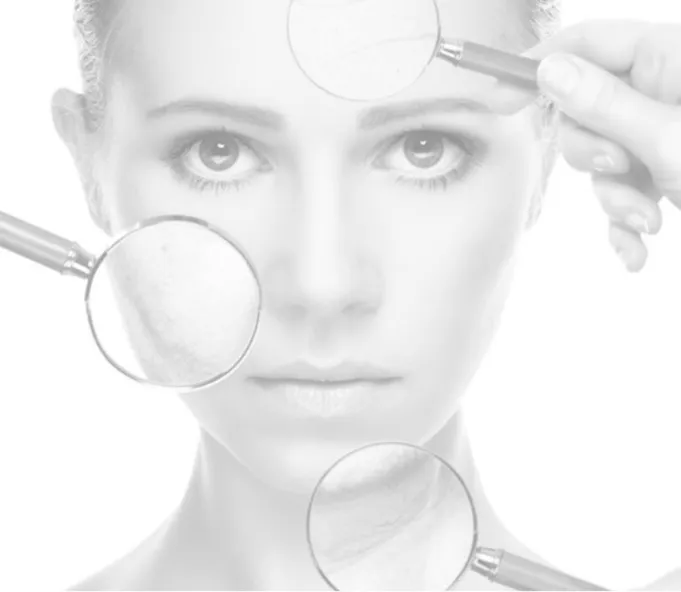
To look more closely at the category of skin care for menopause skin, it can be closely considered as aging products adding the intrinsic hormonal changes. In addition to the geographical variations of their regulatory status according to each country, their performances generally announce several effects on mechanisms which are:
- Targeted: Skin relief, Collagen, Cellular communication, Dermo-epidermal junction,....
- Localized: Wrinkles, Oval Face, Neck, Hands,...
- Focused at different skin depths: Epidermis, Dermal-epidermal junction, Dermis,...
- Interconnected in various mechanisms: Cellular and Biochemical (microbiota, keratinocytes, fibroblasts, melanocytes, nervous receptors...)
More than classical efficacy on the skin surface and structure, skincare dedicated to menopause skin reveal improvements in emotional, well-being, sensorial properties... but, the cutaneous signs of aging are still seriously studied with great accuracy as a tangible proof of the product performances. The promise is a recovery of the tissue elasticity, the face's shape, the plump, and the volume appearance.
| ANTI-AGING CLAIM SUBSTANTIATION – CLINICAL ASSESSMENT | |
| Action | Claims |
| Care | Anti-wrinkle |
| Anti-sagging for the face and the neck | |
| Moisturizing | |
| Lifting – resculpting | |
| Complexion and radiance | |
| Anti-age spot and hyperpigmentation | |
| Strengthen the epidermal junction | |
| Protection | Anti-UVA + UVB + Infra-red + Blue light |
| Anti-pollution | |
| Anti-oxidant – DNA Protection | |
We can categorize the skin aging signs due to menopause:
- Skin color and pigmentation: Redness, tone, Radiance, Age spots,
- Skin topography: Crow's Feet, Furrow Lines, Upper Lip, Under-eye, Forehead wrinkles, Roughness,
- Skin structure: Thickness, Epidermal junction, Barrier function,…
- Volume: Face, Nasolabial Sagging or Smile lines, Puffiness, Eyelids…
- Biomechanical properties: Firmness, Elasticity…
How to Objectivate Menopause Skincare?
A great possibility regarding the analysis of the pro-age performances is offered to the cosmetics brands to clinically demonstrate these effects via biometrological and scientific measures.
In the notion of 'well-being' the notion of 'anti-aging' comes little, one might as well say 'pro-age' or 'plain age', the condition of the skin being thought in its entirety. The identification of the properties of these products uses a sensory approach, sometimes neurosensory and holistic. The feeling, the impacts on the quality of life are measured.
The investigators can choose the tests between 5 main categories:
- Consumer tests
- Sensory or emotional analysis
- Biometrological studies
- Clinical scores
Or people can also design the protocol of the studies combining 2 or 3 of them.
In this table, all the devices enabling quantitative, semi-quantitative, or imaging objectivations are listed. There are many ways to validate the performance of personal care products fighting the hormonal changes caused by menopause. The investigators can choose among the various studied effects and design a multi-parametric protocol.
| ANTI-AGING CLAIM SUBSTANTIATION – CLINICAL ASSESSMENT | |
| Studied Effect | Methods and Devices |
| Biomechanical Properties | Cutometer, Cutiscan (C+K), Dyna Skin and Skin Flex (Orion), Ballistometer (Dia-Stron) |
| Wrinkles and Relief | AEVA-HE, Dermatop-HE (Eotech), ColorFace (Newtone Technologies), Clarity 3D (BTBP), Primos Lite-Primos 3D (Canfield), Visioscan VC 98 (C+K), Antera 3D (Miravex), C-Cube (Pixience) |
| Face Morphology and Volume | ColorFace (Newtone), AEVA-HE, Dermatop-HE (Ecotech), Vectra, Olé, Primos (Canfield), Observ 320 (Innofaith), HeadScan (Orion) |
| Hydration | Corneometer and MoistureMap (C+K), Epsilon (Biox), DPM 9003 (NovaTech), MoistureMeterSC (Delfin), DermaLab (Cortex), Skicon-200... |
| Barrier Function | Tewameter® TM 300 and Nano (C+K), AquaFlux (Biox), Evaporimeter, VapoMeter (Delfin), DermaLab (Cortex)... |
| Age-spots | Mexameter® MX 18, Calorimeter (C+K), SkinColorCatch (Delfin), TiVi 70 Skin Color (Wheels Bridge), C-Cube (Pixience), Chroma Meter (Minolta), SpectraCam (Newtone) |
| Gloss, Complexion and Radiance | ColorFace (Newtone), GonioLux (Orion), Skin GlossyMeter (C+K), Skin GlossMeter (Delfin) |
| Skin Surface | SpectraCam (Newtone), Epsilon (Biox), Dermatop-HE (Ecotech), Visia-CR (Canfield), VisioFace and VisioScan (C+K), ViewSkin, C-Cube (Pixience), Antera 3D (Miravex), TiVi 80 (Wheels Bridge), Clarity 3D Mini (BTBP), Neo Voir II (C-Lab Co), SIAScope (MedX Health), and all video miscroscopes. |
| Skin Structure | Dub Skin-scanner, Dermatop-HE (Eotech), LC-OCT (Damae), Antera 3D (Miravex), Sonde Raman (Horiba Jobin), Viva Scope (Mavig), VivoSight (Michelson), TiVi 80 (Wheels Bridge), Derma Scan (Cortex) |
| Skin Molecular Content | LC-OCT (Damae), Sonde Raman (Horiba Jobin), FibroTX (Ecotech), Raman Spectroscopy Gen-2 SCA (RiverD), Genomic, metabolomic, proteomic analysis. |
| Global Aspect | Visual and tactile objectivation with Scoring by technician experts and dermatologists using scales and photos. Sensory analysis by trained panels or naïve subjects, Emotions evaluation by I.A. Consumer testing. |
We advise investigators to take time with the CROs to design each protocol and define precisely, the inclusion criteria, the time measurements, treatment conditions, the optimal device… It never wastes time briefing these essential elements.
New Perspectives of Evaluation

Now the imaging of the skin from the centimeter to the nanoscale is more and more crucial. Measuring the several elements and structure of the skin: water, lipids, dermal-epidermal junction, extracellular matrix, fibers… The various high-tech biometrological measurements allow connecting the technology with the new digital use of personalization from the shop to the bathroom. This connection between objectivation and the digital way of choosing and buying may bring the cosmeticians closer to the reality of marketing.
Whether for aging, radiance, biomechanical properties, or moisturizing, the several techniques look for higher resolution, larger measurement area, non-invasive, no-contact, and direct methods. The algorithms and the statistics are the principal future contribution to the success of these new technologies.
The combinations of classical biometric measurements with more high-tech devices and specific biomarkers can provide a better understanding of the organization of the skin structure and its functions at this specific period of women's life.
