

Enabling sustainable coatings with mass balance and VeoVa™ polymer technology
Last update on May 19, 2026
This is a sponsored article by Vinavil.
The chemical industry is witnessing a major shift towards circular economy, with the challenge of integrating sustainable feedstocks into existing infrastructure. The mass balance model serves as a practical solution, working as a chain-of-custody model.
Mass balance models enable the blending of renewable and fossil-based materials while maintaining traceability through verifiable bookkeeping. This is supported by the ISCC PLUS certification, ensuring transparency, credibility, and alignment with sustainability goals.
With this framework, Vinavil is advancing its product portfolio with high-performance polymer solutions for modern coatings. Its developments focus on reducing environmental impact without compromising formulation efficiency or performance. From low-VOC systems to bio-attributed materials, innovation aligns with environmental responsibility and regulatory expectations.
In this article, we will take a closer look at Vinavil 04V and Vinavil BIO 04V, based on Vinyl Acetate VeoVa™ based polymer technology, and explore how these solutions support sustainable architectural coatings.
Mass balance model: Transitioning to renewable feedstocks
To enable a fast and efficient transition towards incorporating renewable chemical feedstocks in Vinavil's current infrastructure alongside fossil-based feedstocks, the implementation of the mass balance model becomes very important.
The mass balance is a chain of custody model in which materials or products with specified characteristics are mixed with materials or products without some or all of these characteristics, resulting in a claim on a part of the output, proportional to the input.
A Chain of Custody is a process by which inputs (raw materials) and outputs (finished products), and their associated information are transferred, monitored, and controlled as they move through each step in a relevant supply chain.
By designing a set of measures to implement a chain of custody, including documentation of these measures, a chain of custody system is created. Its purpose is to provide credibility that a given material or product has a set of specified characteristics. The approach taken to control inputs and outputs and associated information in a particular chain of custody system is called the chain of custody model.
In Vinavil's production and value chain, mass balance models are directed to replace a portion of fossil input material with a renewable alternative. Certified and non-certified materials are physically mixed throughout the value chain but kept separate through verifiable bookkeeping, as illustrated below.
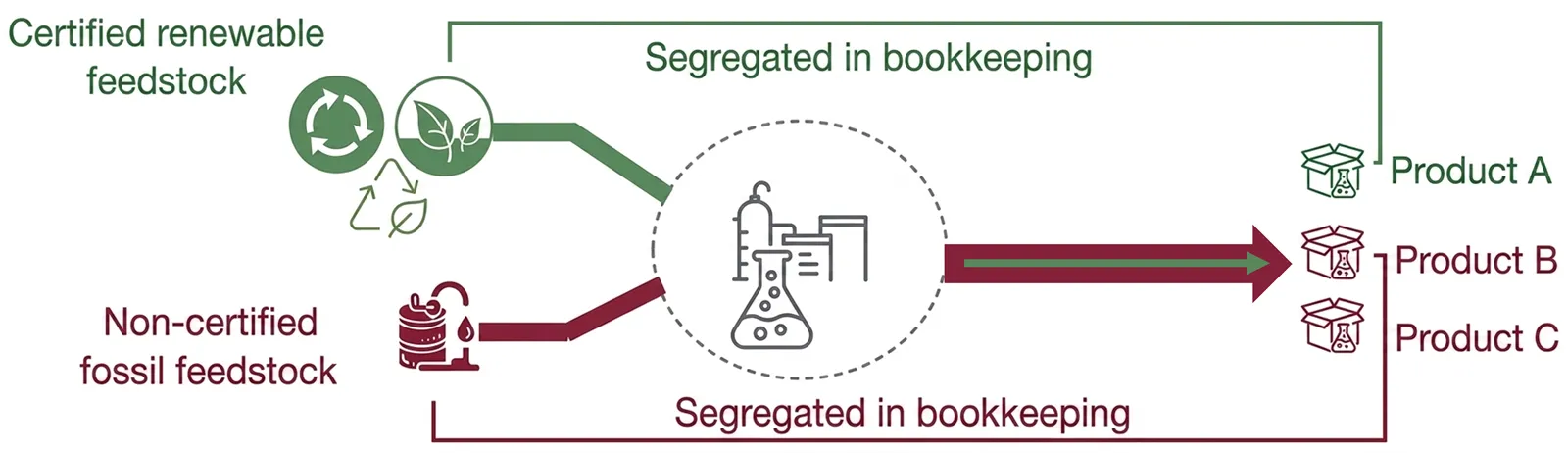
Physical mixing and bookkeeping segregation in mass balance models
ISCC PLUS certification driving circular economy
Typically, certification systems are widely recognized and cover various categories of sustainable materials. The development and implementation of different certification standards promote the mission of mitigating climate change and bringing more traceability into global markets and supply chains.
Vinavil has recently certified its production plants in Villadossola and Ravenna (Italy) according to the International Sustainability and Carbon Certification (ISCC) PLUS standard. ISCC is a globally applicable and leading certification system designed to enhance traceable, sustainable, deforestation-free, and climate-friendly supply chains. ISCC certifications are widely recognized.
The ISCC PLUS standard supports the transition to a circular economy and bioeconomy. This voluntary certification standard validates the sustainability characteristics of alternative feedstocks throughout the entire supply chain, from origin to end consumer.
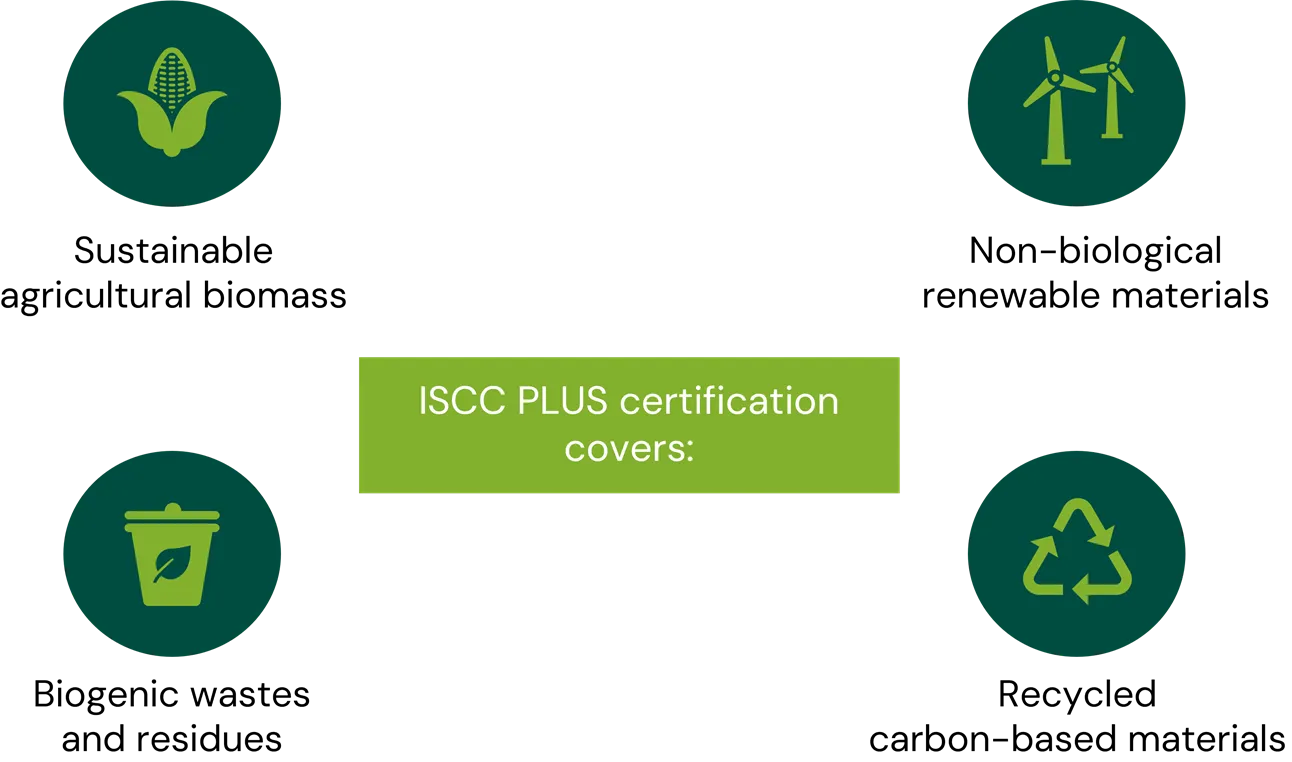
Four pillars of ISCC PLUS certification
Vinyl Acetate VeoVa™ technology: Core to sustainable architectural coatings
Vinavil's product portfolio continually evolves to meet the most demanding market requirements. Its product lines include binders for water-based paints for a wide variety of uses. Customized polymers further demonstrate the ability to deliver tailored, high‑performance solutions.
Vinavil is strongly committed to sustainability, implementing numerous initiatives aimed at reducing environmental impact and promoting responsible practices. Through collaborative efforts, they support a greener agenda and strengthen corporate responsibility. The company has undertaken various measures aligned with sustainability objectives, encompassing a range of initiatives aimed at environmental preservation and social responsibility.
Here are some examples:
- Sustainability report
- New strategic technology initiatives are underway
- Vinavil's research and development commitment to sustainability
- Safety: A new key project for spreading safety culture
- Corporate governance under Legislative Decree 231
- Participation in Responsible Care (Federchimica's voluntary program to promote sustainable development in the chemical industry)
- Active communication on sustainability platforms
- Participation in group projects and task forces at the international level in Life Cycle Assessment studies to assess environmental indicators
- Installation of photovoltaic parks at the Villadossola and Ravenna plants
- Optimization of industrial processes: Reduction of energy and water consumption
Vinavil offers polymer solutions designed to comply with the new eco-friendly criteria for water-based paints and coatings, ensuring high performance in the final formulations. For example, polymers with bio-based content percentage are detectable through 14C analysis. Thanks to ISCC PLUS certification and the mass balance approach, Vinavil can supply polymers containing allocated sustainable content based on the availability of bio‑feedstocks.
In this article, we want to focus on the most important technology, Vinyl Acetate VeoVa™ based polymers, which is the core business in the architectural coatings market for Vinavil.

Products in focus: Vinavil 04V and Vinavil BIO 04V
A good example of what was previously described is represented by Vinavil 04V, the new generation of VeoVa™ 10 vinyl ester-based polymer, free from solvents and formaldehyde, designed to formulate low-VOC interior paints compliant with the current regulations and eco-friendly voluntary labels.
Classes | Results after 10 days (µg/m3) | FRENCH legislation (limit at 28 days) (µg/m3) | CAM Italian legislation (limit at 28 days) (µg/m3) |
| Formaldehyde | <5 | <10 | <60 |
| Acetaldehyde | <5 | <200 | <200 |
| Toluene | <5 | <300 | <300 |
| Tetrachloroethylene | <5 | <250 | <250 |
| Xylene | <5 | <200 | <300 |
| 1,2,4-Trimethylbenzene | <5 | <1000 | <1000 |
| 1,4-Dichlorobenzene | <5 | <60 | <60 |
| Ethylbenzene | <5 | <750 | <750 |
| n-Butylacetate | <5 | <4800 | / |
| 2-Butoxyethanol | <5 | <1000 | <1000 |
| Styrene | <5 | <250 | <250 |
| TVOC [from n-C6 to n-C16] | 193 | <1000 | <1000 |
37% PVC interior low-VOC paint: Emission chamber test according to ISO 16000-6
Water-based paint formulated with Vinavil 04V falls in Class A+ Grenelle Environnement CAM compliance. Vinavil 04V is also suitable for exterior paints, thanks to the following features:
- Self-crosslinking capability
- Excellent wet scrub resistance
- Outstanding color durability
- Good adhesion on alkyd-based paints
In medium and high PVC paints, Vinavil 04V delivers superior performance in terms of wet scrub resistance in comparison to vinyl acetate, ethylene, and styrene acrylic copolymers.
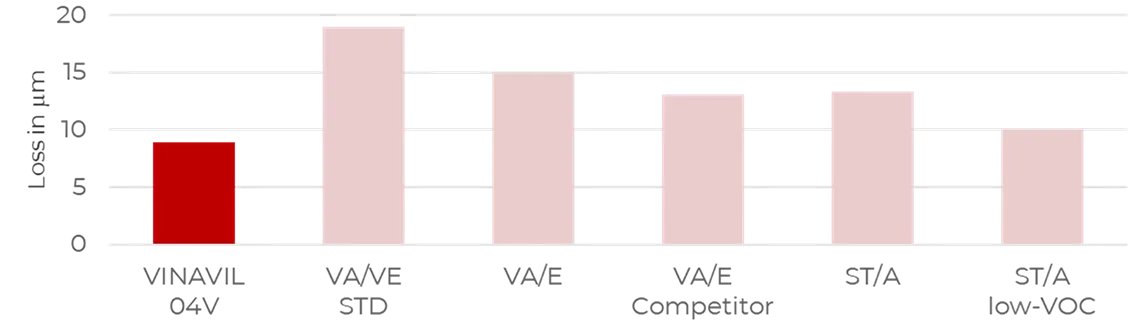
Interior washable paint 75% PVC wet scrub resistance according to ISO 11998
The mass balance version, called Vinavil BIO 04V, is now available. In this version, a portion of fossil-based monomers has been substituted with renewable alternatives such as VeoVa™ 10 MBX vinyl ester¹ from Hexion. Hexion VAD B.V. has attained ISCC PLUS certification for its Versatic™ Acids and Derivatives manufacturing sites in the Netherlands. These certifications enable the introduction of bio-attributed monomers, reducing the carbon impact associated with fossil-based products.
The initial Vinavil BIO 04V prototype, based on VeoVa™ 10 MBX vinyl ester, achieves a bio-attributed material content of up to 50% of the polymer. One notable advantage of Vinavil BIO 04V is its use of the "drop-in" concept, a sustainability approach in mass balance that enables the replacement of fossil-based raw materials with renewable or recycled materials within existing production streams and processes. This strategy does not require adjustments to formulations, equipment, or machinery.
Select the most suitable grades between Vinavil 04V and Vinavil BIO 04V based on your formulation and sustainability targets:
 |  |
1 VeoVa™ 10 Vinyl Ester and VeoVa™ 10 MBX vinyl ester are products manufactured by Hexion Inc. TM denotes trademarks owned or licensed by Hexion Inc.
For more information about VeoVa™ vinyl ester, contact Hexion's global customer service network or submit a request through the Hexion website.
DISCLAIMER: All images, table, and graph used in this article are copyright of Vinavil.