

Rheology modifiers: How to select the right grade?
Last update on May 19, 2026
Rheology modifiers help in achieving the right balance between application ease, stability, and final coating performance.
The right rheology strategy can significantly elevate formulation efficiency and product quality. This enables controlling flow and leveling to prevent sagging and sedimentation in paints and coatings. However, selecting the right chemistry for your system can be daunting.
Our platform brings you an exhaustive master catalog with 2400+ rheology modifiers from 200+ suppliers. The new filters will enable you to compare grades graphically, download technical datasheets, and order samples, all in one place.
In this guide, you will discover what makes rheological additives essential to coating performance. Also, learn to select the right chemistry to achieve the ideal balance of flow, stability, and application properties.
Rheology modifiers: Basics, chemistries & selection essentials
The basics of rheology and rheology modifiers
In paints and coatings, rheology examines the behavior of flow and deformation properties during manufacturing, storage, application, and film formation. It influences key formulation characteristics, such as:
|
Rheology modifiers/thickeners are vital additives that adjust the rheological characteristics of coatings and inks. Apart from getting the desired viscosity, these additives also help in the following aspects:
|
|
During coating production, rheology is useful for achieving optimal flow behavior in the mill base. Rheology is so crucial for your formulation that you should be in control and at ease to play with it. The starting selection criteria are basic as we are adjusting the mill base at this stage. This includes average shear rate and the coating system (waterborne or solvent-based).
However, you may have extra criteria to meet all your requirements. For example, you may try to limit VOCs. Additives such as VOC-free Hydrophobically Ethoxylated Urethanes (HEUR) and Hydrophobically Modified Polyether (HMPE) provide a high level of efficiency in the mid-shear range.

Now that we know why rheology is important for paints and coatings, and how rheology modifiers play a major role in defining the flow. Let's move on to understanding the chemistries of rheology modifiers.
Chemistries of rheology modifiers
Today, we are aware of several thickening technologies that influence the rheology profile of paints and coatings. Rheology modifiers/thickeners can be broadly divided into organic and inorganic chemistries.
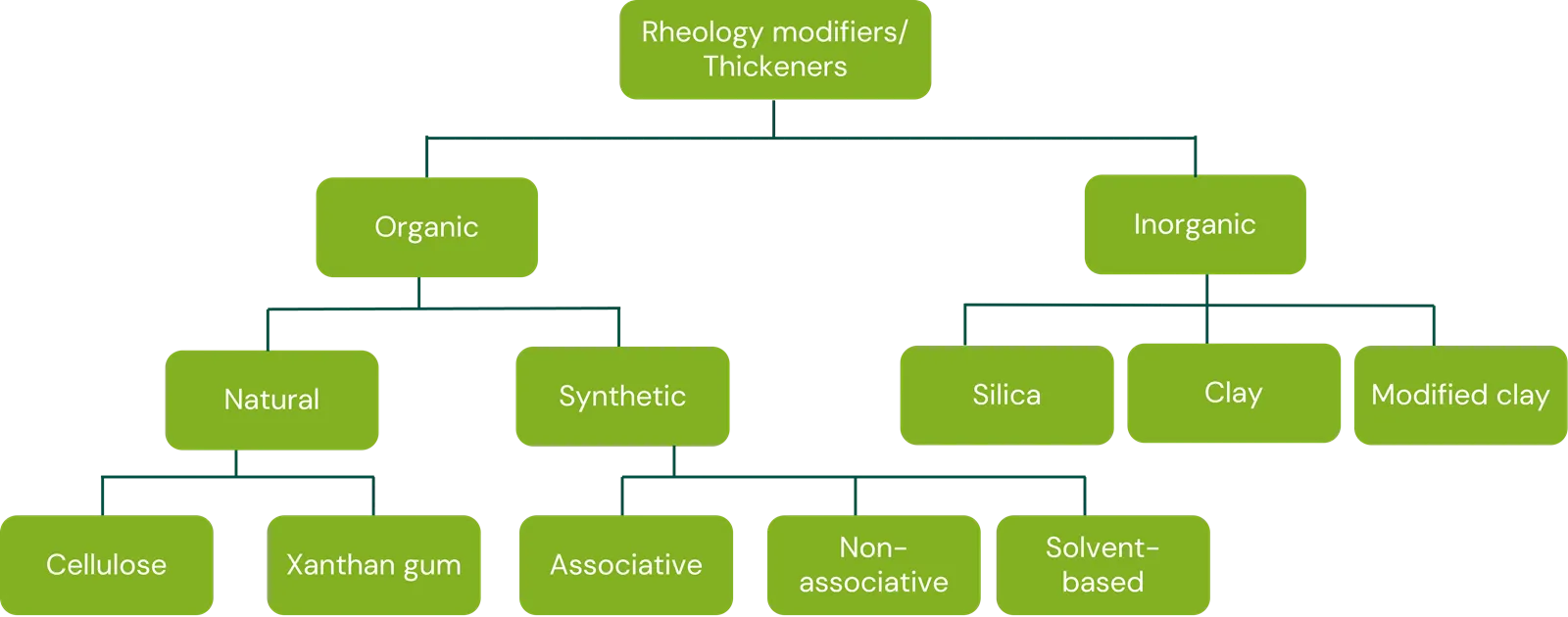
An overview of the chemistry of rheology modifiers in paints and coatings
Organic rheology modifiers
Organic thickeners are essential additives used to control viscosity, flow, and stability in both waterborne and solvent-based coatings. Thus, enabling optimized application and film performance.
For waterborne coatings: Most organic rheology modifiers are surface-active. Furthermore, they may be part of the polymeric film matrix during film formation. This explains, for instance, the excellent coating layer properties such as improved appearance, gloss, and flow. The variations regarding the chemical composition of these rheology modifiers are extraordinarily versatile.
For waterborne paints, different types of organic rheology additives are distinguished based on thickening functionality:
➤ Rheology modifiers that just thicken the aqueous phase.
➤ Products that thicken by interaction with other paint ingredients. For example, associative thickeners.
For solvent-based coatings: Organic rheology modifiers are used with success to optimize the rheological characteristics in solvent-based coating materials. This includes imparting resistance against sagging and sedimentation. Various products are available for the coating formulator. Like waterborne systems, variations regarding the chemical composition of these rheology modifiers are extraordinarily versatile.
Examples of organic rheology modifiers are as follows:
- Based on natural raw materials: Cellulose, xanthan gum
- Based on synthetic materials (polyacrylates, PU): Associative, non-associative, and other solvent-based
Inorganic rheology modifiers
Organoclays & organically modified laminar silicates are among the most widely used inorganic rheology modifiers. They are applied for many purposes in the paint and coating industry. Main representatives of laminar or phyllosilicates are hectorite and bentonite.
Other examples of inorganic thickeners include silica-based rheology modifiers (e.g., fumed silica, colloidal silica, precipitated silica, etc.), clays, and specialty (modified) clays.
Selection criteria of rheology modifiers
The primary role of rheological additives is obviously to play on the rheology of your coatings (open time/wet edge, sag resistance, leveling, settling, film forming, etc.). Yet, for an optimal selection, you will also have to consider their cost, flow adjustments, the compatibility with other additives, and their fit with your regulatory constraints (VOC, for example).
Below is a checklist that you need to consider when selecting rheological additives for your paints and coatings.
|
|
|
|
Now, when you have the suitable rheology modifier options shortlisted according to your system, do not forget that there can be unwanted interactions with other paint ingredients (colorants, surfactants, etc.). This is the time you should optimize thickeners' efficiency - the right loading at the right time, no unwanted interaction, etc.

Finding the right rheology modifier & achieving the optimum balance of properties is quite complex. Now that we are through the broader chemistries of thickeners, let's find out the right technologies of thickeners suitable for waterborne paints and solvent-based coatings.