

PFAS-free coatings: Selecting the right alternatives and managing trade-offs
Last update on Apr 24, 2026
PFAS-free coatings are no longer a future concept; they are becoming a technical and regulatory necessity.
For decades, PFAS-based additives have set the benchmark for coating performance. They deliver unmatched wetting, leveling, oil repellency, and durability. But this performance comes at a cost. Growing concerns around persistence, environmental impact, and regulatory status are forcing the coatings industry to rethink its reliance on PFAS.
So, what happens when you remove one of the most effective chemistries from your formulation toolbox? This is where the real challenge begins.
PFAS-free coatings are not about simple substitution. There is no one-to-one replacement. Instead, formulators must rethink formulation strategy, combine multiple additive technologies, and accept certain performance trade-offs, especially in demanding applications.
Let’s take you through the scrutiny around PFAS, why there is a need to find replacements and finally how to create high-performance PFAS-free coatings.
What are PFAS?
Per- and polyfluoroalkyl substances (PFAS) are a class of synthetic organofluorine substances known for their strong carbon–fluorine bonds. These bonds make PFAS highly stable and resistant to breakdown.
According to the Organization for Economic Co-operation and Development (OECD), PFAS are a broad class of substances containing at least one fully fluorinated methyl or methylene carbon.
PFAS have been used for over 90 years and include a wide range of substances. Their key features include:
- Strong carbon–fluorine (C–F) bonds, among the strongest in chemistry
- High resistance to heat, water, and oil
- Long-lasting presence in the environment
Because of this extreme stability, PFAS are often called “forever chemicals.”
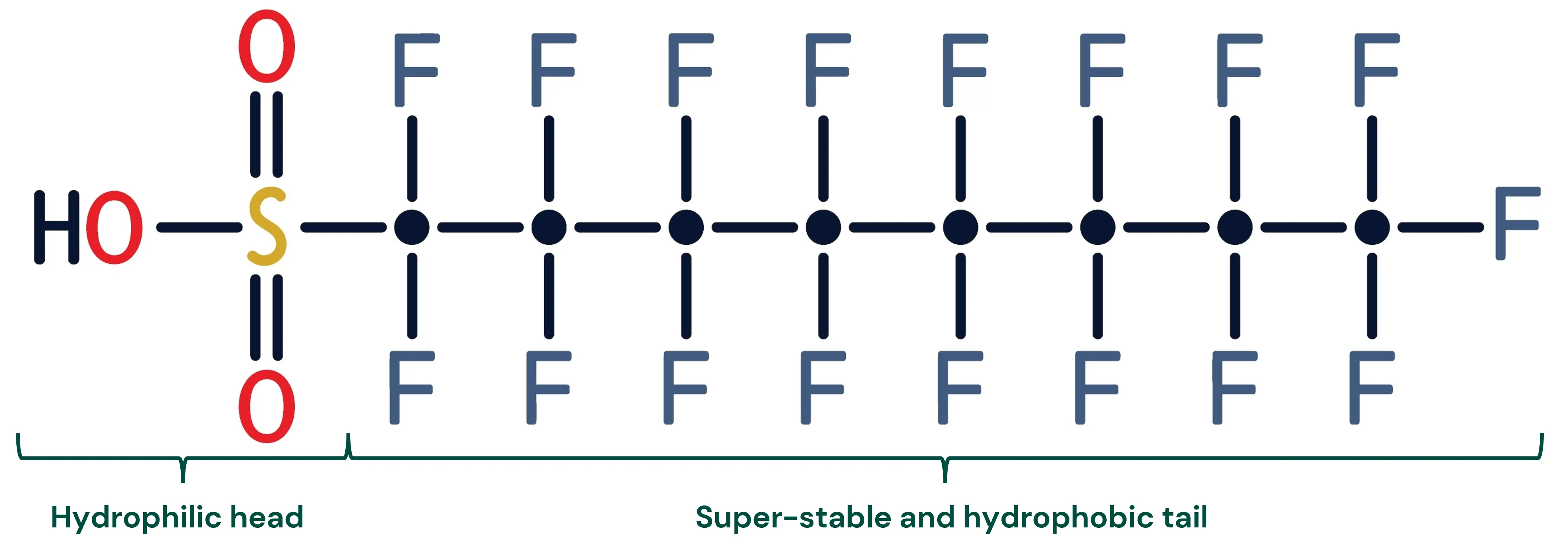
Perfluorooctanesulfonic acid (PFOS) - A typical PFAS
What makes them unique is summarized in the table below.
Structural characteristics | Properties |
| Extremely low surface energy | Hydrophobicity & oleophobicity |
| Very high C-F bond energy |
|
| Distinct polar and non-polar structures | Strong interfacial activity at low dosage |
Why are they so effective in coatings?

PFAS perform well because of their unique structure:
- The carbon–fluorine bond is one of the strongest in organic chemistry
- This bond provides excellent chemical and thermal stability
- Fluorinated chains repel both water (hydrophobic) and oil (oleophobic)
- They create very low surface energy, which improves coating behavior
Because of these properties, PFAS can:
- Wet difficult surfaces, even at low doses
- Resist oily contamination
- Reduce sticking between coated surfaces
- Maintain smooth, low-friction finishes
- Create easy-to-clean surfaces
In addition, PFAS resist heat, sunlight, and oxidation. This makes them highly durable and ideal for outdoor coatings with long service life.
Types of PFAS in coatings
In coatings, PFAS fall into two main categories:
1. Fluorosurfactants (Short-chain, non-polymeric PFAS)

Fluorosurfactants are low-dose additives used to improve coating performance. They help:
- Reduce surface tension
- Improve wetting and leveling
- Prevent surface defects (like craters)
- Reduce blocking (sticking between coated surfaces)
- Improve dirt pickup resistance
- Add some oil repellency
Example: Perfluorobutanesulfonic acid
2. Fluoropolymers

Fluoropolymers are used as binders or topcoat resins when high performance is required. They are used for coatings that need:
- High weather resistance
- Strong UV protection
- Chemical resistance
- Anti-graffiti properties
- Good electrical insulation (dielectric performance)
- Low friction surfaces
Examples: Polytetrafluoroethylene (PTFE) and Polyvinylidene fluoride (PVDF)
What is the problem with PFAS?
PFAS materials exhibit a unique combination of highly desirable performance properties. This raises the question: what is the underlying concern with their use?
The core issue is their extreme persistence, driven by the strength of the C–F bond, one of the most stable in organic chemistry. This makes these substances highly resistant to thermal, chemical, and biological degradation.
As a result, PFAS used in coatings (e.g., fluorosurfactants or residuals from fluoropolymers):
- can accumulate in the environment and in biological systems
- have been associated with toxicity, bioaccumulation, and long environmental half-lives
In practical terms, even low use levels can lead to long-term environmental release during:
- application,
- weathering, or
- disposal
This creates regulatory and liability concerns. Thus, the same chemistry that makes them durable in service also makes them persistent. It is the central technical contradiction driving the shift toward PFAS-free alternatives.

Current regulatory landscape
Globally, regulation is shifting from managing individual PFAS substances to restricting the entire class. This is becoming a primary driver for coatings formulators to adopt PFAS-alternative technologies.
In the European Union, the proposed universal PFAS restriction under REACH Regulation could significantly limit the use of fluorosurfactants in paints and coatings. This may also affect certain fluoropolymer applications depending on derogations, with phased bans and transitional periods under active evaluation.
In the United States, the Toxic Substances Control Act (TSCA) is being used by the U.S. EPA to:
- mandate PFAS reporting,
- expand Significant New Use Rules (SNURs), and
- increase scrutiny on new and existing PFAS chemistries
Parallel state-level regulations are restricting PFAS in specific product categories. They are moving toward broader disclosure and eventual prohibitions. Some state-level regulations notably include California, Maine, and Minnesota.
It is important to note that, as of now, no major fluoropolymers such as PTFE, PVDF, FEVE, PFA, or FEP are explicitly restricted under either U.S. EPA or REACH.
Looking ahead, the key regulatory hurdle is not just compliance with current limits but:
- anticipating class-based bans,
- reporting obligations, and
- supply-chain transparency requirements
All this creates legal and commercial risk for PFAS-containing coatings, accelerating their transition to PFAS alternatives.
Alternatives to PFAS: What options are available?
What should you ask suppliers before approving a PFAS-free alternative?
- (2022). Per- and polyfluoroalkyl substances and alternatives in coatings, paints, and varnishes (CPVs), Report on the commercial availability and current uses, OECD series on risk management, No. 70, Environment, Health and Safety, Environment Directorate. OECD.
- Glüge, Scheringer, Cousins, DeWitt, Goldenman, Lindstrom, Lohmann, A Ng, Trier, and Wang. (2020). An overview of the uses of per- and polyfluoroalkyl substances (PFAS). Environ Sci Process Impacts.
- (2017). DYNOL™ superwetting surfactants. Evonik.
- (2025). Alternatives to fluorosurfactants. Evonik.
- (n.d.). Dispersions, resins, and additives. BASF.
- (n.d.). PFAS-free solutions. BYK.
- (n.d.). Paint and coatings additives. Dow.
- (n.d.). PFAS-free formulations. PATCHAM.