
Optimize rheology, strength & sustainability in adhesives with Omyabond solutions
Last update on Jul 30, 2025
This is a sponsored article by Omya.
In modern adhesive and sealant development, formulation requirements extend beyond mechanical performance—demanding enhanced sustainability, process efficiency, and cost control, all while maintaining high end-product quality.
Omya meets these formulation challenges with two high-performance mineral solutions—Omyabond 120 and Omyabond 160. Engineered to outperform traditional fillers, these are multifunctional performance additives, combining rheological control, reinforcement, and sustainability benefits, helping formulators streamline and elevate their adhesive formulations.
Get tips on how selecting the right Omyabond mineral solutions can enhance the overall adhesive performance.
Why consider treated calcium carbonate?
Conventional rheological modifiers such as fumed silica or polyamide waxes come with challenges—pre-drying steps, moisture sensitivity, addition difficulty, and carbon-intensive footprints.
Omyabond 120 and Omyabond 160 are ultrafine treated calcium carbonate grades that break those boundaries:
- Easy to disperse
- Low moisture content
- High reinforcing effect
- Strong rheological control
- Exceptionally low product carbon footprint
Omyabond 120: Prioritize flexibility and moisture control
If you're formulating SMP adhesives or reactive sealants, Omyabond 120 fulfils all the requirements. It combines the mechanical strength of precipitated calcium carbonate (PCC) with the moisture stability and simplicity of ground calcium carbonate (GCC)—without the process hitches.
Key highlights
- Particle size (D50): 0.3 μm
- BET surface area: 14 m²/g
- Moisture content: < 0.1 %
- Specific rheology profile
- No need for fumed silica or wax modifiers
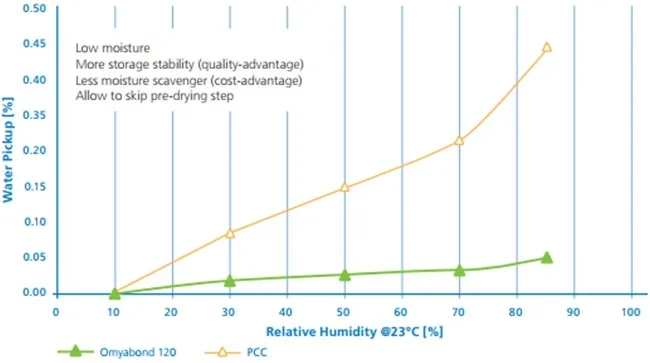
While PCC shows a sharp increase in water uptake with rising humidity, Omyabond 120 maintains consistently low moisture levels. This low moisture absorption translates to extended storage stability, reduced need for moisture scavengers, and the ability to eliminate pre-drying steps—offering both quality and cost advantages in reactive adhesive formulations.
Mechanical mastery - Omyabond 120

| Formulation | PA wax | Fumed silica | Omyabond 120 |
| SMP polymer | 25.9 | 25.9 | 25.9 |
| Plasticizer | 18.0 | 18.0 | 18.0 |
| PA wax | 3.0 | - | - |
| Fumed silica | - | 3.0 | - |
| 2 μm treated GCC | 49.7 | 49.7 | - |
| Omyabond 120 | - | - | 52.7 |
| Additives (Moisture scavenger, stabilizer, catalyst) | 3.4 | 3.4 | 3.4 |
| Mechanical properties at ISO 37 | |||
| Modulus 100 % [MPa] | 0.7 | 0.5 | 0.5 |
| Tensile strength [MPa] | 1.5 | 1.7 | 2.0 |
| Elongation at break [%] | 540 | 660 | 990 |
Notably, the formulation can be refined by reducing polymer content while maintaining mechanical performance—enabling cost optimization through lower raw material consumption and improved processing efficiency.
Replace treated GCC and fumed silica in an elastic adhesive, and achieve -
- 3.0 MPa tensile strength (up from 2.3)
- 370 % elongation (up from 300)
- Lower modulus (more flexibility)
Result: Better performance, fewer components, simpler processing, and lower energy use.

Omyabond 160: The green powerhouse for high-modulus formulations
More than fulfilling the purpose of a filler, Omyabond 160 is a reinforcing ultrafine calcium carbonate that is superior to fumed silica in rheological performance and also surpasses it in mechanical strength and sustainability.
Key highlights
- Designed for hybrid and silicone adhesives
- Optimized for high-modulus systems
- Median size: 0.3 μm
- BET surface area: 14 m²/g
- Moisture: < 0.2 %
- PCF: only 214 kg CO₂e/ton (independently verified)
| Formulation | Fumed silica [parts] | Omyabond 160 [parts] |
| High modulus SMP polymer | 30.0 | 30.0 |
| Plasticizer | 14.0 | 14.0 |
| Adhesion promoter | 0.6 | 0.6 |
| VTMO | 1.0 | 1.0 |
| Catalyst | 0.4 | 0.4 |
| Fumed silica | 4.0 | - |
| GCC - 1 μm D50 % | 50.0 | - |
| Omyabond 160 | - | 54.0 |
| Rheology 1 day, RT, measured at 23°C | ||
| Viscosity at 0.1 s-1 [Pa.s] | 2820 | 3180 |
| Viscosity at 10 s-1 [Pa.s] | 75 | 95 |
| Mechanical properties at ISO 37 | ||
| Modulus at 100 % [MPa] | 1.3 | 1.7 |
| Tensile strength [MPa] | 2.8 | 3.5 |
| Elongation [%] | 510 | 455 |
Switching from fumed silica to Omyabond 160 delivers:

Rheology you can trust
Omyabond 160 matches the anti-slump and shear-thinning attributes of fumed silica, with added formulation flexibility:
- No dusting issues
- Stable viscosity
- Easy processing at ambient conditions

Omyabond 120 vs. Omyabond 160: Which one should you choose?
| Feature | Omyabond 120 | Omyabond 160 |
| Target systems | SMP/Reactive sealants | Hybrid/Silicone adhesives |
| Reinforcement profile | Medium modulus, high flexibility | High modulus, stiff reinforcement |
| Rheological role | Replaces silica & waxes | Replaces fumed silica |
| Moisture content | < 0.1 % | < 0.2 % |
| Typical benefits | Flexibility, elongation, low modulus | High strength, high adhesion, modulus |
| Processing advantage | Cold mixing, easy handling | Excellent dispersion, storage stable |
| Sustainability edge | Less moisture scavenger, low energy | Ultra-low CO₂ footprint |
 |  |
Final thoughts
Choosing the right mineral filler isn’t just a technical choice, it’s a strategic one. With Omyabond 120 and 160, Omya offers reliable, performance-driven, and sustainable solutions that help you:
- Improve formulation performance
- Reduce complexity and cost
- Meet tightening environmental and market demands
It’s time to improve your adhesives—not just with chemistry, but with smarter mineral choices.
Interested in sample formulations or testing support? Reach out to Omya's technical team at construction@omya.com
DISCLAIMER: All figures, tables, and graphs used in this article are copyright of Omya.