

MS Polymer™ Formulations Extend Versatility and Value Proposition of One-Component Sealants
Last update on Mar 30, 2021
Kaneka MS Polymer™ is widely recognized as a premium base resin for producing moisture curable sealants, adhesives, and coatings. The polymer consists of a polyether backbone and silane terminal functionality.
A complete toolbox of MS Polymers™ is available, differentiated by the backbone structure, functionality, and viscosity range. Although the primary use has historically been as construction sealants, the range and blending capability of these resins allow the formulator to design products for a broad variety of other markets.
MS Polymers™ are considered to be 'hybrid' molecules because they provide the best properties of polyurethane and silicone while limiting their individual inherent weaknesses. For example, MS-based sealants combine the strength of polyurethanes with the weathering resistance of silicones. In addition to their unique performance and application properties, these polymers have achieved widespread acceptance due to their solvent-free and isocyanate-free nature.
Here, we will review the formulation versatility of MS Polymers™ that allows the customization of viscosity and early strength development for various applications. Also, learn how simple formulation and blending can provide sealants and adhesives that are matched to exact performance and application properties. In this way, MS Polymers™ can extend their value propositions to applications not previously recognized.
Let's explore the structure of MS polymers along with its properties, formulations & applications in detail.
Basic Chemistry & Curing of MS Polymers™
Molecular Backbone
Several types of MS Polymer™ are commercially available. One particular group consists of a polyether backbone and silane terminal functionality (see Figure below). It is end-capped with dimethoxysilane (DMS) groups. Other MS Polymers™ are available with different functionality, end-groups, and molecular structure. However, here we will focus on the DMS family which has been the most well-established.
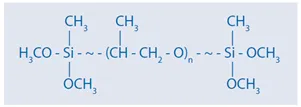
MS Polymer™ Structure with Dimethoxysilane End-groups
MS Polymers™ do not have urethane, urea, or other functional groups that are typical in polyurethane sealants.
- The polymer's polyether main chain provides low viscosity, low glass transition temperature, flexibility over a wide temperature range, low color and odor.
- The silane end-groups provide moisture-cure, crosslinking, and excellent adhesion.
MS Polymers™ offer low viscosity in the range of 7,000-46,000 cps despite the high molecular weight. The viscosity is relatively stable throughout a wide range of temperatures. As a result, compounding is simple, and the resulting sealant is easily gunnable even at low temperatures. Since the polymers are low in viscosity before curing and highly flexible after curing, they do not generally need solvent nor high levels of plasticizer.
Curing Mechanism
The silane groups provide a non-isocyanate curing mechanism, good adhesion to various substrates, and good storage stability. These reactive end-groups cures in the presence of moisture and an appropriate catalyst by means of an alkoxy reaction that is different than the conventional silicone cure mechanism. The water reacts with the silane group to produce silanol.
Further reaction of the silanol with either another silanol or methoxysilane produces three-dimensional siloxane linkages. The crosslinking reaction proceeds in two steps illustrated in the Figure below.
Step 1: Conversion from Methoxysilane to Silanol

Step 2: Condensation of Silanol Groups to Form Siloxane Crosslink

To make the curing mechanism happen, both water (e.g., ambient moisture) and a catalyst are required. The unformulated MS Polymer™ itself has excellent storage stability even in contact with water as long as no catalyst is present. This is unlike unformulated polyurethane prepolymers which must be protected from moisture and exhibit increased viscosity during storage.
Key Properties and Performance of MS Polymers™
Health and Safety During Formulation and Application
Perhaps the most compelling value proposition associated with MS Polymer™ sealants is their lack of isocyanates and solvents. Their absence broadens the range of formulation possibilities and allows the sealants to meet stringent environmental regulations.
Lack of Isocyanates: The silyl-terminated polymer eliminates the need for isocyanate. Isocyanates are highly reactive chemicals. Consequently, formulations containing isocyanates must be protected from contact with reactive agents, including moisture, as this will drastically decrease shelf life.
Isocyanates are also considered to be hazardous materials to use. Caution must be exerted in using materials containing isocyanate including adequate ventilation and prompt washing of contacted body areas. The isocyanate can jeopardize compliance with safety and health regulations as well as the welfare of contractors.
Since no isocyanates are present, bubbling during curing is not a concern as it often is with polyurethane systems. Bubbles can damage the integrity of the sealant or adhesive. MS Polymer™ sealants do not bubble on the surface at all. The sealant's surface is kept smooth and intact. A constant and uninterrupted joint is easily achieved.
Lack of Solvents: The low viscosity of MS Polymer™ resins allows for a solvent-free formulation that is less dependent on temperature change. Therefore, formulations are easy to process and have low-temperature gunnability. MS Polymer™ sealants can be easily extruded from cartridges with a low force even at low temperatures. Furthermore, the smoothing and tooling of the joint are easily accomplished.
The absence of solvent provides environmentally friendly sealants that meet environmental regulations regarding VOCs, out-gassing, and toxicity. Furthermore, the lack of solvents protects the formulator from the rising cost of solvent raw materials and VOC mitigating facilities.
Applications: One-part MS Polymer™ sealants cure relatively fast even at low temperatures. Thus, they find use in applications where property development speed is important (e.g., application when expecting inclement weather or high traffic areas). Once cured, MS Polymer™ sealants also exhibit little dirt pick up when compared to silicone sealants.
Performance During Service
The rise in MS sealant popularity has been primarily due to its versatility and well-balanced properties. Some properties exceed those of other high-performance sealants. The table below compares the performance of MS Polymer™ sealants with polyurethane, silylated polyurethane, and silicone sealants.
| Sealant | Advantage of MS Polymer™ Based Sealant |
| Polyurethanes |
|
| Silylated polyurethanes |
|
| Silicones |
|
Construction Sealant Performance Comparison
Formulations of MS Polymers™ – Ingredients, Blending & Processing
MS Polymer™ sealant formulations, such as those described below, provide:
- A hardness of around 20-40 Shore A,
- An elongation at break of 500-800%,
- A good elastic recovery,
- A tensile strength of 1-3 MPa, and
- A modulus of 0.5-0.8 MPa
Movement capability in construction joints is generally greater than +/- 25%, which places these materials in the category of 'high-performance sealants'. One-component MS sealants meet the requirements of ASTM C920 Class 25, as well as those of Federal Specification TT-S-00230C Class A, and ISO Standard 11600G.
Ingredients Used to Formulate MS Polymers
A broad range of MS Polymer™ grades is available. These are differentiated by modulus, elongation, and viscosity. Typical properties of selected dimethoxy silyl (DMS) grades are provided in the Table below. All these grades have long shelf stability, a light-yellow color, and good formulation properties.
| Kaneka Product | Viscosity, cps | Properties | Key Purpose |
| S203H | 6,000 | Low-modulus, high elongation | General purpose adhesive / sealant with a balance of strength and flexibility |
| S303H | 13,000 | Mid-modulus, broad adhesion profile | |
| S227 | 34,000 | Low-modulus, high elongation, broad adhesion profile | |
| S327 | 34,000 | Low modulus, high elongation, lower residual surface tackiness, wide formulation latitude | |
| SAX220 | 46,000 | Mid-modulus, high elongation, broad adhesion profile, wide formulation latitude | |
| SAX260 | 7,000 | High hardness, low tack-free time, broad adhesion profile, wide formulation latitude | General purpose industrial and flooring adhesives |
| SAX350 | 7,000 | Mid-modulus, broad adhesion profile wide formulation latitude | Easy processing adhesive/sealant |
| SAX400 | 24,000 | Higher strength, hardness, and modulus, faster tack free time, broad adhesion profile, wide formulation latitude | High strength adhesive/ sealant |
Properties of Selected Kaneka MS Polymer™ Resins (Dimethoxy Silyl Type)

Like other sealants, MS Polymer™ sealants can be formulated with various base polymers, plasticizers, fillers, and other additives to provide a wide range of application-specific properties. A toolbox of ingredients provides the formulator with the capability of designing moisture-curable products matching desired requirements. Aside from the base polymer, typical ingredients and their functions are provided in the Table below.
- Calcium carbonate is generally selected as filler because of its desirable effect on modulus, tensile strength, and elongation.
- Many different types of plasticizers can be used as rheology modifiers and to provide greater flexibility.
- Tin and amine compounds are used as catalysts to speed the curing reaction.
- Moisture scavengers are sometimes added to the formulation to improve storage stability.
- Adhesion promoters can be added although the silane groups on the MS Polymer™ function as adhesion promoters in themselves. MS Polymer™ sealant formulations also allow the use of aminosilane adhesion promoters and hindered amine light stabilizers which are not otherwise employed in one-part sealants containing isocyanate groups.
| Type of Additive | Examples | Typical Concentration, Weight % of Total Sealant | Key Functions |
| Plasticizers | Phthalates, polypropylene glycol | 15.0 - 30.0 | Flexibilizer, improved low temperature properties |
| Fillers | Talc, calcium carbonate | 30.0 - 70.0 | Mechanical properties, cost reduction |
| Antioxidants | Hindered phenols | 0.05 - 1.5 | Prevent aging |
| UV & light stabilizers | Hindered amines (HALS), benzophenone compounds, benzotriazole compound | 0.05-1.5 | Improved UV stability and weatherability |
| Catalysts | Dibutyltin laurate, dibutyltin diacetylacetonate | 0.2 - 3.0 | Cure, fast tack-free surface |
| Moisture scavengers | Vinyl silanes | 0.2 - 3.0 | Stability protection, improved shelf-life |
| Adhesion promoters | Functionalized (amino/epoxy) organosilanes | 0.2 - 3.0 | Improved adhesion to multiple substrates |
| Pigments | Titanium dioxide, carbon black | 2.0 - 5.0 | Color |
| Thixotropic agents | Fumed silica, polyamide waxes | 1.0 - 5.0 | Non-sag properties |
Blending MS Polymers™ to Obtain Application-Specific Properties
Several MS Polymers™ can easily be blended to engineer properties required for specific applications. Typical sealant formulations and their resulting properties are provided in the Table below.
- The 'control' is a standard sealant formulation that has been well-accepted.
- The other formulations show how an MS Polymer™ having wide formulation capability (SAX220) can be blended with other MS Polymers™ to provide modifications of properties.
This shows the application versatility of MS Polymer™ sealants and adhesives and how blending can extend their value proposition.
| Components | Concentration, Percent by Weight | ||||
| Control | Example 1 | Example 2 | Example 3 | ||
| MS Polymers™ | S203H | 6.9 | |||
| S303H | 16.1 | ||||
| SAX220 | 6.9 | 16.1 | 16.1 | ||
| SAX400 | 16.1 | 6.9 | |||
| SAX350 | 6.9 | ||||
| Precipitated calcium carbonate | 36.7 | ||||
| Ground calcium carbonate | 12.4 | ||||
| Titanium oxide | 4.6 | ||||
| Plasticizer | 20.6 | ||||
| Additives | 2.3 | ||||
| Catalyst | 0.5 | ||||
| Total | 100.0 | ||||
| Properties | Control | Example 1 | Example 2 | Example 3 | |
| Viscosity (HA, Spindle #7), cps | 1 RPM | 2,240,000 | 2,820,000 | 3,095,000 | 2,605,000 |
| 2 RPM | 1,265,000 | 1,555,000 | 1,6685,000 | 1,450,000 | |
| 10 RPM | 354,000 | 448,000 | 484,000 | 427,000 | |
| 2 RPM / 10 RPM | 3.6 | 3.5 | 3.5 | 3.4 | |
| Skin formation time, mins | 27 | 23 | 30 | 44 | |
| Cure in depth, mm | After 1 day | 2.3 | 2.5 | 2.3 | 2.7 |
| After 7 days | 7.0 | 7.0 | 7.1 | 7.0 | |
| Residual tack, 1=high 8=none | After 1 day | 5 | 6 | 5 | 6 |
| After 7 days | 6 | 6 | 6 | 7 | |
| Hardness (ASTM C661), Shore A | 26 | 32 | 29 | 23 | |
| Tensile properties by dumbbell shape (ASTM D412) | Modulus, MPa | 0.5 | 0.7 | 0.5 | 0.4 |
| Tensile strength, MPa | 1.5 | 2.3 | 2.0 | 1.7 | |
| Elongation, % | 570 | 620 | 750 | 800 | |
| Peel test (dry), CF=Cohesive Failure AF=Adhesive Failure | Anodized aluminium | CF | CF | CF | CF |
| Stainless steel | CF | CF5% AF95% | CF5% AF95% | CF | |
| Galvanized steel | CF | CF45% AF55% | CF | CF | |
| Glass | CF | CF | CF | CF | |
| Polyvinyl chloride | CF | CF | CF | CF | |
| Polycarbonate | CF | CF | CF | CF | |
| Pine wood | CF | CF | CF | CF | |
Adaptability of One-Component Sealant Formulations with Blended MS Polymers™
Processing of MS Polymer™ Formulations
Formulation processes used with all grades of MS Polymers™ are similar to those used in formulating a polyurethane sealant or adhesive.
- Fillers and pigments are recommended to be pre-dried, and mixing should be under vacuum to maintain a recommended moisture content of 800 ppm.
- Chemical driers and water scavengers are employed.
- Good quality packaging is required to enhance the shelf-life of the sealant.
To guarantee a proper shelf-life and constant quality, two different moisture control approaches exist and work very well with MS Polymer™ based sealants or adhesives (See Figure below). The first comprises the dehydration of the product by using chemical drying agents (e.g., moisture scavengers like vinyltrimethoxysilane), while the second uses heat to evaporate the moisture that may be present.
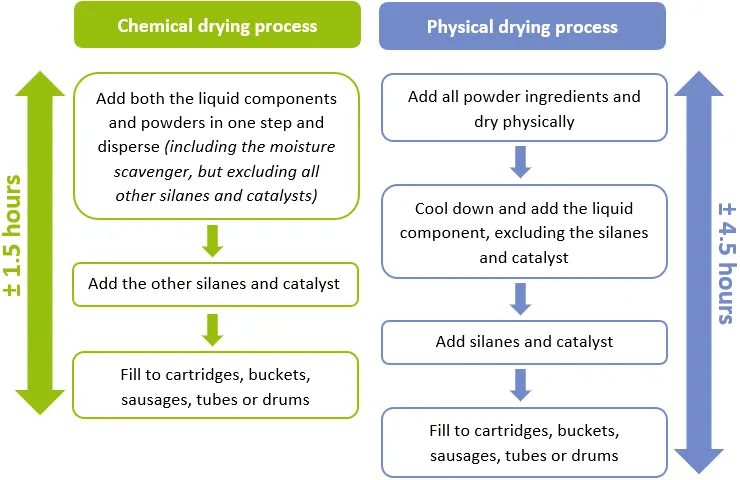
Drying Processes for MS Polymer™ Based Sealants and Adhesives
The heating step in the physical drying process ensures excellent storage stability but requires a significant amount of energy and time to reach the desired temperatures. Moreover, the silanes and catalyst cannot be added at these high temperatures, resulting in an additional time-consuming cooling cycle.
Recent innovations in the field of rheology modifiers, fillers, and machinery have attributed to the improvement of the production process and, as a result, very short production cycles of about 1.5 hours per batch can be reached.
Extending Applications of MS Polymer™ based Products
The unique and adaptable properties enable Kaneka MS Polymer™ based products to deliver outstanding performance for a broad variety of markets, such as:
 | 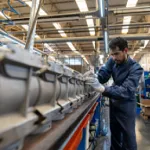 |  |  | 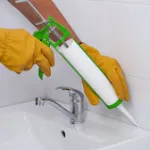 |  |
From L to R: Construction, Industrial, Transportation, Flooring, Waterproofing, DIY, and many others.
The formulations described here have special features that are well suited to specific applications as shown in the Table below.
| Sealant Properties | Formula | |||
| Control | Example 1 | Example 2 | Example 3 | |
| Features |
|
|
|
|
| Adhesive applications |
|
|
|
|
| Sealant applications |
|
|
|
|
| Other applications |
| |||
| Method of application |
|
|
|
|
Special Application Features for MS Polymer™ Based Sealants
Sealant, adhesive, and even coating applications can be covered with the present Kaneka MS Polymer™ portfolio. A complete technology toolbox is offered, which makes the life of formulators easier and improves the quality of their products.

View Starting Point Formulations Based on SMP

Stay Updated with SMP Developments in the Industry