

Silanes: How to select the right grade for plastics?
Last update on Apr 22, 2026
Chemistry of silanes
Silane is a molecule containing a central silicon atom bonded to two types of groups: Alkoxy groups and organo-functional groups.
The generic structure of silane is mentioned below:
where,
- X is a hydrolyzable alkoxy group (methoxy, ethoxy, or acetoxy) and
- Y an organofunctional group (amino-, vinyl-, epoxy-, methacryl- etc.) attached to the silicon by an alkyl bridge, R
These two types of groups exhibit different reactivity and allow sequential reactions.
With that foundation in place, the next step is to see how silanes improve dispersion in filled plastics and elastomers.
Silanes as dispersing agents
Dispersing agents are used to facilitate and stabilize the dispersion of solid compounding materials such as fillers or pigments in a polymeric (or a liquid resin) matrix. Better dispersion leads to better processability and improved material properties!
Silane is one such agent that helps in easier processing and/or better product performances along with cost advantages. Get an overview of how silanes can improve the dispersibility of pigments & fillers in plastics and how they can help in better material processability and performances.
Pick ideal dispersing agents from our master catalog and request samples with ease!
Dispersing mechanism of silanes
During silane treatment of a filler or pigment, a reaction takes place between the functional groups of the filler or pigment (such as OH groups) and the alkoxy groups of the silane to create a silane functionalized surface.
The surface of the filler can be functionalized to improve compatibility with the polymer matrix via specific interactions or chemical reactions between the polymer and silane organofunctional group. The functionality of the silane should be chosen to match the polymer matrix.
Silane treatment also creates a "protective layer" preventing re-agglomeration of the particles. The figure below shows the treatment of mineral surface by organosilane.

Treatment of a mineral surface by an organosilane1
Source: www.azom.com
Benefits of silane dispersing agents
The use of a silane dispersing agent in a filled thermoplastic, rubber, or thermoset formulation results in several benefits which ultimately translate into easier processing and/or better product performances. During masterbatch production, the use of Silane treated pigments allows higher pigment loadings or higher production rates.
Learn the various benefits that silane dispersing agents provide to material or click on the specific benefit to address a specific issue:
- Better Dispersion and Wet-out
- Lower Viscosity of Filled Liquid Resins
- Reduced Cure Inhibition of Resin
- Improved Electrical Properties

Benefits of silane dispersing agents
Better dispersion and wet-out with silane
Using silane dispersing agents leads to a significant improvement of filler and pigment dispersion in a polymer system. The polymers can be thermoset, thermoplastic, or even rubber elastomer networks.
This improvement is due to surface modification of the filler making it more compatible with the polymeric matrix and improving the wettability of the filler. Silanes such as XIAMETER™ Z-6070 Silane also create a "protective layer" minimizing re-agglomeration of the particles and sealing off the effects of the surface on resin cure and electrical properties.
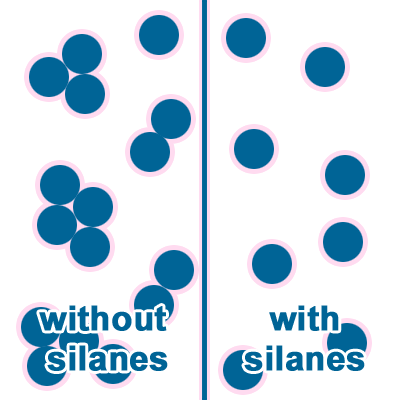
Comparison between filler treated silane and untreated silane
For thermoplastics systems, an improved dispersion results in:
- Easier filler or pigment incorporation (higher loading, wider processing window)
- Lower material viscosity
- Lower surface defects
- Better mechanical properties
- Better opacity for pigments (ex: Titanium Dioxide, TiO2)
For liquid resin systems, improved dispersion often results in less air occlusion and reduced slurry viscosity, allowing easier flow during molding and the possibility of using increased proportions of inexpensive filler. Select suitable silane dispersing agents available on our platform.
Lower viscosity with silane
Introducing filler into a molten polymer tends to increase the melt viscosity of the mixture. The viscosity increase depends on numerous parameters like:
- Viscosity of the molten polymer
- Filler concentration
- Quality of the wetting between the polymer and the filler
- Particle size distribution
Treating filler particles with silanes enables better wetting of the filler by the polymer, helps the filler remain well dispersed, and gives a lower viscosity compound than with untreated fillers. This leads to easier processability, higher throughput, better surface quality, and higher filler loading in masterbatches.
better surface quality and higher loadings
The figure below shows the influence of silane treatment on the melt temperature and torque percent during the production of a PE/TiO2 masterbatch at 80 weight percent TiO2.
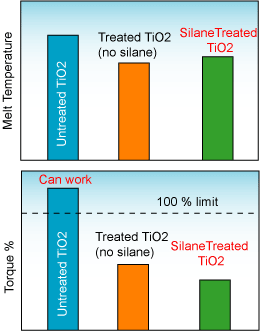
Silane Treated TiO2 allowing low torque and higher throughput
Reduced cure inhibition
Fillers are known to have varying degrees of effect on the cure systems of thermoset resins that can inhibit their cure. Using silanes as dispersing agents can lead to reduced cure inhibition.
Silane treatment of fillers in both polyesters and epoxies often overcomes cure inhibition as measured by cure exotherms (see the figure below). Silanes that were generally the most effective dispersing agents often enabled the highest exotherms.
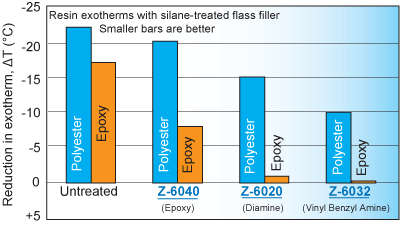
Silanes that allowed maximum exotherms were generally the most effective dispersing agents
Improved electrical properties
The ability of silane dispersing agents to impart improved electrical properties is shown in the table below with an epoxy resin reinforced with quartz filler.
The table below shows an improvement in electrical properties with silane dispersing agents in quartz-reinforced epoxy resins:
System | Dielectric Constant | Dissipation Factor | ||
Dry | Wet* | Dry | Wet* | |
| Unfilled resin | 3.44 | 3.43 | 0.007 | 0.005 |
| Quartz, no silane | 3.39 | 14.60 | 0.017 | 0.305 |
| Quartz, XIAMETER™ OFS-6040 Silane | 3.40 | 3.44 | 0.016 | 0.024 |
| Quartz, XIAMETER™ OFS-6011 Silane | 3.46 | 3.47 | 0.013 | 0.023 |
| * After 72 hours immersion in boiling water | ||||
Without filler, the epoxy resin showed good electrical properties, dielectric constant, and dissipation factor, even after aging for 72 hours in boiling water. However, once quartz filler was added, the hydrophilic surface of the quartz led to a severe loss of electrical properties during the water boil test. With either XIAMETER™ OFS-6040 Silane, XIAMETER™ OFS-6011 Silane, or XIAMETER™ OFS-6070 Silane, the quartz-filled composite exhibits dramatic retention of electrical properties.
Filler treatment with silane dispersing agents
Mineral fillers have become increasingly important additives and modifiers for organic polymer. Silanes are a natural fit to treat the surface of the mineral to make the mineral more dispersible in the polymer.
The different applications of silane dispersing agents in mineral treatment:

The table below lists some benefits of silane treated filler:
| Benefits of Silane Treated Filler | |
Processing benefits Better dispersion leads to:
| Products benefits Better dispersion leads to:
|
TiO2 treatment
TiO2 is the most commonly used white pigment for plastics. It exhibits excellent whiteness, excellent opacity, and good UV resistance. Most compounders and master batchers process TiO2, and all require the following attributes to maintain high-quality standards and competitive prices. Pick from 200+ TiO2 grades available on our platform and easily download technical datasheets or request samples.
The table below shows the key requirements for materials or masterbatches containing TiO2:
Process requirements | Product requirements |
|
|
To achieve this, TiO2 is treated with silane dispersing agents such as XIAMETER™ OFS-6070 Silane.
as well as the performance of the TiO2-filled plastic.
The figure below shows how a silane treatment reduces the melt temperature and the torque required in the compounding machine during the production of a PE/TiO2 masterbatch at 80% TiO2 loading.
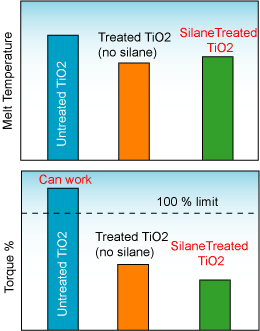
Reduction of the melt temperature and torque of a compounding machine with the addition of silanes
Talc treatment with silane
Talc is a platy filler commonly used as a reinforcer in polyolefins (PE, PP, EVA), styrenics and occasionally in engineering polymers. Talc is used to increase HDT and stiffness and can reduce creep, shrinkage, and coefficient of linear thermal expansion (CLTE).
To achieve this, talc is treated with silane dispersing agents such as XIAMETER™ OFS-6070 Silane.
Wollastonite treatment with silane
Wollastonite is a white acicular filler imparting good dimensional stability, good scratch resistance, and excellent stiffness to thermoplastics such as PP or PA. Main applications are automotive parts such as trims, bumpers, or instrument panels.
Using silane dispersing agents such as XIAMETER™ OFS-6070 Silane to treat Wollastonite provides these performances.
Once dispersion is covered, it’s natural to look at how silanes help bond inorganic and organic components for reinforced materials.
Silanes as coupling agents
Coupling agents are adhesion promoters that are used to provide a stable bond by reducing the interfacial tension between the fibrous or particulate inorganic component and the organic matrix polymer in reinforced and filled plastics. This improved bond results in greater composite strength and longer service life of reinforced and filled plastics.
In simple words, silane coupling agents will act as a link between an inorganic substrate (such as glass, metal, mineral) and an organic material (such as an organic polymer, coating, adhesive) to bond, or couple, the two dissimilar materials together.

Silane coupling mechanism
 |
Coupling mechanism
The alkoxy groups react with the surface groups of many inorganic fillers. They first react with water to produce the silane triol, releasing alcohol as a by-product. The silanol groups then condense with oxide or hydroxyl groups on the filler surface. Neighboring siloxane chains can interact further to produce a polysiloxane layer at the surface.

Silanes require active sites, preferably hydroxyl groups, on the filler surface for reaction to occur. They can therefore be used to treat all:
- Silicate-type fillers
- Inorganic metal oxides and hydroxides
Benefits of silane coupling agents
Improved flexural strength
Silane coupling agents provide the benefit of imparting good mechanical properties such as tensile, flexural and compressive strengths. The figure below shows the improvement of flexural strength of glass fiber reinforced epoxy resins obtained by using silane coupling agents.
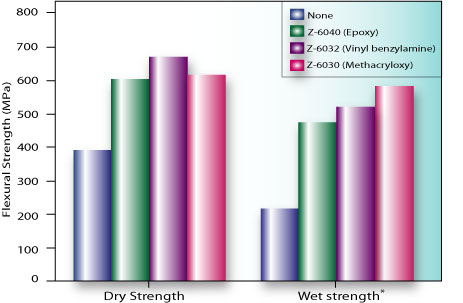
Improvement of flexural strength with silanes coupling agents
Higher modulus
Silane coupling agents when used after filling rubber offer another benefit of imparting a higher modulus. This improvement in clay-filled rubber is shown in the table below.
| Rubber Type | Clay Treatment | 300% Modulus (psi) |
| Natural rubber | None | 1040 |
| 1% XIAMETER™ OFS-6020 Silane | 1655 | |
| SBR rubber | None | 285 |
| 1% XIAMETER™ OFS-6020 Silane | 400 | |
| Nitrile | None | 1230 |
| 1% XIAMETER™ OFS-6020 Silane | 2125 |
Improvement of modulus with silanes coupling agents in clay-filled rubber
Improved filler and pigment dispersion
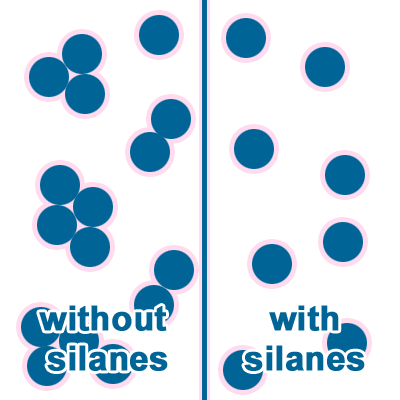
Improvement of dispersion with silanes coupling agents
Higher production rate
Due to the lower viscosity of the composite possible by adding silane coupling agents (table below), improved processability in compounding and injection molding is usually observed, leading to a higher production rate.
| Additive | Viscosity of the mixture (Cp) |
| None | 24500 |
| XIAMETER™ OFS-6030 Silane (Methacyrlate) | 22000 |
| XIAMETER™ OFS-6020 Silane (Diamine) | 14000 |
| XIAMETER™ OFS-6032 Silane (Cationic Styryl) | 4700 |
Less cure inhibition
| System | Reduction Of Cure Exotherm ΔT (°C) | |
| Polyester | Epoxy | |
| Untreated | - 22 | - 17 |
| XIAMETER™ OFS-6040 Silane (Epoxy) | - 20 | - 8 |
| XIAMETER™ OFS-6020 Silane (Diamine) | - 15 | - 1 |
| XIAMETER™ OFS-6032 Silane (Cationic Styryl) | - 10 | 0 |
Filler treatment with silane coupling agents
The silane treatment can improve processing, performance, and durability of a mineral, silica, glass fiber, and bead by:
| Mineral Filler & Silica Treatment | Glass Fiber and Bead Treatment |
|
|
Mineral filler treatment
Mineral fillers have become increasingly important additives and modifiers for organic polymer. The metal hydroxyl groups on the surface of minerals are usually very hydrophobic and very incompatible with organic polymers.
Silanes are a natural fit to treat the surface of the mineral to make the mineral more compatible and dispersible in the polymer, or even make the filler into a reinforcing additive.
Silanes used as coupling agents in filler treatment are useful for many applications, some examples are HFFR wire & cable compounds, Mica-filled polypropylene and polyamide, and clays in rubber.
Silica treatment
Silane coupling agents are often used to treat silica (both fumed and precipitated) treatment with great effectiveness in filled polymer systems. Silanes used as coupling agents in silica treatment are useful for many applications, such as green tires, shoe soles.
Glass fiber and bead treatment
Silane coupling agents are a critical component of glass-reinforced polymers. The glass is very hydrophilic and attracts water to the interface. Without silane treatment on the glass surface, the bond between the glass fiber and the resin would weaken and eventually fail, making a composite essentially useless.
Silane coupling agents are used in glass treatment (fiber, bead...) for general purpose applications, such as automotive, marine, sporting goods, and construction, as well as for high-performance applications in printed circuits boards and aerospace composites.
Glass materials treated with silane coupling agents can be used either in thermosets or in thermoplastics, or any other desired polymer system.
Moving on, silanes also serve a different role in polyethylene by enabling controlled crosslinking for enhanced performance.
Silanes as crosslinking agents for polyethylene
Key applications
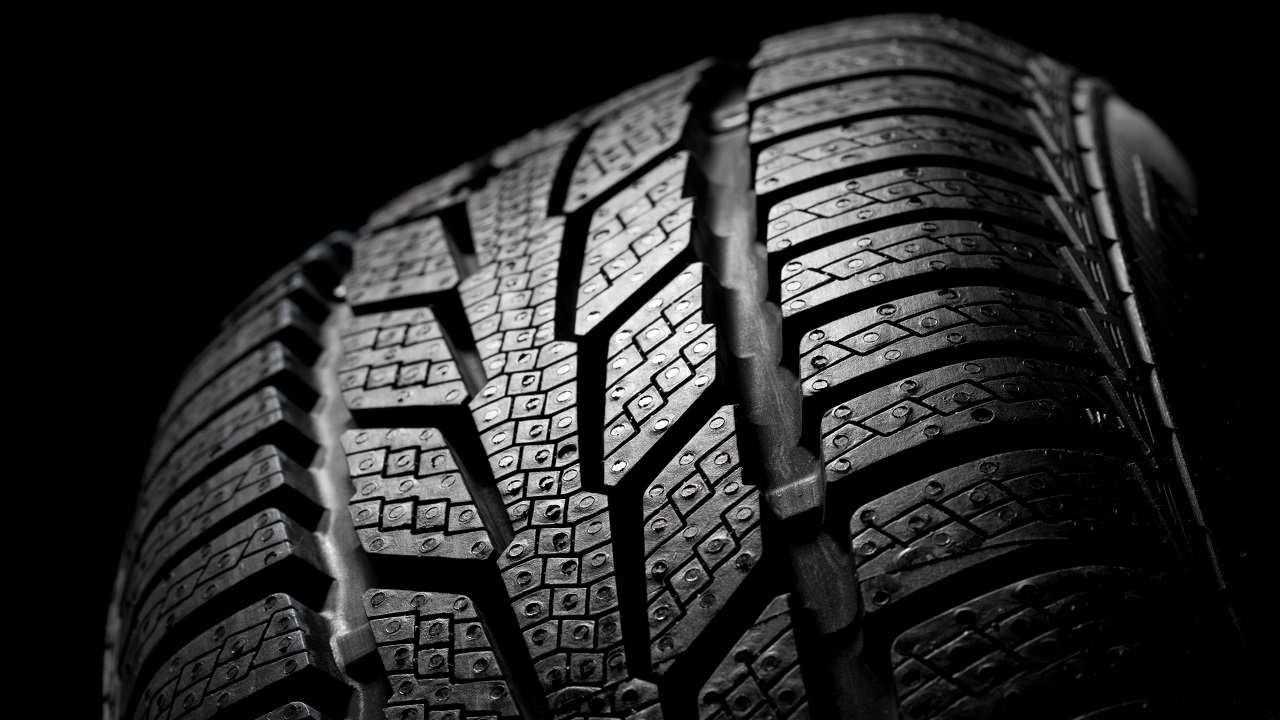
Silane coupling agents enable the production of high-performance tires with lower borring resistance
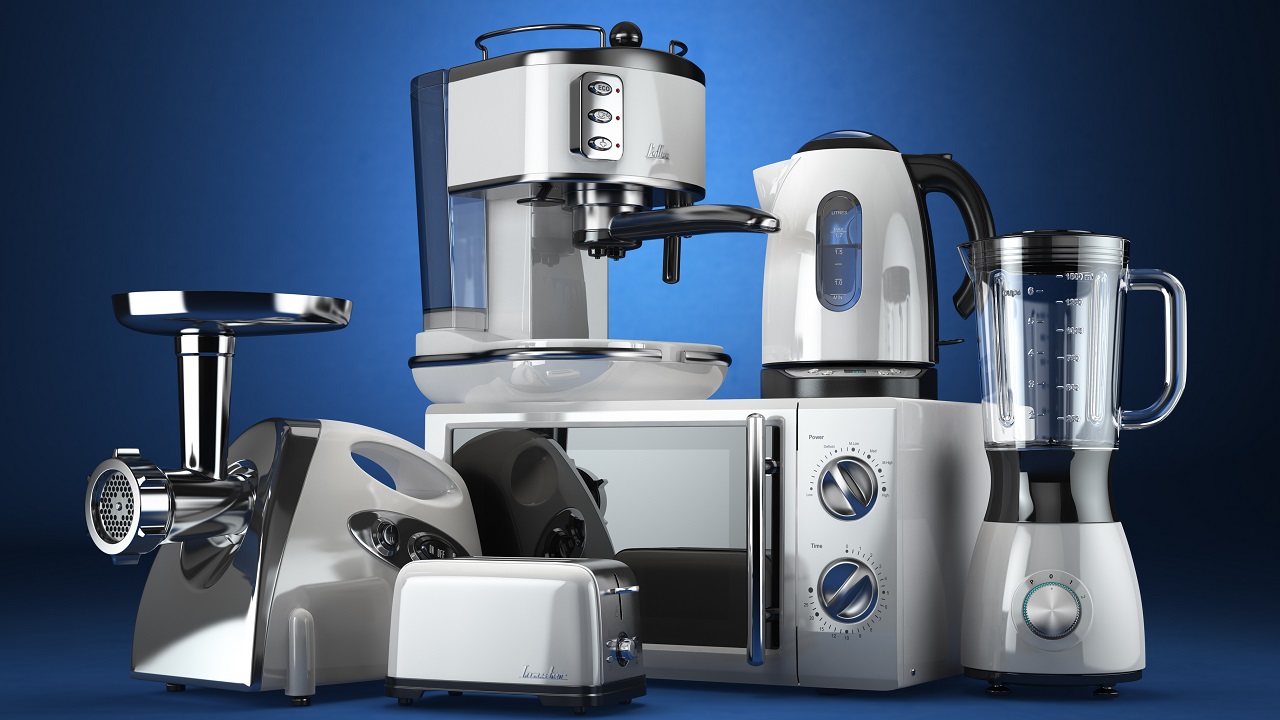
Silane crosslinking agents are used to manufacture wire and cable for appliances
Silane coupling technology is used to manufacture shoe soles