

Non-PFAS Polymer Process Aids – How Ingenia is Supporting the Transition Away from Fluorine-based (PFAS)
Last update on Feb 10, 2025
An Interview with Zach Charlton, Chief Technology Officer at Ingenia Polymers
Polymer processing aids (PPAs) are additives that improve the processability of polymers, especially in the extrusion process. They are used to reduce melt fracture in blown film and die build-up in extrusion which can lead to:
- poor-quality films,
- reduced output, and
- increased processing costs.
Per- and polyfluorinated substances (PFAS) are a group of chemicals that are used in a wide variety of products, including PPAs. However, they have been linked to a number of potential health risks, like cancer, reproductive problems, and thyroid disease. Thus, the packaging industry, brand owners, and regulators are moving away from PFAS materials.
The landscape of polymer processing is undergoing a remarkable transformation as Ingenia Polymers has developed and commercialized PFAS-free PPA solutions to support resin producer and converter markets. These groundbreaking solutions are poised to redefine these markets by providing safer and high performing alternatives to the traditional fluoropolymer-based polymer process aids.
We interviewed Zach Charlton, Chief Technology Officer at Ingenia Polymers to explain and update us on new product developments to support the rapid change that the industry is making, moving away from fluoropolymer-based polymer process aids.
#1 - How are PFAS used in the plastics industry today and what is the primary reason for the move away from PFAS in plastics extrusion?
PFAS (per- and poly- fluoroalkyl substances) are ubiquitous in the plastics industry – they are used in, for example battery separator films, gaskets and seals, and automotive fuel systems to name only a few applications. In polyolefin extrusion processes, PFAS, specifically fluoropolymers, have been used extensively as polymer processing aids (PPAs). In processes such as blown and cast film extrusion, sheet extrusion, and blow molding, PFAS-based PPAs have been used to eliminate melt fracture, ease processing, improve optical properties, and prevent die build-up.
The industry is undergoing a rapid transition away from PFAS due to regulatory developments and consumer sentiment on PFAS materials. Regulatory developments in the US at the state level have already driven a rapid transition away from PFAS materials in food contact applications. Broader regulation in the EU's Packaging and Packaging Waste Regulation (PPWR) coming into force in February 2025, and regulation under consideration by the European Chemicals Agency (ECHA) are driving the current transition in Europe. The rapidity, breadth, and impact of these changes have both challenged and focused the industry to find solutions.
#2 - What has enabled Ingenia to be at the forefront of innovative non-PFAS PPA solutions?
Ingenia had developed the knowledge and technical capability to develop polymer processing aids over decades of work with the PFAS materials. Much of this capability is translatable to non-PFAS materials. However, it was insight provided by Ingenia's Masterbatch Business Manager, and the close integration of our marketing, technical service, regulatory, and research and development teams that allowed us to act on the market need, as we had the capability and opportunity to address it, ahead of many others.
Ingenia has invested heavily in increasing our research and development capacity and capability over the last 5 years. As the market and regulatory pressure to develop alternatives to PFAS increased, and as we started seeing success in the lab, we were able to leverage that increased capacity and scale our efforts. We now have full-time dedicated resources working to improve our current non-PFAS solutions and develop new and novel non-PFAS, non-siloxane, chemistries that deliver equal or superior performance to PFAS-based PPAs. We are dedicated to maintaining leadership in this space and supporting the industry's transition.
#3 - What applications have been the primary focus of Ingenia’s non-PFAS PPA market? Are there different attributes that are important in blown film versus cast film or extrusion coating?
The primary focus of Ingenia's non-PFAS PPA development has been film extrusion – blown film, cast film, and extrusion coating. We have been able to extend the use of our non-PFAS PPAs to blow molding and pipe extrusion with good results. However, the initial efforts were clearly focused on solving the challenges of film producers.
The first concern of film producers is the elimination of sharkskin, without adversely affecting film properties such as coefficient of friction (COF), printability, and optical clarity. The Figure 1 below illustrates a comparison of films processed without PPA (on the left) and with one of our non-PFAS PPAs (on the right). Production of films at high rates in the absence of a PPA leads to the formation of surface defects, called sharkskin. Ingenia's non-PFAS PPAs coat the extrusion die, providing a lubricating layer that eases processing of the polyolefin and eliminates sharkskin.
Figure 1: Ingenia's Film without PPA (Left) and with Non-PFAS PPA (Right)
Benchmarking the performance of PPAs can be done in a 'time-to-clear' study. This test involves extruding a blown film, under standardized and repeatable conditions in order to generate sharkskin on the film. A PPA is then introduced, and the film quality and extrusion conditions (pressure, extruder load, RPM, or output) are monitored as a function of time. The time it takes the PPA to completely clear the sharkskin and produce clear film is indicative of the performance of the PPA. These tests can also be repeated in different resins with varying comonomer type and content, density, viscosity and shear thinning behavior.
An example of this type of study is shown in Figure 2. The performance of several Ingenia non-PFAS PPAs (IP1171, IP1172, IP1173, IP1175) is benchmarked against a traditional fluoropolymer based PPA masterbatch (IP1130) and a poly(ethylene glycol) (PEG) masterbatch - a commonly available non-PFAS PPA in the market. Ingenia's non-PFAS PPAs equal or exceed the performance of fluoropolymer PPAs and far exceed the performance of PEG under the given conditions.
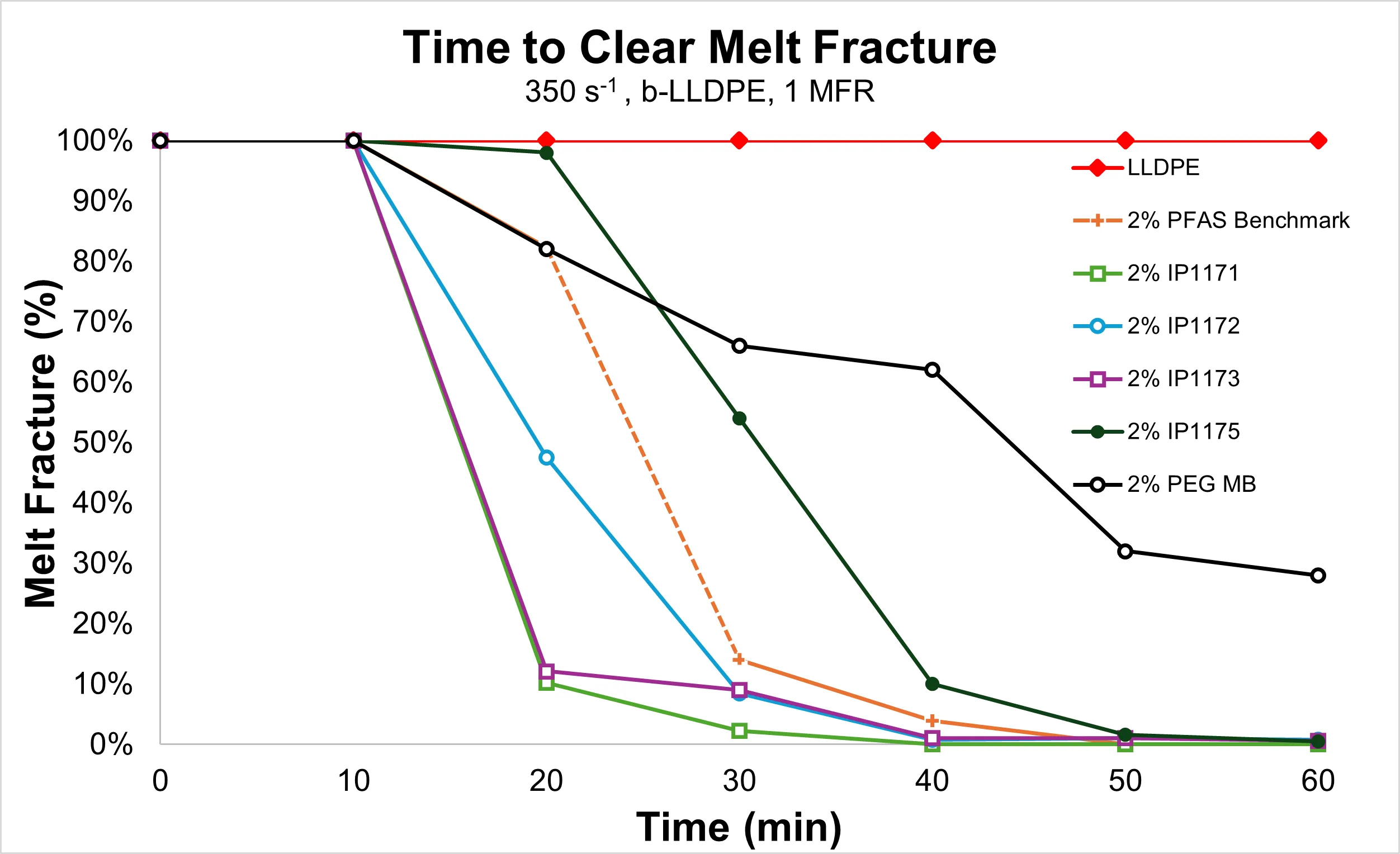
Figure 2: Removal of Sharkskin in Blown Film Extrusion Using PFAS and Non-PFAS PPAs
The second issue addressed by Ingenia's non-PFAS PPAs is Die Build-Up (DBU). DBU is the accumulation of materials – typically degraded material, low molecular weight oligomers, stearates, waxes or minerals – at the exit of the die. The build-up can peel off periodically, causing defects in the film. Removing the build-up requires shut down of the line resulting in reduced productivity and higher operational costs.
Figure 3 shows what DBU looks like in a cast film line without PPA and with addition of Ingenia's non-PFAS PPA (IP1171). IP1171 significantly reduces die build-up, providing reduced downtime and improved productivity. IP1172 and IP1173 offer similar to improved performance vs. IP1171.

Control: LLDPE + 10% TiO2, No PPA

LLDPE + 10% TiO2 + 1000 ppm Active Content of IP1171
Figure 3: Reduced Die Build-Up with IP1171 Non-PFAS PPA
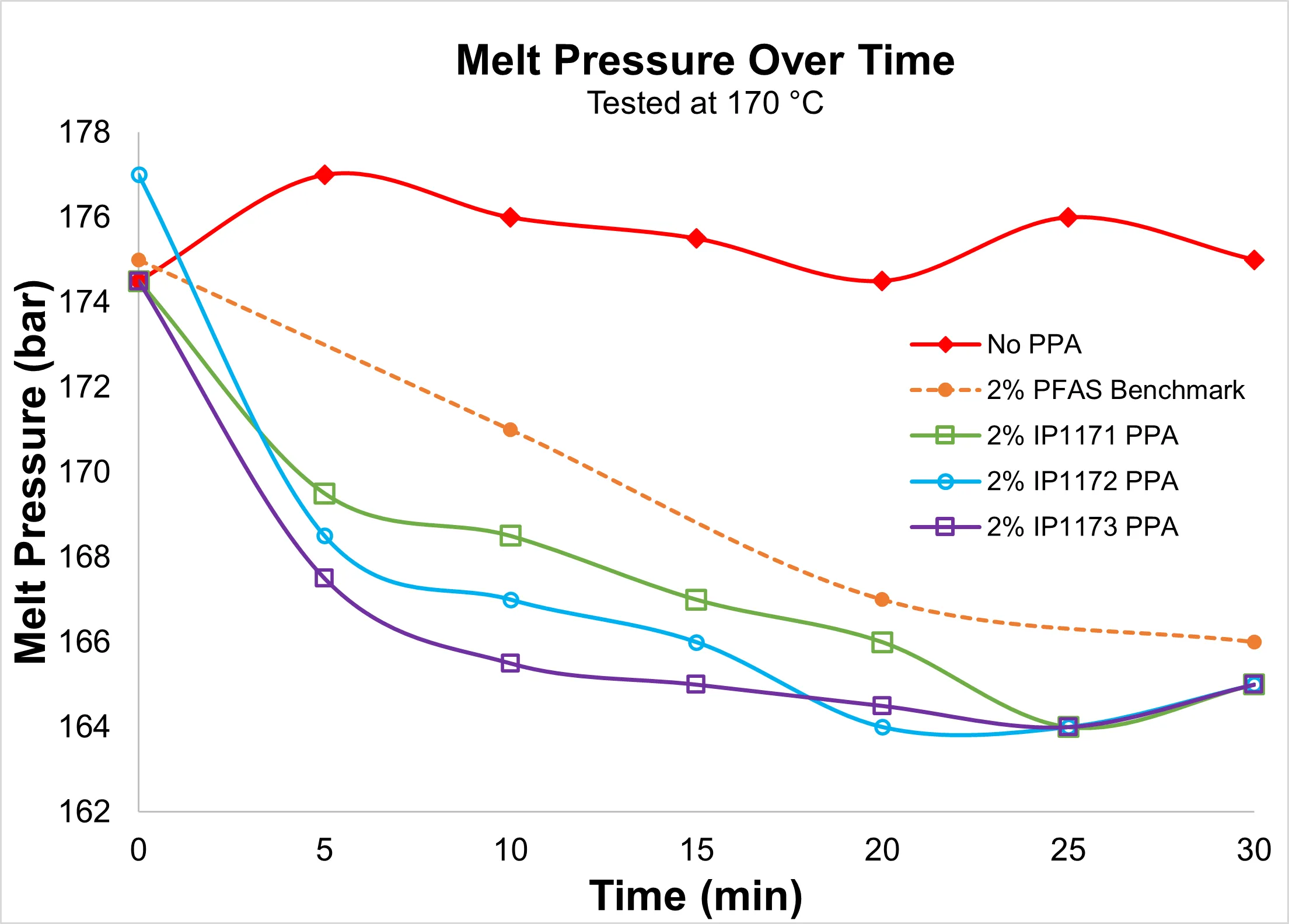
While the primary focus has been blown and cast film production, other extrusion processes, such as blow molding, sheet/pipe extrusion, extrusion coating/laminating can also benefit from these solutions. Recent evaluations of Ingenia's non-PFAS PPAs in blow molding demonstrate that these PPAs reduce melt pressure, enhance surface properties, and increase productivity. Figure 4 shows the reduction in melt pressure against a benchmark fluoropolymer based PPA.

#4 - Why should a plastics processor consider Ingenia when replacing their PFAS-based PPA?
The short answer is that we are able to provide an efficient and effective solution, along with the dedicated regulatory and technical support needed to make the transition to non-PFAS PPAs as easy as possible for the processor.
The portfolio of non-PFAS PPAs is working at efficient dosage levels, in the broadest range of resins and structures. Three-plus years of field experience with these materials have given us the experience to provide clear direction on loading levels in specific resins, structures and applications.
Customer feedback is that our 'Use Guides' have been helpful in guiding processors and our technical service team is available for on-site trial support. This kind of specific guidance minimizes testing time and improves outcomes for film producers.
#5 - What are some of the challenges that film processors have found when switching from PFAS to non-PFAS PPAs?
It has been difficult for processors to navigate potential interactions between different non-PFAS PPAs in the system. For example, using a resin already formulated with a PPA and adding a PPA masterbatch from another supplier with a different chemistry can lead to suboptimal results. This is something that Ingenia has spent some time to understand – we released a study on interactions between different PPA chemistries early in 2024.
The rapidity of the transition to non-PFAS and the qualification work required has been burdensome on processors. We have spoken to processors that have evaluated as many as 20 alternative non-PFAS PPAs. When a PPA shows promise in eliminating sharkskin in blown film the evaluation has to be followed up with die build-up studies - which can take days or weeks.
Once a film producer finds a PPA that works they then have to propagate that work across all of their production lines and film structures, and may need to work with customers for approvals. By providing a non-PFAS PPA that is broadly effective, and providing a high level of technical support, we try to minimize the burden on processors' operations.
#6 - What sets Ingenia’s solutions apart from other suppliers in this market in each of the applications you mentioned?
Ingenia's solutions stand out in the market for their efficiency in eliminating sharkskin, breadth of application in terms of resins and structures, performance for die build-up, and their excellent regulatory compliance. In more detail:
- IP1171, IP1172, and IP1173 are extremely efficient PPA masterbatches. Loading of the active PPA in the film is similar to levels used in traditional fluoropolymer PPAs.
- The greatest differentiator is the excellent die build-up performance of these PPAs. In cast film processes, loadings as low as 0.25% are effective in reducing or removing DBU.
- Ingenia's PPAs are formulated with food contact compliant, non-migratory components, meaning that film properties are not negatively affected and regulatory compliance is met.
| Non-PFAS PPA | Food Contact | PPA Performance and Film Properties | |||||||||
| FDA | EFSA | Mercosur | China | Japan | Removes Sharkskin | Efficient Loading | DBU | Improves Output & No Surging | No Effect on Printing or COF | Temperature Stability (°C) | |
| IP1171 | ✓ | ✓ | ✓ | ✓ | ++ | ++ | ++ | + | + | 270 | |
| IP1172 | ✓ | ✓ | ✓ | ✓ | ++ | ++ | ++ | ++ | + | 270 | |
| IP1173 | ✓ | ✓ | ✓ | ✓ | ✓ | ++ | ++ | ++ | ++ | + | 270 |
| IP1175 | ✓ | ✓ | ✓ | ✓ | ✓ | ++ | + | +++ | + | + | >>300 |
| PEG | ✓ | ✓ | ✓ | ✓ | ✓ | + | + | - | - | + | 240 |
| PDMS | ✓ | ✓ | ✓ | ✓ | ✓ | ++ | - | - | - | >300 | |
| Modified siloxane | ✓ | ✓ | ✓ | ✓ | ✓ | + | + | - | + | 240 | |
| Stearates | ✓ | ✓ | ✓ | ✓ | ✓ | + | + | - | - | - | 220 |

#7 - Where does Ingenia see the non-PFAS PPA market headed?
Ingenia anticipates continued rapid growth in the non-PFAS PPA market for food contact applications. The market is also expected to expand into non-food contact applications, such as pipe and sheet extrusion, and into other geographies as the scope of regulation expands. The demand for high-performance alternatives will drive continued development. After a period of proliferation of solutions, we anticipate the market will eventually settle on a handful of the most effective chemistries.

|

Ingenia Polymers – Discover Supplier Offerings Here
DISCLAIMER: All images and graphs used in this article are copyright of Ingenia Polymers.