

HSP Science-based Formulation for Plastics
Last update on Mar 29, 2018
Some of the familiar tasks while formulating plastics include:
- Finding a new solvent blend for working with a polymer
- Ensuring that all the components in a polymer blend have the right level of 'happiness' together (especially new, green, plasticizers)
- Finding the best way to match the properties of the polymer to those of an another in order to optimize for adhesion
Although in these and other plastics issues, we can do a lot with trial and error but using a science-based approach - Hansen Solubility Parameters is a much more effective way to arrive at speedy solutions to our formulation problems.
Learn from Professor Steven Abbott what Hansen Solubility Parameters are and how they should become a go-to tool for science-based formulation.
Let's get going...
Better Plastics via Science-based Formulation using Hansen Solubility Parameters
So you need to find a new solvent blend for your polymer, or you need to identify a plasticizer that won't exude to the surface, or you need to get maximum compatibility between your polymer and another one for maximum adhesion. How do you use the minimum effort to get the maximum balance of desired properties?
If you try to use ideas such as 'hydrophobic/hydrophilic' or 'polar/non-polar' you are likely to be disappointed in the results. The words are vague and don't begin to describe the subtleties of the sorts of molecular interactions that affect plastics and their ingredients.
Focusing Specific Areas of Plastics
Formulating scientifically requires numbers and we especially need to know whether how 'like' or 'unlike' any components in our formulation might be. A good measure would be a 'distance' between components, and for this,we need three numbers that describe each chemical, polymer, particle or additive used in our plastic formulation.
Why must we use three? It turns out that two is too small and four is much too complicated. Though, it is worth noting that the molecular size is an extra parameter that is routinely used.
We start by describing:
- What those three numbers are
- How you can predict or measure them
- How you can use them in three specific areas of plastics
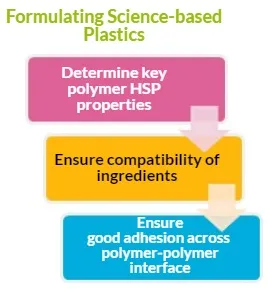
The three specific areas of plastics include:
- Determining the key polymer HSP properties
- Ensuring compatibility between the ingredients added to a polymer
- Ensuring compatibility between polymers to obtain, for example, good adhesion
The 3 Hansen Solubility Parameters (HSP)
The three HSP describe three key, familiar features of any molecule:
- The Dispersive aspect
- The Polar aspect
- The Hydrogen-bonding aspect.
Formulators have no problem with the Polar and Hydrogen-bonding aspects. The Dispersive part is less familiar but still intuitive – it's the general (van der Waals) interactions between all molecules. Molecules with a broad electron cloud (e.g. aromatics); self-interact more strongly than those with a tight cloud (e.g. alkanes).
These three factors are the Hansen Solubility Parameters.
The table below lists the HSP of some common solvents:
| Solvent | δD | δP | δH |
| Acetonitrile | 15.3 | 18 | 6.1 |
| Acetone | 15.5 | 10.4 | 7 |
| Benzene | 18.4 | 0 | 2 |
| Diethyl Ether | 14.5 | 2.9 | 4.6 |
| Dimethyl Sulfoxide | 18.4 | 16.4 | 10.2 |
| Hexane | 14.9 | 0 | 0 |
| Ethyl Acetate | 15.8 | 5.3 | 7.2 |
| Ethanol | 15.8 | 8.8 | 19.4 |
| Methylene Dichloride | 17 | 7.3 | 7.1 |
| N-Methyl-2-Pyrrolidone | 18 | 12.3 | 7.2 |
| Tetrahydrofuran | 16.8 | 5.7 | 8 |
| Water | 15.5 | 16 | 42.3 |
Looking at the list above, there is no problem making sense of the broad trend of the numbers.
- Acetonitrile, for example, is very polar, so its δP value is high, whereas its δH value is not so big as its ability to hydrogen-bond is modest. Ethanol is medium in terms of δP value, with a large δH value, as we would expect from such a hydrogen-bonded solvent. Each of them has a relatively small δD value.
- Benzene and DMSO both have higher δD values. Thanks to the large electron clouds around them!
- Hexane is a simple, relatively low δD solvent; acetone and ethyl acetate are just middle-of-the-road in their three parameters.
Determining How "Like" Molecules are
Now we are set up to find how 'like' two molecules are. We simply calculate the 'distance', D, in 3D space between any pair using the famous HSP formula (including a factor of 4 for the δD values)
D² = 4(δD1-δD2)²+ (δP1-δP2)²+ (δH1-δH2)²
- D values of less than, say, 4 represent a reasonable match and values greater than, say, 8 represent a poor match. So if you have a target molecule and a list of potentially compatible molecules, you just need to calculate D between the target and each molecule.
- After sorting them from low (good) to high (bad), then find which of the low D molecules meet your other requirements, such as cost or greenness.
Typical examples would be if the target is a polymer and the molecules are solvents, or they might be plasticizers. Equally, the target could be an API and the molecules could be polymers, in order to identify which would be best for controlled release. HSP also work very well when the target is a pigment or nanoparticle and the aim is to create a coating or a stable polymer blend (e.g. nanoclays for performance enhancement).
What if no molecule matches all your plastics formulation requirements?
Thanks to another piece of HSP magic, if there is no single molecule that meets all your requirements, you can create a rational blend between two molecules which have high D values but which you like to use for other reasons. Suppose each molecule has a reasonable match of δD and δP with your target but one has a low δH and the other has a high δH.
The HSP of a blend is simply the weighted average of the components. So, in this case, the δH can be tuned to be a close match to your target. Therefore, a blend of unusable molecules (D too large) becomes usable. This ability to create great blends from poor starting materials is the secret to HSP's success over the past 50 years.
Given that to do these calculations you need the HSP values, where can you find them?
Finding the Parameters
Fortunately, the HSP are known (and in the public domain) for all the common solvents, the newer green solvents and for many polymers and additives.
What about your own special chemical, polymer, additive, filler?
The answer is that there are two techniques for measuring HSP values, each of which you can do in-house or contract out to those set up to offer such a service.
- The first technique requires you to judge whether your material is 'happy' (soluble, swellable, dispersible …) or 'unhappy' in a set of solvents that span HSP space. The set of 'good' solvents defines a sphere with the HSP at its center and the radius of which defines the usable range of solvents.
- The second technique is based on Inverse Gas Chromatography (IGC) and measures the strength or weakness of the interactions of probe solvent molecules with your sample, which forms the stationary phase of the IGC column. The standard technique is the more widely used. The IGC technique is especially useful for oligomers, surfactants, and excipients that are so fluid at room temperature that the standard test gives too many 'good' solvents and too few 'bad' ones.
HSP of Polymers and Dispersions
Determining the Solubility
We can immediately apply our new-found knowledge to the question of polymer solubility, one of the main uses of HSP in the formulation world.
Flory-Huggins theory gives us a well-known formula that tells us whether a polymer is soluble or not in a solvent. It has two terms:
- The first is the entropic effect
- The second is the enthalpic effect, and, yes, it was derived from lattice theory
The enthalpic effect is normally described in terms of the χ parameter, but it can equally be described using the HSP Distance. This means that,if we know the HSP of a polymer we can immediately apply the Flory-Huggins theory to get a good estimate of its solubility. The app does this for you, conveniently showing a test tube which is either a single color – meaning a solution, or two colors meaning a phase separation into a dilute polymer solution and some polymer is swollen with solvent.
In the app example, when D = 7.3 for this 50K MWt polymer and medium-sized solvent, the polymer is just soluble at all concentrations.
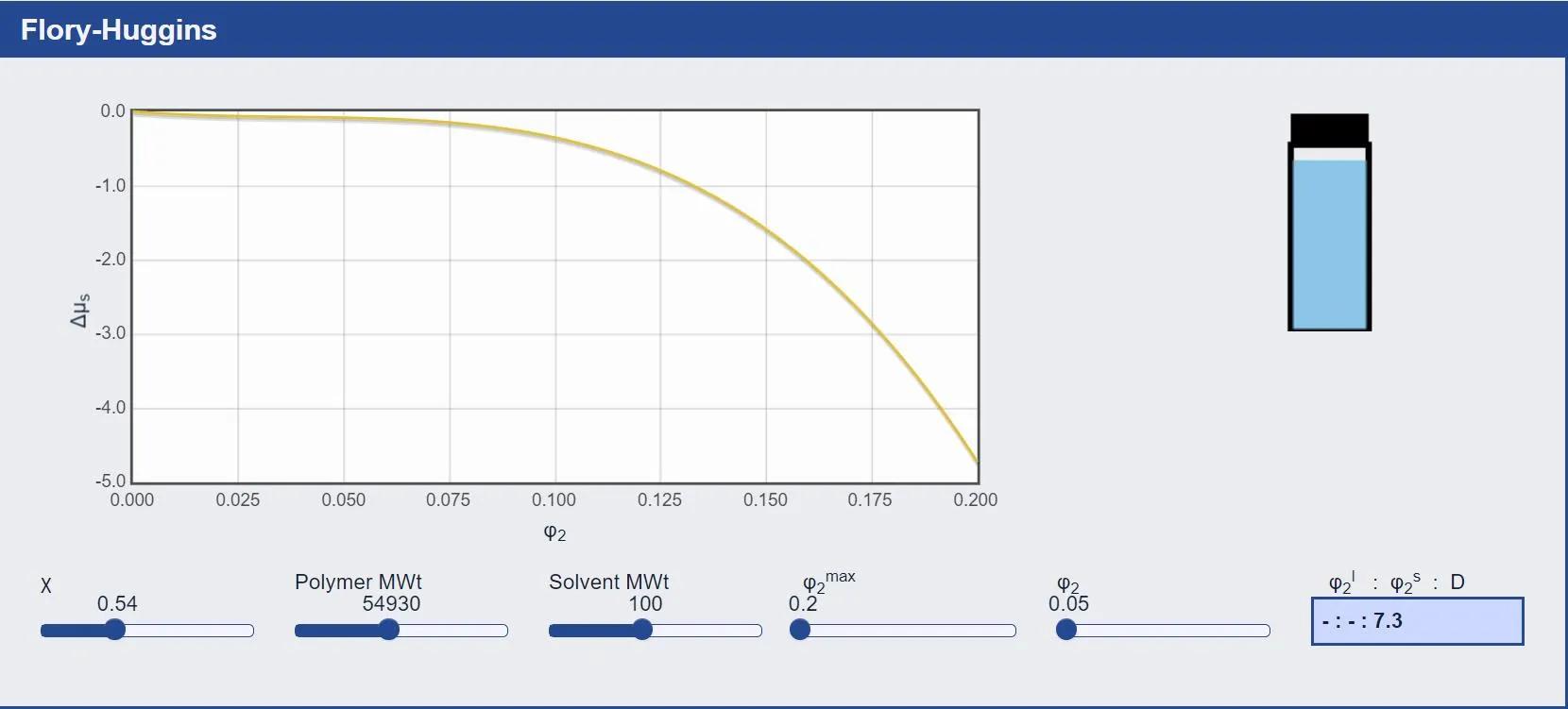
Determining Solubility of a Polymer via Flory-Huggins App
But at a distance of 7.4, it becomes insoluble
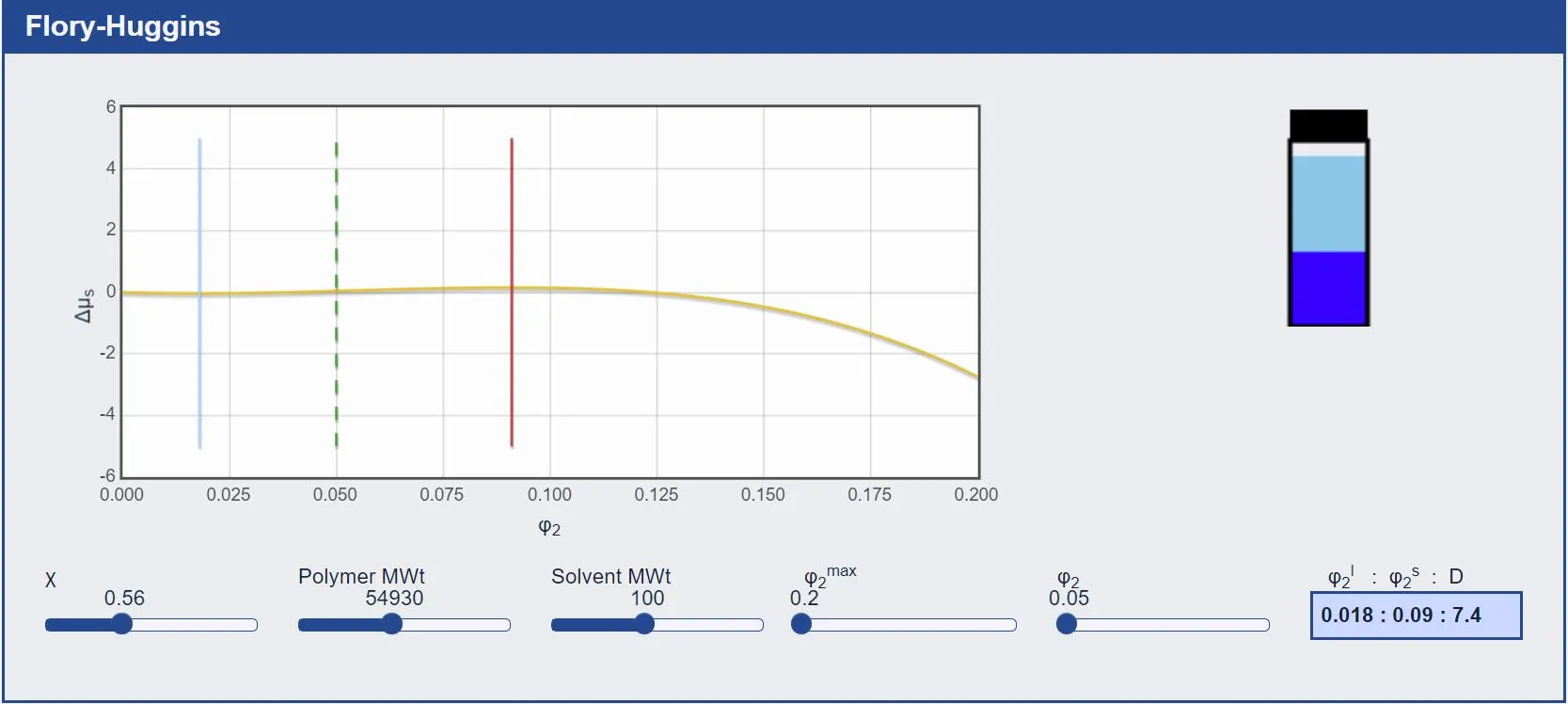
Determining Solubility of a Polymer via Flory-Huggins App

We have the HSP for many standard polymers, so it is easy to find good and bad solvents for these.
What about an unknown polymer?
We can use the reverse logic. If we find a set of solvents in which the polymer is soluble and another set where it is insoluble, we know, from Flory-Huggins theory that we can fit the data to a sphere whose center is the HSP of the polymer and with a radius such that all the good solvents are inside and all the bad ones are outside.
We can see this for the determination of the HSP of polymer PLA, polylactic acid. The good solvents are shown in blue and the bad ones in red. The HSP of PLA is the green dot in the center of the green sphere.
Ensuring the Compatibility
Fortunately, it has been shown that we can use the same 'sphere' measurement for the HSP of a wide variety of materials. For example, the HSP of cross-linked polymers can be found using swelling to distinguish the good from bad solvents. We don't say that we have a Hansen Swellability Parameter because the thermodynamics are the same. And it is routine to measure the HSP of pigments and nanoparticles using sedimentation time as a guide.
All you need is an objective measure of whether the material is 'happy' or 'unhappy' in the test solvents. Again, we don't say we have a Hansen Dispersability Parameter, because when you examine the science deeply; you find that it makes sense to say that a nanoparticle (plus whatever dispersants are attached to it) is soluble rather than merely dispersable. With the benefit of hindsight perhaps, we should have spoken of HCP – Hansen Compatibility Parameters, because in the end,like is compatible with like. So when you hear of HSP, imagine them as being HCP!
Polymer Compatibility with Other Ingredients of Plastics Formulation
#1. Polymer-Polymer Compatibility
Our real-world experience is that there are plenty of reasonable polymer blends between related polymers. Here we have a difference between 'reasonable' and 'thermodynamics'.
- Moderate molecular weight PMMA and PEMA are easily mixed together and under normal circumstances will not phase separate.
- The thermodynamic limit applies to high molecular weights and long times at high temperatures allowing the polymers to reach equilibrium.
So, if you want practical polymer blending with a low risk of long-term phase separation, a low HSP Distance is a good starting point.
If you use a more elaborate version of HSP which splits δH into donor/acceptor, you can find that polymers with relatively large distances, such as polyvinyl phenol and polyvinyl acetate can form stable blends via donor/acceptor interactions.
#2. Polymer-Other Additive Compatibility
When it comes to plasticizers and additives, such antioxidants or pigments, nanoclays etc. - low HSP Distance is the first criterion for long-term stability.
It pained me to read, for example, the early work on plasticizers for PLA. A few moments work calculating the HSP Distance would have avoided years of painful work showing that many popular plasticizers bloomed to the surface during aging tests: they simply were not compatible. On the other hand,
- It is possible to select from a list of known plasticizers to find those with a small Distance, or
- Screen a large range of bio-based building blocks for molecules which are likely to have a small Distance, and then, to use other tools to measure or estimate other key properties for a plasticizer (I have done this in real life), such as MPt of BPt.
Similarly, a lot of naïve experiments were done using functionalized nanoclays to improve the properties of PLA. A few moments work would have shown that the Distance from the (say) tallow quats to PLA was far too large for compatibility and sure enough, the clays were hard to disperse and gave few advantages once dispersed. Had formulators worked with the providers of nanoclay dispersants to find or develop those with a compatible HSP, they would have saved a lot of mutual frustration.
By knowing the HSP of your additives from your suppliers or by measuring the values for your own special ingredients, it becomes much easier to create 'happy' formulations where everything likes to be with everything else. Many long-term problems with coatings are caused by incompatibilities that could easily have been identified early on via HSP Distance.
Polymer-Polymer Adhesion
The best way to get adhesion across a polymer-polymer interface is to have polymer chains crossing from both sides and becoming entangled. How can we calculate the chances of two polymers being able to intermingle and entangle to the required amount?
A rather simple formula from Helfand relates the intermingling distance to the χ parameter and, therefore, to HSP Distance.

Relation Between χ Parameter and HSP Distance
In this example, a polymer with a Kuhn length (a virtual, effective, monomer length) of 1.5nm could intermingle by 3.2nm when the HSP Distance = 3.9 (at χ = 0.15).
Because the mythology that adhesion depends on surface energies is so widespread (even though surface energies are 1000x too small to be relevant) this powerful way to understand adhesion across interfaces is far too little known. But those who know it can attest to its power in being able to formulate correctly.
And it's not just polymer-polymer. We often have a non-polymer surface and need to attach a primer molecule to aid adhesion. The primer needs to be long enough to tangle and compatible enough to be happy to associate with the polymer. So, finding the HSP of the primer is vital for success.
But however much the Helfand formula tells us we might get intermingling; the polymers are not going to cross the interface unaided.
- For heat sealing, we have temperature and time
- For coating, we have solvents
If one polymer is being delivered from the solvent then, of course, there must be good polymer-solvent compatibility as discussed earlier. But we also need the solvent to attack the polymer onto which we are coating. Attack, yes, but not too much, or we destroy the surface.
Tuning the solvent to have enough 'bite' into the surface to enable entanglement to take place (i.e., over a few nm) without destroying the surface (defects on the µm) scale is another job for HSP.
These examples are among many other application possibilities of HSP matching, which are worth considering for efficient polymer developments. Other typical applications would be:
- Determining Solvent Evaporation Rates Faster
- Overcoming Flavor Scalping of a Bio-based Polymer
- Developing Particles-Polymer Dispersions Faster
Conclusion
For more than 50 years, HSP has proven itself in the world of formulations. Common tasks such as finding good solvents (or blends) or ensuring compatibility between components in a formulation become much more rational and efficient when the HSP of all the key ingredients are known, either from your suppliers or internally, and HSP Distance calculations are used routinely to find the best combinations.