

Choose the right antioxidant for peroxide-curing of elastomers
Last update on Jul 18, 2025
This article was originally published in 2002 and revised in 2025.
The use of peroxide vulcanization in elastomer processing presents unique challenges when incorporating antioxidants into rubber formulations. Unlike sulfur-cured systems, peroxide curing operates through a free radical mechanism that can directly compete with antioxidant functionality, creating a delicate balance between achieving adequate crosslinking and maintaining long-term protection against oxidative degradation.
Peroxide-cured rubber systems face a fundamental dilemma: the same free radical species that enable crosslinking during vulcanization are also responsible for oxidative degradation during service life. Antioxidants, designed to neutralize these harmful radicals, can inadvertently interfere with the curing process itself. This interference can result in reduced crosslink density, compromised mechanical properties, and paradoxically, poorer aging performance despite the presence of protective additives.
In this guide, let us examine the complex interactions between antioxidants and peroxide curing systems. The analysis covers rheological effects, aging performance, synergistic combinations, and practical guidelines for optimizing antioxidant selection in peroxide-cured EPDM, NBR, and HNBR formulations.
Reaction of antioxidant with peroxides
The peroxide vulcanization occurs by free radical mechanism. It competes with the reaction of the peroxide with the other additives containing labile hydrogen atoms. The antioxidants, depending on their category, react in different ways:
The phenolic and amine types neutralize alkoxy and peroxy radicals before they attack the polymer.
A phosphite type decomposes hydroperoxides and stops the propagation of the radicals.
Consequently, there is a competition between the antioxidant and the peroxide (see figure 1, table 1). Due to this competition, some antioxidants can inhibit peroxide curing.
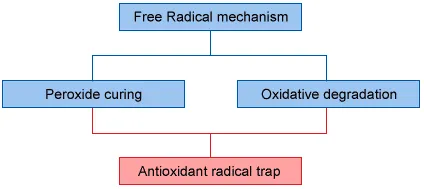
Figure 1: The interactions of the cure and degradation mechanisms
Peroxide curing | Oxidative degradation | Antioxidant protection |
Free radical mechanism initiated by thermal energy | Autocatalytic free radical process initiated by thermal, mechanical, or electromagnetic energy | Peroxide decomposition: carbon and peroxy radical trap |
Table 1: Antioxidant protection, peroxide curing, and oxidative degradation
Generally speaking, it is expected from the antioxidant that:
- A negligible effect on the cure level corresponds to a good aging protection because the antioxidant is not consumed during the crosslinking.
- A big impact on the cure level leads to a poor protection.
Effect of antioxidants on the rheology of peroxide-cured EPDM
P.R. DLUZNESKI (RCT 74, 3, July-august 2001, p 451) compared the change of the ODR delta torque and the ts2 for seven mixings with various antioxidants (see table 2).
Delta torque | ts2 | ||
Phenol unhindered low molecular weight | 4-CP | 20 | 1.8 |
Phenol hindered low molecular weight | BHT | 36 | 1.6 |
Phenol hindered high molecular weight | 37 | 1.3 | |
Polymerized quinoline | AgeRite® Resin D® | 33 | 1.5 |
Arylphosphite | Irgaphos® 168 | 37 | 1.1 |
Dioctyldiphenylamine | Vanox® 12 | 25 | 1.8 |
Diphenylamine/acetone reaction product | 26 | 1.7 | |
Table 2: The effects of the antioxidant type on rheology

Figure 2: The effect of the antioxidant type on the rheology
Effect of antioxidants on the aging properties
A.G. FERRADINO (158th ACS, October 2000, paper78) and B. OHM & al. (158th ACS, October 2000, paper 99) study the action of several antioxidants on the aging of the peroxide-cured rubbers (see tables 3 and 4).
Category of the antioxidants | Reference | Observations |
Phenol high molecular weight | 1010* | Non discoloring, non-staining |
Polymerized quinoline | TMQ* | Discoloring, staining |
Hindered aromatic amine | 445 | Low discoloring, low staining |
Styrenated diphenylamine | SDPA | - |
Dioctyl diphenylamine | ODPA | - |
Nickel dimethyl dithiocarbamate | NDMC | Green discoloration, non-staining |
| * Equivalent to Irganox® 1010 ** Equivalent to AgeRite® Resin D® | ||
Table 3: The properties and nature of some antioxidants
Peroxide-cured EPDM | |||||||
Antioxidant type | None | 445 | TMQ | NDMC | OPDA | SPDA | |
Aging | |||||||
Tensile strength retention % | 3d, 177°C | Brittle | 70 to 90 | 63 | melted | ||
Elongation retention % | Brittle | 70 | |||||
Compression set, % | 3d, 100°C | 6 to 13 | 14 | 23 | 18 | 43 | 15 |
Tensile strength, MPa | 42d, 150°C | 3.7 | 5.1 | ||||
Elongation retention, % | 130 | 245 | |||||
Tensile strength retention, % | 30 | 49 | |||||
Elongation retention, % | 28 | 40 | |||||
Compression set, % | 1d, 125°C | 34 | 42 | ||||
Peroxide-cured HNBR | |||||||
Antioxidant type | Control | 445 | SPDA | A0961 | |||
Compression set, % | 3d, 175°C | 28 | 60 | 57 | 49 | ||
Table 4: The aging of some antioxidants in the peroxide-cured rubbers
Synergistic effect of the imidazole derivative antioxidant combination
The mercapto-imidazole derivatives, as zinc 2-mercaptotoluiimidazole (ZMTI) or zinc 2-mercaptobenzimidazole (ZMBI) can become bounded to the polymer during the vulcanization or during the aging. Consequently, they assume a more permanent protection during the aging. ZMTI also acts as metal deactivator. Furthermore, the combination of the imidazole derivative with some antioxidants leads to a synergistic effect (see table 5). Its intensity depends on the nature of the polymer, antioxidant, and imidazole derivative.
Synergistic effect of the TMQ and ZMTI on a peroxide-cured EPDM | ||||
| Property | Aging | TMQ | ZMTI | TMQ + ZMTI |
Tensile retention, % | 10d, 150°C | 78 | 53 | 114 |
Elongation retention, % | 60 | 32 | 96 | |
Synergistic effect of the ODPA and ZMTI on a peroxide-cured EPDM | ||||
| Property | Aging | OPDA | ZMTI | OPDA + ZMTI |
Elongation retention, % | 3d, 177°C | Melted | 10 | 65 |
Compression set, % | 3d, 100°C | 43 | 18 | |
Synergistic effect of the AO 445 and ZMTI on a peroxide-cured HNBR | ||||
| Property | Aging | AO 445 | ZMTI | AO 445 + ZMTI |
Elongation retention, % | 3d, 175°C | 46 | 59 | 63 |
Synergistic effect of the AO 445 and ZMTI on a peroxide-cured HNBR | ||||
| Property | Aging | 1010 6 phr | ZMTI 6phr | 1010 at 2phr ZMTI at 4 phr |
Tensile retention, % | 14d, 180°C | 20 | 35 | 100 |
Elongation retention % | 10 | 20 | 90 | |
Table 5: The synergistic effect of the antioxidant and ZMTI combinations on the peroxide-cured rubbers
Effect of the antioxidant dosage
Sufficient levels of the antioxidants are necessary to develop some protection and, generally, there is an optimum dosage for each antioxidant. These are high-cost ingredients and it is essential to optimize their level. A.G. FERRADINO studied the effect of the ZMTI level on a peroxide-cured EPDM (see table 6).
Effect of ZMTI level on a peroxide-cured EPDM | ||||
| Property ↓ / Dosage → | 0 | 3 phr | 6 phr | |
| Aging | ||||
Elongation retention, % | 7d, 177°C | 44 | 67 | 82 |
Table 6: The effect of the ZMTI level on a peroxide-cured EPDM
Effect of the exact nature of the imidazole derivative: ZMTI, MTI, or ZMBI?
B. OHM & al. (158th ACS, October 2000, paper 99) and A.G. FERRADINO (158th ACS, October 2000, paper 78) compared effectiveness of the MTI, ZMTI, and ZMBI on peroxide-cured NBRs.
Property | Aging | Control | MSDPA (1 phr) MTI (2 phr) | MSDPA (1 phr) ZMTI (2 phr) |
Tensile retention, % | 3 d, 150°C | 45 | 78 | 93 |
Elongation retention, % | 12 | 31 | 41 | |
Compression set, % | 3 d, 125°C | 20 | 22 | 23 |
Tensile retention, % | 3d, 150°C, ASTM 901 then 3d, 150°C, air | 72 | 22 | 23 |
Elongation retention, % | 19 | 37 | 31 | |
Property | Aging | Control | ZMTI | AO 445 + ZMTI |
Tensile retention, % | 3d, 177°C | - | 109 | 97 |
Elongation retention, % | - | 85 | 70 |
Table 7: The effect of the nature of the imidazole derivative on the aging protection of the peroxide-cured NBR elastomers
Effect on antioxidants on the use of an acid acceptor
The magnesium oxide and zinc oxide can be used as acid acceptors in peroxide crosslinking. They lead to a better retention of the tensile properties and a lower compression set (see table 8).
Remarks on the choice of antioxidant
Some antioxidants inhibit the peroxide vulcanization and lead to a low crosslink density, a high compression set, and a poor aging protection.
If the antioxidant has a little effect on the curing, it is necessary to watch the peroxide level and crosslink density that monitor the compression set, tensile strength, and retention of the properties.
- A high level of the peroxide leads to a higher crosslink density and a better compression set.
- A medium level of the peroxide leads to a high initial tensile strength.
- A low level of the peroxide favors the retention of the tensile strength during the aging.
The synergistic effect of the combination of an antioxidant and an imidazole derivative is of great interest.
As for all aging protection problems, the antioxidant should have a low volatility, discoloring, staining, and blooming properties compatible with the final use.
- A.G. FERRADINO (158th ACS, October 2000, paper 78)
- B. OHM & al. (158th ACS, October 2000, paper 99)
- P.R. DLUZNESKI (RCT 74, 3, July-august 2001, p 451)
- www.akrochem.com
- www.rtvanderbilt.com