
Improving post-consumer recycling resins with additives
Last update on Aug 30, 2021
A key focal point in a circular plastics economy is to develop recycled resins into well-performing end-use application performing materials. Additives to upgrade recycled plastic resins will play a central role here.
For example, BASF has very recently commercialized an entirely new additive product range specifically targetedat increasing the thermal stability, processing ease, UV weathering, and mechanical properties in post-consumerand post-industrial recycled polyolefins (LLDPE, LDPE, HDPE, and PP) and their blends, even with impurities.
The new 'IrgaCycle™' additives are composed of five …030… to 034… grades tailored to recycled use inflexible,rigid, and molding applications within the packaging, automotive, and construction end-uses, helping companiesto achieve their sustainability goals. This is an important factor in mechanical recycling that accounts for 50% ofall current global recycling, and that is growing by 10% in volume yearly. Finally, BASF's 'IrgaCycle™' additive productforms are ready for ease of use and fit seamlessly application-wise in mechanical recycling.
Let's take a quick look at five emerging additive technologies targeted at improving plastics recycled materials...
Avient’s oxygen scavenger reduces haze and yellowing in recycled PET
Avient has commercialized a novel non-nylon-based, oxygen scavenger targeted at PolyEthylene Terephthalate (PET) recycled bottles. The specific grade developed is known as ColorMatrix™ Amosorb™ 4020G. With an increasing amount of recycled PET becoming available, it is critical for end-use packagers to maintain oxygen scavenging capability.
The Amosorb™ 4020G oxygen scavenging additive produces 50% less haze and yellowing in recycled PET for bottles and other rigid applications. Competitive oxygen scavenging additive systems yield at best 10-15% haze and yellowing in PET.

Avient's ColorMatrix™ Amosorb™ 4020G Haze/Yellowing Reducing PET Recycle Additive
Riverdale’s additive improves mechanical properties in polyolefin recyclates
Next, let's look at a new development that increases the mechanical toughness in polyolefin recyclate. A good area of interest recently has been improving the mechanical toughness of recycled High-Density PolyEthylene (HDPE) and PolyPropylene (PP).
Riverdale has commercialized a liquid additive that is capable of restoring near virgin properties at 0.15 to 0.55 percent by weight loading.
- This unique additive system acts in a lubricating fashion with the aforementioned polyolefin polymers.
- Besides enhancing polymer melt flow, the additive has a strong bond with either of the base polymers while maintaining base resin flexibility.
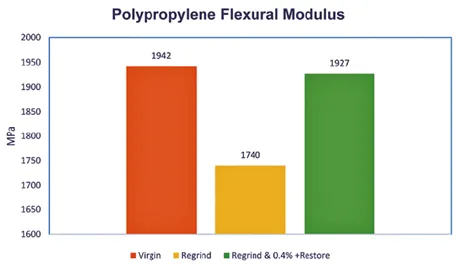
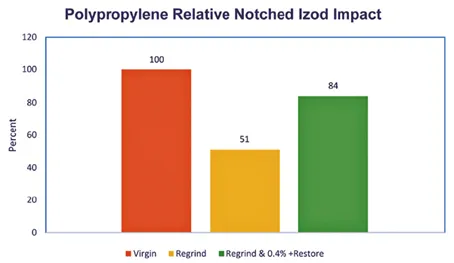
Riverdale's +ReStore Recycled PP Toughness Improving Additive: Modulus (L) Impact (R)
Kraton’s additives for Post-Consumer Recyclate (PCR) material blends
Delving further, Styrene Block Copolymer (SBC) based compatibilizers and modifiers for post-consumer recycled resins have advanced. Kraton has commercialized two compatibilizer additives namely C1000 and C1010.
- The C1010 SBC is also available in a very cost-efficient 50% recycled content form. They can be added at as little as 1-2% by weight, and are not US FDA (Food and Drug Administration) approved.
- These compatibilizers are formulated for use with recycled polyolefin resins such as High-Density PolyEthylene (HDPE) and PolyPropylene (PP) contaminated with recycled PolyEthylene Terephthalate (PET).
Additionally, the C1000 and C1010 grades are useful to compatibilize recycled PET that may be commingled with PP, PolyAmide (PA, Nylon), or miscellaneous fillers.
Modifier additive grades C2000 and C3000 are useful for blending with recycled High-Density PolyEthylene (HDPE) and PolyPropylene (PP) resins to enhance stress crack chemical resistance as well as impact toughness.

Kraton's CirKular+™ Physical Property Improvement Additive HDPE and PP/PET Blends
Ampacet’s ThermProtect masterbatches for PET recycling
Ampacet, a global masterbatch leader, has introduced ThermProtect™ PET, a range of recycled PolyEthylene Terephthalate (rPET) stabilizing masterbatches that reduce yellowing due to polymer thermal degradation, enabling processors to increase the content of recycled PET in virgin material without compromising product aesthetics or performance. This product range is suitable for injection stretch blow molding (ISBM), injection molding, and extrusion thermoforming processes.
Polysecure and Nextek develop fluorescent markers to sort recycled plastics
Our ending additive technology highlights a different way to sort recycled plastics using fluorescent tag markers compounded into the recyclate. This allows the recyclate to be efficiently sorted at the waste facility using specialty UltraViolet (UV) light detectors.
Two companies, Polysecure and Nextek have developed such additive and identification systems. For example, Nextek is using fluorescent markers in plastic package label materials to separate out PolyPropylene (PP) food-grade resins at sorting facilities.

Polysecure and Nextek Develop Fluorescent Sorting Additives for Recycled PP and HDPE Identification
Want to get a 360° view of 2021 game-changing plastic recycling innovations?
Dr. Donald Rosato will take you through the industry's major plastics recycling innovations & combinations to apply w.r.t. regional waste management systems. He will also lay focus on major innovations which include:circular polyolefin product based on Polypropylene, high recycle content PC/ABS and PC resins with PCR levels initially upto 30% & ECO Polyamide product with fibers from waste glass.
