
Covestro showcases solutions for AI, smart living and healthcare at CHINAPLAS 2026
Last update on Apr 21, 2026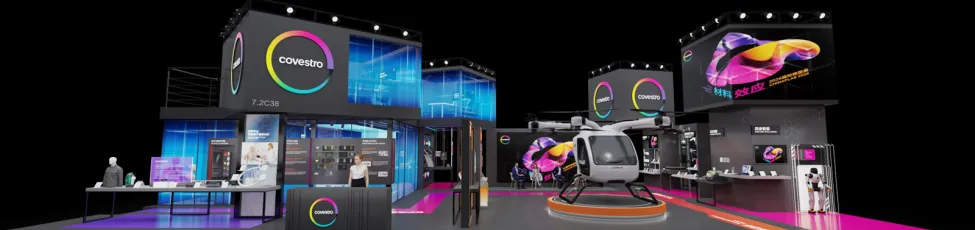
Covestro is participating in CHINAPLAS 2026, taking place in Shanghai from April 21 to 24, where it is presenting material solutions under the theme “The Material Effect.” The company indicates that the exhibit will focus on applications including flying cars, humanoid robots, data centers and medical wearables.
Interested in Covestro's products? Explore profile now>>
Structured around 3 key areas:
The presentation is structured around three areas: Advancing Intelligence Frontiers, Elevating Smart Living, and Empowering Connected & Trusted Healthcare. According to Covestro, these areas reflect how material developments are being applied in emerging industries, connected devices and healthcare systems.
“Technological innovation is advancing at an unprecedented pace, reshaping industries worldwide. The rapid rise of AI in particular is creating a wave of new applications,” said Lily Wang, president of Engineering Plastics at Covestro. “In response, Covestro continues to develop sustainable, high-performance solutions for customers, leveraging the ‘Material Effect’ to redefine industry boundaries and drive innovation in next-generation mobility, electrical and electronics, and healthcare, while advancing our commitment to a circular economy.”
Advancing intelligence frontiers
Covestro states that developments in AI and intelligent systems are contributing to new sectors such as low-altitude aviation, embodied intelligence and smart energy. These applications require materials that support lightweight construction, long-term reliability and high system safety.
At CHINAPLAS 2026, the company plans to display the AirCab flying car developed with its partner GOVY, as an example of material use in electric vertical takeoff and landing (eVTOL) aircraft. The portfolio includes polycarbonate windshields, roof sensor modules, polyurethane encapsulation foams for battery safety and coating systems for lightweight structures. According to Covestro, these materials address requirements related to weight, safety and performance in such aircraft. The company also notes that its materials are used in AI navigation systems and lightweight drone structures.
For humanoid robots, Covestro will present material options across multiple components. The company states that polycarbonate can be used in structural parts for impact resistance, in electronic housings for heat management, and in battery enclosures for flame-retardant performance. It also highlights infrared-transmitting grades for sensor housings. In addition, rigid polycarbonate films can support human–machine interaction through ambient lighting effects and touch functionality, while flexible TPU films are suitable for tactile sensing in dexterous hands and electronic skin.
In the smart energy segment, Covestro reports increasing material requirements linked to energy storage, charging infrastructure and grid integration. Its polycarbonate materials are intended for equipment enclosures used in applications such as energy storage systems, EV charging stations and residential energy solutions.
Looking for polycarbonate grades by Covestro? View all grades >>
“Technological innovation is advancing at an unprecedented pace, reshaping industries worldwide. The rapid rise of AI in particular is creating a wave of new applications,” said Lily Wang, President of Engineering Plastics at Covestro. “In response, Covestro continues to develop sustainable, high-performance solutions for customers, leveraging the ‘Material Effect’ to redefine industry boundaries and drive innovation in next-generation mobility, electrical and electronics, and healthcare, while advancing our commitment to a circular economy.”
Elevating smart living
As AI reshapes industries and daily life, it is raising the bar for everyday devices and the infrastructure behind them. Data centers and supercomputers need materials that meet strict standards for flame retardancy, thermal management and structural strength under high-density computing loads. The company states that its bio-circular attributed Makrolon® RE grades can reduce CO₂ footprint by around 80 percent compared to conventional polycarbonate.
For consumer electronics, including gaming devices and AI-enabled laptops, Covestro offers glass fiber- and carbon fiber-reinforced engineering plastics with properties such as stiffness, translucency and flame retardancy, which the company says can support product design and performance.
The company also references developments in satellite-based connectivity. Its engineering plastics are described as supporting signal transmission, impact resistance and durability in broadband terminal equipment for continuous outdoor operation.
Empowering connected & trusted healthcare
In healthcare applications, Covestro focuses on materials for wearable devices, diagnostics and drug delivery systems. The company presents its material portfolio through demonstrators such as the Maestro point-of-care device, which uses Makrolon® Dx polycarbonate. According to Covestro, the material’s optical clarity and low fluorescence support signal accuracy in molecular diagnostics.
As wearable devices, remote care and AI-assisted diagnostics become more widespread, healthcare is moving closer to the home. Covestro has developed medical-grade material solutions across wearable monitoring, molecular diagnostics and precision drug delivery, helping enable a more connected and trusted healthcare ecosystem.
See 7990+ commercially available grades for medical/healthcare applications in our Master Catalog now!
For drug delivery, the company showcases an injection pen demonstrator made from medical-grade polycarbonate, including glass fiber-reinforced grades. Covestro states that the materials support smooth operation, structural integrity and dimensional stability, while adhesive-free assembly enables easier disassembly and recycling.
In wearable healthcare devices, TPU films are positioned for extended skin contact, with properties such as flexibility and softness that, according to the company, can support user comfort.
Visit Covestro at CHINAPLAS 2026, Hall 7.2, Booth C38, National Exhibition and Convention Center (Shanghai), to discover how the Material Effect is shaping the future.
Image credits: Covestro