
Solving Common Polymer Pelletizing Issue – Appearance of Fines!
Last update on Sep 18, 2018
 Pelletizing of plastics is an operation that involves the processing and cutting of a melted polymer to cylindrical, dry, and easy-to-handle plastics pellets.
 The pellets that are produced are used in further processing operations, such as injection molding and profile extrusion. The pelletizing operation can be done with polymer alone or it can also be done on polymers that contain various additives, such as processing aids as well as inorganic fillers.
It can be performed on both amorphous and semi-crystalline polymers. The pelletizing of semi-crystalline polymers can present more challenges than the same operation on amorphous polymers. Also, the presence of fillers in the polymer formulation can lead to additional issues in the pelletizing operation.
The melting or softening of the polymer material in the pelletizing process is usually done using an extruder. Depending on the specific formulation that is being processed, either a single or twin screw extruder is utilized. If the polymer contains additives, a is often used to help guarantee that a uniform mixture has been obtained. After passing through the die of an extruder, the melted polymer is typically cooled or quenched in some type of water bath assembly. This causes the molten polymer to solidify.
After the solidification process is completed, the polymer formulation material is cut into pellets usually using some type of rotating cutting device. The pellets that are produced by the described operation are the precursor material for additional processing operations such as and profile .
Such a situation will allow for easier processing of the polymer for the final part production.
The figure below shows a typical pelletizing line that is currently used in commercial operations:
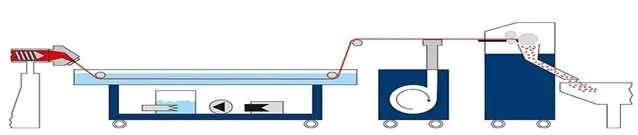
Typical Pelletizing Line
There are several pelletizing technologies that are available today for use in a host of processes. The most common of these technologies is theuse of strands to produce the final polymer pellets for part production. This technology offers certain benefits and advantages that are suitable for particular process needs. However, at the same time, it also has its own set of challenges and problems that require a certain level of expertise and understanding.
Discussed here is the most common pelletizing issue, the production of fines, with the strand pelletizing process and potential solutions to that problem. Specific focus will be provided on the material features that can lead to the occurrence of fines and what steps should be taken to reduce those effects.
Let's take a look:
How to deal with Fines?
The primary goal for resin producers and compounders in a pelletizing operation is to produce consistent pellet sizes and shapes to a target length and diameter with no contamination from fines. The production of consistent pellet geometries will limit downtime issues with additional production steps.
The presence of fines is a common issue with many crystalline and filled polymers. It is not as much of an issue with the pelletizing of amorphous polymers. This is because amorphous polymers tend to have a more consistent structure than do semi-crystalline polymers. For example, semi-crystalline polymers can possess different levels of overall crystallinity and that can impact their pelletizing.
The occurrence of fines is an issue for downstream polymer processors because they can:
- Alter the bulk density of materials
- Degrade or burn in the barrel of an extruder due to the fact they will not feed properly, and
- Cause downtime concerns in the conveying process
The presence of fines can be a serious issue for filled polymers because they often have different hardness features than do the corresponding unfilled polymers. This can lead to the need for different optimum pelletizing conditions for the filled polymer than for the unfilled polymer. This fact is not always recognized by polymer compounders and processors. This can lead to the presence of fines in polymer formulations that contain inorganic fillers.
Let's find out how to avoid the occurrence of fines in pellets:
Control the Temperature of Pelletizing Process
Fines can be reduced or eliminated by adjusting one process parameter. The temperature of the strandline should be as close to the softening point of the material. This ensures that the material strand is being cut as hot as possible to avoid fracture.
However, the strand should also not be too hot because that can also lead to cutting issues. Thus, the temperature control of the entire pelletizing process is crucial to the elimination of fines. The use of current equipment should allow for the maintenance of the temperature during the pelletizing operation to within several degrees of the set point temperature for each step of the operation. Also, the optimum set point temperature needs to be realized for each new type of polymer and each unique formulation.
In attempting to reduce or eliminate the presence of fines in pelletized polymers, it is critical to realize that the optimum temperature will be different for each new formulation that has been developed. Thus, a series of formulations that use a particular base polymer but contain different amounts of filler will have different hardness values and, thus, will have different optimum processing conditions for the reduction or elimination of the presence of fines.
Also, formulations that are blends or mixtures of different polymers will have different optimum processing conditions than either of the base polymers in the specific new mixture.

Maag's OTP Process
Consider the Unique Equipment Needs for Different Formulations
In addition to realizing that different polymer formulations will have unique pelletizing temperature profiles, it is necessary to understand that new products will have specific equipment needs. Thus, one formulation that is being developed will require one type of cutting device while another formulation will need a different equipment set-up.
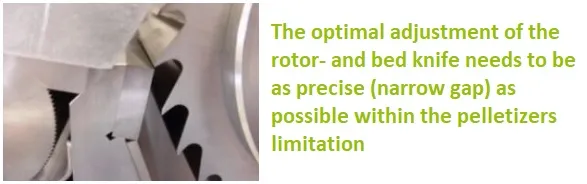
Further, there are various pelletizing technologies that are being used and are being developed. Each particular technology has advantages associated with it as well as certain issues. An understanding of each technology will lead to an optimization of the pelletizing approach for the specific formula that is being examined. The key point to realize is that not each technology is applicable to each polymer and there will be optimum equipment designs that are most useful for each type of material.
Another fact that needs to be understood is that the maintenance and replacement needs of the cutting equipment in a pelletizing line will be highly dependent on the nature of the formulation that is being utilized. For example, materials that contain large concentrations of inorganic fillers are usually harder to cut without the occurrence of fines in the pellets.
The overall hardness of the filled composition is the primary reason for this observation. Also, due to the relatively high hardness of these types of formulations, it will be necessary to replace the cutting equipment more frequently to assure that a good cut of the pellet is occurring. The good cut that is obtained by the presence of fresh and sharp cutting equipment will help guarantee a very low level of fines being present in the processed pellets.
Conclusion
As additional new polymer formulations, including filled materials and polymer mixtures, are developed. Automation that has been developed will allow for faster implementation and use of these novel materials. That automation can also be used to reduce the temperature variations that are observed. It does need to be understood that each polymer formulation has unique pelletizing features, both in terms of polymer processing conditions as well as equipment needs.
These unique needs need to be realized to obtain the highest quality pellets for additional downstream processing operations, such as injection molding and profile extrusion.