

SLS rapid prototype manufacturing on demand
Last update on Jul 29, 2025
This article was originally published in 2008 and revised in 2025.
Rapid prototyping (RP) refers to a host of related technologies that are used to fabricate physical objects directly from CAD data sources. These unique methods add and bond materials in layers to form objects. They offer advantages in many applications compared to classical subtractive fabrication methods like turning or milling.
Objects can be formed with any geometric intricacy or complexity. Also, the fabrication does not require elaborate machine setup or final assembly. Objects can be made from multiple materials, or as composites, or materials can even be varied in a controlled fashion at any location in an object. These capabilities have resulted in rapid prototyping's wide use as a way to reduce time to market in manufacturing.
Today's systems are extensively used by engineers to better understand and communicate their product designs as well as to make rapid tooling to manufacture those products. Rapid prototyping processes include:
- Selective Laser Sintering (SLS),
- Stereolithography (SLA),
- Fused Deposition Modeling (FDM),
- 3-Dimensional Printing (3DP), and
- Laminated Object Manufacturing (LOM)
In the following sections, explore how selective laser sintering (SLS) drives innovation, efficiency, and flexibility in modern rapid prototyping applications.
Selective laser sintering basics
laser sintering process (SSelective laser sintering (SLS) is, in principle, similar to stereolithography. In this process, fabrication of a physical model/part is effected by selectively melting a finely powdered (50 µm) thermoplastic material layer by layer.
A leveling roller spreads each consecutive layer of powder over the surface of the build chamber. This happens as the fabrication piston moves down one model/part layer thickness to accommodate the layer of powder, while the powder delivery piston moves upward incrementally to supply powder to the process.
The surface of the tightly compacted powder is selectively heated with a concentrated infrared (IR) beam from a CO2 laser. The powder is melted where the IR beam strikes under the guidance of the x-y scanner, causing the particles to fuse. The entire fabrication chamber is sealed and maintained at a temperature just below the melting point of the plastic powder.
Thus, heat from the laser needs only to elevate the temperature slightly to cause sintering. This minimizes thermal distortion, facilitates fusion to the previous layer, and greatly speeds the process. A nitrogen atmosphere is maintained in the fabrication chamber. This prevents the possibility of a dust explosion caused by handling the powder.
Unlike stereolithography, no supports are required with SLS. This is because the overhangs and undercuts are supported by the solid powder bed. Additionally, no final curing is required. However, surface finishes are not as good as those achieved with stereolithography. Since the objects are sintered, they are porous. Depending on the application, it may be necessary to infiltrate the object with another material to improve mechanical characteristics.

Selective laser sintering process
(Source: University of California at San Diego)
Automated laser sintered workflow via IPCM
EOS introduced a new version of the P 3xx series of systems for the rapid prototyping and manufacture of plastic components via laser sintering. The EOSINT P 380i has a new design integrating the latest electrical and machine safety concepts.
It complies with all relevant machine standards in North America as well as European and Asian standards. This machine offers a large build envelope of 13 ½" x 13 ½" x 26 ½" and includes the company's patented exchangeable frame system for rapid job turnaround.
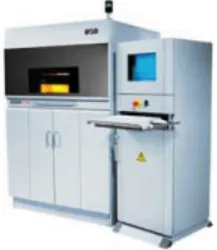
EOSINT P 380i
(Source: EOS GmbH)
EOS has also upgraded EOSINT P 700, which further improves the detail resolution and productivity of the system. The upgrade features are automatically included in all new systems and are also available. They are offered as retrofits for existing machines. Both the EOSINT P 380i and P 700 systems are now available with a range of peripheral devices for integrated process chain management (IPCM). This includes an automatic powder feeding system and an unpacking and sieving station.
IPCM offers a high level of automation and ease of handling, even for high volumes of powder material. The powder bed containing the laser-sintered parts can be removed from the machine immediately after job completion. It is done by means of the exchangeable frame system and docked onto the unpacking and sieving station, from where unsintered powder is returned automatically via a mixing unit back to the machine for reuse.
Several machines can be fed from a single IPCM system, or multiple IPCM systems can feed different powder types into the same machine. The concept thereby provides maximum flexibility, efficiency, and user-friendliness for automated e-manufacturing.
Cost and production benefits of SLS
Hettich Zentrifugen, Andreas Hettich GmbH, a medical device manufacturer, is using a rapid prototyping method rather than injection molding. It is used to produce its high-value, limited series 'Rotolavit' blood centrifuge.

Rotolavit blood centrifuge
(Source: Hettich Zentrifugen, Andreas Hettich GmbH)
The SLS process chosen was the least costly manufacturing option and allowed greater design freedom. The Rotolavit was developed as a joint project between EOS and Hettich Zentrifugen. Hettich was interested in studying the potential of SLS for actual series production, in addition to plastics prototype preparation.
As Hettich typically sells fewer than 1000 units/yr of the centrifuge, the cost of the steel tool would have made injection molding more costly than laser sintering. The SLS parts, produced from EOS's proprietary PA 2200 nylon 12, which is manufactured for it by Evonik, proved technically and chemically suitable for the application. The complete unit can be made and assembled at a cost estimated to be 30% less than for injection molding.
Also, by employing SLS, Hettich was able to reduce the number of parts relative to injection molding. For the washing rotor, the number of assembly components was reduced from 32 in the previous version to 3, two of which are laser-sintered.
Deburring of the unit's test tube holders, an added cost with injection-molded parts, was also no longer required. More importantly, Hettich can now manufacture centrifuges on demand, significantly reducing warehousing costs.
The SLS designs can also be altered to meet customer needs without substantial additional costs. Customizing limited output applications using SLS is finding greater acceptance for small to medium-sized processors who are competing against mass producers.

Rotolavit washing rotor
(Source: Hettich Zentrifugen, Andreas Hettich GmbH)