
PMMA: A Much More Flexible Material than Usually Expected
Last update on May 7, 2013
When we think of transparent polymers, few main polymers come to mind for being used in transparent plastics. (PC), Poly methyl-methacrylate (PMMA), and Polystyrene are probably those we think of at first.
More recently clear polypropylene (PP) also made significant progresses thanks to new efficient clarifying additives, also called clarifiers. This trend came into force more than ever these past few years. The latest market studies now estimate transparent plastics like polystyrene see decreasing volumes in favor of clarified PP. ..
But when it comes to outdoor exposure, excellent light transmission and color retention over time. The only plastic material to come to mind is PMMA. This polymer has many technical advantages versus other transparent polymers, which makes it ideal for replacing glass.
PMMA's high performance could be attributed to:
- Excellent optical properties
- Beauty and safety
- Toughness
- And much more…
Let's understand the unique properties of PMMA in detail…
PMMA : More Than Just A Lightweight Alternative
Historically, it was used as a lightweight material for glazing. Its growing use in such applications made it being called "organic glass". Half the weight of glass but five times more resistant to impact, PMMA had indeed good performances to compete with glass. It could be used for Building & Domestic Construction applications as well. This is because it has 20% more thermal insulation compared to glass. And energy savings is critical for such applications.
But PMMA is more than just a lightweight alternative to glass. Thanks to its versatility of processing and multiple formulations. It enjoys a robust growth estimate for the coming decades. The latest market study on the PMMA landscape predicts an annual growth rate of 6.5% until 2017, to reach a global application market size o fUS$ 9.7 billion.
PMMA, a versatile material
PMMA is a versatile material and is formulated to meet defined technical specifications. Commercial grades always contain a certain amount of additives to improve material performances or its processability. As an example PMMA is often said or believed to be brittle. This statement is based on its low elongation at break (e.g.: in the 5% range only for general purpose PMMA grades where low to medium vsity PC grades reach 100%).
Polymer Type | Ultimate Tensile Strength (MPa) | Elongation (%) | Tensile Modulus (GPa) |
ABS | 40 | 30 | 2.3 |
ABS + 30% Glass Fiber | 60 | 2 | 9 |
Acetal Copolymer | 60 | 45 | 2.7 |
Acetal Copolymer + 30% Glass Fiber | 110 | 3 | 9.5 |
Acrylic | 70 | 5 | 3.2 |
Nylon 6 | 70 | 90 | 1.8 |
Polyamide-Imide | 110 | 6 | 4.5 |
Polycarbonate | 70 | 100 | 2.6 |
Polyethylene, HDPE | 15 | 500 | 0.8 |
Polyethylene Terephthalate (PET) | 55 | 125 | 2.7 |
Polyimide | 85 | 7 | 2.5 |
Polyimide + Glass Fiber | 150 | 2 | 12 |
Polypropylene | 40 | 100 | 1.9 |
Polystyrene | 40 | 7 | 3 |
Tensile Strength Table from Matweb featuring the low elongation at break of PMMA as well as its higher tensile modulus vs. other transparent resins like PC or PET
Unnotched Charpy Impact test on PMMA
The absorbed energy during impact is also much lower with PMMA than it is with PC. This is obvious when looking at the unnotched Charpy impact test results at room temperature for both materials. General-purpose PMMA grades will lie in the 10KJ/m2 range where PC impact test bars are not broken at all. Such mechanical performance differences are mainly explained by the molecular weight (Mw) differences of both materials. Mw of PMMA (several hundred thousands) is much higher than the Mw of PC (several ten thousands).
However, because PMMA, like many other plastic materials, is always formulated. New improved grades are developed based on the end use requirements. Taking back the above examples impact modifiers are used to increase the PMMA impact resistance. If general-purpose PMMA grades show an unnotched Charpy impact value in the 10KJ/m2range selecting an automotive glazing PMMA grade will climb to the 20KJ/m2range (e.g.: Lucite® Diakon® CMG302) .
Some very high impact PMMA grades have also been developed. They show unnotched Charpy impact test results of 60KJ/m2at room temperature (e.g.: Arkema Altuglas® DRT). Such enhanced formulations for tough applications also have side effects on other properties. Using impact modifiers is detrimental to the light transmittance of the material. Light transmittance of PMMA is usually at 92% (test method ASTM D-1003). Whereas such very high impact PMMA grades will exhibit a transmittance of 90%.
This is still high enough for crystal clear applications, but maybe an issue when dealing withhigh purity lighting applications though. This is where the in-depth engineering work should start. what is exactly needed in terms oftechnical performances?Product development engineers can make compromise on what is not needed. this could be done withcareful listing and ranking requirements. The material supplier technical teams can help in this process. This way, the material performance can be improved, that are indeed critical on the final application.
Is It Brittle And Low Heat Resistant Polymer?
PMMA's versatility also helps in addressing another thought-to-be issue of PMMA. Compared to other engineering resins likePC, it has limited heat resistance. Whereas heat deflection temperatures (HDT A - 1.8MPa and HDT B - 0.45 MPa) of PC are respectively close to120°C and 130°C for low to medium viscosity PC grades. These HDT are respectively averaging85°C and 90°C respectively for general-purpose PMMA grades. Again high heat resistant PMMA grades are commercially available and show increased thermal resistance. The high heat PMMA grade ofLucite®, the Diakon® CMG302 exhibits a HDT A — 1.8Mpa of 99°C and aHDT B — 0.45MPa of 102°C. It is therefore a common mistake to considerPMMA as a brittle and low heat resistant polymer.
A Strong Housing Material!
Over-designing can become very expensive. When snap fits are used to ensure a robust assembly of e.g. a housing the force to be applied on the plastic pieces should be tightly controlled. For such applications it is common to look for good impact resistant material as far as housing usually means a certain level of protection of what is inside. Therefore the common mistake is to select the plastic material featuring a very good impact resistance; e.g. ABS. By doing so the force to be applied on the snap fits is reduced compared to the same part made with PMMA (see in Table above, the higher tensile modulus of PMMA compared to ABS).
Assembly will be easier with ABS because the force to be applied will be rather low; but this also plays the other way around: such plastic housing could randomly open up; whereas the higher force required to bend PMMA snapping features would guarantee a more stable assembly system. It is therefore critical to avoid over-evaluating the impact resistance needed because this would push to select a material that is at the end less suited to the final use.
Multiple Applications of PMMA
Care should be taken when defining the technical needs on the final applications, what priorities can be set up on these technical needs and what compromise can be made. This avoids squeezing a critical product development step, which would then lead to another material, which may bring up other issues. Following properties of PMMA makes it fit to be used for outdoor applications :
- PMMA has such excellent stability that even the UV-stabilized PC grades could never compete with it when used for outdoor applications.
- Another key strength of PMMA materials is their inherent high surface hardness, which means excellent scratch and abrasion resistance. Again the very high molecular weight of PMMA induces these surface properties, thanks to the polymer chain entanglement. Durability of PMMA articles is therefore compatible with outdoor exposure conditions; and there are many outdoor applications currently using PMMA. Co-extruded PMMA onto PVC substrate is a well-known solution for rain gutters, decking and siding uses.
- The excellent scratch and abrasion resistance, as well as the color deepness and retention vs. UV exposure are critical for such outdoor applications.
- Another significant market outcome for PMMA materials is in the signage applications. Because PMMA has an excellent weatherability and light transmission performance it can be used on sophisticated signage displays using back or edge lighted systems.
- Its good dimensional stability, which is due to its amorphous structure, is also useful for large panels and displays.
Other Applications of PMMA
Apart from the outdoor applications, PMMA has a lot more to serve:
Because PMMA has excellent optical properties (light transmittance, purity when processed with care, refractive index) it is widely used for optical applications like :
- Light guides
- Automotive taillight
- Stoplight lenses
- Dials windows
- Optical lenses
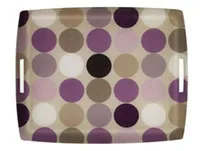
Tray developed by Platex France
featuring a 4mm thick top acrylic sheetDue to its inherent clarity PMMA can be easily colored, with multiple translucent effect results. PMMA is the dominant polymer used in design and architectural projects. Its aesthetical properties make it the ideal organic material for uses where beauty is the primary requirement.
- Famous designers widely use it for their creative works and PMMA is also well known in jewelry. Its excellent transparency can also help in reaching the right color deepness. Designers play with this natural PMMA property to achieve optical effect on consumer goods.
The following example is a common use of PMMA trays. The manufacturer, Platex1 located in France, which is one of the 3 biggest European tray producers claimed the top acrylic 4mm thick layer brings a true deepness of the decoration pattern and colors.
- PMMA is also widely and increasingly used in the Medical sector. Moving from beauty to safety PMMA transparency and toughness are useful on baby incubator boxes, where nurses and surgeons need to keep a tight visual control on babies requiring such equipment. Natus2 Medical Inc. based in California has developed the following product: Closed Infant Transport Incubator.

Closed Infant Transport Incubator developed by Natus Medical Inc. featuring a double-wall acrylic hood for better temperature stabilization |
- PMMA is not perceived as a brittle material in this case because the double wall design is not intended to provide increased impact resistance but improved thermal insulation. Babies requiring such equipment are already very fragile, and any slight body temperature changes are important enough to attract attention. Therefore, as stated by the manufacturer in the product description the thermal stabilization is indeed critical on such applications. Applying a more sophisticated design, doubling the amount of material is clearly justified in such cases.
Conclusion
Although PMMA suffers from a misperception on its mechanical performances and is often said to be a "brittle material" the incredibly high number of markets using this amorphous polymer, its versatility in terms of processing techniques and the increasing number of new formulations being developed show exactly the opposite. This misperception has to be seen under the engineer eyes. When talking about brittleness one should be more accurate and talk about low elongation at break and low impact energy absorption. These low values also mean higher tensile and flexural modulus, which means rigidity.
On top of these technical considerations PMMA, like any plastics, is a formulated material benefiting from diverse additives, which improves its performances or attenuates its weaknesses. We have seen that if a general purpose PMMA grade exhibits 10KJ/m2energy absorption under the Charpy unnotched impact test conditions at room temperature this value is multiplied by 6 when considering a high impact PMMA grade.
Out of these huge technical differences from one formulation to another should also consider the exact technical requirements of the final application. Over-designing the raw material on the impact resistance requirement may lead to the selection of another material, which will under-perform on other criteria like UV resistance and light transmission? Corrective actions can still take place on parts in use, but at what costs?
- http://www.platex.com
- http://www.natus.com