

Evaluating chemically resistant adhesives: Key factors for long-term performance
Last update on Jul 7, 2026
This is a sponsored article by Master Bond.
Industrial systems operating under aggressive chemical exposure and elevated temperatures demand adhesive technologies that can maintain structural integrity, resist degradation, and support long-term reliability. From aerospace assemblies and petrochemical equipment to gas separation membranes, and electronic components, adhesives are increasingly expected to perform beyond conventional bonding applications.
Among thermosetting adhesive chemistries, epoxy systems are widely recognized for their excellent chemical resistance, thermal stability, and mechanical strength. However, not all epoxy formulations perform equally under hostile operating environments. Selecting the right system requires understanding not only the chemistry involved, but also the real-world exposure conditions, temperature requirements, and processing constraints.
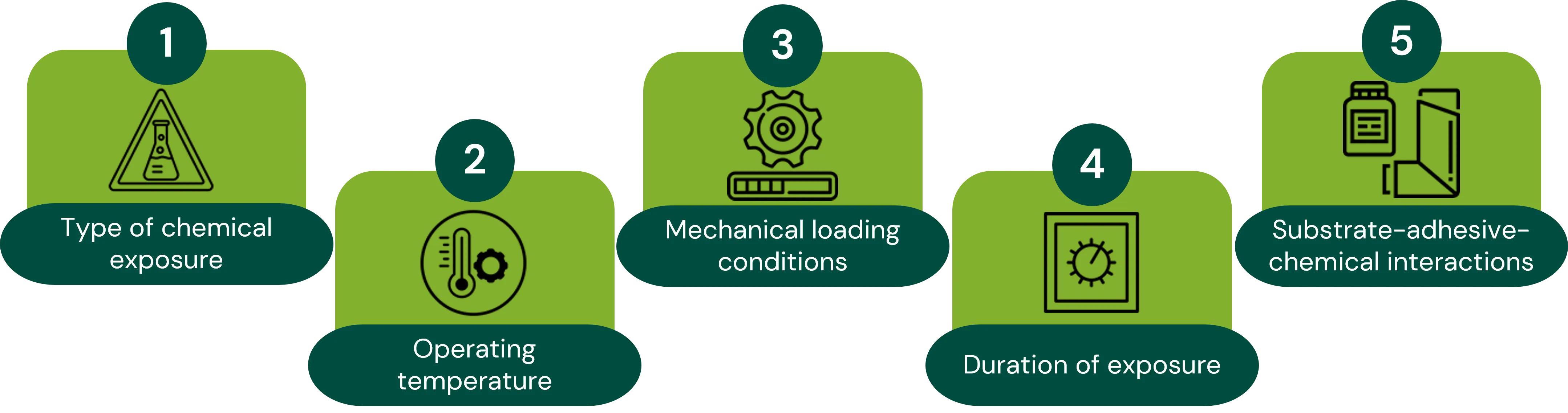
Selecting a chemical-resistant adhesive requires more than reviewing a chemical resistance chart. Engineers must evaluate the type of chemical exposure, operating temperature, mechanical loading conditions, and duration of exposure. They must also consider the interaction between the adhesive, substrate, and chemical environment.
Understanding these factors is critical for achieving long-term reliability in demanding industrial applications. This article explores key considerations for evaluating chemically resistant adhesives and highlights a real-world application example involving Master Bond EP46HT-2.
Why does chemical resistance matter in adhesive selection?
Chemical exposure is a critical factor in adhesive selection in various applications. In many industrial environments, adhesives are subjected not only to direct chemical contact but also to varying mechanical stresses, thermal cycling, humidity, and prolonged service exposure.
Evaluating adhesive performance requires consideration of several variables including:
- Type of chemical exposure (splash, intermittent immersion, continuous immersion)
- Operating temperature
- Mechanical loading conditions
- Duration of exposure
- Interaction between substrates, adhesives, and chemical agents
Cross-linked adhesive systems such as epoxies generally offer the broadest chemical resistance among adhesive families, particularly when operating below their glass transition temperature (Tg).
| Polymers | Water | Ethyl Alcohol | MEK | Ethylene Glycol | Acetone | Jet Fuel | 10% Sulfuric Acid | 70% Sulfuric Acid | 10% Nitric Acid | 10% Hydrochloric Acid | 10% Sodium Hydroxide | 50% Sodium Hydroxide | 50% Potassium Hydroxide |
| EP21LV | E | F | F | G | F | G | E | NR | F | F | E | G | G |
| EP21TP-2 | E | F | F | G | F | E | F | NR | NR | F | G | F | F |
| EP21AR-HT | E | G | G | E | G | E | E | E | E | E | E | G | G |
| EP30-2 | E | G | G | E | G | E | E | F | F | G | E | E | E |
| EP30HT | E | F | G | E | G | E | G | F | F | F | E | E | E |
| EP39-2 | E | G | G | E | G | E | G | F | G | G | E | E | E |
| EP41S-MED | E | F | F | E | F | E | E | F | F | F | E | E | E |
| EP41S-HT | E | E | E | E | E | E | E | F | G | G | E | E | E |
| EP42-HT-2 | E | G | G | E | G/E | E | E | F/G | G | G | E | E | E |
| EP45-HT | E | E | E | E | E | E | E | G | E | E | E | E | E |
| EP62-1 | E | E | E | E | E | E | E | E | E | E | E | E | E |
| UV18S | E | F | G | G | F/G | G | G/E | NR | F | F | E | G | G |
| Key: E= Excellent; G= Good; F= Fair; NR= Not recommended | |||||||||||||
Chemical resistance of Master Bond two-component epoxies
However, even within epoxy chemistries, resistance profiles vary considerably depending on formulation design, curing mechanisms, and additives. As a result, adhesive selection should always be based on the specific chemical environment and application requirements rather than generalized assumptions about epoxy performance.
Supporting advanced carbon capture and hydrogen generation research
The importance of selecting chemically resistant adhesives is illustrated by DOE-funded research involving high-temperature gas separation systems for hydrogen production and carbon capture applications.
In a research program funded by the U.S. Department of Energy, researchers from the University of Texas at Austin and Virginia Tech investigated temperature-dependent gas transport properties of advanced polybenzimidazole (PBI)-based membranes used for gas separation processes.
These membrane systems operated under elevated temperatures and aggressive processing environments, creating demanding requirements for mounting and sealing materials. The researchers selected Master Bond EP46HT-2 to mount sample films onto brass support disks due to its heat resistance and chemical stability.
The adhesive system underwent:
- Initial curing for 3 hours at 140°C
- Post-curing for 3 hours at 180°C
- Overnight degassing under vacuum at 190°C with a liquid nitrogen trap
The study highlighted several advantages of EP46HT-2 for this application:
- Stable performance at elevated temperatures
- Decomposition temperature above 350°C
- Resistance to aggressive gas separation environments
- Absence of volatile compounds that could interfere with gas permeability measurements

The study showed that H2/CO2 selectivity increased with temperature in the tetraaminodiphenylsulfone (TADPS)-based membranes, while selectivity for CO2/N2, CO2/CH4, and N2/CH4 decreased, highlighting their potential for hydrogen purification and carbon capture applications.
When evaluating adhesives for demanding environments, it is important to replicate real-world operating conditions as closely as possible. Standardized testing alone may not fully predict long-term field performance. The following factors can significantly influence adhesive durability over time:
- Elevated temperatures
- Long-duration chemical exposure
- Simultaneous mechanical loading
- Continuous immersion conditions
Note: Testing methods may sometimes introduce thermal effects not encountered during actual service conditions. This can potentially lead to misleading conclusions about adhesive suitability.

Applications across multiple industries
Chemically resistant adhesives are used in a wide range of demanding industrial applications, including:
- Aerospace bonding and sealing
- Petrochemical equipment
- High-temperature electronics
- Membrane separation systems
- OEM assemblies
- Potting and encapsulation
- Chemical processing systems
Their ability to withstand exposure to fuels, solvents, acids, bases, and hydrocarbons while maintaining mechanical and thermal performance makes them suitable for harsh operating environments.

Conclusion
As industrial systems continue to operate under increasingly demanding thermal and chemical conditions, adhesive technologies must deliver more than simple bonding performance. Long-term resistance to aggressive environments, dimensional stability at elevated temperatures, and compatibility with advanced manufacturing processes are becoming essential requirements.
Selecting the right chemically resistant adhesive requires a thorough understanding of the chemical environment, exposure conditions, thermal loads, and mechanical stresses involved. Epoxy systems with high cross-link density and elevated glass transition temperatures offer a strong foundation for demanding applications, but formulation-level evaluation remains essential. As demonstrated by the EP46HT-2 application in carbon capture and hydrogen generation research, adhesives that combine thermal stability, chemical resistance, and solvent-free formulation can meet the most rigorous industrial requirements.
Master Bond — View all supplier offerings »
DISCLAIMER: All images used in this article are copyright of Master Bond.