
Impact resistance of polymers
Last update on Sep 11, 2025
With the increasing dependence on plastics, it has become crucial than ever to learn more about impact resistance for improved performance, safety, and longevity.
The resilience of these plastics is largely influenced by interrelated factors like:
- the polymer's molecular structure,
- the presence of copolymers,
- the addition of reinforcements or modifiers, and
- the environmental conditions (e.g., temperature, etc.)
Impact resistance plays a pivotal role in the design and selection of polymers used in critical applications. This ranges from automotive bumpers and safety gear to electronics casings and medical devices. As industries seek lighter, stronger, and greener materials, impact-resistant plastics are evolving through advances in nanotechnology, smart polymers, and eco-friendly designs.
In the following sections, let's delve into the structural design considerations and the role of polymer blends, additives, and environmental factors on the impact resistance of polymers.
What is impact resistance in plastics?
Impact resistance in plastics refers to a material’s ability to withstand sudden shock without deforming. By their nature, plastic materials can exhibit varying degrees of impact resistance. Some plastics are inherently brittle, while others are ductile and can absorb significant impact energy. In essence, impact-resistant plastics are engineered to balance strength, flexibility, and durability. This enables them to withstand the forces of impact and provide reliable performance.
Durability (the material's ability to withstand wear, abrasion, and other forms of degradation over time) and toughness (the ability to absorb energy before fracturing) ensure that impact-resistant plastics can perform reliably in demanding applications.
Properties of impact-resistant plastics
When considering impact-resistant plastics, it is essential to understand the specific properties that contribute to their ability to withstand impacts. Here is a breakdown of some of the general properties of impact-resistant plastics:
- High toughness: This refers to a material's ability to absorb energy and deform plastically before fracturing. It is a crucial factor in impact resistance.
- Flexibility: Some impact-resistant plastics exhibit a degree of flexibility. This allows them to bend or deform upon impact, dissipating the energy.
- Durability: These materials are designed to withstand repeated impacts and harsh conditions. Thus ensuring long-term performance.
- Chemical resistance: Many impact-resistant plastics also possess good resistance to chemicals. This is essential for applications in various environments.
- Temperature stability: The ability to maintain impact resistance over a range of temperatures is vital. This is because temperature changes can significantly affect a material's properties.
- Lightweight: Often, these plastics offer a favorable strength-to-weight ratio. Thus making them ideal for applications where weight reduction is essential.
Factors influencing impact resistance in plastics3
Achieving high impact resistance in plastics involves careful control of several factors. These are explained in detail below:
Polymer structure
The impact resistance of plastics is deeply tied to their structure and composition. The molecular arrangement of the plastic significantly affects its ability to absorb impact. Below is a breakdown of these factors:
- Polymer chains: The length and arrangement of polymer chains significantly influence impact resistance. Longer chains tend to entangle more, increasing toughness. The presence of flexible segments within the polymer chain allows for energy absorption during impact.
- Copolymerization: Combining different monomers through copolymerization creates materials with enhanced impact resistance. For example, in ABS, the butadiene rubber component provides the necessary flexibility.
- Molecular weight: Higher molecular weight polymers generally exhibit greater impact strength due to increased chain entanglement.
Additives
Several polymer additives can be added to plastics to enhance their impact strength. Examples include impact modifiers, plasticizers, nanoparticles, reinforcing agents (fillers and fibers), etc. Let's understand their roles in detail:
- Impact modifiers: These additives, often elastomers (rubbery polymers), are incorporated into the plastic matrix to absorb impact energy. They create a dispersed phase within the polymer matrix that can deform and dissipate energy. This prevents crack propagation, resulting in materials that exhibit increased ductility and toughness.
- Plasticizers: They increase the flexibility and ductility of plastics. This enhances their ability to withstand impacts.
- Nanoparticles: In some cases, nanoparticles can be added to reinforce the polymer matrix and improve impact resistance.
- Reinforcing additives: Fibers (e.g., glass fibers, carbon fibers) and particulate fillers can reinforce the polymer matrix. Thus increasing the strength and impact resistance. These fillers provide structural support and can absorb impact energy. The size and distribution of fillers play a crucial role in determining their effectiveness in enhancing impact strength. This difference in aspect ratio induces differences in properties, which are enhanced with increasing fiber length. However, in degradation behavior, fibers acting as continuous media can transport aggressive factors, such as moisture, inside composite materials.

Dependence of properties on fiber length in glass fiber reinforced polypropylene (PP)5
Polymer blends
Combining different polymers can create blends with tailored impact properties. For example, blending a brittle polymer with a ductile one can result in a material with improved toughness. The key to success with polymer blends is the compatibility of the two polymers.
The way the separate polymers are dispersed within the blend is very important. The ideal situation is to have a very fine dispersion of the impact modifier within the base polymer. Zhang et al., used ethylene-methyl acrylate-glycidyl methacrylate (EMAGMA) as a reactive interfacial compatibilizer for blends of Poly Lactic Acid (PLA)/Polyether Block Amide (PEBA) and achieved impact strength up to 500 J/m, while maintaining tensile strength at 50 MPa.
Performance improvements in these ternary blends were attributed to their unique morphology of partial encapsulation of PEBA by EMAGMA in PLA matrix. Interfacial cavitation and good adhesion between phases resulted in massive shear yielding of the PLA matrix.

Components, morphology, and impact strength of supertoughened PLA blends4
Temperature
Many plastics become more brittle at lower temperatures, reducing their impact resistance. At higher temperatures, they generally become more ductile and better able to absorb impact. However, excessive heat can also soften some plastics, reducing structural integrity.
Material thickness
Generally, thicker materials exhibit higher impact resistance. However, beyond a certain point, increased thickness may introduce internal stresses or affect cooling. This can slightly reduce overall toughness.
Notch sensitivity
Sharp corners or notches can create stress concentration points, making the material more prone to fracture.
Which impact-resistant polymer to choose based on your requirements?
When selecting impact-resistant plastics, it is important to understand the properties of some of the most commonly used materials. Below is a detailed account of some of the most impact-resistant polymers to choose from:
High-impact polystyrene (HIPS)
High-impact polystyrene is a modified form of polystyrene with added rubber to improve its impact resistance. It is known for its good impact strength, rigidity, and ease of processing. It is also cost-effective and easy to thermoform. However, it has limited heat resistance and UV stability. Its applications include packaging, electronic housings, toys, and automotive interior components.
Polycarbonate (PC)
Polycarbonate offers exceptionally high impact resistance, even at low temperatures. It has a unique molecular structure with long, flexible chains that can easily deform and absorb impact energy. It is also known for its optical clarity, dimensional stability, and high temperature resistance. In general, PC shows better impact resistance than ABS. It is a more expensive material. It is used in safety glasses, automotive components, and electronic device housings.
Acrylonitrile butadiene styrene (ABS)
Acrylonitrile butadiene styrene consists of a rigid styrene-acrylonitrile matrix with dispersed butadiene rubber particles. The rubber particles act as impact modifiers, absorbing energy and preventing crack growth. Thus, ABS provides a good balance of impact resistance, rigidity, and processability. It is relatively cost-effective than PC and offers a good surface finish. It also has good chemical resistance. It is used in automotive interior parts, electronic housings, and consumer goods.
Polypropylene (PP)
Polypropylene's impact resistance varies depending on its formulation. Copolymers of PP have much higher impact resistance than homopolymers. It is known for its chemical resistance and fatigue resistance. It can become brittle at low temperatures. It is used in applications like automotive bumpers, packaging, and industrial components.
Polyethylene (PE)
Polyethylene shows excellent chemical resistance and low-temperature flexibility. In certain forms, PE can have very high impact resistance. High-density polyethylene (HDPE) offers good impact resistance, especially in thicker forms. Low-density polyethylene (LDPE) and linear low-density polyethylene (LLDPE) have moderate impact resistance, with LLDPE having better impact resistance than LDPE. It is commonly used in packaging, pipes, and containers.
Nylon (Polyamide/PA)
Nylon offers good impact resistance, especially when reinforced. It is also known for its excellent wear resistance and chemical resistance. It can absorb moisture, which can affect its properties. It finds application in gears, bearings, and automotive parts.
Thermosets
Thermosets, in general, have higher strength and temperature resistance. Impact resistance varies greatly depending on the specific thermoset resin and reinforcing fillers. However, thermoplastics are preferable when high impact resistance is needed. Examples of thermosets include epoxy, polyester, and phenolic resins.
Select materials with high impact resistance available in our extensive database:
 |  |  |  |
Benefits and pain points of impact-resistant plastics
Discover what to look for when selecting impact-resistant polymers by comparing their key benefits and pain points mentioned in the table below:
| Benefits | Paint points |
|
|
Where are impact-resistant plastics used?
Impact-resistant plastics are vital in enhancing safety, durability, and reliability across various applications. Some of these applications are discussed below:
Automotive

Bumpers, dashboards, and interior components rely on impact-resistant plastics for safety and durability. Automotive bumpers absorb impact energy during collisions. This minimizes damage to the vehicle and protects passengers.
Safety gear

Safety gear, such as helmets and protective pads, must withstand impacts to protect individuals from injuries. Eyewear, including safety glasses and sports goggles, must protect the eyes from impacts and debris.
Electronic housings

Electronic housings protect sensitive components from impacts and damage.
Medical devices

Medical devices require durable materials that can withstand impacts and sterilization processes.
Other industries
Several other industries where impact-resistant plastics are commonly used are as follows:
Browse our database to select impact-resistant polymers for various end applications:
 |  |  |  |
Safety profile of impact-resistant plastics
The toxicity and safety of impact-resistant plastics are important considerations, especially given their wide range of applications. Generally, impact-resistant plastics are not inherently highly toxic in their finished, solid form. However, potential toxicity concerns arise from:
- the monomers used in their production
- the additives incorporated to enhance their properties
- the degradation products that may be released under certain conditions (e.g., high temperatures, burning)
Environmental impact
- Many plastics, including impact-resistant ones, are slow to degrade, leading to environmental accumulation. Microplastics and small plastic particles can persist in ecosystems and pose risks to wildlife.
- The production of plastics often involves the use of fossil fuels and can contribute to greenhouse gas emissions.
- Improper disposal of plastics can lead to pollution of land and water.
- Recycling plastics can be complex due to the variety of polymers and additives used. Contamination and sorting difficulties can hinder recycling efforts. Many impact-resistant plastics are polymer blends, which are difficult to recycle.
- Recycling programs are being developed to improve the recovery and reuse of plastics. Research is ongoing to develop more sustainable plastic materials and recycling technologies.
Impact of additives and food regulatory measures
- Additives like phthalates, bisphenol A (BPA), stabilizers, and flame retardants are used to enhance the properties of plastics. However, they have raised concerns about potential health effects. Manufacturers are increasingly using safer alternatives.
- Regulations are in place to limit the use of harmful additives in plastics, especially in products that come into contact with food or children. Food-grade plastics are subject to strict regulations to ensure they do not release harmful substances into food. Organizations like the FDA (in the U.S.) and EFSA (in Europe) set safety standards.
- Ongoing research aims to develop safer and more sustainable additives. Using food-grade impact-resistant plastics is considered safe.
Select various regulatory-approved high impact-resistant plastics from our exhaustive database:
| Regulations | Commercial grades |
| RoHS-certified | Select from 1015+ grades |
| REACH-certified | Select from 650+ grades |
| US FDA-certified | Select from 480+ grades |
| WEEE-certified | Select from 160+ grades |
| TSCA-certified | Select from 90+ grades |
| USDA BioPreferred®-certified | Select from 8+ grades |
| ISCC+-certified | Select from 5+ grades |
How is impact resistance measured in plastics?
Impact resistance is typically measured using standardized tests. These involve subjecting a plastic specimen to a controlled impact and measuring the energy absorbed during fracture. Common tests performed to measure the impact resistance of polymers are explained below:
Izod impact test
The Izod impact test is a standardized test (ASTM D256 or ISO 180) used to determine the impact resistance of plastic materials. In this test, a notched specimen is clamped vertically, and a pendulum strikes the specimen near the notch. The energy absorbed during the fracture is measured, providing a value for the impact strength. This test is very common in the industry.

Izod impact test with sample placement fixtures1
Charpy impact test
A specimen is supported horizontally, and a pendulum strikes it. Similar to the Izod test, it measures the energy absorbed.
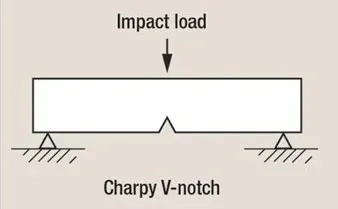
Charpy impact test with sample placement fixtures1
Falling dart impact test
This test is often used for plastic films and sheets. A weighted dart is dropped onto the material, and the energy required to cause failure is measured. Impact strength is typically expressed in units of energy per unit area, such as joules per square meter (J/m²) or joules per square centimetre (J/cm²).

Working principle of the falling dart impact tester2
Emerging trends and market analysis of impact-resistant plastics
Future trends and innovations
The field of impact-resistant plastics is constantly evolving, with several emerging trends and innovations shaping its future.
Nanotechnology and smart polymers
Nanocomposites, smart polymers, and advanced polymer blends will play a significant role in future applications. These materials will enable the creation of high-performance products with enhanced safety and durability.
- Nanotechnology: Incorporating nanoparticles (e.g., carbon nanotubes, nanoclays) into polymer matrices can significantly enhance impact resistance. They reinforce at the molecular level, improving toughness and strength. In addition to impact resistance, nanotechnology can also improve thermal stability and barrier properties.
- Adaptive materials: Smart polymers can respond to external stimuli, such as temperature or stress, to adjust their properties. These materials can dynamically adapt their impact resistance based on the conditions.
- Self-healing polymers: Researchers are developing polymers that can repair themselves after damage, extending their lifespan and improving reliability.
- Advanced polymer blends: New polymer blends are being developed to optimize impact resistance and other properties. These blends often involve combining polymers with complementary characteristics.
Sustainable impact-resistant polymers
- Sustainability: Growing environmental concerns are driving the development of biodegradable and recyclable alternatives to traditional plastics. Researchers are exploring bio-based polymers and closed-loop recycling systems with comparable impact resistance to conventional plastics.
- Challenges: Achieving high impact resistance in biodegradable polymers remains a challenge. Cost and scalability are also factors to consider.
Advancements in additives and processing techniques
- Advanced additives: New impact modifiers are being developed that are more effective and have less environmental impact.
- 3D printing: 3D printing is enabling the creation of complex geometries with tailored impact resistance. This technology allows for the design of custom impact-resistant components for specific applications.
- Technological advancements: Integration of sensors and other technologies into impact-resistant materials allows for monitoring of structural health.
Competitor and market analysis
Analyzing the competitive landscape of the impact-resistant plastics market involves understanding key players, market trends, and pricing dynamics.
Competition is based on factors such as:
| Suppliers differentiate themselves through:
|
Key players in the industry
The top manufacturers are typically large, multinational chemical companies with extensive production facilities and distribution networks. They invest heavily in research and development to create new and improved impact-resistant materials. These companies often have a strong global presence and serve a wide range of industries.
Major chemical companies and material suppliers that dominate the market include SABIC, Covestro AG, LyondellBasell Industries, INEOS, Trinseo, LG Chem, Mitsubishi Engineering-Plastics Corporation, and DuPont. These companies produce a wide range of impact-resistant polymers, including PC, ABS, and modified PP.
Global market analysis
The market is driven by demand from various industries, including automotive, construction, packaging, and electronics. Growth is influenced by factors such as:
- increasing demand for lightweight and durable materials
- stringent safety regulations
- growing applications in emerging economies
Market reports show steady growth, with regional variations depending on industrial development.
Price trends
Price volatility can be significant, especially during periods of economic uncertainty or supply chain disruptions. There is also a growing trend towards sustainable or bio-based polymers that command a higher price. Prices are influenced by:
- raw material costs (e.g., crude oil prices)
- supply and demand dynamics
- production costs
- regional market conditions
- economic fluctuation
- https://www.prestogroup.com/blog/test-the-impact-strength-of-plastic-with-charpy-test/
- https://www.worldoftest.com/falling-dart-impact-tester
- Pi Chang, Eng, and Akio Takahashi. "Factors influencing the impact strength of high impact polystyrene." Polymer Engineering & Science 18.5 (1978): 350-354
- Nagarajan, Vidhya, Amar K. Mohanty, and Manjusri Misra. "Perspective on polylactic acid (PLA) based sustainable materials for durable applications: Focus on toughness and heat resistance." ACS Sustainable Chemistry & Engineering 4.6 (2016): 2899-2916
- Brebu, Mihai. "Environmental degradation of plastic composites with natural fillers—a review." Polymers 12.1 (2020): 166