Advances in Engineered Medical Plastic Implant Solutions

Last update on Feb 7, 2011

Don Rosato


Advances in Permanent Implants

The Growing Permanent Implant Market

Particularly in industrial societies, an increasing and aging population with a more active lifestyle coupled with continuous development of new surgical techniques and implant materials is driving the medical implant market which for the last decade has seen double-digit growth. Additionally orthopedic implants are being considered for patients at a younger age which increases the need for materials that can be permanently implanted for 30 years or more. The orthopedic market has many sectors with hip and knee replacement demand the highest worldwide, driven not only by the growing elderly population, but also by amplified physiological problems that result from the increased incidence of obesity.

Various Material Combinations Offer Advantages and Drawbacks

Delaminated UHMWPE Knee Component
(Source: Materials Science and Technology, Universidad de Zaragoza)
Implants such as hip and knee replacements that replace damaged natural bearing surfaces with artificial ones to alleviate pain and improve patient quality of life have been used for many years. While mechanical strength is an important consideration for orthopedic implants, wear resistance is the critical property by which bearing surface success is judged. Titanium and stainless steel metal-on-metal implants which have found favor over the years owing to their exceptional mechanical strength are encountering mounting concern regarding the metal-on-metal wear not only because of the potential need for revision procedures but also concern for the metallic debris formed. Individuals with metal-on-metal hip implants often have elevated levels of chromium and cobalt in their blood and urine and there is speculation that such metallic ions entering the bloodstream might be toxic or linked to cancer. At the other end of the spectrum are ceramic-on-ceramic implants. New ceramics used for these implants have excellent hardness with extremely low wear rates and any ceramic wear debris that is generated is biologically inert. However, because ceramics are brittle ceramic-on-ceramic implants can fracture, or result in intraoperative chipping creating serious medical problems. Articulation noise in the form of squeaking has also been reported. As a result of the metal-on-metal and ceramic-on-ceramic concerns, metal-on-polyethylene and increasingly ceramic-on-polyethylene are the most frequently used among surface bearing material combinations.

Polyethylene is distinguished by biocompatibility, stability, fatigue resistance and strength with ultrahigh molecular weight polyethylene (UHMWPE) offering relatively low wear rates, that falls between that of metals and ceramics. While UHMWPE is one of the highest wear resistant polymer resins available, when it is used in joint replacements, there is still some debris formed by wear. These foreign particles are attacked by the body leading to osteolysis, an autoimmune reaction which causes resorption of living bone tissue. To improve implant survival, and reduce the occurrence of osteolysis, researchers have turned to highly crosslinked UHMWPE grades that are more resistant to wear and therefore generate less debris than conventional UHMWPE. The material is crosslinked by radiating with high doses of gamma radiation. While wear resistance has been improved in this way, this crosslinking has been found to also reduce the UHMWPE material's mechanical strength and oxidative stability, making it more prone to fracture/failure.

Easily Crosslinked UHMWPE Implant Development

Easily Cross-linkable UHMWPE
(Source: DSM Biomedical)
DSM Biomedical recently announced the development of a new easily crosslinkable UHMWPE material that is intended to improve the mechanical properties and service life of hip and knee implants. The new UHMWPE copolymer family contains small, highly reactive molecules that crosslink at much lower radiation doses than was possible using previous UHMWPE formulations. As the desired degree of crosslinking can be achieved using 3-4 times less radiation than typically used with conventional UHMWPE crosslinking, the adverse effects of radiation on the polymer's mechanical properties are minimized and fewer O2 radicals are formed resulting in a more stable polymer.

The crosslinked UHMWPE is 20-25% stronger with 2-3 times fewer free radicals than traditional crosslinked UHMWPE enabling the fabrication of stronger hip and knee implants with improved long-term stability. DSM has filed a patent on the new polymer platform and its application in total joint arthroplasty including hips, knees, shoulders, elbows, wrists, ankles and discs of the spinal column. The material is also used in production of DSM's ultrastrong Dyneema purity fiber used for various medical devices including orthopedic sutures and ligment fixation devices.

Polycarbonate-Urethane Alternative Hip Replacement Material

It is preferable to produce surfaces for articulation from materials having high strength, that have low wear, corrosion resistance and a low coefficient of friction. The use of polycarbonate-polyurethane (PCU) in place of UHMWPE in hip implants is an alternative approach to eliminating the wear issues of polymer weight bearing surfaces. PCU is a class of polyurethanes that has essentially all the elastomeric properties of polyether urethanes, but is devoid of oxidation-prone ether linkages. While the trend has been to use increasingly harder materials to reduce wear on the weight bearing surfaces, nature takes a different approach using cartilage that is much softer than the replacement materials used in joint implant applications. PCU use attempts to replicate the function of cartilage. UHMWPE is stiffer than cartilage with approximately 70 times higher modulus of elasticity. However, PCU elasticity is similar to that of cartilage.
Comparison of Weight Bearing Polymers to Cartilage
(Source: Joint Implant Surgery and Research Foundation)

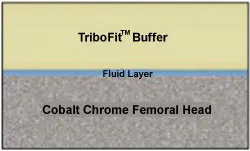
The benefits of using PCU include: less wear and reduced debris generation, as well as provision of more natural stress distribution. The material is also hydrophilic in contrast to UHMWPE which is hydrophobic. This allows for a layer of synovial fluid, a viscous, lubricating fluid found in joint cavities, to form between the artificial bearing surfaces to reduce friction.

Microelasto-Hydrodynamic Lubrication
(Source: Active Implant Corporation)

DSM produces Bionate thermoplastic PCU a medical polymer designed for use in total hip arthroplasty (THA) and other long-term implants including spinal discs, spinal fixation systems, catheters, stents, pacemaker leads, and neurostimulation devices. The company recently extended its Bionate product family with the introduction of Bionate II which offers improved strength and unique built in surface technology for chronic implants. The SAME (self assembling monolayer end-group) technology enables medical devices to be equipped with permanent surface modification eliminating the need for secondary surface treatments.

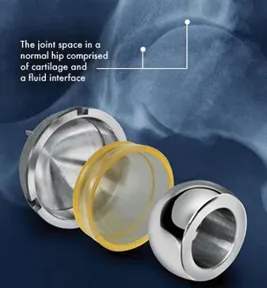
Active Implant Corporation recently introduced its TriboFit THA system which features PCU as compliant bearing surface material in the artificial hip socket. The soft compliant PCU proprietary acetabula 'buffer' serves as cartilage replacement in the implant system to restore more closely the normal biomechanical properties of the hip.

TriboFit Hip System with PCU Acetabular Buffer
(Source: Active Implants Corporation)

Advanced Applications of Implantable Grade PEEK

Zeniva PEEK Stock Shapes for Medical Implants
(Source: Solvay Advanced Polymers LLC)
An especially strong engineering thermoplastic PEEK (Polyetheretherketone) is tough and abrasion resistant with high impact strength and superior flexural/tensile properties that are retained even at very high temperatures. The material can be repeatedly sterilized without degrading its mechanical properties, and is also biocompatible, has a low coefficient of friction and is resistant to attack by a wide range of inorganic and organic chemicals including bodily fluids making it useful for long-term implantation of medical devices for more than 30 days.

Solvay Advanced Polymers LLC has introduced an array of stock shape rod and plates made from Zeniva PEEK for medical implant applications such as cardiovascular connectors, spinal implants and pacemaker components. Zeniva is one of four polymers (which also include Proniva self-reinforced polyphenylene, Veriva polyphenylsulfone, and Eviva polysulfone) from the company's Solviva family of biomaterials offered for medical implants. Available in a range of sizes, the stock shapes are suitable for close tolerance machining of finished medical implants or implant prototypes designed for injection molding.

PEEK Patient Specific Implant Technology
(Source: Maastricht University Medical Center)

Maastricht University Medical Centre (MUMC+) has developed unique cranio-maxillofacial implant technology that makes use of PEEK to create facial and cranial Patient Specific Implants (PSI) typically employed to repair skull defects resulting from trauma, tumors and aneurysms. Using PEEK-Optima from Invibio, MUMC+'s PSI technology offers advantages above those provided by medical-grade titanium the biomaterial traditionally used for cranio-maxillofacial PSIs. The MUMC+ process designs customized PSI to the precise cranio-maxillofacial contours of the patient employing CAD software which can then be produced on-site, with a high speed milling technology.

The benefits of PEEK over titanium in this application include:

  • Biological properties very comparable to bone
  • No stress shielding
  • No temperature conduction
  • Radiolucency/compatibility with medical imaging to monitor healing progress

Implantable Carbon Fiber Reinforced PEEK

Endolign produced by Invibio Ltd. is a biocompatible composite of continuous carbon fibers in a PEEK-Optima polymer matrix for use in load bearing medical implants that call for contact with bodily fluids of greater than 30 days. The PEEK carbon fiber composite provides the strength and performance of traditionally used metals such as cobalt chromium alloys, titanium alloys and stainless steel combined with the biocompatibility and superior radiolucent imaging compatibility of polymers. Traditional metal implant materials can cause imaging artifacts and scatter that interferes with comprehensive examination of the adjacent tissue and bone.
Features
PEEK-OPTIMA
MOTIS
ENDOLIGN
Titanium
UHMWPE
Allograft
Mechanical Strength
X
X
X
X
Consistent properties and quality
X
X
X
X
X
Can be repeatedly sterilized without impeding performance
X
X
X
X
Proven long-term biocompatibility
X
X
X
X
X
Modulus similar to cortical bone
X
X
X
Allows clear healing site assessment and device placement verification
X
X
X
X

Table 1: Comparison with Selected Implantable Biomaterials
(Source: Invibio Ltd.)

Humeral PEEK Carbon Fiber Composite Nailing System

NMB Medical Applications Ltd.'s innovative intramedullary interlocking nail is made from Invibio's Endolign PEEK Optima carbon fiber composite. Stronger and more elastic than titanium, the carbon fiber reinforced PEEK composite used to produce the Quantum composite nailing system designed for treatment of humeral fractures provides clear, scatter-free, MRI-compatible imaging.
Elastic Modulus Comparison to Cortical Bone
(Source: NMB Medical Applications Ltd.)

The Quantum composite nail with its highly tailored elasticity, higher fatigue strength and MRI-compatibility advances treatment of long bone fractures. In addition to MRI follow-up, the nail's radiolucent properties permit fluoroscopic and CT visualization of the bone fracture site during implantation while radiopaque markers over the distal interlocking holes facilitate drill path adjustment during implantation. The Quantum nail is the first to provide surgeons with a clear vision of the fracture site and adjacent structures.

Endolign Polymer Composite Nail for Humeral Fractures
(Source: NMB Medical Applications Ltd.)

Biodegradable Medical Implants Development

Biodegradable versus Traditional Orthopedic Fixation Devices

There is strong interest in biodegradable plastics in the medical/pharmaceutical field where the biodegradability/biocompatibility of biopolymers make them attractive for a range of applications. The field of biodegradable medical implants is one of the fastest growing areas in a worldwide orthopedics market forecast to grow to US$40.5 billion in 2011. Implantable medical devices have long been used in orthopedic surgery to hold fractured bones and torn ligaments in place with titanium and other metals customarily used in these applications. Although titanium has the high strength, low weight and outstanding corrosion resistance necessary to adequately support the healing process, it also has many disadvantages including:
  • Growth restriction
  • Second operation needed for implant removal
  • Implant palpability
  • Temperature sensitivity and visibility
  • Imaging/radiotherapy interference

Biopolymer selection for biomedical applications is based on mechanical properties, biostability, biocompatibility, biodegradation rate, and processability. Crystalline/semicrystalline biopolymers which have higher tensile strengths and moduli (stiffness) than amorphous types are more suitable for load-bearing applications, such as orthopedic fixation and sutures. Present biomedical research of crystalline PHA and PHB is concentrated on biodegradable implant materials. PLA properties can be enhanced by copolymerization with other biodegradable monomers, for example, glycolic acid. The percent crystallinity of glycolic acid/lactic acid copolymer can be controlled as a function of mol% glycolide in the copolymer to tailor mechanical performance and resorption rates as required for different medical applications. Compounds of bioresorbable polymers filled with bioactive bone growth additives are also being developed that will help to promote bone growth when used in biodegradable implants.

Biomaterial Resorption Time

Biomaterial Resorption Time
(Source: PolyMedex Discovery Group)

PLA Composites Replace Titanium/Stainless Steel in Surgical Screw Implants

Interferential Screws
Interferential Screws: PLA (L), PLA/Hydroxylapatite (C), Medical Stainless Steel (R)
(Source: Fraunhofer-Gesellschaft)
The Fraunhofer Institute for Manufacturing Engineering and Applied Materials (IFAM) has developed a biocompatible/biodegradable surgical screw which is injection molded from PLA composite. The screw replaces titanium interferential screws used to attach pieces of tendon to bone in surgical procedures for anterior (ACL) and posterior cruciate ligament (PCL) reconstruction. Titanium screws used in such procedures typically have to be removed or replaced with new ones. While biodegradable PLA materials have been used in this application, they have the disadvantage that a hole is left in the bone after the PLA degrades. Fraunhofer researchers developed a moldable composite of PLA and hydroxylapatite, a ceramic that is a key constituent of bone mineral that promotes bone growth into the implant. Properties of the biomaterial prototype are very similar to natural bone with a compressive strength of 130 newtons/mm2 versus 130-180 for bone. Depending upon the PLA composition, the composite screw will degrade within 24 months.

ConMed Corporation markets its Matryx interference screw for application as a fixation device in ACL and PCL reconstruction. The screw is composed of a proprietary compound of self-reinforced 96L/4D PLA copolymer the strongest resorbable implant material available blended with beta tricalcium phosphate (β-TCP) a known osteoconductive material. The compound forms a porous matrix that facilitates bone growth to fill the hole left by the dissolving screw.

PLA/β-TCP Matryx Interference Screw
(Source: ConMed Corporation)
Resobone Patch on Skull Model
(Source: Fraunhofer-Gesellschaft)

PolyMedex Discovery Group has expanded its services offered for production of implantable polymers to include clean room compounding of bone growth additives into polymers. The company compounds bioactive fillers beta tricalcium phosphate (β-TCP), hydroxylapatite (HA) and biphasic calcium phosphate (BCP) into implantable polymers to promote bone growth and bonding to the polymer (PEEK for permanent implants and polycaprolactone-PCL, polylactic acid-PLA, or polyglycolide-PGA for implants used for temporary support while the body replaces the implant with natural bone.

Researchers at the Fraunhofer Institute for Laser Technology have developed 'Resobone' biodegradable patch material that prompts the skull to heal itself. The patch material, produced from PLA and β-TCP, has a lattice like structure of microchannels produced by selective laser melting to provide a substrate for the surrounding bone to grow into. The degradable material replaces missing bone material until the body closes the bone fissure.


Polymeric Implant Suppliers

Company
Tradename
Website
Active Implants Corporation
TriboFit
www.activeimplants.com
Conmed Corporation
Matryx
www.conmed.com
DSM Biomedical
Bionate
www.dsm.com
Fraunhofer-Gesellschaft
Resobone
www.fraunhofer.de
Invibio Ltd.
PEEK Optima; Endolign
www.invibio.com
NMB Medical Applications Ltd.
Quantum
www.nmb-med.com
PolyMedex Discovery Group
PolyMedex
www.polymedexgroup.com
Solvay Advanced Polymers
Zeniva, Solviva
www.solvayadvancedpolymers.com
Table 2: Polymeric Implant Suppliers