

Nanotechnology Advances for Functional Coatings – R&D Overview
Last update on Feb 20, 2020
 The application of nanomaterials continues to attract attention embracing the new generation of coating technologies. Nanotechnology-enabled smart coatings could prevent your electronics from scratching, can make cloths or smartphones waterproof (remember P2i's water-proof nanocoating!) or even perform other minor modern miracles.
 The list of benefits offered by nanocoatings in applications is huge! Thus, growing application interest is not only driving advance research efforts to develop new nanocoatings, but the industry is also increasingly incorporating nanotech-enhanced smart coatings in real-world applications!
Going beyond graphene…
As we all know, 'graphene' has already earned the interest in several industries with a host of attractive features & properties. It has been at the forefront of nanomaterials research over the past few years. But today, researchers are also exploring other materials (e.g. 2D layered materials) contributing to the popularity of highly functional, nano-enabled coatings.
Thus, going beyond graphene in this special coverage on nanocoatings advances, we bring you some very interesting developments from the nanocoatings R&D world. Also, explore real world examples of nano-enabled coatings proven beneficial across many applications.
Let's begin with tackling unpleasant greasy smudges or fingerprints on everyday products…
Preventing Fingerprints, Smudges and Fogging
#1. Nanocoating to Prevent Greasy Smudges on Stainless Steel Surfaces

A team ofGerman researchers has created a new nanocoating that uses its water and oil repellant properties to:
- Prevent fingerprints on stainless steel surfaces and
- Protect metal surface from harmful effects of greasy film
The layer of coating containing special additives works in two different ways:
- The small surface area of contact
'When the particles integrated into the coating settle on the surface of the stainless steel, the surface becomes rougher and its surface area increases. When a finger comes into contact with the refrigerator door, it only touches the raised points on the surface and the grease on the fingertip never reaches the 'valleys' of the stainless-steel surface. This means the surface area which actually comes into contact with the grease is kept very small.' - Adjustment in the refractive index of the coating
'The refractive index of the coating has been adjusted so that it matches that of the skin's natural oil content. This means light is reflected by the coated stainless-steel surface in about the same manner as by a surface that has been touched by sticky fingers. As a result, the fingerprints are hardly noticeable.'
Nanotechnology specialists at FEW Chemicals GmbH are handling the development of the coating systems, while the Fraunhofer team is concentrating on the analysis of these layers to prevent smearing. Furthermore, the researchers are developing an automatic testing machine for the layers. The device is not intended to investigate the particles in the coating, but rather the visibility of the fingerprints themselves.
#2. NANOPRINT Anti-Fingerprint Formula to Improve Glass-based Surfaces in Variety of Industries
 | MetaShield offers an anti-fingerprint nanotechnology-based coating called 'NANOPRINT'. It is an optically transparent coating designed for glass-based surfaces. Key benefits include:
|
Main applications:
| Consumer products | Commercial applications |
|
|
#3. Nanoparticles-based Transparent Coating to Prevent Fogging

Researchers at ETH Zurich have developed a durable coating made of gold nanoparticles embedded in non-conductive titanium oxide which prevents fogging on transparent surfaces. According to the team, the coating relies on sunlight to heat the surface. It absorbs the infrared component of sunlight along with a small part of the visible sunlight and converts the light into heat.
Tests have shown that when exposed to sunlight, fogged surfaces coated with gold nanoparticles and titanium oxide clear four times faster than surfaces treated with a normal anti-fog agent.
Possible applications: Ski goggles, diving masks, eyewear, camera lens, car windows
Nano-enabled Coatings and Energy Harvesting/Saving Solutions
#1. Converting Wasted Energy into Useful Electricity
 KAUST has developed a thermoelectric nanomaterial
 that could capture the heat lost by devices, ranging from mobile phones to vehicle engines, and turn it directly back into useful electricity.
The nanomaterial is made by spin coating a liquid solution of nanomaterials called quantum dots. The team spin-coated a thin layer of lead-sulfide quantum dots on a surface and then added a solution of short linker ligands that crosslink the quantum dots together to enhance the material's electronic properties.
for coating on flexible plastics for use almost anywhere.
#2. Boron Nitride-based Nano-coating for Longer-lasting Lithium Batteries
In 1980, John Goodenough invented the modern lithium-ion battery and today, they have become an extremely important energy source for humans. However, it is hard to improve energy storage and increase battery life while ensuring safe operation.
Now, Columbia Engineering researchers have developed a new method for safely prolonging battery life.

Boron Nitride-based Technique for Longer-lasting Lithium Batteries
Previous research has shown that energy density could be improved by using lithium metal to replace the graphite anode, but this method can cause short-circuiting and essentially lower battery safety.
However, in the study, they focused on solid, ceramic electrolytes. They inserted a nano-coating of boron nitride (BN) to stabilize solid electrolytes in lithium metal batteries. They deposited 5~10 nm boron nitride (BN) nano-film as a protective layer to isolate the electrical contact between lithium metal and the ionic conductor (the solid electrolyte), along with a trace quantity of polymer or liquid electrolyte to infiltrate the electrode/electrolyte interface.
flammable electrolytes in Li-ion batteries.
#3. Ceramic Coating That Controls Heat Radiation

Not only limited to enhancing the lifespan of batteries, but Boron Nitride can also be a wonder material to increase the lifetime of the coating and thus, increasing efficiency of components inside jet engines and electricity-generating turbines.
Ceramic coatings are standard inside the hottest part of turbines. They protect the turbine blades from high temperatures, protect the nickel alloy that forms the blade structure and thus allow operation above the melting point of the metal. But although these coatings play a vital role in the structural stability of the blade, they do not actually control how the blade radiates heat, which compromises the performance and efficiency of the turbine.
Now, researchers from Purdue University have developed a coating comprised of ceramic (boron nitride) nanotubes which act as thermal antennae, controlling both the direction and the electromagnetic spectrum of heat radiation.
These boron nitride nanotubes control radiation through oscillations of light and matter, called polaritons, inside the ceramic material. High temperatures excite the polaritons, which the nanotubes – as antennas – then couple efficiently to outgoing heat radiation.
perform enhanced cooling of a system or send information in very specific directions or wavelengths.
Blackest Black Carbon Nanotube Coating
Last year, BMW has unveiled 'the world's blackest' car using nanotech coating called 'Vantablack'. Hussein Al Attar, the designer responsible for the new BMW X6, calls his work 'The Beast'.

Vantablack: The World's Blackest Car
Vantablack is a coating of carbon nanotubes, and not actually a color pigment or a paint. It absorbs incident light almost completely. Against a deep black background, objects coated in Vantablack material seem to disappear, as the perception of spatial depth is lost. This is because the human eye perceives shapes coated in Vantablack to be two-dimensional.
During the same time when 'The Beast' was launched, MIT engineers claimed to have created a blackest black coating from carbon nanotubes that is reportedly 10 times darker than any material created before, including Vantablack.
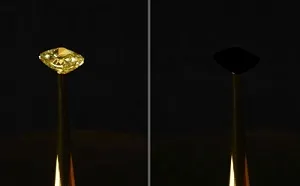
New CNT-based Coating is 10 Times Blacker
The material is made from vertically aligned carbon nanotubes, or CNTs — microscopic filaments of carbon, like a fuzzy forest of tiny trees, that the team grew on a surface of chlorine-etched aluminum foil. The foil captures at least 99.995 percent of any incoming light, making it the blackest material on record.
According to the study, CNT material, aside from making an artistic statement, may also be of practical use, for instance in optical blinders that reduce unwanted glare, to help space telescopes spot orbiting exoplanets.
More ‘Not to Miss’ Nanocoating Innovations!
| Innovation | Description |
 | Temperature Regulating Fabric
Possible Applications: Sportswear, Clothing, bed linen Source: University of Maryland |
 | Nano-silver Coating for Dental Implants
Possible Applications: Dental Implants Source: Agharkar Research Institute (ARI), Pune |
 | MetaShieldCLEAN - Stains, Dust and Dirt Repellent Nano coating
Possible Applications: Consumer products, Packaging products, Ideal for the cosmetics industry Source: MetaShield LLC |
 | Magnetoelectric and Magnetocaloric Smart Composite Material
Possible Applications: Biological Implants Source: Baltic Federal University |
 | Flexible Conductive Coating for 'Smart' Nonwovens
Possible Applications: Nonwoven materials used in medical, automotive, energy, etc. Source: Battelle |
Map new development opportunities for your functional coatings by reviewing Smart Coatings trends in our exclusive innovation round-up. The new materials, latest commercial launches, promising concepts, & innovations can be a game-changer for you as well, if you act quick. Join today!

- https://www.fraunhofer.de/en/press/research-news/2019/july/nanocoating-prevents-greasy-smears.html
- https://mma.prnewswire.com/media/1024564/Nanoprint_fingerprint.jpg?p=twitter
- https://ethz.ch/en/news-and-events/eth-news/news/2019/03/nanotechnology-and-sunlight-clear-the-way-for-better-visibility.html
- https://discovery.kaust.edu.sa/en/article/838/energy-harvesting-nanomaterials-created-cool
- https://engineering.columbia.edu/press-release/yuan-yang-longer-lithium-battery
- https://www.purdue.edu/newsroom/releases/2019/Q4/new-antenna-tech-to-equip-ceramic-coatings-with-heat-radiation-control.html
- https://www.bmw.com/en/design/the-bmw-X6-vantablack-car.html
- http://news.mit.edu/2019/blackest-black-material-cnt-0913
- https://indusdictum.com/2020/02/14/agharkar-instt-pune-develops-materials-that-can-reduce-dental-implant-failure/
- https://www.eurekalert.org/pub_releases/2020-01/ikbf-sma012020.php
- https://www.nonwovens-industry.com/issues/2019-03-1/view_features/smart-heating-a-flexible-conductive-coating-for-nonwovens