

Titanium Dioxide: How to select the right pigment for coatings?
Last update on Apr 22, 2026
Titanium dioxide is by far the most suited white pigment because of its high refractive index and lack of visible light absorption. TiO2 grades are available in varying particle sizes and can undergo a variety of post-treatment. However, the pigment is expensive, especially when the volume prices of systems are used.
Therefore, there always remains a need to develop a full-proof strategy to get the best results in terms of:
- scattering efficiency and cost/performance ratio
- optimizing the dispersion process
- considerations to select the right pigment type
In this guide, you will learn how to select the right TiO2 pigment to achieve the best possible white color strength and hiding power in your coatings and inks. Discover how the choice of TiO2 grade impacts color, opacity, and overall performance, helping you optimize your formulations for superior results.
Titanium Dioxide: Definition, importance, and production
What is Titanium Dioxide?
Titanium dioxide is an inorganic compound with the chemical formula TiO2. Derived from the elemental metal titanium, this versatile compound is a white solid that is insoluble in water. This feature, combined with its high opacity and brightness, makes it an ideal choice for use as a pigment in paints.
Other names of titanium dioxide include:
- Titanium (IV) oxide or titania
- Titanium white
- Pigment White 6 (PW6)
- CI 77891
The pigment is expensive, especially when volume prices of systems are used. Most paint and ink companies buy raw materials per weight and sell their products by volume. As TiO2 has a relatively high density, ρ ≈ 4 g/cm3, the raw material contributes substantially to the volume price of a system.
Importance of TiO2 in paints and coatings
In the world of paints and coatings, titanium dioxide plays a crucial role in providing whiteness and hiding power, also called opacity. This is because of two reasons:
- TiO2 particles of the right size scatter visible light, having wavelength λ ≈ 380 - 700 nm, effectively because TiO2 has a high refractive index.
- It is white because it does not absorb visible light
Its ability to scatter and reflect light efficiently contributes to the overall quality and performance of the paint. This makes it an indispensable component in the formulation of various types of paints, from architectural coatings to automotive finishes.
The goal is to change the optical properties of the systems, i.e., coatings and inks. The phenomena that govern t the optical properties of particles with these systems include:
- Absorption: Particles in the system can interact with visible light. The absorption of light by particles is governed by the chemical composition of the molecules that are within the particles.
- Reflection & refraction of visible light occurs at the interface of two materials.
- Scattering: TiO2 is based on the light scattering phenomenon. This is due to its high refractive index.
Looking for the right Titanium Dioxide grade for your next project? Use the SpecialChem platform to explore 2,500+ commercial Titanium Dioxide options in our Master Catalog. Easily download technical datasheets or request samples!
 |
Production of TiO2 pigment
A few processes are used to produce TiO2 pigment. Rutile TiO2 is found in nature. This is because the rutile crystal structure is the thermodynamically stable form of titanium dioxide. In chemical processes natural TiO2 can be purified, thus obtaining synthetic TiO2. The pigment can be made from ores, rich in titanium, that are mined from the earth.
Two chemical routes are used to make both rutile and anatase TiO2 pigments.
Sulphate process
In the sulfate process, the titanium-rich ore is reacted with sulfuric acid, giving TiOSO4. Pure TiO2 is obtained from TiOSO4 in several steps, going via TiO(OH)2. Depending on the chemistry and route chosen, either rutile or anatase titanium dioxide is made.
Chloride process
In the chloride process, the crude titanium-rich starting material is purified by converting titanium to titanium tetrachloride (TiCl4) by using chlorine gas (Cl2). The titanium tetrachloride is then oxidized at high temperature, giving pure rutile titanium dioxide. Anatase TiO2 is not made via the chloride process.
In both processes, the size of the pigment particles as well as the post-treatment is adjusted by fine-tuning the final steps in the chemical route.
After covering production, the next focus is on how TiO₂ particles interact with light and how this governs their performance in a coating system.
Achieve efficient scattering of Titanium Dioxide pigments
Scattering of light by solid particles in a matrix
The refractive index, represented by the letter n, of a material describes how light propagates through and is bent by, that material. The magnitude of the refractive index, depending upon the electronic structure of the molecules, governs to what extent the path of light changes, when entering or leaving a material.
Particles in a matrix, like pigment particles surrounded by the binder system in a coating, ink or plastic, can change the propagation direction of light when the particles and the matrix have a different refractive index. This phenomenon, called scattering, results in both white color (provided that the particles do not absorb visible light) and the hiding power of the coating.
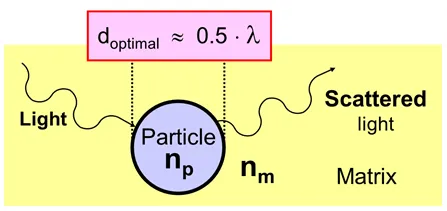
Scattering of light by particles in a matrix
Scattering efficiency - Factors which govern them
The scattering efficiency of pigment particles in a system is governed by two key properties.
Scattering is strong when the difference in the refractive index of particle & matrix, Δn = np - nm, is big
The refractive index of binders used in coatings and inks is around 1.55. Titanium Dioxide is preferably used as a scattering source because the pigment does not absorb visible light and it has a high refractive index.
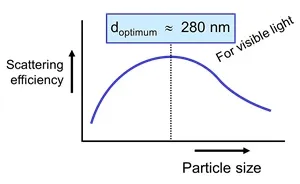
Scattering efficiency of TiO2 particles
The size of the scattering particles is important
For a specific wavelength of light, λ, there is an optimum with respect to particle size. Particles give maximum scattering efficiency when the diameter of the particles is about half the wavelength of the electromagnetic radiation that is scattered. This implies that particles with a diameter of around 280 nm scatter visible light, with wavelength λ ≈ 380 - 700 nm, most efficiently.
The optimum pigment volume concentration in TiO2 for efficient scattering
The properties of a system, like a coating, are governed by, amongst others, the loading of the system with solid particles. Particle loading is quantified by the property Pigment Volume Concentration (PVC). The PVC of a system is defined as the volume percentage of solid particles in the system after film formation has taken place:
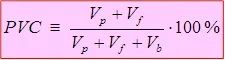
Here:
» Vf : Total volume of all fillers in the system
» Vb : Volume of the non-volatile part of the binders in the system
The definition implies that the PVC of a system is calculated by leaving the volatile components, like water and solvents, out. The volumes of the non-volatile components should be used, implying that weights must be transferred into volumes by using the density of each of the components.
A system of high PVC has a high loading of solid particles and a system of low PVC contains a low amount of solid particles, as shown in the figure below:
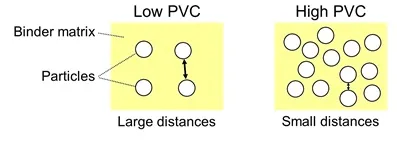
Low versus high pigment volume concentration
The TiO2 particles must be separated from each other and distributed uniformly over the system, in order to obtain optimum scattering of each primary titanium dioxide particle.
Pigment particles hinder each other with respect to scattering when the particles are close to one another. The PVC of a system, especially the PVC in TiO2, is important with respect to the scattering efficiency of TiO2 particles. The distance between titanium dioxide particles goes down when the PVC in TiO2 goes up.

Scattering efficiency of TiO2 as function of PVC in TiO2
Find out what happens to scattering efficiency at different concentrations of PVC in titanium dioxide.
- At 15%: The distance between the pigment particles becomes small. The particles start to interfere with each other.
- Between 15 - 30%: The scattering efficiency of each pigment particle becomes worse.
- Higher than 30%: The particles interfere so strongly that scattering power goes down. Adding titanium dioxide to the paint in large quantity worsens both hiding power and white color strength.
With respect to the composition of a system that contains titanium dioxide pigment that is meant to give whiteness and hiding power because of scattering, the PVC in TiO2 should not exceed the threshold value of 30 volume%. The total PVC, taking all solid particles into account, of a system can be (much) higher than 30%, as long as the PVC in TiO2 is below 30%.
Alternative materials to obtain extra scattering
Titanium dioxide in the paint industry can be combined with other materials that scatter visible light to obtain extra scattering efficiency. A precondition for such a material is that it has a refractive index that differs substantially from the refractive index of the binder system surrounding the particles. Preferably, it is possible to distribute the material as particles with a diameter of around 300 nm in the system.
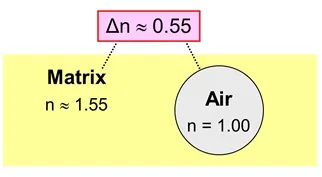
An air particle in a binder matrix
It turns out that there is only one real practical option: the use of air, having a refractive index n = 1.00. Air particles in a system do not absorb visible light and they give both a white color as well as hiding power. Apart from that, stable air particles of the right size can act as effective spacers for the TiO2 particles.
Particle ↔ Matrix | Δn |
| Rutile TiO2 ↔ Matrix | 1.20 |
| Air ↔ Matrix | 0.55 |
Air particles do not scatter visible light as effectively as TiO2 particles, even when air is well distributed in the matrix as particles with the optimum diameter. The reason is that the difference in the refractive index of TiO2 and binder matrix is bigger than the difference in the refractive index of air and binder matrix.
There are several ways to introduce air particles in a coating.
- An approach that is often used is to load the system with such a high amount of solid particles that there is an insufficient binder in the system to cover all the solid particles and to fill the spaces between the solid particles. Then, air voids form during film formation when water and/or solvent evaporates from the system.
- Another option is to use fillers that have air bubbles encapsulated within the particles. Flash-calcined kaolin is a filler that was treated with heat in such a way that closed pores are formed in each solid particle.
- An approach used to assure that stable air particles of the right size are introduced in the system is to use a hollow polymeric filler. After film formation, the filler particles consist of an air-core in a shell of polymer. The size of the whole particle, as well as the thickness of the shell of each particle, is such that the air within the particles gives optimal light scattering. Apart from this, hollow filler particles of the right size arrange spacing of the pigment particles.
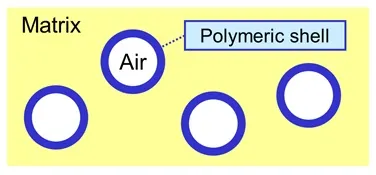
Hollow polymeric particles in binder matrix
Understanding light scattering sets the stage for discussing practical strategies to maximize the effectiveness of TiO₂ in your formulations.
Ways to optimize the use of Titanium Dioxide
Optimize the dispersion process
Each primary TiO2 particle has to be used as efficiently as possible. TiO2 pigment scatters light most efficiently when all particles are separated from each other and distributed over the system.
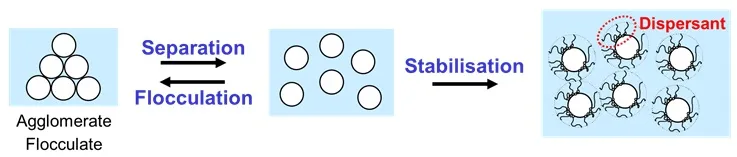
Dispersion process: Separation and stabilization of solid particles in a liquid
A challenge in this respect is that solid particles attract each other strongly. This has two implications:
Separation
A lot of work must be done to separate the particles from each other during the dispersion process. Separation is done by using high-energy dispersion equipment like:
- Disk disperser (often called dissolver), or
- Pearl mill
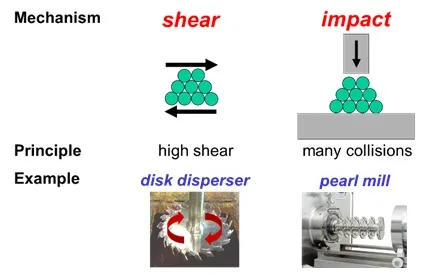
Dispersion equipment used to separate solid particles from each other
The shear forces in a dissolver set-up are too weak to separate all primary pigment particles from one another. More complete separation is obtained by using a pearl mill.
Stabilization
The particles must be stabilized against flocculation. That is, the spontaneous gluing together of solid particles in a liquid caused by the attractive forces between the particles. Stabilization against flocculation is obtained by adsorbing a stabilizer, called dispersant, at the surface of the solid particles immediately after particles have been separated from each other.
The dispersant, also called dispersing agent assures that the particles repel each other. Thus, particles remain separated from each other. Two mechanisms can be used for this:
- Electrostatic stabilization: It results when all particles have an identical electrostatic charge.
- Steric stabilization: It results from polymeric tails, being part of the dispersant molecules, that dissolves in the liquid continuous phase surrounding the particles.
Distribute the particles
The scattering efficiency of expensive titanium dioxide pigment is maximized when all primary particles are separated from each other, stabilized against flocculation and distributed over the complete system. The distance between the individual pigment particles should be as large as possible. It is said that the pigment particles must be spaced in the system.

Spacing and crowding of TiO2
Spacing between TiO2 and filler particles
Spacing can be obtained when TiO2 particles are combined with filler particles that have comparable size. The filler particles do not scatter light but they prevent interference of the titanium dioxide particles. Crowding, the undesired grouping together of TiO2 particles results when the pigment is combined with filler particles that are big, compared to the TiO2 particles.
Optimum whiteness and hiding power of titanium dioxide pigment can be obtained by combining the pigment with the right dosage of filler particles with the right size.
 |
Once optimization strategies are clear, it’s essential to look at the selection criteria that influence how well a given TiO₂ pigment will perform for your specific application.