

How to Increase the Initial Gloss of My Coating?
Last update on Nov 30, 2022
We would like to acknowledge Jochum Beetsma for sharing his technical expertise and validating the page.
If you are always below your gloss target when your coating formulation exits the production line, you might have a dispersion problem. Let's see why.
If your gloss is fine at the production stage, but then degrades, you should rather check how to troubleshoot your loss of gloss during storage or transport.
What is gloss?
Gloss quantifies the ability of a surface to reflect light. The more the light is reflected like a mirror, the glossier the surface appears. Achieving the right gloss plays an important role as it can alter the visual appearance. It is a critical acceptance factor.
Why is it crucial to fix your gloss level at the production stage?
There are 2 reasons why the gloss value of your paint must be within specs just after the formulation is made:
- Once produced it becomes challenging to change the formulation or recycle it. If your gloss is out of specs, your coatings are likely to go to waste.
- Also, gloss is a property that will, most probably, not improve over time. Hence, achieving the gloss target at the start is crucial.
What is the relation between gloss and the dried coating surface?
Smooth surfaces with few microscopic irregularities reflect light like a mirror. It results in a bright, shiny finish. If the surface of your coating is rough, it gives diffused light reflection. Thus, it appears less glossy.
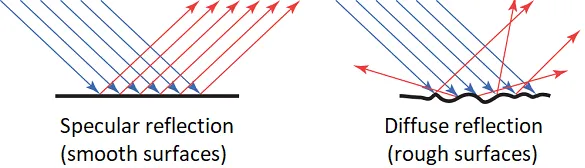
So, when you experience a too-low gloss after producing your paint, it is likely due to the surface of the dried film being not smooth enough.
Let's look at typical factors that can disturb surface smoothness.
2 Most Likely Causes Behind Low Initial Gloss in Coatings
The low initial gloss could be due to a few reasons, let's explore some of them here.
Pigment volume concentration (PVC) is too high
One factor contributing to low gloss could be that the pigment volume concentration (PVC) is too high. The PVC of a system is the volume percentage of solid particles, pigments and fillers, in the dry paint.
PVC can be calculated using the following formula:
Coatings with higher pigment volume concentrations have a rougher surface after film formation. So, gloss decreases with increasing PVC.
Poor Dispersion
A too-low initial gloss can also be caused by poor pigment dispersion. We commonly speak of pigment dispersion, but it is also true for dispersion of fillers.
Solid particles tend to glue together, forming agglomerates. The dispersion process aims at breaking these lumps and keep the particles separated. If the dispersion process fails, then you end up with bigger particles than you should in your system. Poor dispersion encompasses two aspects:
- the initial separation is not good enough
- particles flocculate, implying that they glue together again.
In practice, how to increase gloss?
Check if your current PVC value is correct for the type of coatings you want:
| Coating Type | PVC Value |
| Gloss coatings | 0-20% |
| Semi-gloss coatings | 15-35% |
| Matt coatings | 40-80% |
| If you're out of these ranges, it may be a good idea to adjust PVC. | |
Optimize your pigment dispersion
- The amount of dispersing agent could be too high or too low, resulting in gloss being too low, sooner or later. Calculate theoretical load of your dispersing agent.
- Even the choice of your dispersing agent may not be well-suited for your pigments and fillers.